



- Cost per lead = total marketing spend / total leads collected, counting team time, advertising, service providers and tools.
- Calculate the CPL channel by channel: gaps between channels often come from differences in conversion.
- A very low CPL often goes hand in hand with low-quality leads.
- If the cost of a qualified lead exceeds the net margin, the campaign loses money.
- In the article’s example, a CAC of 2,000 euros against a maximum CPL of 2,500 euros leaves a margin of 500 euros.
Cost per lead (CPL) is a metric that lets you anticipate the profitability of your lead generation campaigns and fine-tune their calibration before rollout. CPL defines the cost required to acquire a lead. While the calculation is fairly simple, you need to distinguish several levels of cost per lead, depending on how qualified and valid the lead is.
Want to measure how effective your lead generation campaigns are? In this article, we present a methodology for doing so, which consists of calculating and then comparing the CPL and the max CPL. Find out right now how to calculate these two metrics.
Cost per lead formula
Cost per lead (CPL) is an important marketing KPI. It lets you measure how effective your marketing investments are. Whether you buy a list, collect names at trade shows or generate leads through inbound marketing techniques, knowing your cost per lead will help you spend your marketing budget better.
The cost per lead formula is very simple:

Marketing spend includes the time invested by the teams in charge of marketing, advertising spend, the cost of service providers and the cost of tools: in a word, all the direct and indirect costs incurred in designing and running your campaigns.
A quick tip from SalesdoradoSet up Google Analytics goals to easily track the source of your leads (advertising, email, social media…). This will let you calculate a CPL per source.
Knowing how much a lead costs you will let you make the right strategic decisions and better target your marketing spend (advertising, emailing, webinars…). We recommend calculating the CPL for each channel in order to measure their respective performance and adjust your media mix. Large CPL gaps between channels may be linked to conversion gaps. By definition, the higher the conversion rate, the lower the CPL, all other things being equal. From a strategic standpoint, it makes sense to allocate as much of the marketing budget as possible to the channels with the lowest CPL.
What is a « good » CPL?
Is a cost per lead of 20 euros, for example, a « good » CPL or a « bad » CPL? It is actually very hard to answer this question, since it depends on several factors: the industry, the type of campaign, how qualified the lead is and the value of the end customer. A very low CPL is often associated with low-quality leads. And vice versa.
Raw, qualified or valid lead? From raw CPL to max CPL
People often talk about « leads » without any further detail, as if the term had a single meaning that never changed. In reality, not all leads are equal. A lead is a person who has shown interest in an offer, and by extension the information that person has provided (email address…). The strength of the interest shown and the amount of information collected determine how qualified the lead is. The more qualified a lead is, the greater its value, and the more you can afford to invest to get it.
When you set up a B2B lead generation program, the goal is to collect leads at a reasonable cost, leads that will then be passed on to the sales teams in charge of turning them into customers. An effective technique for determining in advance how much you can afford to spend on a lead is to calculate your campaign’s maximum CPL. Here is the methodology.
Let’s start by calculating the cost of a raw lead. A raw lead is, for example, a person who has simply sent an email asking for information. A raw lead, by definition, has not yet gone through any qualification work on your side. To calculate the raw CPL, you need to add up all the fixed and variable costs that can be directly attributed to the campaign, and divide the total by the number of expected responses (= number of raw leads). The trickiest part is really taking all the costs into account. It is easy to let some of them slip through the cracks. Among these costs, think in particular of design and pre-production work, the cost of creating content, and the variable costs involved in developing and running the campaign.
Also readFind out how to build a lead scoring strategy.
A raw lead, as such, has little value. A raw lead is still a long way from becoming a customer. A lot of qualification work is needed. Let’s now see how to calculate the lead qualification cost. The formula for this metric is simple, like most of the formulas in this article, for that matter. It is calculated by dividing all the spending related to collecting, managing and qualifying leads (lead nurturing) by the number of raw leads handled. At this stage, it makes more sense to determine this metric on an annual (or half-yearly) basis rather than per campaign. It will be much simpler. If part of the lead qualification work is outsourced, add your service providers’ invoices to your internal costs.
We now have two metrics at our disposal: the cost of a raw lead (or raw CPL) and the cost of qualifying a raw lead. From there, you can calculate the cost of a qualified lead by adding the two metrics together.
Cost of a qualified lead = cost of a raw lead + qualification cost.
After calculating the cost of a qualified lead, you need to turn to the sales teams and ask them a few questions. Ask them about the average order value, which is calculated by dividing total revenue by the number of orders. Ask them for the margin rate per order, and the share of the order used to pay the sales reps (= sales expenses / number of orders). With all this information, you will be able to judge for yourself whether the cost of a qualified lead is reasonable or not. In particular, if the cost of a qualified lead is higher than the net margin, there is clearly a problem. The operation is not profitable: the company is losing money. You need to rework some aspects of your campaign (narrow the targeting, rethink the offer…).
To calculate a maximum cost per lead (= one that does not jeopardize the profitability of the operation), you do not necessarily need to know how many responses will be collected, qualified and finally converted. However, you do need to know the cost per raw lead, the qualification cost and the conversion rates from qualified leads to valid leads. You also need to know the net margin per order and the level of sales expenses per order. This table sums up the approach:
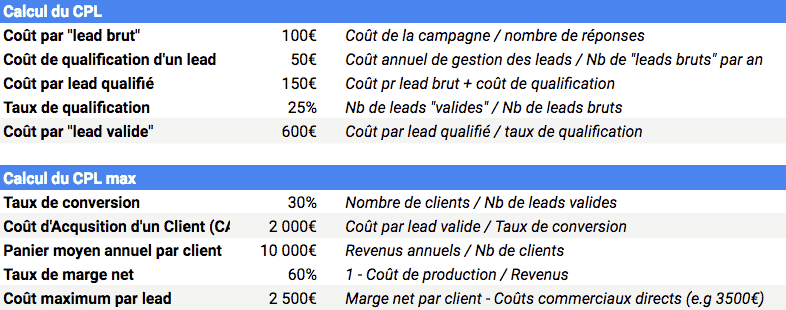
Let’s take an entirely hypothetical example to flesh this out. Say you spend 15,000 euros and get 150 responses, i.e. 150 raw leads. Whatever the amount spent and the volume of responses obtained, by far the most important metric is the cost per « raw lead ». In the table above, we assumed a cost of 100 euros. We also calculated a qualification cost of 50 euros, which gives us a cost per qualified lead of 150 euros.
The lead qualification process led to the loss of a certain number of leads: some people end up no longer being interested in the offer. In our example, we assume a qualification rate of 25%. In other words, we managed to qualify 25% of the initial raw leads. This lets us calculate the cost of a « valid » lead (= a qualified lead): 600 euros (150 euros / 0.25).
Thanks to the information provided by the sales reps, you know that the conversion rate of valid leads is 30%. The sales teams manage to turn 30% of the valid leads you pass on to them into customers. From this we deduce the customer acquisition cost (CAC): 2,000 euros (600 / 0.30). This customer acquisition cost must be compared with the maximum cost per lead, of 2,500 euros. The maximum cost per lead factors in the net margin rate and the sales costs.
A priori, the campaign looks promising: the customer acquisition cost is 500 euros below the maximum cost per lead. We recommend using a spreadsheet to enter your various assumptions and calculate the profitability of your lead generation campaigns.
Which attribution model should you use to calculate your CPL?
The goal is to reduce the cost per lead as much as possible, to maximize the ROI of campaigns. As a marketer, you need to be able to track the number of leads you generate, with a good understanding of the length of sales cycles. That is much easier said than done. Bizible surveyed 370 B2B marketers, asking them how many leads they generated per month and which attribution model they used. The chart below shows the average number of leads generated per attribution model:
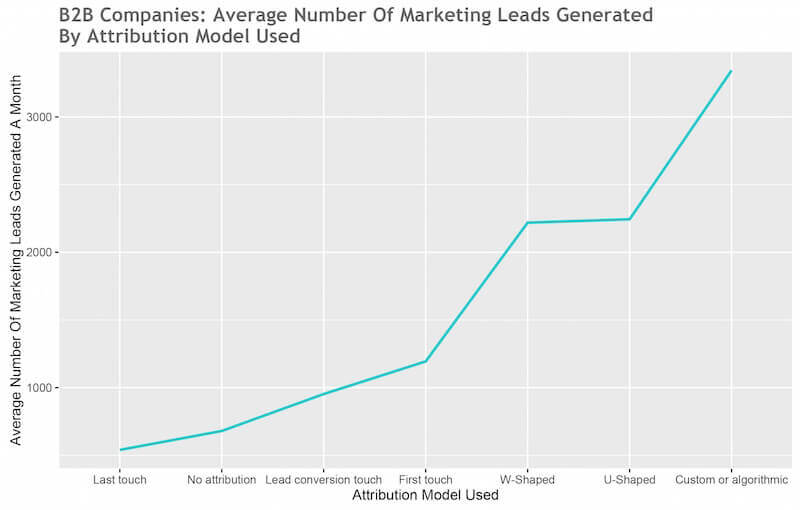
We can see that the more the volume of leads increases, the more complex the attribution model used. Custom or algorithm-based attribution models are the ones that generate the most leads. Conversely, when there is only a single touchpoint, with no attribution model, the volume of leads is very low.
These results are fairly logical. In their lead generation work, marketers face an ever-growing amount of data. To cope with it, they set up increasingly complex attribution models to get a more granular view of conversion data. The goal being to separate the good campaigns from the bad ones.
Bizible produced a rather interesting table showing lead volumes by industry:
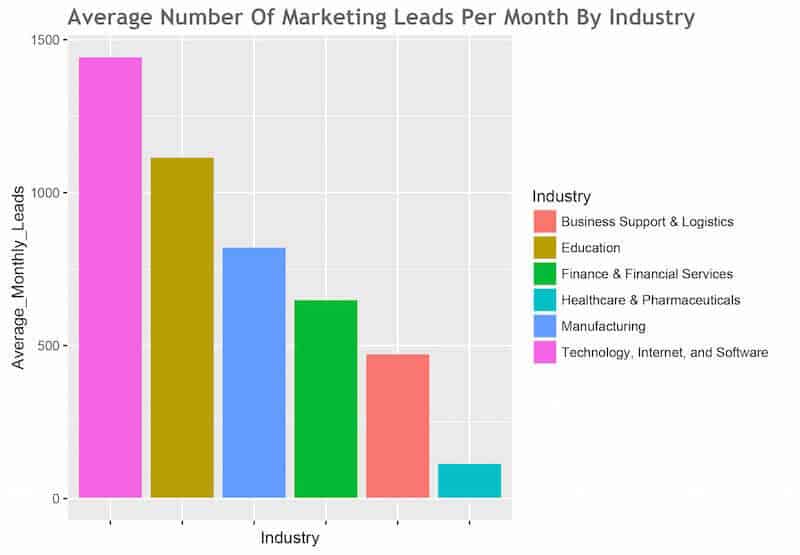
Unsurprisingly, there is a high volume of leads in the new technology, internet and software sector. In this sector, marketing investments are indeed very high: growth at all costs is the rule. The attribution models used in this sector are generally fairly complex.
But does that mean all companies, whatever their industry, should opt for complex attribution models because of the large volume of leads they help generate? The answer, as the study’s sponsor itself admits, is not clear-cut. The lower lead volume observed in other sectors may also be due to the fact that these are often smaller entities that, structurally, cannot generate large lead volumes.
However, one thing is obvious: attribution models make it possible to manage spending better and reduce the cost per lead, by increasing the number of leads. They also make it possible to forecast, to know fairly precisely how many leads can be generated for X euros.
Also readCheck out our top 10 email list cleaning tools.
With attribution models, you can get a very precise measurement of cost per lead by campaign and by channel. Marketers generally use several channels for their campaigns. Calculating CPL per campaign is very useful for identifying the effective actions tied to the right channels. Attribution models therefore have their place. With attribution models, you can calculate a CPL by campaign and by channel, but also identify the touchpoints that generate the most sales. Ultimately, by reconstructing customer journeys, attribution models give you a better understanding of the behavior of your target audience, your prospects or customers. Limited knowledge of leads leads to imprecise lead generation programs and makes growth forecasts difficult.
So, to conclude, we recommend calculating the CPL and the max CPL on the one hand, and setting up an effective attribution model on the other, to improve the performance of your lead generation campaigns and optimize them over time.
The questions we get over and over.
What is the cost per lead formula?
Cost per lead = total marketing spend / total leads collected. Marketing spend includes the time invested by marketing teams, advertising spend, and the cost of service providers and tools: all the direct and indirect costs of the campaign.
What is a good CPL?
It is very hard to answer in absolute terms: it depends on the industry, the type of campaign, how qualified the lead is and the value of the end customer. A very low CPL is often associated with low-quality leads, and vice versa.
How do you calculate the cost of a qualified lead?
By adding the cost of a raw lead (campaign costs divided by the number of responses) and the qualification cost (spending on collecting, managing and qualifying leads divided by the number of raw leads handled, preferably on an annual basis).
What is the maximum cost per lead?
It is the cost per lead that does not jeopardize the profitability of the operation. It is calculated from the net margin per customer, minus direct sales costs. You then compare it with the customer acquisition cost obtained with the qualification and conversion rates.
Why use an attribution model to calculate your CPL?
Because it lets you calculate a CPL by campaign and by channel, identify the touchpoints that generate the most sales and forecast how many leads can be generated for a given budget.


What the community says.