



- A marketing qualified lead (MQL) is not yet a sales qualified lead (SQL): measure the move from one to the other before passing leads to sales reps.
- Quote-to-sale conversion rate = number of sales closed / total number of quotes issued x 100.
- To measure the sales cycle, date the starting point and end point of each sale, then take the average.
- Also track sales reps’ actions (follow-up emails, demos, calls), not just the percentage of the target reached.
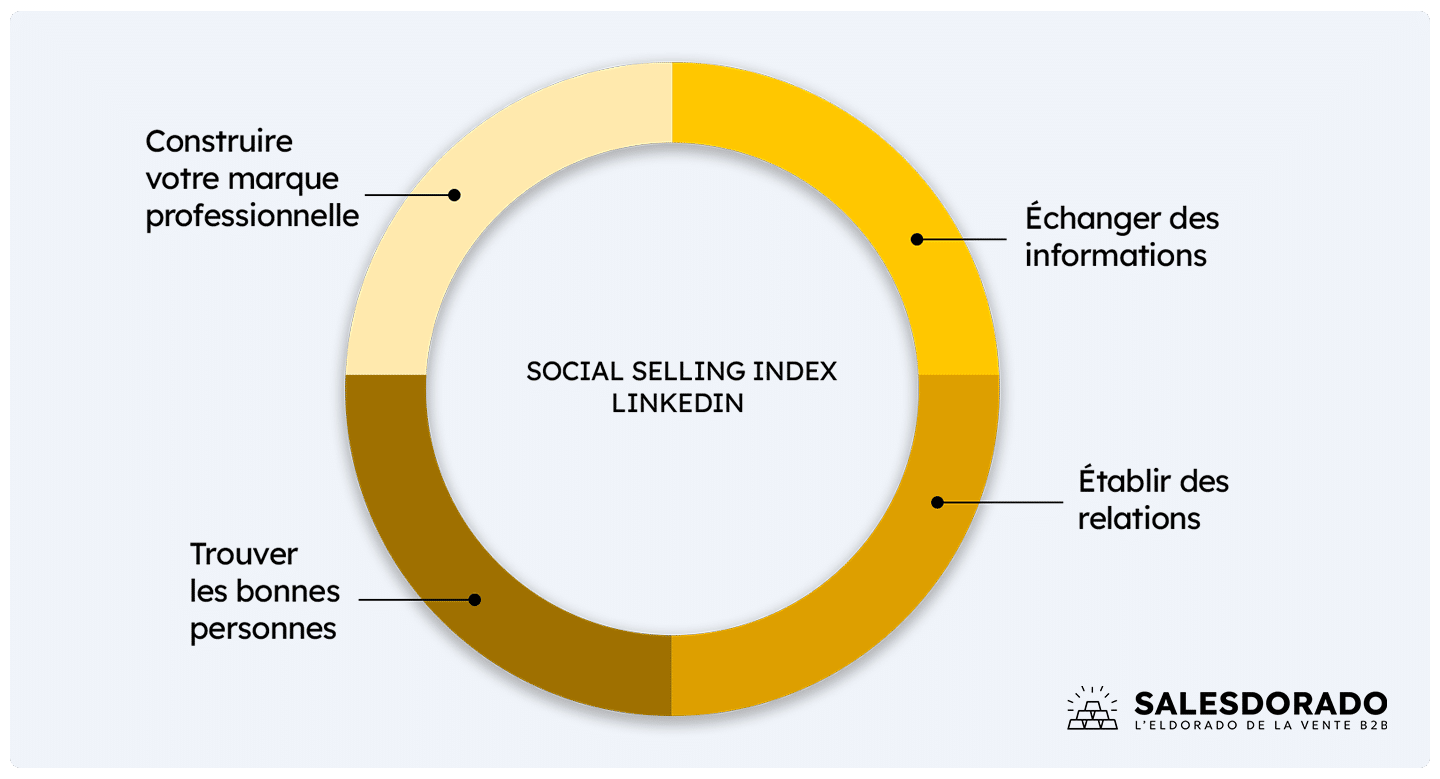
- If your funnel goes through LinkedIn, the Social Selling Index measures brand image, connections, engagement and relationships.
There are many sales performance indicators, known as sales KPIs, which fall into two broad categories: quantitative and qualitative indicators.
Some indicators are single values or the result of calculations, which we will detail, giving rates to track sales performance over time.
Your performance indicators should let you:
- track your sales reps’ sales performance
- make strategic decisions to improve your sales
In this article, we list the 10 sales performance indicators to track.
1. Total lead volume
The first sales indicator to measure is the total number of leads/opportunities your company generates.
When you determine the total number of leads you have generated, you will need to take the following into account:
- Number of website visitors (available via Google Analytics)
- Number of confirmed attendees at your webinar (registration statistics)
- Visits to a physical store (footfall counting)
- Number of subscribers to your blog
- Trade show registrations (registration statistics), etc.
It is important to attract prospects from a large number of different sources. Once you have collected these prospects, the next step is to qualify them.
Going further
- Discover our comparison of the best software to host your webinars
- How do you set up effective webinars to generate more leads?
2. MQL > SQL conversion rate
There are two types of leads:
- Marketing qualified leads (MQL): People who entered their contact details in exchange for content, such as white papers, or by registering for webinars.
- Sales qualified leads (SQL): These are prospects who truly match your “buyer persona” and intend to buy.
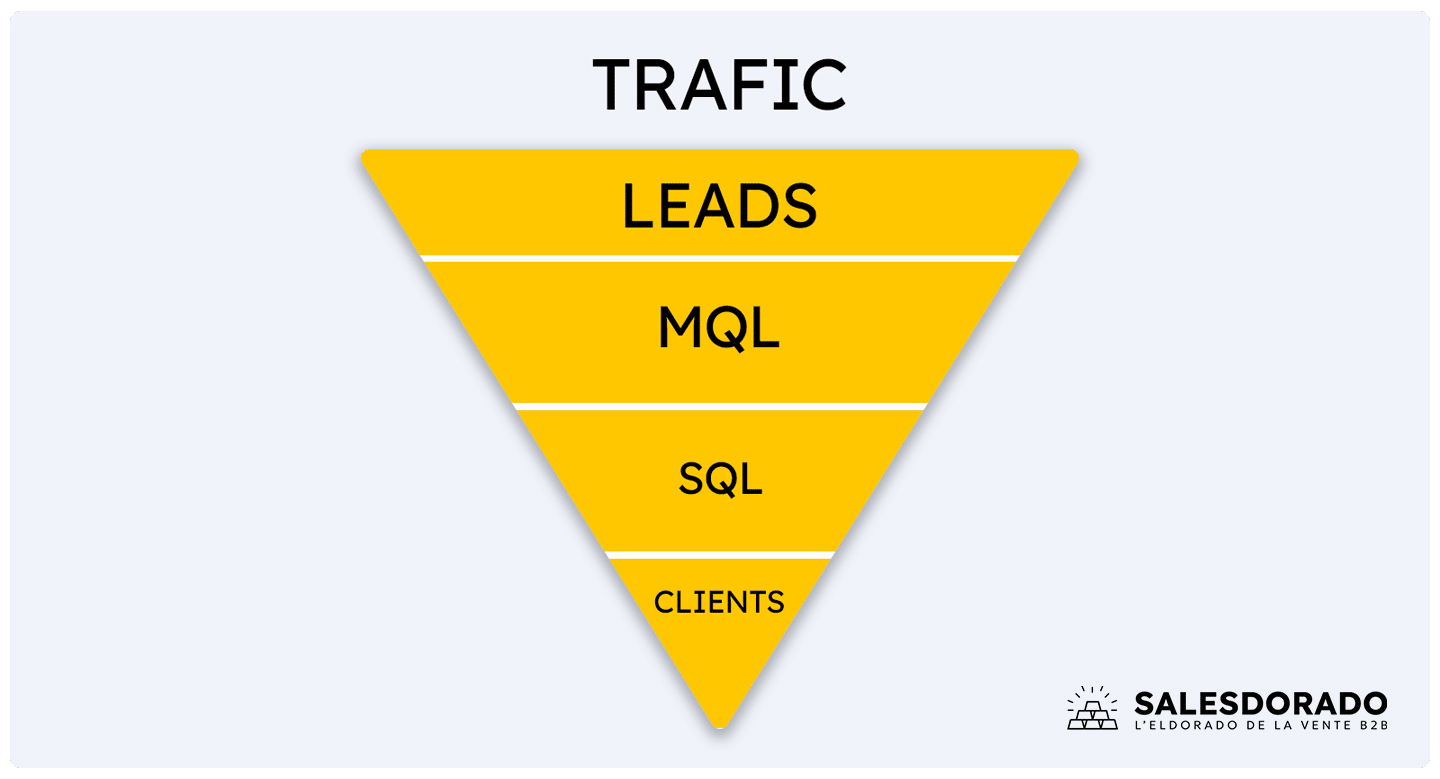
This will help you determine whether your lead generation strategies are working well and whether your marketing teams are encouraging the right prospects to contact you. Carefully measuring this sales performance indicator will help you avoid handing bad leads to your sales reps, which leads to more effective sales.
A qualified prospect can vary from one company to another. The point is to examine the buyer’s personality and personal information to determine whether they are the type of prospect who could actually make a purchase and benefit from the products/services you offer.
Going further
- MQL vs SQL: lead qualification by marketing or sales teams
- Lead scoring: definition and complete guide
- Discover our complete guide to lead qualification
3. Number of open opportunities
The number of sales opportunities lets you measure the success of your strategies.
A sales opportunity means you came very close to a sale. If you measure what happens after the opportunity (do they convert?), you can understand which approaches upstream of the opportunity are the most successful.
Keep track of the number of sales opportunities you have had throughout your sales pipeline. This gives you a clear view of the number of opportunities generated by each channel. You then need a consistent lead nurturing strategy to keep these opportunities alive.
4. Quote-to-sale conversion rate
With the conversion rate, you know whether your current sales funnel works better than previous ones. You split-test with a quantifiable measure (the data from your old funnel) to compare the performance of a newer sales funnel. That way, you will always pick the better of the two options.
This sales performance indicator constantly shows you how many people converted on the first call, the second and the third. It also tells you who the best-performing salespeople are. This way, you can track all the efforts made while improving sales by focusing on the types of customers who convert on the first call (call means people click on the CTA).
If you have a high conversion rate, your strategies are working and interest your targets. If our conversion rates drop, then we need to find new strategies to get your targets to take the action you want.
How do you calculate the sales quote conversion rate?
Sales quote conversion rate = (Number of Sales Closed / Total Number of Quotes Issued) x 100.
5. Number of touchpoints
The number of touchpoints is the cumulative sum of the interactions (phone calls, emails…) you have with a prospect to close a deal.
It takes an average of seven interactions to get in touch with someone and have a real sales call. Keeping up this volume is essential to maintain and improve our sales.
Defining a prospect’s number of touchpoints with marketing content and sales team members is crucial to understand its impact on customer acquisition cost.
Also readGlossary of sales techniques
6. Sales cycle length
This sales KPI is important because it gives you an idea of how you manage your time and your team. Once you have an idea of the sales cycle length for a typical qualified customer, you can plan the closing date of each sale. Understanding this will help you better distribute the workload of your sales teams.
For example, if one of the stages of your sales pipeline has a long delay before conversion, this could affect the overall conversion rate. A prolonged waiting time can make customers lose interest in the product/service. Improving the transition times between each stage of your funnel helps increase sales and keep potential customers interested in your product or service.
How do you calculate sales cycle length?
To do this calculation, you need to identify the starting point and end point of a sale. For example, the first phone call can be the starting point and the signing of a quote the end point. At a minimum you will need to date these two events to do the calculation, which you can easily do with a CRM.
As soon as you have this notion of time, you can apply it to all your sales to calculate an average in days or months depending on your business.
Average sales cycle length = Sum of the Durations of All Sales / Number of Sales
7. Projected value of your sales funnel
This sales performance indicator is a vital KPI for measuring the health of your pipeline. It is not a sophisticated measure, but that is the point. It lets you understand at a glance whether you will reach your sales targets. Above or below a certain threshold you have defined, you know whether you need to worry or not.
In your CRM, you need to track the value of our sales or of your ongoing deals. This helps us track your monthly sales revenue forecasts.
Going further
- CRM: the complete guide
- Our comparison of B2B CRM software
- Setting up a sales CRM: how much does it cost?
8. Number of actions by your sales reps
If you only ever measure progress toward your sales targets, you will not get the best out of your sales teams.
When sales reps only see a numerical value (for example, 35% of the target reached), they do not feel motivated to keep carrying out meaningful actions that drive this progress.
Instead, they will feel that none of the actions they take matter.
Make sure you track actions such as:
- Follow-up emails;
- Demos;
- Calls.
Measure the number of sales actions carried out as a key sales performance indicator so your sales reps exceed targets and expectations.
9. Email reply rate
Did you know that the average person deletes 48% of the emails they receive every day?
Hard to stand out in this context. The sales performance indicator that interests us most here is the reply rate, because it shows that your recipient is interested in your content. A low reply rate usually means your content is not suitable or that you are not targeting the right customer.
10. Social Selling Index
If one stage of your sales funnel includes social selling via LinkedIn, the SSI (Social Selling Index) is a KPI you need to track.
If you are not using social selling yet, it is time to start:
- 75% of B2B buyers and 84% of senior executives use social media to make purchasing decisions.
- 98% of salespeople with more than 5,000 connections on LinkedIn meet or exceed their quota.
- Selling through social networks generates 38% more new opportunities than traditional selling.
LinkedIn’s Social Selling Index works wonderfully as a sales funnel KPI, especially if you use social selling in the lead generation phase.
The SSI measures the four elements of successful social selling:
- Brand image. Monitor how effectively your sales reps complete their profile with customers in mind, add interesting content and receive endorsements for their skills.
- Connection. The second variable concerns your reps’ contacts with their prospects via LinkedIn. When integrated into your sales funnel, LinkedIn’s SSI system will also help your sales reps by letting them target prospects precisely. It measures how your reps leverage existing connections to connect with new potential customers.
- Engaging with insights. A good sales rep must stay in touch with their industry in order to be seen as a reliable source by their prospects. The SSI measures how often your reps engage with and share relevant content.
- Building relationships. Finally, it is not enough to post a message and call it a day. The SSI also measures how your sales reps nurture relationships and how they follow up.
These are the sales performance indicators we consider most important to take into account to optimize your sales processes and ultimately improve your sales. Tell us in the comments if you use other KPIs we should present!
The questions we get over and over.
What is the difference between an MQL and an SQL?
The MQL, marketing qualified lead, entered their contact details in exchange for content, such as a white paper or a webinar registration. The SQL, sales qualified lead, truly matches your buyer persona and intends to buy.
How do you calculate the quote-to-sale conversion rate?
Sales quote conversion rate = (number of sales closed / total number of quotes issued) x 100.
How do you calculate sales cycle length?
Identify the starting point and end point of a sale, for example the first phone call and the signing of the quote, and date them, which a CRM does easily. Average sales cycle length = sum of the durations of all sales / number of sales.
Why track the number of actions by sales reps?
Because a sales rep who only sees a numerical value, for example 35% of the target reached, is not motivated to keep up the actions that move this figure forward. Track follow-up emails, demos and calls.
What does LinkedIn’s Social Selling Index measure?
The four elements of successful social selling: brand image, connections with prospects, engagement with relevant content and relationship building.



What the community says.