



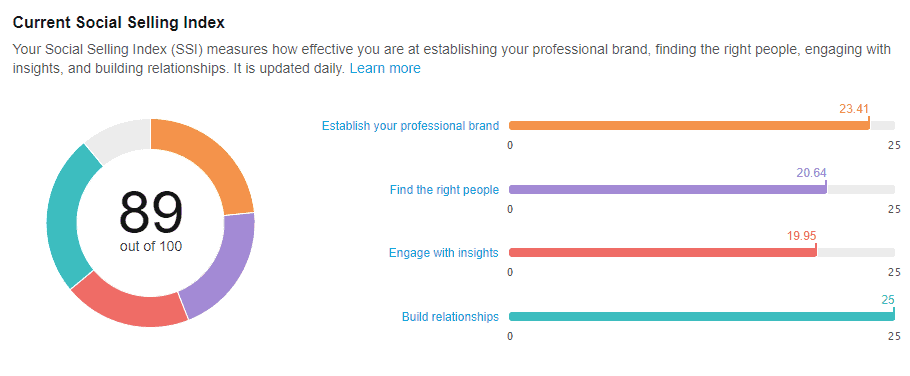
- LinkedIn’s SSI scores four areas: professional brand, network, engagement and relationships with decision-makers. It says nothing about Twitter or Facebook.
- Inbound connections tell you more than raw network growth.
- Engagement rate = interactions (likes, comments, shares) / number of views.
- A low response rate to messages is often a sign that you need to rework your approach, or get to know the prospect better before writing to them.
- Without verifiable revenue, the rest doesn’t count for long.
In this article, we present the most important statistics social sellers can use to monitor their social selling initiatives and spot opportunities for improvement. Before we start, a word of warning: don’t lose the fun in your work! Measuring your progress and your success is absolutely essential, but don’t make it an obsession.
1. LinkedIn’s Social Selling Index
In social selling, there aren’t many catch-all metrics that will give you a global view of your success, except perhaps… LinkedIn’s Social Selling Index (SSI). Right now, this statistic is by far the fastest way to get an overview of your social selling efforts. The SSI metric assesses your efforts on LinkedIn only. So it won’t help you evaluate your performance on Twitter, Facebook or other platforms. That said, if you crack LinkedIn’s habits and see your SSI go up, it’s unlikely you can’t pull off the same thing on other platforms. The SSI looks at four key areas of any social selling campaign:
- Establishing your professional brand on the platform.
- Finding the right people and building your network.
- Engaging with the right people and encouraging engagement from your followers.
- Building relationships with decision-makers.
LinkedIn’s huge database helps them assign a value to the actions you take on the platform every day. The SSI has become one of the most popular social selling metrics in use today. It encourages engagement and helps social sellers focus on specific goals to improve their overall score. Even if it isn’t one of the must-have tools for generating leads from LinkedIn, it remains an index to watch closely.
2. Your network growth
Your network growth is a simple metric that can give you a good overview of how your social selling efforts help you connect with your target audience. When you gain new connections (friends, colleagues, etc.) you build a wider network. More people then know who you are. As a result, more people will interact with your posts and your content, and more people will take part in conversations with you. Every social seller should track their network growth on individual platforms and across their whole social selling strategy. A wider network means more opportunities. To get through your repetitive tasks faster, you can also use the best social selling tools.
3. Connection requests received
The speed at which your network grows matters. But going on LinkedIn and spamming connection requests to grow your network is an example of fast growth that is unlikely to produce business results. Measuring your network growth can be a little misleading. It all depends on your strategic goals. Inbound connections are often a more useful way to measure that growth.

Received connections come from anyone who sends you a connection request on LinkedIn, follows you on Twitter or adds you as a friend on Facebook (or follows your page). Received connections reflect social selling success more than network growth itself does. Inbound connections mean prospects are finding you. They can find you through mutual connections, content you’ve shared on the platform or recommendation systems on the social network of your choice.
4. The engagement rate on your content
When you share content, how many people like it, comment on it or share it with their own audience? Delivering value by sharing high-quality content is a core part of social selling. You want to become a source of information for your audience. You want them to see you as an expert in your field. On the other hand, you shouldn’t just share your own content. You need to share content from third-party sources to give your audience a wide range of quality resources. Ultimately, your goal is to identify what matters most to your audience and share content around those topics. What are their most common questions? What do they need to know about your product, your company and your industry? What kind of content will help them reach their goals? Measuring your content’s engagement rates across platforms tells you whether you’re doing a good job or not.
Salesdorado’s tipHere is the definition of engagement rate:
Number of interactions (likes + comments + shares) / Number of views.
5. The response rate to your messages
How quickly people reply to the messages you’ve sent them can give you an insight into your ability to interact with new prospects. A low response rate to your messages may be a sign that you need to rework your approach style. Or perhaps you should assess the time you invest in getting to know a prospect well before contacting them by message. There are many ways to approach and adjust this particular metric. But the message response rate is essential for determining whether you’re doing a good job of « warming up » prospects before engaging with them. While some social selling strategies involve cold emails or cold messages, most start with a question to open the conversation.
Salesdorado’s adviceTo measure your response rate better, we encourage you to use a tool like Dux-Soup or Waalaxy (formerly ProspectIn).
6. Your followers’ engagement rate on your content
Your followers’ engagement rate is a clear indicator of how effective your social selling strategies are. What percentage of the people you connect with on a platform end up interacting with your content? This metric not only helps you identify whether or not you’re connecting with the right people, it also tells you how well you’re positioning yourself as someone people like to engage with. When the people who follow you interact with the content you share, you are (perhaps without knowing it) building relationships. That’s the foundation of every social selling initiative: genuine relationships. Your followers’ engagement rate may be the most important metric on this list.
7. Referrals received
Building a reliable network is essential for social selling and for your long-term sales success. Once they have built a solid network, most social sellers choose to focus less on continuous outreach. They choose to focus more on generating referrals, while letting their social networks grow organically through the content they share. This lets you focus on big-picture tasks that set you up for long-term success, with less day-to-day work.

More than 80% of consumers buy products on the recommendation of someone they know. In many ways, referrals are a social seller’s best asset. The referrals you’ve received can reveal how successful you are at building relationships with prospects. They also help you earn their trust. Put simply: people refer others to people they trust.
8. Clicks on your links
Clicks on your links are an effective metric when you review your outreach strategies. They help you assess how your prospects connect with your content during the relationship-building phase. When you share a link to relevant, valuable content, you want your audience to click on it. Many of them won’t. Knowing the percentage of prospects who click on your links can tell you more about how far they see you as a source of authority… or not.
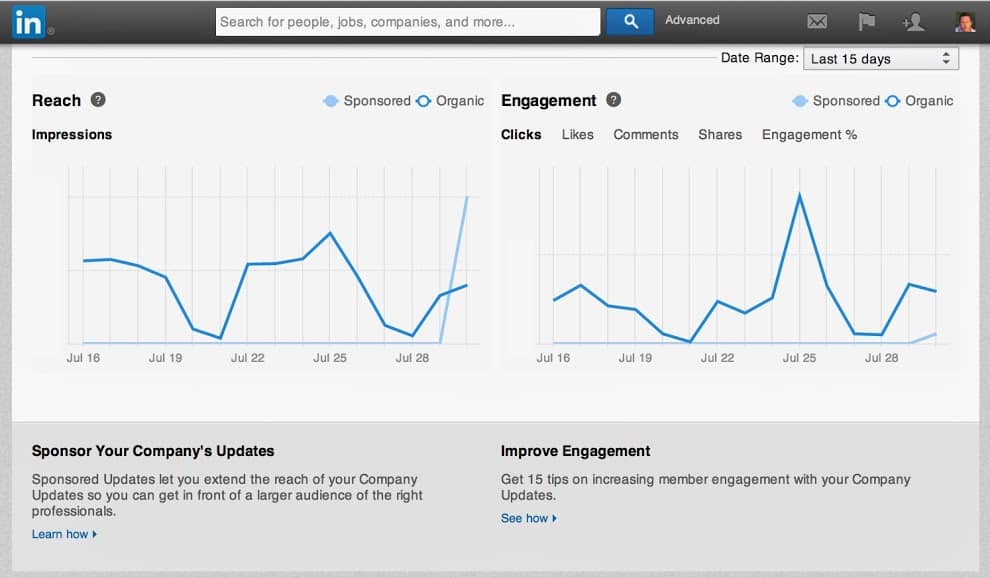
Link clicks show that your prospects are interested in the content you send them. A high click-through rate shows that your audience values the content you share with them. They want to read what you have to say and what you’ve shared. Link clicks indicate the strength of your relationships.
9. The number of conversations started
While social selling is a process focused on quality interactions, there is also something to be said for quantity. As long as quality doesn’t drop, having more conversations under way inevitably leads to more opportunities. More relationships, more conversations, more requests and therefore more sales. Starting a set number of new conversations every week can be a good way to make sure you stay top of mind. At first, until you have enough presence to generate enough inbound prospects, you’ll have to actively start new conversations to grow your network.
10. Revenue generated
Even if it doesn’t really fit the definition of social selling, your goal is to make money. If your social selling efforts don’t generate verifiable revenue, you probably won’t keep going for long. Fortunately, social selling revenue is easy to track. Since you engage in real conversations with your prospects, you know exactly which customers actually went through your sales pipeline. You were there at every step of the process.
Social selling has to make sense from a revenue standpoint for all the other metrics to count. However, using a wide range of parameters to refine your strategies over time will help you increase the revenue generated. As you grow your presence, more referrals and inbound prospects will enter your pipeline. That will automatically lead to higher revenue and growth for your business.
The questions we get over and over.
What is LinkedIn's Social Selling Index?
A metric that assesses your efforts on LinkedIn only, across four areas: establishing your professional brand, finding the right people and building your network, engaging with the right people, and building relationships with decision-makers. It's the fastest way to get an overview of your social selling efforts.
How do you calculate your content's engagement rate?
Number of interactions (likes, comments and shares) divided by the number of views.
Why track connection requests received rather than network growth?
Because spamming connection requests grows the network without producing business results. Inbound connections mean prospects are finding you, through mutual connections, the content you've shared or the social network's recommendation systems.
What does the message response rate measure?
Your ability to interact with new prospects. A low response rate may be a sign that you need to rework your approach style, or invest more time in getting to know a prospect well before contacting them.
How do you measure the revenue generated by social selling?
Since you hold real conversations with your prospects, you know exactly which customers went through your sales pipeline. If your efforts don't generate verifiable revenue, you probably won't keep going for long.


What the community says.