


- A landing page reachable only through a given keyword allows an A/B test on homogeneous traffic, including on pricing.
- Micro-tests on a small geographic sample validate keywords, ads, prices and slogans before a launch. Don’t mix them with your existing campaigns.
- On a high-intent keyword, Google Ads, SEO and affiliation are worked together to measure an « aggregated CTR », the real market share on the keyword.
- In B2B, conversions are rare: break the funnel down into micro-conversions to give Google Ads enough signals.
- Linkedin ads pointing to a resource, then a Google Ads pixel on the confirmation page, create a remarketing list limited to your target accounts.
B2B marketing teams are generally organized by activity, or by expertise. And for good reason: if you don’t want to rely solely on Google’s recommendations, which mostly boil down to increasing your budgets or adding broad keywords, there is a real entry cost to managing a Google Ads account.
That said, B2B buying behavior is a bit more complex than an ideal funnel where 100 clicks bring X conversions. And SEA is also a powerful tool to support a strategy, test optimizations, a message or an audience, and strengthen your presence on core-business queries.
In this article, we cover 5 levers that make SEA a powerful tool to design, adapt and execute your marketing strategy, and conversely, we show how other channels can be a major optimization lever for your SEA campaigns.
About this articleThis article is sponsored by the SEA agency Yumens. Yumens has strong SEA expertise and also brings in other areas of expertise such as SEO, UX, data and web analytics, which act as complementary levers.
1. Test protocols and controlled traffic

SEA lets you target a specific keyword, and define the landing page associated with a keyword, a group of keywords or a campaign.
One of the biggest problems when you set up a test protocol, whatever it is, is controlling the traffic and the overall experience – from the first click to the conversion – to avoid introducing bias into the test.
You can set up an A/B test on your homepage, for example, but unless you have a (very) large volume, you will inevitably get a fairly uneven traffic distribution across certain segments. Too uneven to get a significant result.
With SEA, you can define a completely isolated landing page, reachable only through a given keyword (or group of keywords) from Google, and design an overall experience that you apply only to visitors coming from that exact traffic source.
You can set up A/B tests directly from Google Ads, which splits homogeneous traffic (on the same keyword or group of keywords) and sends it to a control version or to one (or more) test version(s).
It is an extremely common & powerful testing lever, including for testing very deep things like pricing.
2. Market knowledge & Language market fit

Micro-tests
With SEA, you can run macro-tests and micro-tests, which cover different elements of your structure in order to assess the potential viability of their idea before moving on to development and launch. The advantage of micro-tests is that they are run on small audience samples, and help you fine-tune the details of your offer.
For example, you can ask yourself the following questions:
- How will users search?
- What features would they like to see in the new launch?
- What are the most effective marketing strategies for our sample?
The micro-test is designed with very specific questions, on a sample limited in number of people and in time, in order to provide more detail on the best way to go about development and launch.
How do you micro-test your new product/service with Google Ads? Once you have a clear idea of demand, potential costs and how users might search for your new product or service, you can dig a little deeper with active micro-tests.
The point of micro-tests in Google Ads is that you can get detailed data on the best marketing techniques well before launch. You can test everything: keywords, ad copy, the assets (formerly extensions) that work best, the structure and copy of the landing page, etc.
Don’t hesitate to go further and also test the most popular features, the most advantageous price range, logos and slogans, etc. The advantage of the micro-test is that you can test absolutely everything.
Salesdorado’s tipTo run your micro-tests with a Google Ads test campaign, you can follow these steps:
- Define your geographic targeting carefully: the smallest possible sample, to reduce costs and test demand in different locations.
- Create separate campaigns for the different elements to test (logos, ad copy, etc.)
- Have a simple message to get the concept across clearly in your test ad: you would be surprised how hard it is to turn a brilliant, complex idea into a simple, marketable message
Watch outBe careful not to mix test campaigns with existing campaigns, or you risk confusing your customers and losing conversions.
Competitor keywords
One of the great strengths of Google Ads is also that you can target competitors’ brand names. Technically, using brand names in ad text can be restricted following a complaint from the trademark owner (even if it is often possible in practice). But above all, targeting a competitor keyword is perfectly acceptable, as long as you don’t mislead the user. You get a real search volume on your competitors’ brand names, which gives you a fairly accurate estimate of their brand-related traffic.
By using broad enough keywords, you can then study the search terms (the exact words searched). This lets you identify interesting keyword combinations, and the underlying questions associated with a product or service.
For example, “Mailchimp in French” gives you an idea of the market looking for emailing software, and in particular emailing software in French. Not quite a selling point yet, but not far off.
Language market fit
In his article on what he calls language market fit, Matt Lerner offers a few examples to illustrate the concept. For example, of the following two (homepage) headlines, one converted 10x better than the other.
- Option A: “Accelerate your learning”.
- Option B: “Easily organize, share and take notes on web pages, PDFs and academic papers, so you learn faster, remember better and get things done”.
Option B converted visitors into signups 10 times better (30%) than the first version (3%).
But it’s not just a marketing “hack”: it’s about finding the right words to explain your product or service to your potential customers, words that resonate with the goals and problems already in their heads.
That is what he calls the fit between language and market: when you talk about your product, a light bulb goes on in your prospects’ heads and tells them: “That’s EXACTLY what I’m looking for”. They feel like you’ve read their minds.
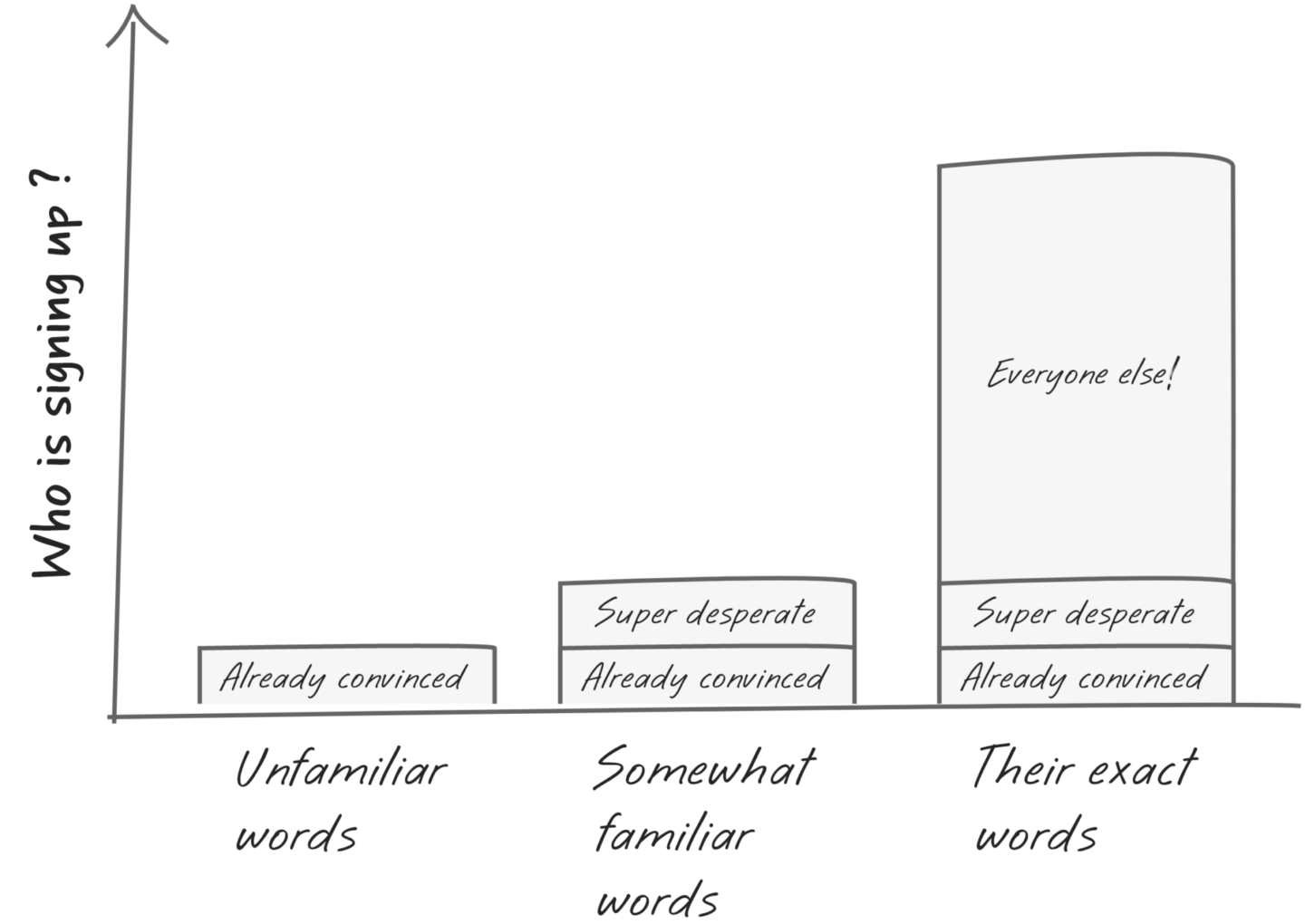
Source: First Round Review, Finding Language/Market Fit: How to Make Customers Feel Like You’ve Read Their Minds
At first, you focus more on the fit between your product and the market, to meet the needs of potential customers – especially since improving the language can seem to be purely a marketing matter.
But this neglect comes at a high cost: all the money invested in your ad campaigns barely pays off. The goal for new, little-known companies is to manage to convert low-intent visitors: it’s quite difficult, and “tightening” your language by refining it can really help.
The point of SEA is that you have a full-scale playground to look for this language market fit. Google results pages (SERP – for Search Engine Results Page) are made (more or less) only of words, and Google queries are nothing but words.
3. Search-driven marketing & Surround Sound Effect
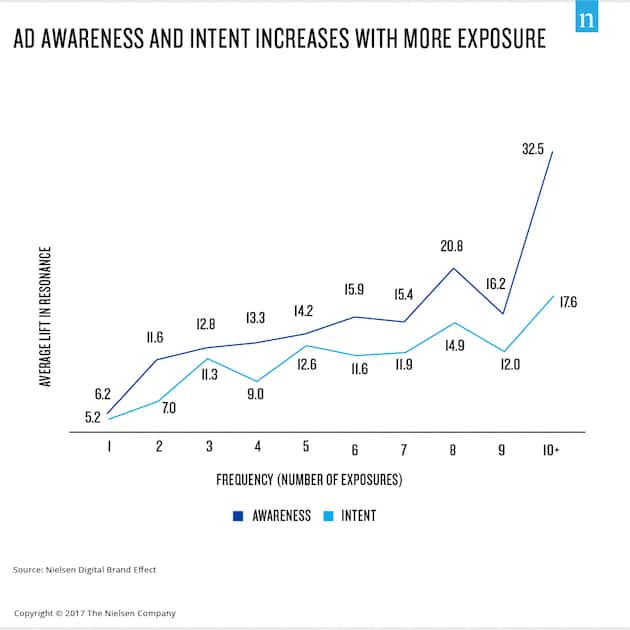
Why do people choose a product? The surround sound effect strategy is fairly simple: the more a person hears about your product from different sources, the more likely they are to buy it.
“The more frequently someone hears about your product from multiple sources, the more likely they are to buy your product”, Hubspot, The Surround Sound Series
Imagine you are at a dinner party and you want to know what your companions have read recently. You ask them: “What have you read? What should I read next?”
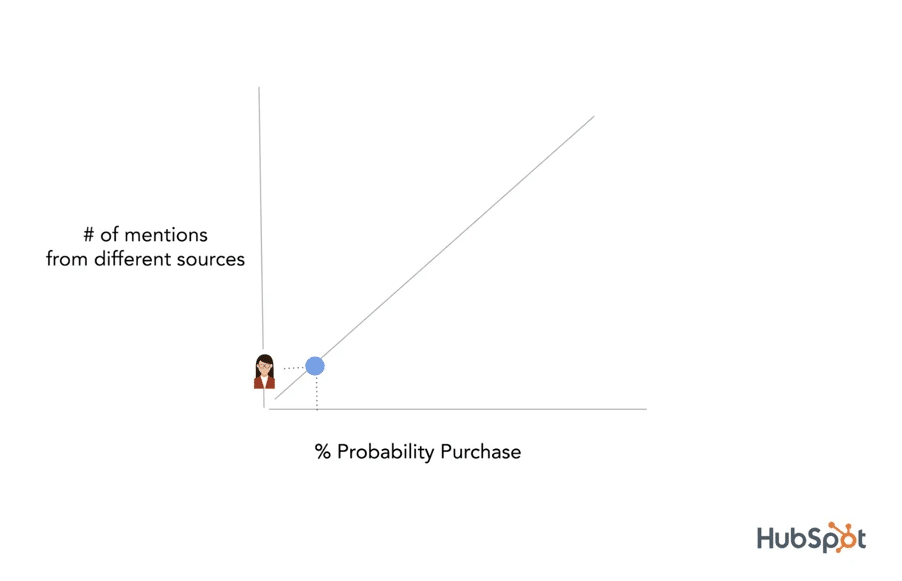
If only one guest tells you about a book, it won’t stand out and won’t be worth more than any other book. On the other hand, if all your guests tell you about the same book, it works like a chorus effect, what is called the “surround effect”. Unless you’re crazy, you are going to get hold of that book.
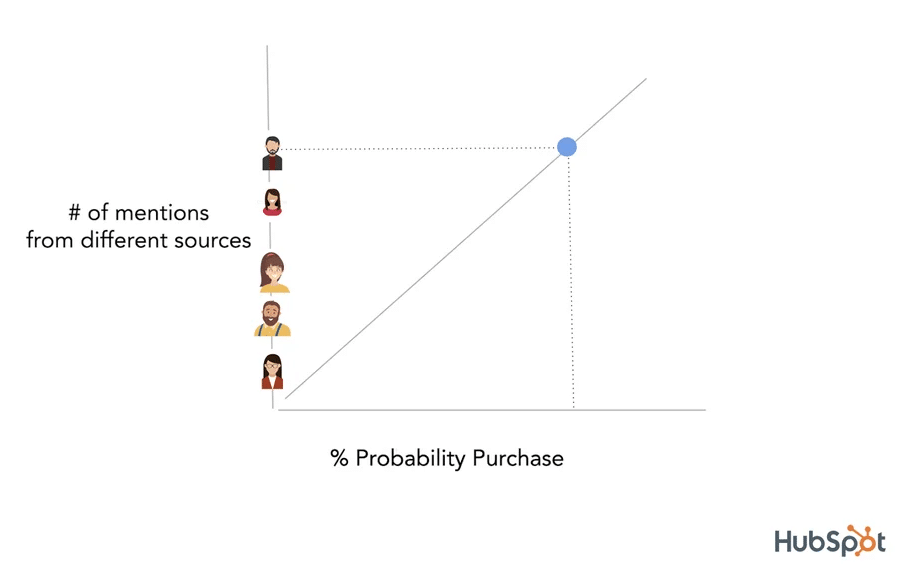
In reality, picture this dinner as a myriad of diverse influences: podcasts, newspaper articles, book bibliographies and, of course, suggestions from friends. The idea is to get lots of people talking about you favorably, ideally at the same time.
Salesdorado’s tipIt’s even more true for a product launch. In the first days of the launch, people need to see your project everywhere: blogs, Linkedin, X (formerly Twitter), newsletters, … – absolutely everywhere.
For Google SERPs, it’s exactly the same: all the search results need to talk about you.
On a high-intent keyword (example: Best CRM software) SERPs are typically split like this:
- Ads (Google Ads) from 3 or 4 competitors
- One or two organic results of the landing page type (conversion-oriented) for the leading software on the market. For example, Hubspot, with its free plan, manages to rank a conversion-oriented page for “best free crm”
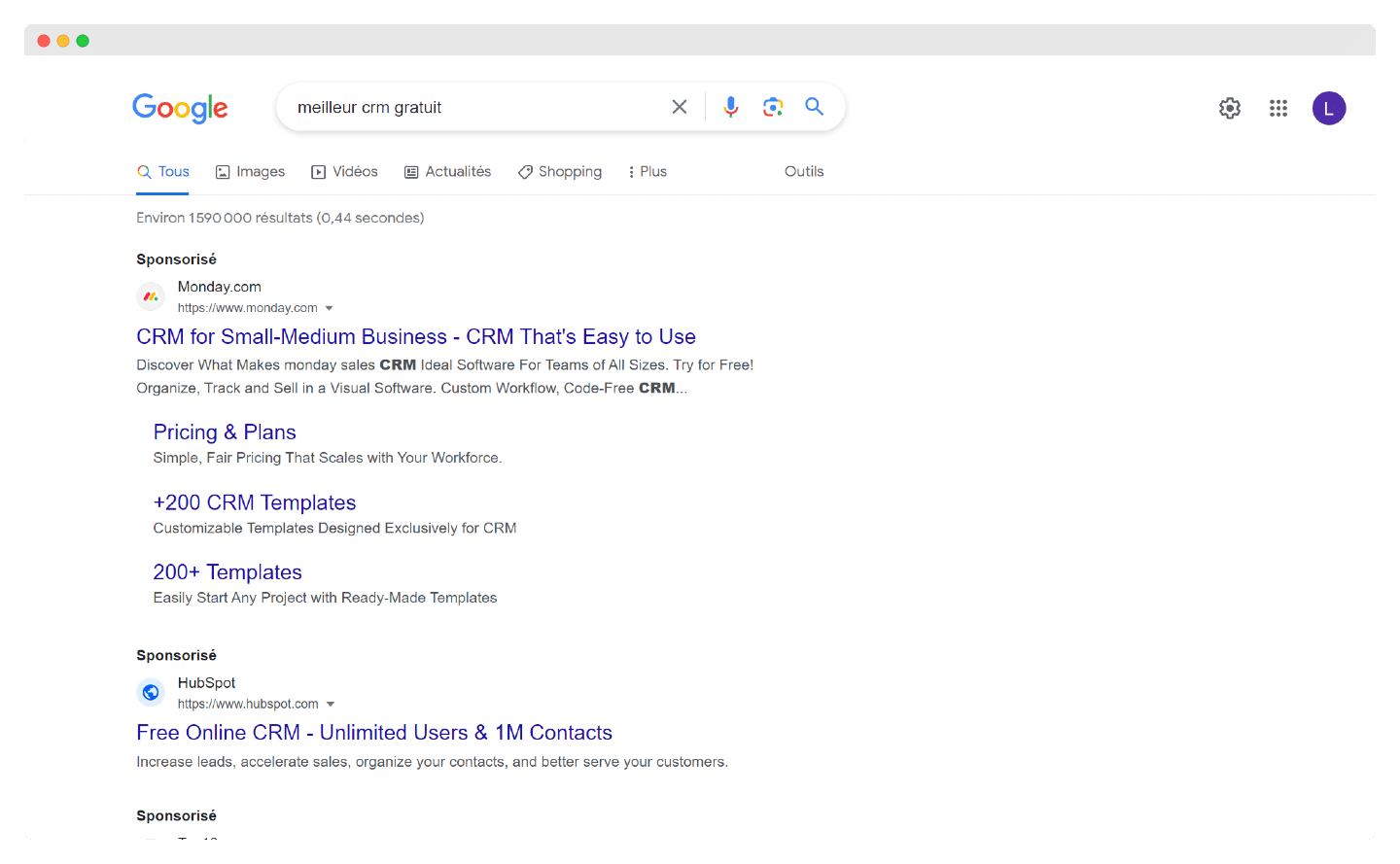
- Comparisons (Top 10 CRM software etc)
In marketing, this actually represents 3 fairly different disciplines, with fairly different levers:
- Google Ads – You can rank on the keyword relatively easily, even if it’s ultra-competitive, which requires a good Quality Score and good conversion rates for the (high…) CPCs to become acceptable
- SEO – It’s a very long-term effort to build enough authority on the topic to rank on these keywords with conversion-oriented pages. Semantic silos, technical optimizations, UX and UI, and authority building (links, mentions, …)
- Affiliation & Partnerships – Most of these Top 10 articles are published by more or less independent media. The goal here is to convince as many media outlets as possible to mention your brand, and to mention it as high as possible in the article to become present.
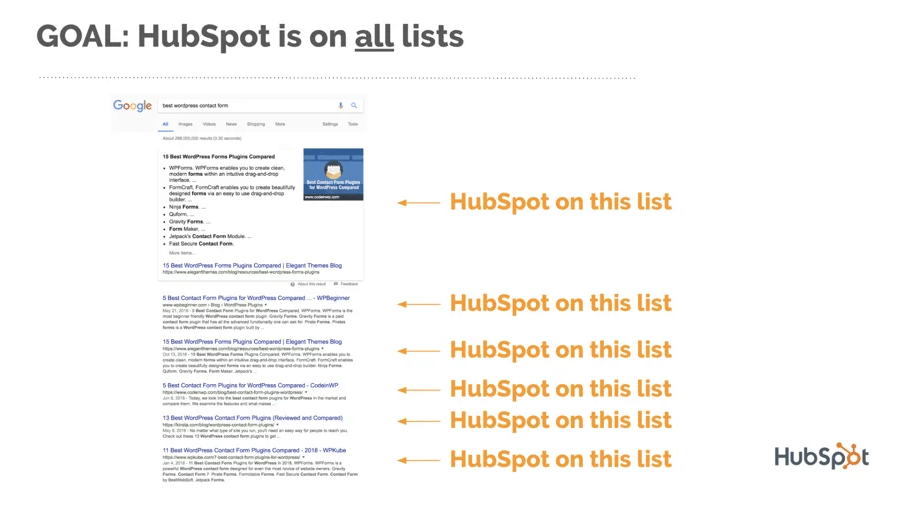
Source: Hubspot, The Surround Sound Series
As a strategy, this goes a very, very long way in mature & competitive markets. You can measure an “aggregated CTR” – on a search, how many clicks ultimately lead to your site – That’s the real market share on the keyword.
Rather than working each channel independently (or even almost in internal competition…), this synergy on precisely identified keywords gets much better results on all channels, and justifies much larger investments in paid channels, including retargeting, which becomes much more profitable.
Source: Nielsen Digital Brand Effect
4. Defining micro-conversions, UX design & aha moment
Don’t forget that Google Ads needs a lot of conversion volume to work well.
When you work with high average deal sizes – which is very common in B2B – search volumes, and customer volumes, are comparatively very low. But to optimize a campaign, you need statistically representative volumes.
In short, if you land one customer per keyword per month, it’s going to be very hard to optimize.
This pushes Google Ads marketers to break the funnel down into “micro-conversions” to increase the volume of signals (rather than the purchase alone). We very often think of signups or demo requests, but you can go much further, and be much more granular.
But it goes even further: SEA, and in particular this idea of micro-conversions, can drive fairly deep and powerful strategic changes, and make it possible to test them simply and quickly.
That is one of the great advantages of free tools, simulators, qualification forms, actions taken in the product, etc.
In the software world, for example, a model that is growing a lot is the reverse trial.
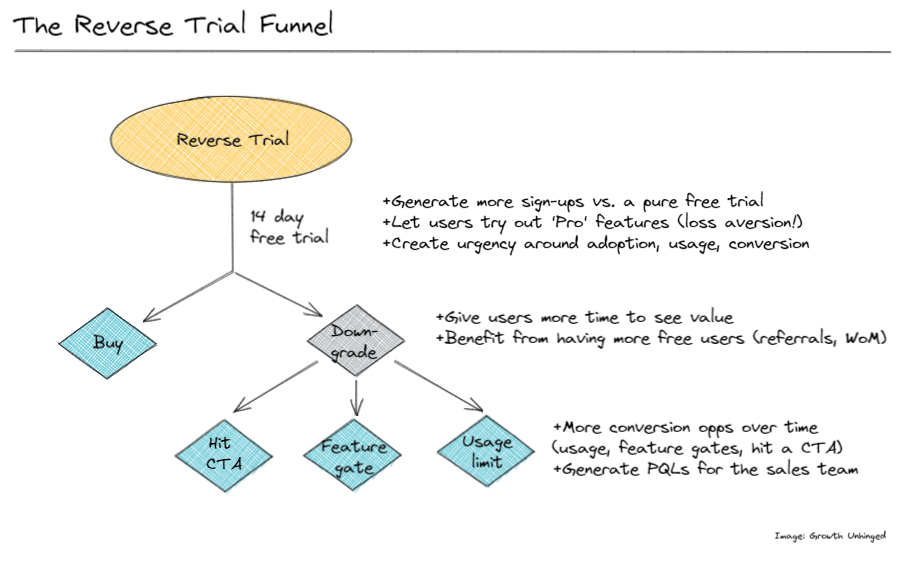
Source: OpenView Partners Blog, Your Guide to Reverse Trials
A reverse trial is when new users start with a time-limited trial of your paid features. At the end of the trial, they can either buy, or downgrade to a completely free tier.
You show users the best of your product, and at the end you benefit from loss aversion – the pain of losing something is an extremely powerful conversion driver.
This type of funnel seems to be the best of both worlds. You don’t have to choose between acquisition and conversion goals; you can pursue both! What’s more, you give new users your very best, by giving them access to your most advanced features for a limited time. From a behavioral psychology standpoint, you start benefiting from loss aversion, where the pain of losing something is a motivating factor twice as powerful as the pleasure of gaining.
In practice, according to former Airtable Head of Growth Lauryn Isford – one of the pioneers of the reverse-trial strategy – , you are better off offering your customers any feature that accelerates its growth at the top of the funnel.
Conversely, the features to keep in paid plans should match target user personas and clearly differentiate the value for each of them.
For example, so-called “moat” features, “sticky” features or “sophistication” features:
- “Moat” features: high switching costs or powerful network effects that increase value relative to the competition.
- Sticky features: once a user starts using this feature, they pay more to use more of it.
- Sophistication features: use of deeper, more complex functions
For example, for Airtable, a new customer can build a basic CRM in Airtable for free. The Salesforce integration, which unlocks deeper usage and extends the workflow, is better suited to a paid plan. On the other hand, the ability to invite many colleagues to a board in your CRM should be free, in order to expose the product to as many people as possible.
Watch outThere is a wide variety of CRM pricing models, based on number of seats, usage, tiers, and combinations of each of them. Exactly how you “give away” premium features depends on your product and should be tied to how customers use it.
5. SEA and ABM – An impossible equation?
You can also use retargeting on Google Ads, to set a much more aggressive maximum budget on certain clicks.
In an ABM strategy, it’s common to use social ads to pull in traffic from a set of target accounts (thanks to Linkedin in particular), and create Google retargeting lists on those accounts. It’s a special case, but a very common one, and fairly powerful.
A good strategy combining ABM and SEA can look like this:
- Create a high-value resource, but one with rather low virality, to control traffic as much as possible
- Run Social Ads on your target accounts, for example with Linkedin ads.
- You can make the download conditional on filling in a form to pre-qualify your target audience even further
- Build remarketing lists with a Google Ads pixel placed on the download confirmation page. If you pre-qualify, set up 2 pages with 2 different pixels to isolate the audience that matches your target accounts. If the user enters a company or an email linked to your target accounts, you redirect them to the page with the target audience pixel, and otherwise to the page with the other audience pixel.
- Then set up remarketing rules in Google Ads, to make sure you get a higher position when members of your target audience search for a keyword you are positioned on. You will mechanically be much more present, only for your target audience.
Also readOur selection of the best Google Ads training courses
Go furtherRead our complete guide to Account Based Marketing.
The questions we get over and over.
Why use SEA to run A/B tests?
With SEA, you can define an isolated landing page, reachable only through a keyword or a group of keywords. The traffic is homogeneous, which avoids the bias of an A/B test on a homepage where traffic is too unevenly distributed to get a significant result.
What is language market fit?
It's the fit between language and market, a concept from Matt Lerner: finding the words that explain your product by resonating with your prospects' goals and problems. In his example, a detailed headline converted 10 times better (30%) than a short headline (3%).
What is the surround sound effect?
The more a person hears about your product from different sources, the more likely they are to buy it. On Google, the idea is to be present in the ads, the organic results and the comparisons on the same keyword.
Why define micro-conversions in Google Ads?
Google Ads needs a lot of conversions to optimize a campaign. In B2B, with high average deal sizes, customer volumes are low: you break the funnel down into micro-conversions (signup, demo request, simulator, action in the product) to increase the volume of signals.
How do you combine SEA and ABM?
By drawing your target accounts to a resource through social ads, for example on Linkedin, then placing a Google Ads pixel on the download confirmation page. Remarketing rules then give you a higher position when those accounts search for your keywords.



What the community says.