


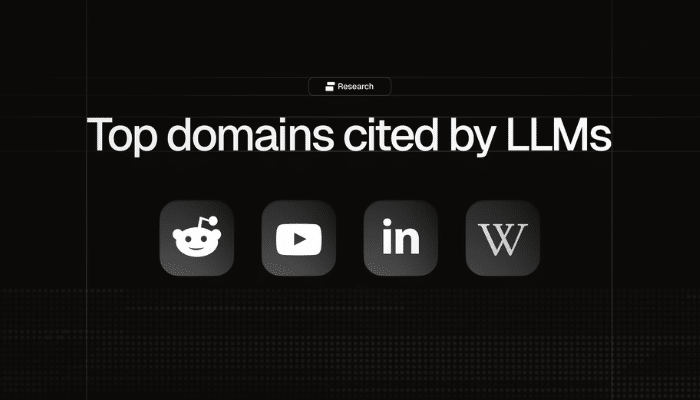
Peec AI analyzed 30 million sources cited by ChatGPT, Gemini, Perplexity, Google AI Mode and AI Overviews. The verdict: LinkedIn ranks third overall, behind Reddit and YouTube. For B2B sales and marketing teams, this figure changes the game. What your executives post on their LinkedIn profile ends up directly in the answers ChatGPT or Perplexity serve to your prospects.
Key takeaways
- LinkedIn is the 3rd most cited domain across all AI engines, according to the Peec AI study from March 2026.
- The platform appears in the top 5 of Google AI Mode, AI Overviews, Perplexity and ChatGPT.
- Three types of LinkedIn content surface in AI answers: Pulse articles, standard posts and company page updates.
- Posts by founders, executives and employees directly shape how AI describes a brand.
- For B2B, LinkedIn plays a double game with G2 on Perplexity, where both platforms feed software comparison queries.
LinkedIn in the global top 3 of sources cited by AI
The Peec AI study published on March 31, 2026 gives an overall ranking of the domains most cited by the five major AI search engines. Reddit takes first place, YouTube second, LinkedIn third. Wikipedia, Forbes, G2, Yelp, Facebook, Medium and TechRadar complete the top 10.
The scope covers ChatGPT, Google AI Mode, Gemini, Perplexity and AI Overviews on the US market. Peec AI measured the sources directly cited in generated answers, not those merely consulted by the engines. The distinction matters: a cited source really influences the answer, a consulted source can be ignored.
LinkedIn sits in the top 5 of four platforms out of five. Only Gemini, more oriented toward Wikipedia and Medium, leaves it out of its leading five. This near-systematic presence makes LinkedIn a pillar that B2B marketing teams can no longer ignore.
A per-platform ranking that clarifies the trade-offs
LinkedIn’s exact position varies depending on the AI engine queried. The detail changes priorities depending on the target audience.
| AI platform | LinkedIn’s position in the top 5 | Other dominant sources |
|---|---|---|
| Google AI Mode | 4th | YouTube, Reddit, Facebook, Yelp |
| AI Overviews | 4th | YouTube, Reddit, Facebook, Medium |
| Perplexity | 3rd | Reddit, YouTube, Wikipedia, G2 |
| ChatGPT | 5th | Wikipedia, Reddit, Forbes, TechRadar |
| Gemini | Outside the top 5 | Reddit, YouTube, Wikipedia, Medium, PCMag |
Why AI cites LinkedIn so often
AI engines don’t pick at random. They favor sources where the signal is dense and freshness is guaranteed. For B2B, LinkedIn ticks both boxes.
Tomek Rudzki, author of the Peec AI study, identifies three LinkedIn formats that feed AI answers. First, LinkedIn Pulse articles, which work like long-form editorial content, indexed and accessible to crawlers. Then standard posts, which capture product news, industry commentary and lessons learned. Finally, company page updates, which serve as a reliable source for corporate information (funding rounds, appointments, launches).
Peec AI sees in its own data that content published on its LinkedIn company page, or through its employees’ accounts, is regularly picked up by the major models. It is no longer one distribution channel among others. It is a documentary source for AI.
Executives’ voices directly shape how AI perceives a brand
The most strategic point of the study fits in one sentence. Posts by founders, executives and employees, especially around product announcements and company milestones, can end up dictating how an AI describes a brand.
In practice, if a senior salesperson regularly posts a well-argued view of their CRM tool on LinkedIn, and several colleagues follow suit, ChatGPT will end up building that narrative into its answers. Personal branding is no longer just an exercise in professional visibility. It becomes a lever for brand positioning in the AI ecosystem.
This mechanism has a direct consequence for marketing managers: content produced by employees carries as much weight, sometimes more, as the corporate blog or product pages. Training teams to post now also means doing AI SEO.
LinkedIn and Perplexity, the B2B duo to watch closely
Perplexity is the AI engine B2B buyers use for their early-stage research. And on Perplexity, LinkedIn ranks 3rd, just ahead of Wikipedia and G2.
This position is far from trivial. When a purchasing manager asks Perplexity which CRM vendor fits their needs, the engine builds its answer from Reddit discussions (real usage), YouTube videos (demos and reviews), LinkedIn profiles and posts (vendor expertise), Wikipedia (factual reliability) and G2 listings (structured benchmark). The five sources complement each other.
For a SaaS vendor or an integrator, being absent from LinkedIn means removing one of the five building blocks Perplexity uses to talk about you. The other four are not enough to build a favorable recommendation if the company’s own voice is missing.
ChatGPT uses LinkedIn differently from Perplexity
On ChatGPT, LinkedIn ranks 5th behind Wikipedia, Reddit, Forbes and TechRadar. OpenAI’s engine favors recognized editorial sources, which leaves less room for social platforms. Yet LinkedIn stays in its top 5.
The likely explanation lies in the nature of the queries. ChatGPT is asked more often for definitions, conceptual analyses and summaries. On these topics, Pulse articles written by industry experts work as editorial sources in their own right. A well-sourced post from a CRM consultant can rank at the same level as a Forbes article in the model’s eyes.
Teams that regularly produce long, well-documented content on LinkedIn therefore stack the benefits. They feed Perplexity and Google AI Mode with their short posts. They feed ChatGPT with their more in-depth Pulse articles.
What it changes for a B2B content strategy
The hierarchy of channels is shifting. For a long time, LinkedIn was seen as a distribution channel that amplified content from the brand’s website. The Peec AI data turns this model upside down. LinkedIn has become a primary source for AI engines, just like the corporate website.
First practical consequence: treat every LinkedIn post as a lasting editorial asset, not as disposable content. The post that gets 30 likes today may be cited in a Perplexity answer six months from now. A minimum level of writing and factual rigor is a must.
Second consequence: structure how employees speak up. Not by imposing standardized posts that ring false, but by equipping executives and in-house experts to post regularly on their areas of expertise. Authenticity comes first, but so does consistency.
Four concrete trade-offs for marketing managers
The Peec AI study data suggests several shifts. Here are the most actionable in the short term.
- Rebalance the ratio between content published on the corporate blog and content published on LinkedIn. If 90% of the writing budget goes to the website, the allocation deserves a second look.
- Measure direct competitors’ LinkedIn presence with an AEO monitoring tool. A brand that dominates the LinkedIn conversation on a topic will see its narrative picked up by AI.
- Train salespeople and technical experts to post. Posts from the field carry a credibility that marketing cannot manufacture.
- Produce at least one long Pulse article per month for each identified expert, to feed the engines that favor the editorial format (ChatGPT, Gemini).
The limits of the Peec AI study to keep in mind
The analysis covers the US market only. For French-language queries, the hierarchies may differ, even though LinkedIn is an international network with a solid French-speaking base. Equivalent French studies are still missing to confirm the pattern on the European B2B market.
Peec AI does not publish percentages, only ranks. So there is no way to know whether LinkedIn accounts for 3% or 15% of total citations. The Profound study published in June 2025 gave more quantitative detail, with LinkedIn at 1.3% of total citation volume on Google AI Overviews and 0.8% on Perplexity. Modest figures in absolute terms, but they reflect a significant presence in a universe where the long tail is highly scattered.
Finally, Peec AI is a vendor of AEO tracking software. The commercial bias exists: the study naturally reinforces the need to measure AI visibility, and therefore to use this type of tool. The data remains credible, but the angle should be read with some distance.

What the community says.