


On May 5, 2026, Pappers announced on LinkedIn the integration of Staan, the European search index co-created by Qwant and Ecosia, into its Pappers IA assistant. When the AI needs information from the open web, company news or a recent press article, it now queries this 100% European index rather than Bing or Google. A first on the French B2B market.
Key takeaways
- Pappers IA, the assistant launched in 2026 by the publisher of pappers.fr, now uses Staan for its web searches
- Staan is the European index launched in August 2025 by European Search Perspective (EUSP), the 50/50 joint venture between Qwant and Ecosia
- Pappers presents an end-to-end stack: 100% French data, 100% European search
- For Staan, it is the first major French B2B AI customer reference made public
- The main selling point for users: traceable sourcing compared with American assistants such as ChatGPT or Perplexity
How does the Staan integration work in Pappers IA?
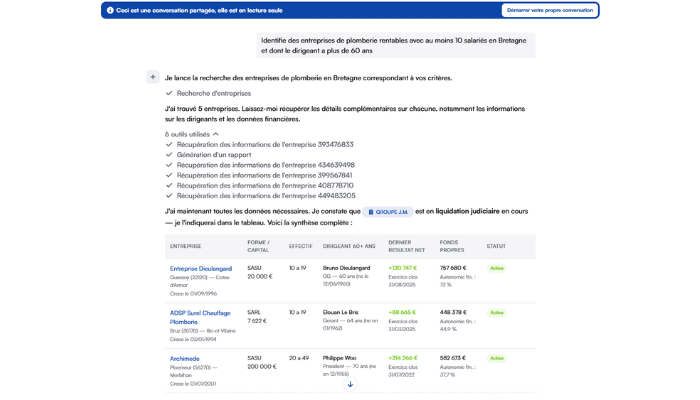
Pappers IA is a conversational assistant that queries the Pappers database ecosystem (Entreprises, Justice, Immobilier, Politique) in natural language. Its value proposition rests on three elements: reasoning displayed in plain sight before the answer, tools traced at every step, and a systematic link to the original data.
Like any LLM assistant, Pappers IA has to fetch context beyond its internal databases: the latest funding round not yet reflected in the accounts, a press article about an executive, a recent controversy. This web search layer is now provided by Staan.
Staan is the index launched in August 2025 by European Search Perspective. The company is a 50/50 joint venture created by Qwant and Ecosia in November 2024. Its stated goal from the start: to offer a European alternative to Bing and Google for grounding AI models, at an announced cost of around one tenth of what the big American providers charge. Pappers IA becomes one of its first visible French B2B users.
Why did Pappers choose Staan over Bing or Google?
Pierre Fruchard, co-founder of Pappers, explains the choice on LinkedIn by a shared DNA with EUSP along three lines: data quality, independence from the big American platforms, and transparency about sources. The mention of respect for press publishers’ rights, which appears in the announcement, is no accident. It addresses a sensitive topic on the French B2B market, where compliance with European neighboring rights rules remains a differentiating argument against American players that are still criticized on this front.
The narrative fits in one sentence: « At Pappers, the data is 100% French. The search is 100% European. That’s no coincidence. » It is a head-on answer to general-purpose AI assistants (Claude, ChatGPT, Perplexity) that can answer questions about French companies but rely on models trained abroad and on American web indexes. For legal functions, finance departments and compliance teams who must document the provenance of every piece of data, the sovereignty argument carries weight in public tenders and regulated sectors.
The French sovereign stack is being built piece by piece
The Pappers x EUSP partnership is less an isolated event than a new piece in a French sovereign stack that is gradually filling out. The building blocks can now be identified across the whole company analysis chain: data layer, search layer, model layer, infrastructure layer and access protocol layer. Each has at least one credible sovereign player.
| Layer | Sovereign player | Role |
|---|---|---|
| Company data | Pappers | Open data from INPI, INSEE, BODACC, RNE, commercial court registries |
| Web index | Staan (EUSP) | European web search for AI grounding |
| Language model | Mistral AI | Conversational model available to French assistants |
| Cloud infrastructure | OVHcloud, Scaleway | SecNumCloud sovereign hosting |
| Access protocol | MCP Pappers | Standardized connection to LLMs (Claude, ChatGPT, Mistral) |
Pappers has already published its official MCP server, which exposes more than 35 investigation tools to any compatible AI assistant. With the Staan integration, the publisher adds a new layer: not only does it make its data queryable by third-party AIs, it also offers its own assistant pre-wired on European foundations. The two approaches coexist and address different use cases.
What it changes for sales and marketing teams
Pappers IA now combines three sources that American tools do not bring together in a single query: structured legal data (revenue, executives, filed accounts), Pappers Justice case law, and the European web news layer via Staan. For salespeople, a query such as « Analyze the financial health and recent controversies of the CEO of company X » draws on all three layers in a single sourced answer. The time saved preparing a call or a qualification note is immediate. No more juggling between Pappers, Google News and the CRM.
For B2B marketing
The sovereignty argument becomes usable with regulated key accounts. A 100% European stack (French data, European search, sovereign hosting) directly meets the requirements of banking, energy, defense and public sector tenders, where traceability of the data chain has become a deciding criterion. For ABM teams targeting these accounts, it is a new sales message ready to use. Pappers IA can be positioned as the alternative to American solutions that raise issues with the legal department or the DPO. The conversation shifts from price to compliance, which changes the negotiation dynamic.
For CIOs
The point is not to replace Claude or ChatGPT but to position Pappers IA within the landscape of assistants already deployed. The publisher is clearly playing complementarity: Pappers IA for analyses that require French legal and tax sourcing, Claude or ChatGPT for general-purpose uses. The Pappers MCP remains the bridge connecting the two worlds. A team can keep using Claude or ChatGPT day to day while plugging in the Pappers MCP server for specifically French needs. Pappers IA is aimed at teams that want a pre-integrated stack with automatic sourcing.
The signal for the European search market
Beyond the Pappers case, the announcement is also a validation signal for Staan, which was barely out of its launch phase nine months ago. EUSP had positioned its index as an infrastructure layer meant to serve other European players, under API license, for grounding chatbots and assistants. The partnership with Pappers is precisely the kind of B2B customer reference EUSP was looking to land.
Boris Lecoeur, who takes over as head of Synfonium (the holding company that owns Qwant) on May 11, 2026, said he wants to turn these technological foundations into products used at scale by companies, developers and AI players in Europe. The Pappers integration is exactly that kind of product: a usable B2B reference to sell Staan to other French AI publishers that will share the same need for European grounding.
What remains to be clarified
Several points are worth watching in the coming weeks. The exact scope of the integration has not been specified. Is Staan used exclusively or alongside other indexes? Staan’s latency and coverage on fine-grained B2B queries, such as searching recent press news about an SME, still have to be tested against real use by Pappers IA teams. The commercial terms (revenue sharing, API license, exclusivity on certain verticals) have not been disclosed. The question also remains open as to whether this kind of deal can be replicated for other French AI publishers wanting to follow the same path.
One thing is settled: for the first time, a leading French B2B AI assistant publicly shows a European search stack. It is less a technical event than a strategic marker for the market.


What the community says.