



- The sales methodology rests on three elements: the buyer journey, the sales process and the qualification matrix.
- Sales process stages must be inspectable: “verified discovery” beats “the influencer has bought in”.
- BANT is a bit old school, but it is a good starting point for a qualification matrix.
- An exam checks product knowledge, a certification tests skills like the discovery call, on a scorecard shared in advance.
- The trainer who assesses the role play must not be the trainee’s hiring manager.
Every high-performing salesperson succeeds in their own way. Relying heavily on ride-along mentors during training can undermine a new hire’s ability to shine by using their own strengths.
That’s why defining your sales methodology is what makes a sales training plan scalable and predictable. This training plan rests on three elements: the buyer journey, the sales process and the qualification matrix.
Exams and certifications add predictability to the sales training formula. They also provide a platform for learning and iterating on the formula.
What makes a good training plan? How do you build it and optimize it? Here are the 3 steps you can’t skip to set up a good training plan.
Go furtherFor this article, we drew heavily on what we consider the Bible of training plans. You can get it here: The Sales Acceleration Formula – Mark Roberge (ex-CRO @ Hubspot)
What makes a good training plan?

A training plan is a strategic human resources management tool that brings together all the training a company offers over one year. Tied to company policy, the training plan should help develop your employees’ skills and adapt them as your company changes. A good training plan must follow a schedule and have a budget, because it is paid for by the company, not by the employees.
Here are a few method pointers for setting up your training plan:
1. Define the elements of your sales methodology

A well-designed sales methodology has three parts: the buyer journey, the sales process and the qualification matrix. Together, these three elements form the “best practices blueprint” around which a successful training program must be built.
- The buyer journey: these are the general stages a customer goes through before buying a product. For example: the buyer discovers a problem they want to solve, the same buyer looks for information on the problem and possible solutions, then draws up a short list of solutions to evaluate, weighing the costs and benefits of each one.
Watch outDefining this buying journey carefully is very important, so you can be sure the buyer’s needs always stay at the center of each of the stages of the sales cycle. It also lets the sales team step back and think about how the buying journey could be sped up or streamlined.
- The sales process: it should guide the customer all along their buying journey. It runs from prospecting to the connect call, during which the salesperson can present their product and services to the customer. If that call goes well, it can lead to a discovery call, then a presentation of the solution you offer, and so on. Each of these steps is a potential stage of a sales process.
These stages need to be aligned with the buying journey, to make sure the buyer sees the salesperson as helpful throughout the process.
Also make sure the stages of the sales process can be inspected and assessed, so you can understand the true status of each opportunity. For example, “the influencer has bought in” is a very poor sales process stage because it is too subjective and can vary from one salesperson to another. And it is very hard for a manager to check whether an opportunity has really reached that point.
Salesdorado’s tip“Verified discovery” is a much better option: it means the salesperson has emailed the prospect a summary of the discovery call and the prospect has replied confirming it. Both the salesperson and the manager know exactly whether an opportunity is at that stage.
The buyer feels aligned with the salesperson thanks to this explicit confirmation of their goals and of how they see the solution.
- The qualification matrix: it defines the information required from a prospective buyer at the different stages of the sales process, to understand whether we can help them. This information is rarely gathered in the same order from one deal to the next.
One of the most common qualification matrices is BANT, for Budget, Authority, Need and Timing.
- Budget: this means the salesperson has confirmed with the customer that the value generated by the solution is greater than its cost, and that the budget to cover the cost is available.
- Authority: the salesperson has confirmed the budget criteria with the person in charge of the budget.
- Need: the salesperson understands the goal the customer wants to reach.
- Timing: the salesperson has set a specific timeline by which the prospect wants to address the need.
BANT is a bit old school, but it’s a good starting point. As the buyer’s context changes and you understand it better, iterate beyond BANT toward a qualification matrix that works for you. Just remember that the criteria must be short, simple and easy to understand.
Go furtherWe’ve written plenty of articles on qualification matrices and lead scoring, which you can find here:
- What is BANT?
- Lead scoring: definition & free sample Excel file
- Top 10 project management training courses
- Top 10 Excel training courses
2. Build a training program that fits your sales methodology
Once the sales methodology is defined, structuring a training program is fairly simple. Introduce the elements of the sales methodology in the order you created them.
Start with a training session on the buying journey. Put yourself in the buyer’s shoes and try to come up with examples of the questions buyers ask themselves at each stage of the buying journey. Next, you can run a session introducing the sales process and the qualification matrix.
Ideally, you then create separate sessions to dig into each stage of the sales process: one on prospecting, one on the connect call, another on the discovery call, and so on.
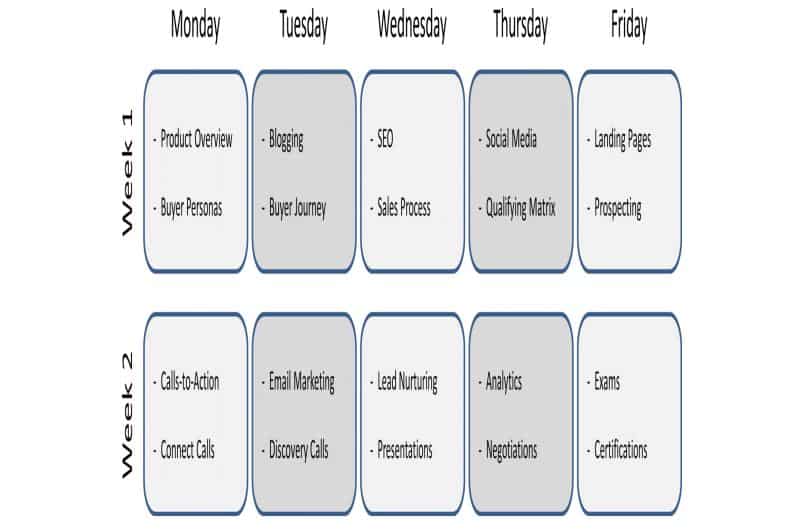
Source: The Sales Acceleration Formula – Mark Roberge
As the team grows, don’t hesitate to give your best salespeople the chance to teach one of these courses, especially if one of them matches their “superpower”. This approach is very different from ACME’s mentoring strategy. Unlike ACME, you match superpowers to specific training topics.
As sales manager, you have approved the content, but you delegate the work to your best salespeople, who will appreciate the professional development opportunities this gives them.
2.1 Build an inventory of training material
This is the first step before you move on to designing specific modules. Build an inventory that can assess the sales training services available on the market. List them and benchmark them against your current training services.
Discuss your findings and your needs with the R&D and HR departments to agree on the types of modules and the sales training methods.
2.2 Define goals and key performance indicators
As with any management program, setting goals will prove useful. Identify the areas where you think your current sales team could improve and include them in your training program.
Make sure the goals you set are realistic and help identify current and future performance gaps.
2.3 Assess specific training methods
This step is crucial because it means reviewing and reworking your existing sales training program, if you have one.
2.4 Set objectives
Even if you have lots of statistical goals to hit with your sales training program, focus first on a few core objectives. Your program should aim to deliver good-quality training that increases the organization’s sales and productivity.
It should also make it possible to create and explore new sales opportunities to improve knowledge and skills. At bottom, your sales training program should be a resource that you and your sales force can rely on.
2.5 Add predictability to the sales training formula
A “ride-along” sales training strategy is neither scalable nor predictable. The Sales Acceleration Formula – Mark Roberge (ex-CRO @ Hubspot)
What if I had to speed up hiring salespeople? How many new hires could shadow each top performer? Are these new hires going to distract my best people? How should I quantify the program’s success? How should I assess and improve it?
The idea is to make your training measurable so you can iterate on it scientifically. Hence the value of adding an exam or certifications.
- The exam: based on factual information, its purpose is to make sure new hires leave the training program with a satisfactory level of product knowledge.
- Certifications: these are used more to test qualitative skills, such as the ability to move through the stages of the sales process.
For example, to graduate from training, new hires must be certified on the “discovery” stage: they are asked to run the discovery call with one of the trainers. In this role play, specific skills of the trainee are assessed, such as their ability to open the conversation with open-ended questions, to listen to the prospect to dig deeper into their needs, and finally their ability to cover the different aspects of the qualification matrix.
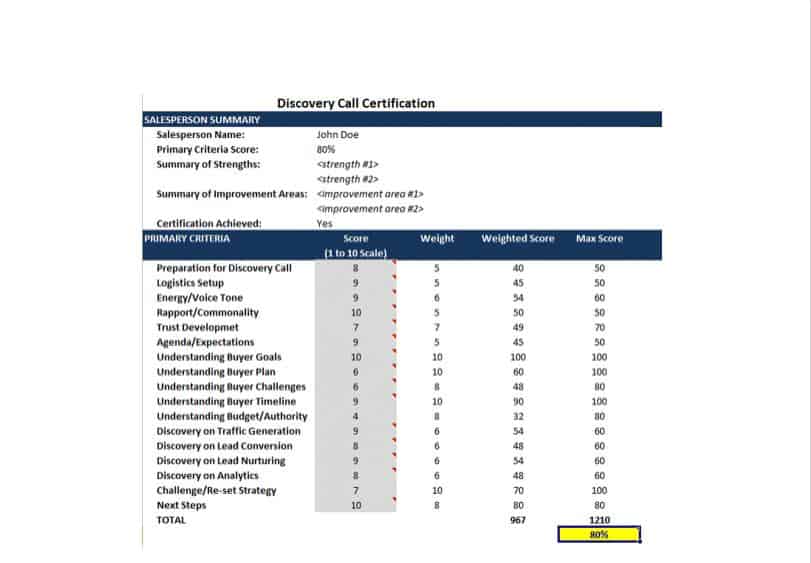
Source: The Sales Acceleration Formula – Mark Roberge
The certification scorecard must define each of these skills precisely so they can be assessed quantitatively, and not just with a comment like “Good job”. For fairness, remember to share this scorecard with your trainees beforehand so expectations are clear.
These exams and certifications make your sales training formula more predictable and let you iterate on the formula.
Watch outIt’s essential that the person assessing the role play, in this case the sales trainer, is not the trainee’s hiring manager, otherwise there may be a conflict of interest.
Go furtherHere are a few examples of good training courses:
- Sales training: the top 15
- Top 15 cold calling training courses
- Cold calling: role-play examples
3. Iterate on and optimize your sales training plan

With a well-defined sales methodology, a detailed course curriculum and a solid set of exams and certifications, you can improve the sales training process. This training must keep evolving to respond to changes in the company.
Here are a few tools to drive iteration of your training formula, while also justifying the iteration:
- Feedback forms: after six months, you can ask the employee in the role to assess your training program. For example, they can rank the modules from most to least useful, or think about potential topics the program was missing, based on their experience.
- Correlations between training performance and sales performance: does a high score on the training exam predict success in the field? Or the opposite? What about certifications? If there is no correlation at all, the training formula still needs to be questioned. Conversely, strong correlations let you focus on the aspects of training that seem to drive sales success.
- Sales team adjustment: as the company changes, the sales team sometimes has to be reorganized or readjusted. Having a structured sales training formula already in place allowed the organization to assess where and how to adjust the sales training formula to keep up with how our company was changing.
Go furtherFind all our articles on the art of motivating your sales reps:
The questions we get over and over.
What is a training plan?
A strategic human resources management tool that brings together all the training a company offers over one year. It must follow a schedule and have a budget, because it is paid for by the company, not by the employees.
What is the sales methodology of a sales training plan based on?
On three elements: the buyer journey, the sales process and the qualification matrix. They form the best practices blueprint around which the training program is built.
What does BANT stand for?
Budget, Authority, Need and Timing. The salesperson confirms that the value of the solution exceeds its cost and that the budget is available, that they are talking to the person in charge of the budget, that they understand the customer’s goal and that a timeline is set.
What is the difference between an exam and a certification in sales training?
The exam, based on factual information, checks that new hires know the products. The certification tests qualitative skills, such as running a discovery call in a role play with a trainer.
How do you improve a sales training plan?
With feedback forms filled in by the reps after six months, by looking for correlations between training results and sales results, and by adjusting the training as the sales team changes.



What the community says.