



- A script isn’t a text to recite word for word: it’s a framework the salesperson makes their own and adapts to their style.
- Standard structure: opening, reason for the call, permission to qualify, targeted questions, value proposition, next steps.
- On the first call, avoid an overly salesy pitch that puts the prospect on the defensive.
- A second voicemail must bring new value, for example social proof.
- When you hear “send me an email”, accept, then lock in a time slot to talk again.
Phone sales scripts have a bad reputation. Too rigid, too mechanical, too artificial, they sometimes give the impression that the salesperson is reciting a text learned by heart.
And yet, used well, they remain one of the most powerful levers for turning calls into business opportunities. It all comes down to approach: a good script shouldn’t format the conversation, it should structure the exchange to maximize impact without hurting spontaneity.
In this article, I share 10 examples of call scripts designed to be effective without sounding robotic, along with tips for adapting them to your style and your prospects.
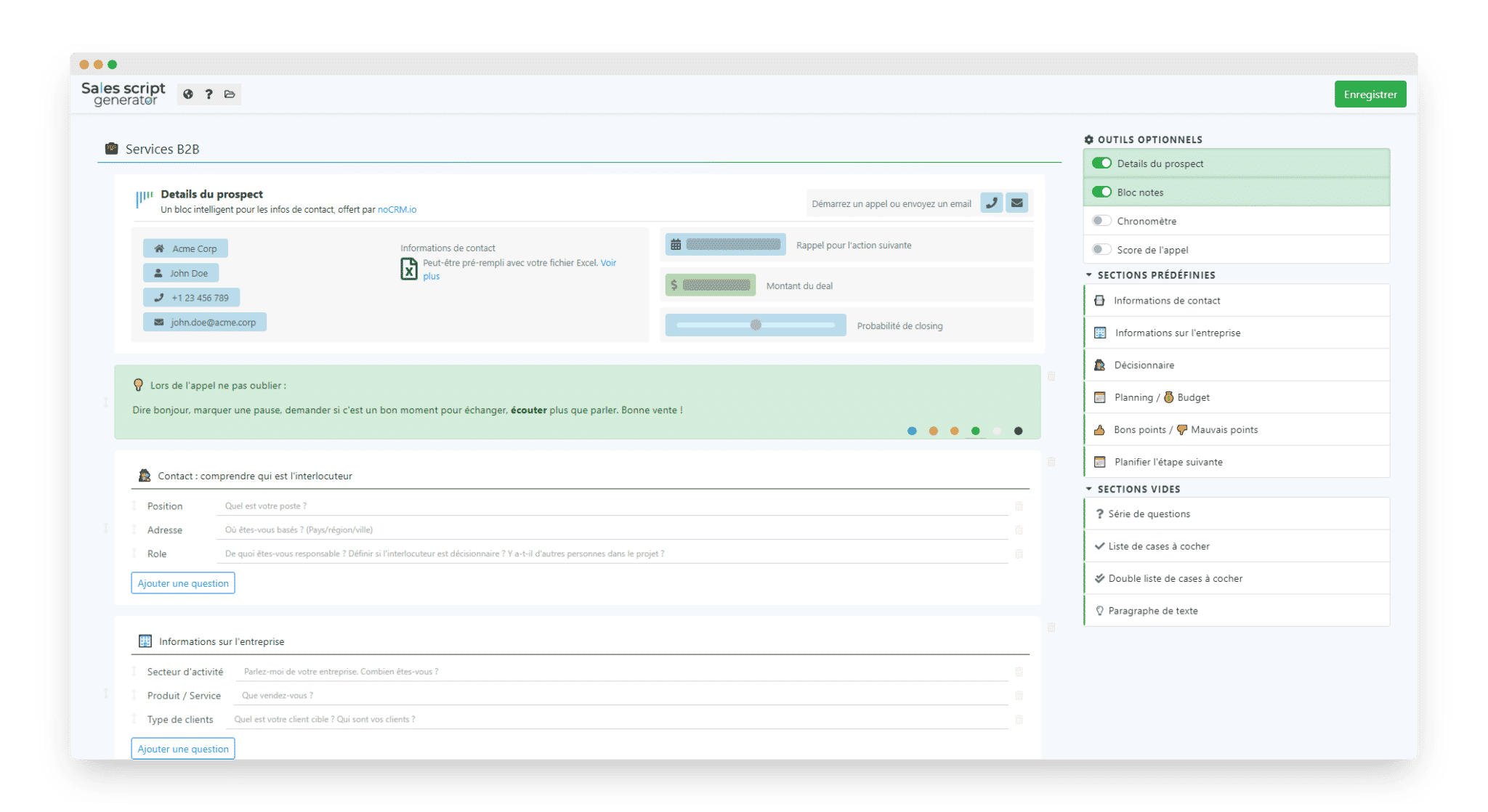
Sales script generatorLooking for a super intuitive tool to write your sales scripts? noCRM has you covered and honestly, I was blown away by the quality of the tool!
Fill in each block step by step, adapt the template by adding sections if needed and download your sales script. The best part? It’s completely free, even if you’re not a noCRM customer 🙂
What you’ll learn in this article:
- How to structure an effective phone sales script that doesn’t sound fake
- The 10 best call script examples for different sales situations
- Why and how to adapt your script to create more natural and engaging conversations
- The classic mistakes to avoid when using a sales script
What is a phone sales script? Definition and standard structure
Before presenting concrete examples, let’s first clarify what exactly a phone sales script is in the context of cold calling.
A sales script (people also talk about call scripts, but that term is more generic) is a conversational guide that structures the dialogue between a salesperson and a prospect on the phone. It’s a kind of “screenplay” for the interaction, marking out the key stages of the discussion to maximize the chances of conversion.
The goal of the script isn’t to format the discussion rigidly but, on the contrary, to give the salesperson an adaptable strategic framework for building a smooth, persuasive exchange.
An effective phone sales script should generally include the following sequences:
- A punchy opening line to grab attention
- A contextualized presentation of the reason for the call
- A request for permission to qualify the prospect
- Targeted questioning to identify the potential
- A “one-shot” value proposition
- A clear conclusion on the next steps
This standard structure is what you can build your own call frameworks around, adapting it to the specifics of your target and your offer.
The challenge is to strike the right balance between a methodological framework and the freedom to adapt to the prospect. The ideal script is flexible enough to encourage a natural discussion, but solid enough to guide the salesperson through the critical stages.
Read alsoProspecting tools
Should you really use a sales script?
It’s a question many salespeople ask themselves: is a sales script really useful, or is there a risk that it stifles spontaneity and makes calls too mechanical?
Let’s be clear: cold calling scripts aren’t meant to turn your team into machines reciting a predefined text that they are strictly forbidden to stray from.
The sales script, as we’ve seen, shouldn’t be thought of as a straitjacket, but as a frame of reference. It structures the exchange, guides the salesperson and guarantees a consistent, punchy message, just like most sales processes, by the way. But a good script isn’t a fixed text to follow word for word, obviously! It has to be flexible and adaptable.
Let’s add that a good salesperson doesn’t just read a script: they make it their own, internalize it, adapt it to their style and know when to step away from it to lead a natural, engaging conversation. That’s why training and practice are essential: having a good script isn’t enough, you also need to know how to use it intelligently.
A sales script should secure the exchanges without hurting the flow of the conversations.
To do this, the salesperson can select certain parts of their script and rephrase the text, to turn it into a sales tool that suits them better. That way they’ll be able to make it their own more easily and be more effective.
Sales script example #1: The opening call (Breaking the ice)
The first contact is often the trickiest. You have a few seconds to grab the prospect’s attention and get them to continue the conversation, without making the call feel intrusive.
The classic mistake? A pitch that’s too salesy from the very first sentences, which immediately puts the prospect on the defensive. The goal here is therefore to adopt a smooth, natural and engaging approach that sparks curiosity while building a climate of trust.
Sales script exampleSalesperson:
“Hello [Prospect’s name], this is [Your first name] from [Your company name]. I hope you’re well.”
(Pause to let the prospect answer. If the answer is positive, move on immediately. If they ask why you’re calling, don’t take it badly: it’s a normal reaction.)
Salesperson:
“I’m calling quickly because I noticed that [mention a relevant observation about the prospect’s company or an industry issue]. At [Your company name], we help companies like yours [sum up in one sentence the main value you bring].”
(Pause to gauge the prospect’s reaction. If they’re interested, continue.)
Salesperson:
“Before going any further, is this a topic that concerns you today?”
(Let the prospect answer. If they express interest, move on.)
Salesperson:
“Great, in that case, I suggest a quick 10-minute call to see if and how we could help you. What would be the best time for you this week?”
Sales script example #2: The qualification call (Spotting the right prospects)
Getting a first conversation with a prospect doesn’t mean they’re ready to buy. Before offering anything, you need to understand their situation, their needs and their pain points.
A good qualification call shouldn’t feel like an interrogation, but like a structured conversation where the prospect feels listened to. The goal is twofold: confirm that they really fit your target and make them want to learn more about your solution. Here’s an example of a sales script along those lines:
Sales script exampleSalesperson:
“Hello [Prospect’s name], this is [Your first name] from [Your company name]. I hope you’re well.”
(Pause to let the prospect answer.)
Salesperson:
“I’m calling quickly because I noticed that [mention a relevant observation about the prospect’s company or an industry issue]. We work with similar companies to [sum up in one sentence the main value you bring], and I wanted to learn more about your situation.”
(Pause to let the prospect react.)
Salesperson:
“Before going any further, could you tell me how you currently handle [the specific problem your solution solves]?”
(Listen to the prospect’s answer and adapt accordingly.)
Salesperson:
“OK, and what are the main challenges you face on that front?”
(Let the prospect speak and dig deeper if necessary.)
Salesperson:
“I see. In that case, what I suggest is a more detailed conversation to look together at how we could help you optimize [the key aspect concerned]. Would you be available [specific time slot proposal]?”
Sales script example #3: The voicemail (Grabbing attention in a few seconds)
It often happens that a prospect doesn’t pick up the phone, either because they’re busy or because they don’t answer unknown numbers. In that case, leaving an effective voicemail can make the difference.
The goal isn’t simply to flag your call, but to give the prospect a compelling reason to call you back. A message that’s too generic will go unnoticed, whereas a short, clear and punchy message will increase your chances of getting a response.
Sales script exampleSalesperson:
“Hello [Prospect’s name], this is [Your first name] from [Your company name].
I’m leaving you a quick message because I’ve identified an opportunity to help you [sum up a concrete, relevant benefit for the prospect].
If you’re interested, I’d be happy to discuss it with you in a quick call.
You can call me back at [your phone number] or send me an email at [your email address].
Once again, this is [Your first name] from [Your company name]. Looking forward to hearing from you!
Talk soon.”
Read alsoThe guide to B2B lead generation
Sales script example #4: The follow-up voicemail (Following up without harassing)
When a first voicemail hasn’t got a response, it can be tempting to follow up with the same kind of message… but that would be a mistake.
A second voicemail must bring new added value and emphasize a concrete benefit for the prospect. It has to grab their attention differently, by including social proof or a striking statistic, while staying concise and engaging. Here’s a phone sales script that plays on that balance:
Sales script exampleSalesperson:
“Hello [Prospect’s name], I’m [Your first name] from [Your company name].
I’m taking the liberty of leaving you this message because I noticed that your company [mention a specific activity or issue]. We regularly work with companies like [Client 1] and [Client 2] to help them [sum up in one sentence a clear, relevant benefit].
These companies have generally seen an improvement in [key result: increased sales, time saved, reduced costs, etc.] in just [estimated time].
I think this could be of interest to you too. If you’re open to a quick chat, you can call me back at [your number] or reply to the email I’m about to send you right after this.
Looking forward to hearing from you, and to talking soon!”
Sales script generatorLooking for a super intuitive tool to write your sales scripts? noCRM has you covered and honestly, I was blown away by the quality of the tool!
Fill in each block step by step, adapt the template by adding sections if needed and download your sales script. The best part? It’s completely free, even if you’re not a noCRM customer 🙂
Sales script example #5: The gatekeeper (Getting past receptionists tactfully)
Receptionists and assistants are tasked with screening calls and stopping salespeople from contacting decision-makers directly. They don’t make decisions, but they control access to the key people.
The mistake to avoid is trying to “blow past” the filter too quickly or making it sound like a sales call. The right approach is to first get valuable information (the contact’s name, direct email address), then come back later with a more personalized message. Here’s our call script example:
Sales script exampleSalesperson:
“Hello, could you help me? I’m trying to get in touch with the person in charge of [relevant area: marketing, HR, purchasing, etc.].
Do you know who handles that at your company?”
(If the person gives a name, continue. If not, rephrase slightly.)
Salesperson:
“Thank you so much! And what’s the best way to reach him/her? Does he/she prefer a direct call or an email?”
(If the contact details are given, thank them and hang up.)
Salesperson:
“Perfect, thanks for your help! I’ll send him/her a message. Have a nice day!”
(If the person refuses to give the contact details, try another approach.)
Salesperson:
“In that case, could you simply pass on my message? It’s about [benefit or opportunity relevant to the company]. I can be reached at [your number] and I’ll also send him/her an email to make things easier. Thanks again!”
Going furtherLooking to optimize your phone prospecting? Feel free to draw on our resources below to take things up a notch!
- How to find anyone’s (mobile) phone number?
- Kaspr vs Lusha vs Datagma: which one to choose to find phone numbers?
- Method for building a sales discovery plan
- Our prospecting files to download for free
- Top 10 Cold Calling Software
Sales script example #6: Send me an email (Getting around the email excuse)
“Send me an email” is one of the most common objections in cold calling. If the prospect says this to you, it’s often to end the conversation without saying no directly.
The trap would be to just send an email and wait for an answer that will never come. The key is therefore to accept the request… while locking in a time slot to talk, so your message doesn’t get lost in their inbox.
Sales script exampleSalesperson:
“Would you have a little time next week to talk further?”
(If the prospect answers: “Send me an email”, don’t get defensive, bounce back smartly.)
Salesperson:
“Of course, I’ll send you an email. Could you confirm your address?”
(The prospect gives their email.)
Salesperson:
“Thanks! Just to make sure my message doesn’t sit in your inbox without any follow-up, when would be the best time to discuss it briefly?”
(The prospect mentions a day.)
Salesperson:
“Morning or afternoon?”
(The prospect chooses.)
Salesperson:
“Perfect, let’s say [Day] at [Time]. I’ll send you a recap email and an invitation so we can talk about it quickly. Have a nice day!”
I also like Julien Bouic’s version: “I’d gladly send you an email, but I must write them really badly because nobody ever replies to me. Could I call you back on Tuesday at 11:30 instead?”
Sales script example #7: Offering a tip or an idea for free (Creating value from the first contact)
Sharing a relevant tip from the first contact can be a good way to grab the prospect’s attention and build a relationship of trust.
But be careful: this approach is a double-edged sword. If your tip is too generic or poorly targeted, you risk losing credibility and giving the impression of a speech prepared in advance. To maximize the impact, you need to prepare your call beforehand and bring real added value that makes the prospect want to know more.
Sales script exampleSalesperson:
“Hello [Prospect’s first name], this is [Your first name] from [Your company]. I hope you’re well.”
(Pause to let the prospect answer.)
Salesperson:
“I’m taking the liberty of contacting you because I noticed that [specific observation about the prospect’s business]. I immediately thought that a few adjustments could help you optimize your results.”
(Pause to capture their interest.)
Salesperson:
“For example, we helped [Client 1] [sum up a concrete benefit linked to your solution]. In just [time frame], they saw [measurable result].”
Salesperson:
“I’d be happy to share a few ideas that have worked well for our clients. Would you have 15 minutes next week to discuss them?”
Sales script example #8: Offering information about the competition for free (Playing the expertise card)
Prospects always keep a close eye on trends in their market and on the strategies their competitors put in place. By sharing valuable insights about the industry, you position yourself as an expert and immediately create interest in the discussion.
But be careful: this isn’t just about reciting figures or generalities. To grab the prospect’s attention, your information has to be targeted, relevant and lead naturally to a discussion of their own strategic issues.
Sales script exampleSalesperson:
“Hello [Prospect’s first name], this is [Your first name] from [Your company]. I hope you’re well.”
(Pause to let the prospect answer.)
Salesperson:
“I’m contacting you because we’ve just finalized a benchmark study on [prospect’s industry], in which we analyzed more than [number of companies], highlighting their strategies, strengths and areas for improvement.”
Salesperson:
“For example, [Competitor 1] and [Competitor 2] recently implemented [example of a strategy or innovation], which allowed them to [measurable result]. We’ve identified some interesting trends that could be useful to you.”
Salesperson:
“Is this a topic you follow closely? I can share a few insights with you in a quick call. Would you be available [time slot proposal]?”
Sales script example #9: Offering to solve a need you know is immediate & urgent (Seize the urgency)
A prospect with an urgent need is often more receptive to being contacted, provided your message is clear and punchy. To maximize the impact, you need to show that you’ve identified a specific need and demonstrate, with a concrete example, how your solution can address it quickly.
Sales script exampleSalesperson:
“Hello [Prospect’s name], I’m [Your first name] from [Your company].
I’m contacting you quickly because I noticed that your company [mention the urgent need identified, e.g.: recruitment, expansion, drop in performance]. I imagine it’s a priority topic for you right now.”
(Pause to capture their attention.)
Salesperson:
“We recently supported [Client 1] and [Client 2] on similar issues, and thanks to [Your solution], they were able to [sum up a key benefit: time saved, more leads, reduced costs, etc.] in just [estimated time].”
Salesperson:
“I think a quick call could be useful for you to see whether this could also apply to your situation. Would you be available [specific time slot proposal] to discuss it briefly?”
Read alsoSales qualification
Sales script example #10: Value selling (Highlighting the concrete impact of your solution)
In prospecting, one of the most powerful levers is to immediately show the concrete impact of your solution. Rather than talking about your product or service in general, you need to captivate the prospect by getting them to ask themselves: “What if I were missing out on an opportunity?”
The idea is to introduce a striking fact or a punchy statistic that echoes their issues. The more tangible and quantifiable the example, the more inclined the prospect will be to continue the discussion.
Sales script exampleSalesperson:
“Hello [Prospect’s name], I’m [Your first name] from [Your company]. I hope you’re well.”
(Pause to let the prospect answer.)
Salesperson:
“I’m contacting you because we recently helped several companies like yours [sum up in one sentence the key benefit of your solution]. In fact, we identified [impactful statistic or result, e.g.: X amounts recovered, X% improvement, X hours saved], and I was wondering whether you were sure you weren’t affected.”
Salesperson:
“You may already have a system in place, but in 80% of cases, we still detect optimization opportunities. I’d be happy to talk with you about it. Would you be available [specific time slot proposal] to take stock?”
Going furtherLooking to optimize your phone prospecting? Feel free to draw on our resources below to take things up a notch!
- Discover the best times to make prospecting calls
- Rely on 10 questions to qualify a prospect over the phone
- Succeed at cold calling: from the opening line to closing the call
- The comparison of B2B call centers to outsource your sales prospecting
Salesdorado’s tipFed up with Excel files? A good CRM lets you take your prospecting to a whole new level. Discover our selection of the best free CRM software
Glossary – Call scripts & cold calling
- Phone sales script. It’s a framework that structures sales calls, step by step: opening, qualification, pitch, conclusion. The goal isn’t to follow a text to the letter, but to keep a guiding thread that makes the exchange flow more smoothly. A good script lets you frame the discussion without hurting spontaneity.
- Outbound call. This is a call initiated by the salesperson, often in a prospecting or follow-up context. An outbound call requires a well-thought-out opening line to grab attention quickly. It’s a proactive approach that assumes you know your target well.
- Inbound call. An inbound call is made by the customer or the prospect. The challenge is often to respond effectively to a request while identifying possible sales opportunities. Here too, a script can help structure the exchange, especially to ask the right questions.
- Sales phoning. Phoning refers to all phone prospecting campaigns, often carried out cold. It’s a direct method that makes it possible to quickly generate leads or meetings. It works if the files are well targeted and the scripts well designed.
- Call center. A call center handles a large volume of inbound or outbound calls, often on behalf of several companies. It can take on customer service, qualification or prospecting assignments. Agents generally rely on scripts to ensure consistency across conversations.
- Phone prospecting. Phone prospecting consists of calling contacts to present an offer, qualify a need or propose a meeting. It’s a direct approach that requires grabbing attention quickly and handling objections. It remains an effective lever when it’s well targeted and well executed.
- Call script. The call script is a more general document than the sales script: it can cover customer service, support or qualification calls. It structures the flow of the call to ensure clarity and consistency. In a sales setting, it mainly helps you gain impact and consistency.
- Sales pitch. The sales pitch is a short, structured presentation of your offer or your company. It comes very early in the call, often right after the introduction. The goal is to spark interest in a few sentences, without going into detail yet.
- Gatekeeper. The gatekeeper refers to the screening done by an assistant or a switchboard before you reach the person you’re targeting. It’s a classic step in B2B, which can slow down prospecting if it isn’t well anticipated. Some scripts include specific wording to get past this filter more easily.
- Phone appointment setting. The goal here isn’t to sell immediately, but to get a time slot to talk in more detail. This approach is common in long sales cycles, especially in B2B. A good script focuses on the value of the conversation rather than on the offer itself.
The questions we get over and over.
What is a phone sales script?
A conversational guide that structures the dialogue between a salesperson and a prospect on the phone. It marks out the key stages of the discussion to maximize the chances of conversion, without formatting the exchange rigidly.
What steps should a sales script include?
An opening line to grab attention, a contextualized presentation of the reason for the call, a request for permission to qualify the prospect, targeted questioning, a value proposition and a clear conclusion on the next steps.
Should you follow your script word for word?
No. The script is a frame of reference, not a straitjacket: the salesperson makes it their own, adapts it to their style and knows when to step away from it to lead a natural conversation.
How do you get past the gatekeeper?
Without trying to blow past the filter or making it sound like a sales call: you first get the contact’s name and the best way to reach them, then come back later with a more personalized message.
What should you say to a prospect who says “send me an email”?
Accept the request, confirm their address, then ask them for the best time to discuss it briefly, so that the message doesn’t get lost in their inbox.



What the community says.