


- Define the stages of your sales cycle precisely before trying to shorten it.
- Average cycle length: total days of each closed sale, divided by the number of deals. Watch the standard deviation and segment if the distribution has several peaks.
- The starting point of the cycle (entry into the CRM, first contact or conversion into an opportunity) must be clear to the whole team.
- Follow up consistently, set deadlines and talk price early enough.
- Four KPIs: response time, loss rate by stage, lead-to-opportunity conversion, opportunity-to-sale conversion.
To shorten your sales cycle, you first need to understand it well and get your whole team aligned on what needs to be done. Knowing clearly what the stages of your company’s sales cycle are (and those of your industry) will help you improve it and be more effective.
Sales activities should be process-driven and very well planned. Implementing these processes and testing them over and over helps your sales reps improve their conversion rate. Creating sustainable growth is the key to your company’s long-term success.
In this article, we give you a short guide to the sales cycle and how to shorten it.
The 7 stages of the B2B sales cycle
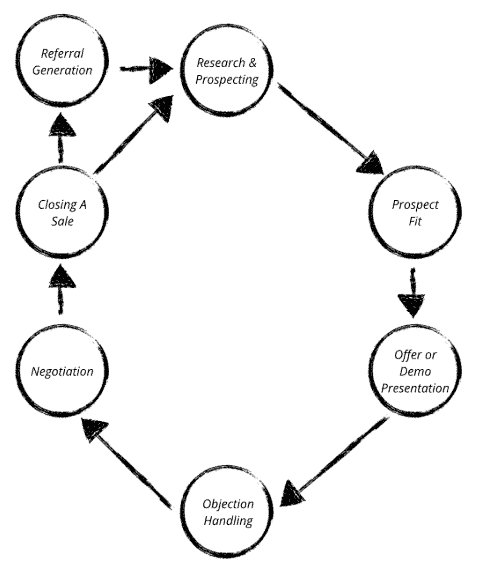
There’s no point trying to shorten your sales cycle if you can’t define its stages precisely. To keep things simple, here are the 7 main stages:
- Making contact
- Discovery and qualification
- The sales pitch
- Handling objections
- Negotiation
- Closing
- Building a lasting business relationship
1. Making contact
First, you reach out to your prospects, usually by phone or email. The goal is to introduce yourself and your company, but also to start a conversation about the prospect’s needs. Be friendly and encouraging: you’re trying to build a relationship.
Go furtherWe won’t go through every step of prospecting here, but here are all the articles we’ve written on the subject:
2. Discovery and qualification
To find out whether a prospect is a fit for your product or service, try to learn as much as possible about their pain points and identify their needs. Ask qualification questions, research their company: you can build a lead scoring model (or use a BANT-type model) to assess how likely they are to become a customer.
3. The sales pitch
This is your presentation: the idea is to have a tailored offer designed to meet the prospect’s specific needs. If the pitch goes well, this stage can also involve sending a proposal for review.
Go further
4. Handling objections
Expect your prospects to have concerns, questions, even objections about the offer. Whether it’s about price, timing or the solution itself, it’s a chance to listen and get to know their pain points.
5. Negotiation
See objections as an opportunity to uncover your prospect’s needs, then reposition your offer to meet them.
Go further
6. Closing
Closing a deal is both an art and a science. Refine your closing techniques to get your prospect fully on board and turn them into a new customer.
7. Building a lasting business relationship
You’ve closed the sale and the customer has signed, but the sales process isn’t over: you absolutely have to keep the relationship of trust between you and your customer going. To build loyalty, think of the 4R technique (from the French rassurer, remercier, raccompagner, revoir): reassure, thank, see the customer off, see them again. Make sure they’re satisfied, follow up to see if there’s anything you can do to help them get the most out of your product or service. If they’re completely satisfied, it’s the perfect time to ask them for a referral or to build their loyalty.
Go further
How to make use of the sales stages?
It’s important to identify your sales stages very quickly by using or building a model, especially around the way potential customers get to know you.
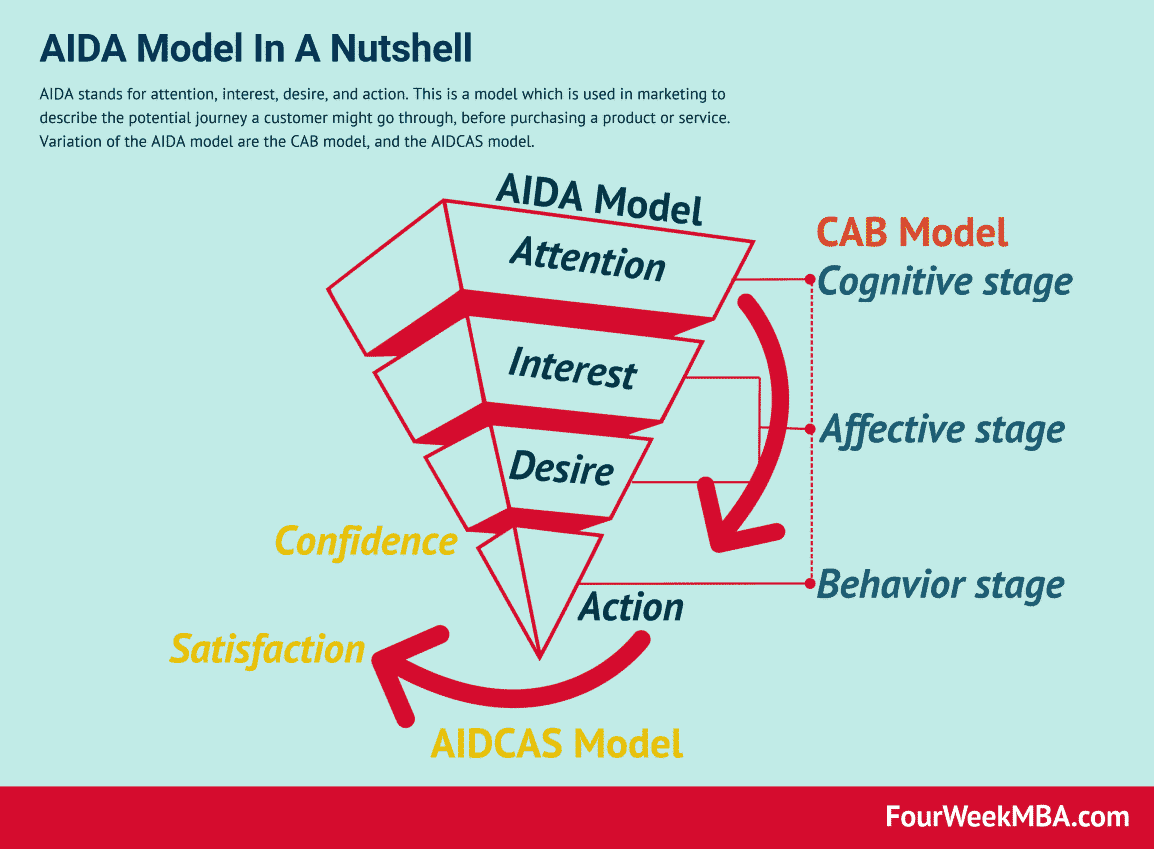
In marketing, there’s the well-known AIDA model (Attention, Interest, Desire, Action), which highlights the four phases a prospect goes through before making a decision. It helps you understand what stage a prospect is at, and then prioritize the stages to improve.
But if you really want to understand which stages to improve and how to rank them, you can go for sales funnel-type models.
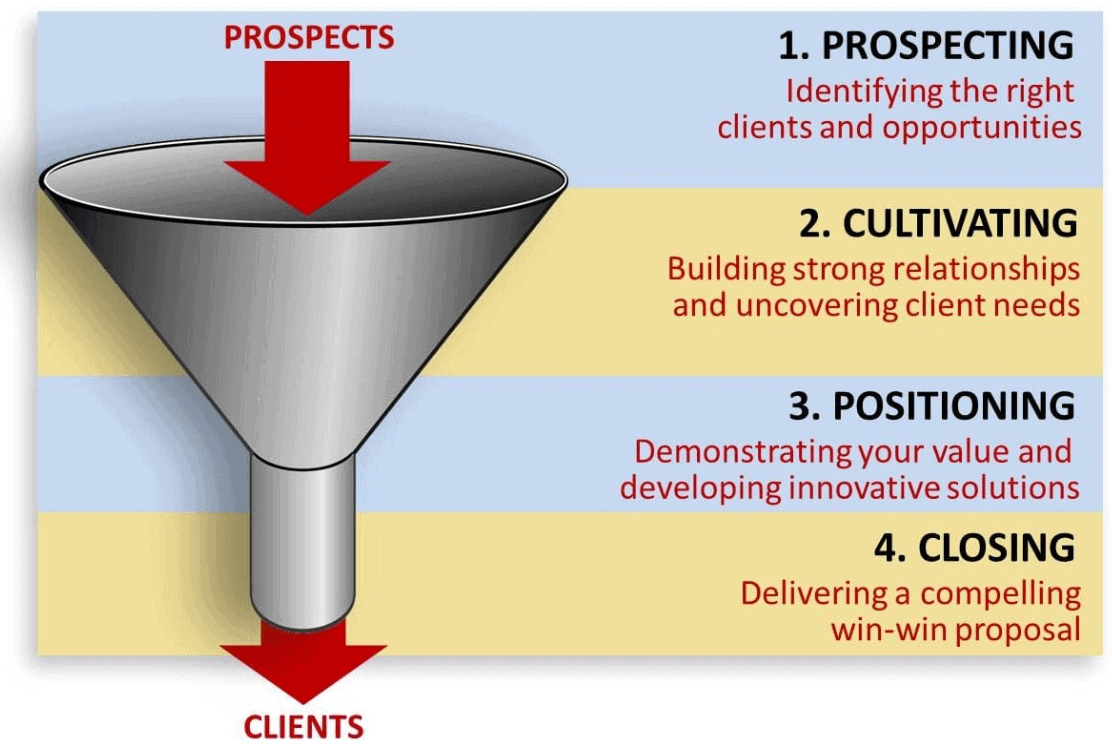
The sales funnel represents an ideal, potential path that prospective customers follow before becoming actual customers. As a representation, it’s also often an approximation, which helps marketing and sales teams structure their processes at scale, so they can build repeatable sales and marketing tactics to convert customers.
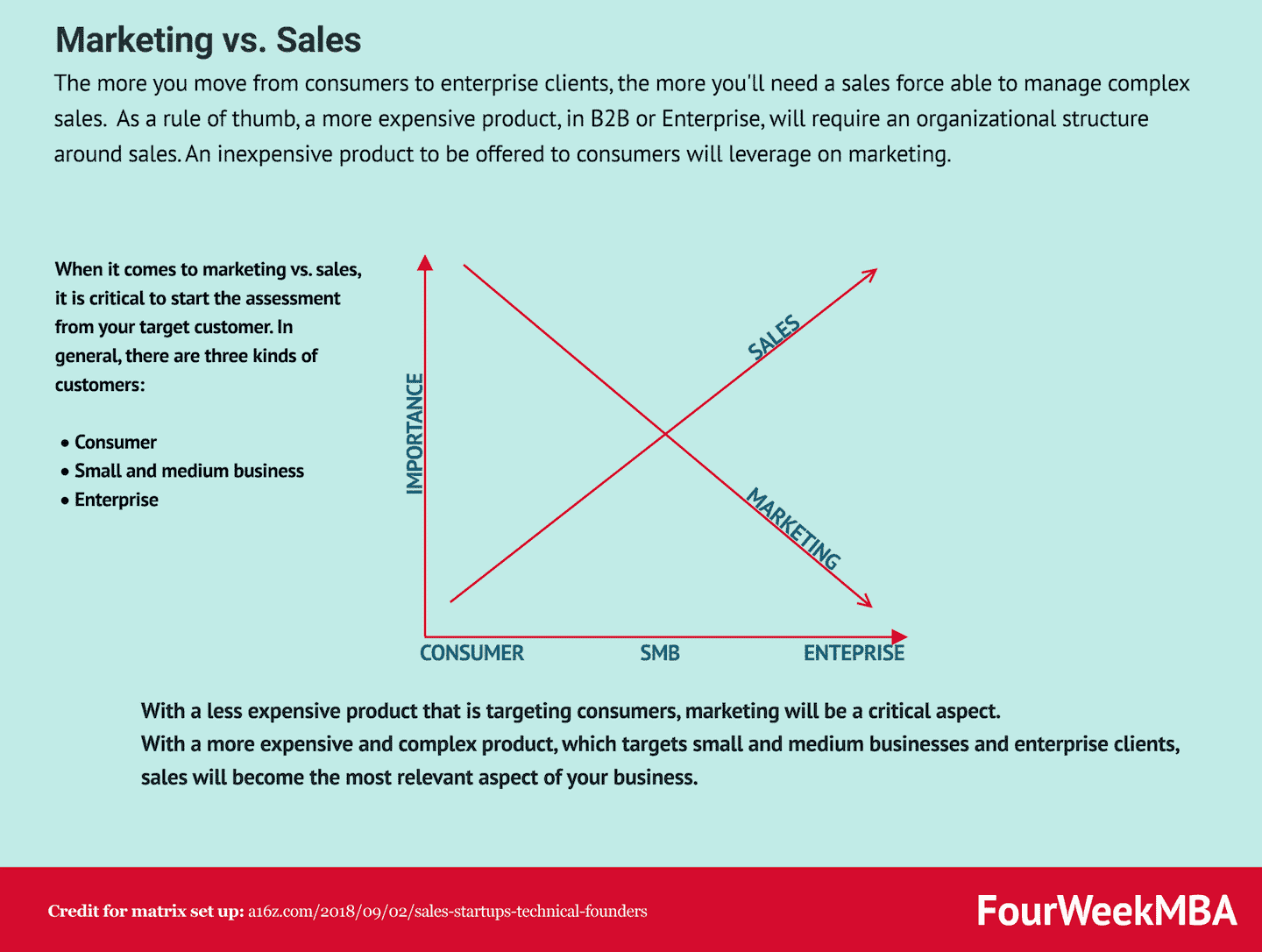
But there are plenty of different models, and you have to be careful not to force a model onto a company it doesn’t fit at all. Just moving from B2C to B2B can change everything: as a rule, a more expensive product needs an organizational structure built around the sales team, while a low-cost consumer product will rely on marketing.
For example, a more marketing-driven company will tend to follow a flywheel model, where scale matters more than the quality of each prospect.
The same goes for freemium business models (you can call them that when the whole organization is aligned on the freemium offer), where the top of the funnel is filled with a large number of prospects.
How to calculate and estimate the length of a sales cycle?
The length of your average sales cycle says a lot about your company, and tracking it closely can give you valuable information to optimize your sales process.
For example, you notice that certain types of customers get stuck at certain stages, which drags out the sales cycle and makes it more expensive. The point is to reduce the bottlenecks to speed up your whole sales process.
How to calculate the length of the sales cycle
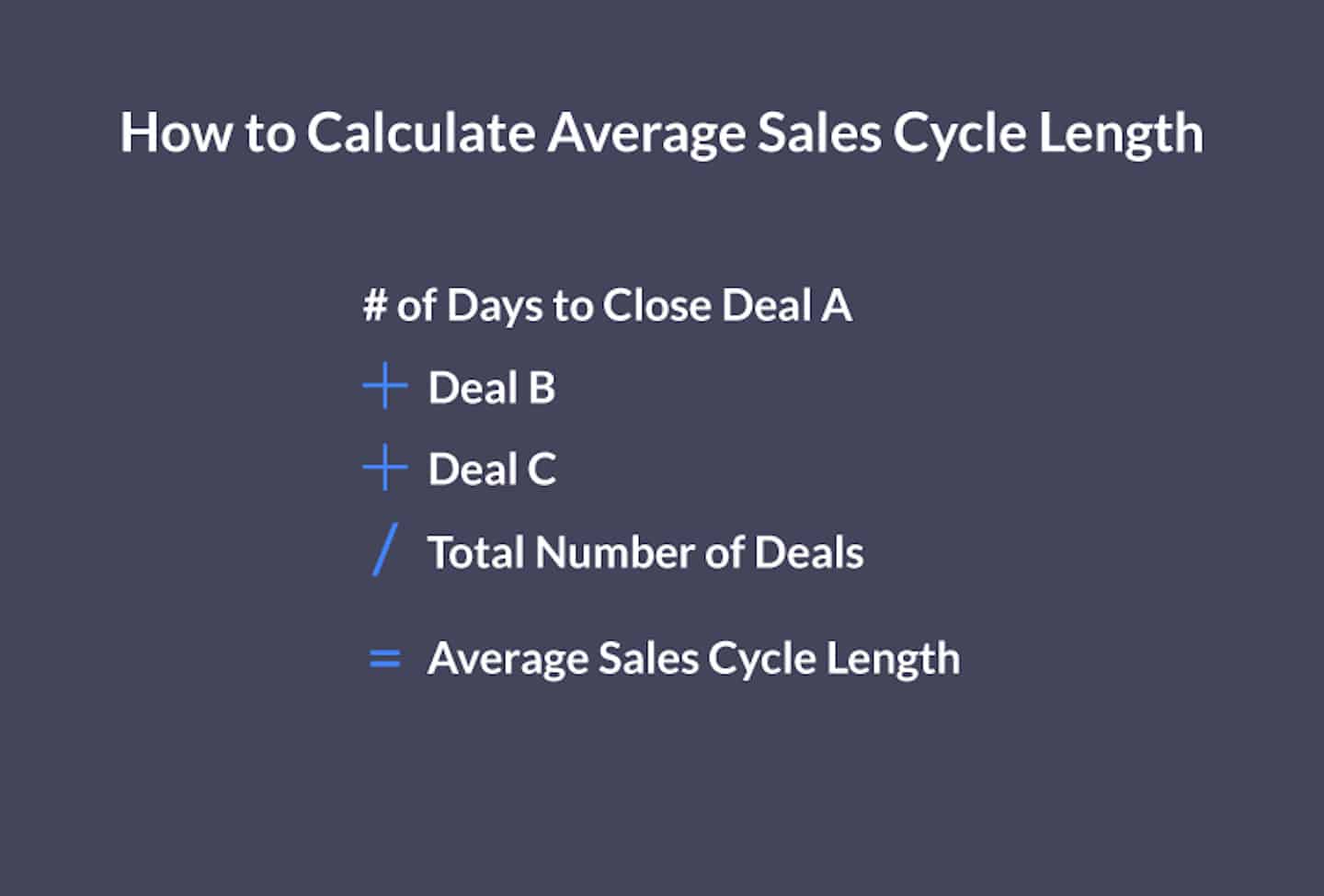
To estimate the length of the sales cycle, you need to look at past sales data and calculate the average number of days between the start and the close of the sale.
The first step is to add up the total number of days it took to close each sale in the week, month, quarter or year you want to measure. Then divide the sum by the total number of deals.
For example, let’s say you recently closed three deals with the following sales cycle lengths:
- Deal A = 10 days
- Deal B = 14 days
- Deal C = 16 days
To find your average sales cycle, just add up the length of each deal to get a total of 40 days for all sales combined.
Then divide the number of days by the number of deals to get the average length in days.
40 / 3 = 13.3 days
With this metric, you can estimate that similar deals in the future will take about 13.3 days. That lets you forecast future revenue and predict close dates.
Watch outThere’s always a (significant) bias with averages. A good average has to be the average of (relatively) homogeneous items. So keep an eye on the standard deviation (the variance) of the dataset, even if it means splitting into several sales cycles (if they are really very different) and measuring the length of each. Rule of thumb: if you get a roughly Gaussian (bell-shaped) distribution, there’s a good chance you’re on track. If you get two peaks or more, on the other hand, segment.
When should the sales cycle start?
When it comes to measuring the length of your sales cycle, there are several schools of thought, especially about when the sales cycle actually begins.
Although it seems simple, defining the starting point of your sales cycle is trickier than you might think. There are three moments that can mark its start:
- When a contact first enters your CRM.
- When you first reach out to a new prospect.
- When a prospect turns into an opportunity.
Tracking your sales cycle from the moment a new prospect is created in your CRM is known as first-touch attribution. Those who use this method often focus on optimizing top-of-funnel activities, such as lead generation and prospecting.
Starting your sales cycle when you first reach out to a new prospect, on the other hand, leaves prospecting out of the measurement. It may be a better option if you buy prospect lists and enter them into your CRM before contacting them (for example, if you need to do more in-depth research but want to keep their contact details in your system).
Finally, some companies prefer to start their sales cycle when a prospect turns into an opportunity. This results in fewer stages in the sales cycle, which suits teams that want to focus on optimizing the negotiation, closing and follow-up stages. However, it only works if your team clearly understands the difference between leads and opportunities.
In shortWhatever starting point you choose, make sure your whole team knows clearly which specific activity triggers the sales cycle. Consistent tracking is essential to calculate an accurate average length and to identify how changes in the sales process can be used to shorten your sales cycle.
10 tips to speed up your sales cycles

1. Work on your targeting
If your sales pipeline starts leaking at the qualification stage, you may be attracting prospects who match your interests but who aren’t the decision-makers you need. Identify the job titles that cause the most trouble in your conversations: maybe you’d be better off leaving them out of your search?
2. Study each stage to find the sticking points
The more you know about how your prospects move through the pipeline, the better your chances of spotting a problem before it’s too late. If you notice a bottleneck forming, focus on the stage of the sales cycle concerned to find the cause of the blockage.
For example, if your prospects tend to get stuck at the proposal stage, maybe you need to spend more time learning about them before submitting your offer, or work with your prospect to write a proposal everyone can agree on.
3. Set deadlines
If your prospects take a long time to respond, it may be because you haven’t set them any deadline. The goal is for your sales reps to get them to set a date for the next call or meeting and stick to it.
Also use this to create a sense of urgency: nothing beats a limited-time offer to fire up your prospects. That can mean setting an expiry date on your offer, giving them the chance to lock in current pricing before your rates go up, or offering them a gift if they sign before a certain date.
4. Be consistent with your follow-ups
Sales pros know very well that making first contact is only a small win in the whole process. Follow-up is what makes the difference. Prospects sometimes disappear and stop answering calls or even emails.
On average, it takes 5 follow-up emails to move a prospect down the funnel, but the average rep makes 2 follow-up attempts with a prospect. Bottom line: follow up consistently and don’t hesitate to chase your prospects.
Go furtherTo make things easier, you can read our article on How to write a follow-up email that gets replies?
5. Close out stalled opportunities
Don’t waste time on an opportunity that isn’t moving forward. Sometimes your prospect can’t sign with their current budget, or the timing just isn’t right. In that case, take them out of your pipeline for now and put them on hold.
This keeps your pipeline (and your head) clear, and lets you focus entirely on the deals that are moving forward.
6. Work on objections
Listen carefully to your prospects’ objections to learn their priorities and concerns. This helps you refine your sales pitch going forward.
And if you handle sales objections properly, you can use them as a way to move the deal forward. By rephrasing their questions and concerns, you educate the prospect about your product or service. For each objection, try to give a clear answer and show added value.
7. Build up trust
The faster you earn someone’s trust, the faster you can sell them something. And the best way to do that is to have been referred: warm prospects have already heard good things about you, and they are more likely to need you, otherwise they would never have contacted you.
However, if you do cold calling or cold emailing, you can still build trust by sharing case studies, customer testimonials and logos of notable companies you have worked with.
8. Talk about money early enough
Always be transparent about your prices from the start, explaining exactly what you offer, your added value and how much it costs. This not only lets you qualify prospects by budget and give a sense of the deal’s potential value, but also builds trust.
If you’re afraid that bringing up costs too early in the conversation will scare off potential customers, you’re probably not targeting well. And adding extra fees at the last minute is a great way to drive customers away.
9. Automate the tasks that can be automated
All the time you still lose entering data by hand and doing other repetitive tasks would be better spent selling or finding new prospects. With AI, there are plenty of tools that handle tedious tasks like data entry.
Go further
10. Make the closing stage as easy as possible
Don’t let paperwork slow you down when you’re this close to closing the sale. You can create an online contract that your prospects can access on any device, so they can sign on the go.
It’s also essential to work with the prospect when drafting the contract, to make sure they fully understand and accept your terms. That way you avoid pointless back-and-forth once the final document is drafted, and it will be ready to sign as soon as you send it.
4 key performance indicators (KPIs) to optimize your sales cycles

1. Response time at each sales stage
By definition, this is the time between a customer’s request and your sales rep’s response. Although this metric is often measured after the customer’s first contact, you can look at prospect response time at any stage of the sales cycle.
The basic idea is that you only control your “side” of the sales cycle: if the lead takes 3 days to reply to each email, there’s not much you can do about it. If you take three days too, though, that’s not normal and it can seriously hurt you.
To optimize this KPI, you can track how prospect statuses change in your CRM and then generate reports on your reps’ average response time. If they take too long to respond, you can consider adding headcount to improve productivity or offering them extra training to improve response time.
2. Loss rate at each sales stage
This is the percentage of deals lost at each stage of the sales cycle, counting the lost sales each time.
The goal is to spot bottlenecks quickly: then you can dig deeper and see whether they’re linked to your sales process or to your people. Measuring this metric helps you see the weak points of your sales cycle.
To optimize this KPI, a sales CRM is a smart investment because it lets you generate reports on lost deals by stage. At a glance, you can see your weak points: for example, if you notice that many deals are lost during negotiation, maybe your reps need more coaching to help them close deals. Or you can launch promotional offers to encourage your customers to commit.
3. Lead-to-opportunity conversion rate
The lead-to-opportunity ratio is the percentage of opportunities generated compared with your company’s total number of leads. It’s a ratio, which means that the more leads you generate, the more opportunities you have.
It’s important to track this metric to see whether there are weaknesses in your lead generation and qualification process. On average, this rate is 13%, but many sales managers aim for a ratio two or three times higher.
Here again, although you can calculate it by hand, a CRM is a good tool to track this indicator: it generates reports not only on this ratio but also on lead sources, to help you improve the ratio effectively.
For example, if you have plenty of leads but very few opportunities, that points to a flaw in your lead generation process. Are your lead generation efforts in line with your customer persona? This indicator also lets you check which sources generate quality leads, and so see where to focus your efforts.
4. Opportunity-to-sale conversion rate
This indicator measures the number of sales made compared with your company’s number of opportunities.
Here again, this KPI lets you assess how effective your sales reps are and how they perform. But this conversion rate also lets you check how effective your sales cycle is.
For example, if you find that your conversion rate is below the industry average, you can review the processes and resources you use. Ask yourself the following questions:
- Do you equip your sales reps with presentation decks?
- Do you provide objection handling templates and techniques?
- Do your people know clearly what kinds of offers or discounts they can propose to win customers?
These questions cover the three stages of the sales cycle: presentation, evaluation and closing. So it’s essential to give your reps these resources to help them close deals faster.
Go furtherLead source is a key variable for studying the sales cycle, because behavior varies a lot depending on the source, and it’s often worth looking at each KPI in light of this variable.
The questions we get over and over.
What are the 7 stages of the B2B sales cycle?
Making contact, discovery and qualification, the sales pitch, handling objections, negotiation, closing and building a lasting business relationship.
How do you calculate the average length of a sales cycle?
Add up the total number of days it took to close each sale over the period measured, then divide the sum by the number of deals. Three deals of 10, 14 and 16 days give 40 / 3 = 13.3 days.
When does the sales cycle start?
There are three possible starting points: when a contact enters the CRM, the first contact with a new prospect, or the moment a prospect turns into an opportunity. What matters is that the whole team knows which activity triggers the cycle.
How do you speed up a sales cycle?
By working on targeting, studying each stage to find the sticking points, setting deadlines, following up consistently, closing out stalled opportunities, talking money early enough and automating repetitive tasks.
Which KPIs should you track to optimize a sales cycle?
Response time at each stage, loss rate at each stage, the lead-to-opportunity conversion rate and the opportunity-to-sale conversion rate.


What the community says.