



- Push assigns the lead directly to a rep’s queue; pull lets reps claim the leads they want.
- Round robin distributes leads in turn: fair and easy to set up, but very simplistic.
- Letting reps choose means risking that smaller or more complex leads are left aside.
- Shark tank and top producer bet on response speed, and leads get called quickly.
- Distributing by performance gives more leads to the best reps, at the risk of demotivating the others.
In sales, lead distribution methods can be classified into « push » and « pull » approaches.
- The « push » method consists of assigning leads to sales reps immediately
- while the « pull » method lets sales reps choose their prospects. A combination of the two encourages competition.
Some factors, such as your reps’ availability, where they are located or their performance, can influence lead distribution decisions.
In this article, I present different methods, each with its pros and cons, and the factors to take into account when defining your lead distribution!
Also readThe guide to B2B lead generation
Push & pull lead distribution methods
PUSH lead distribution
The push method consists of assigning prospects directly to the queue of a sales rep, who will be in charge of converting them into customers.
Strengths
- Easy to understand
- Predictable
- Immediate assignment
Weaknesses
- Less competition between reps
- Less pressure
- Doesn’t take reps’ availability into account
PULL lead distribution
The pull method consists of letting sales reps select the leads they want and handle them themselves. It’s a much more selective method that lets reps target the leads they think they can convert.
Strengths
- Reps only claim leads when they are ready
- Distribution can be capped
- Reps have more control
Weaknesses
- Some leads can be forgotten
- Lead assignment is slower
PUSH & PULL lead distribution
The push & pull method consists of letting leads contact the sales reps themselves, and the first rep who answers is in charge of converting them. The prospect is neither assigned nor claimed: it is, in a way, won by the fastest rep.
Strengths
- Prospects are called immediately by the first available agent
- A very flexible method that can be used with several distribution models
Push lead distribution methods
The Round Robin push method
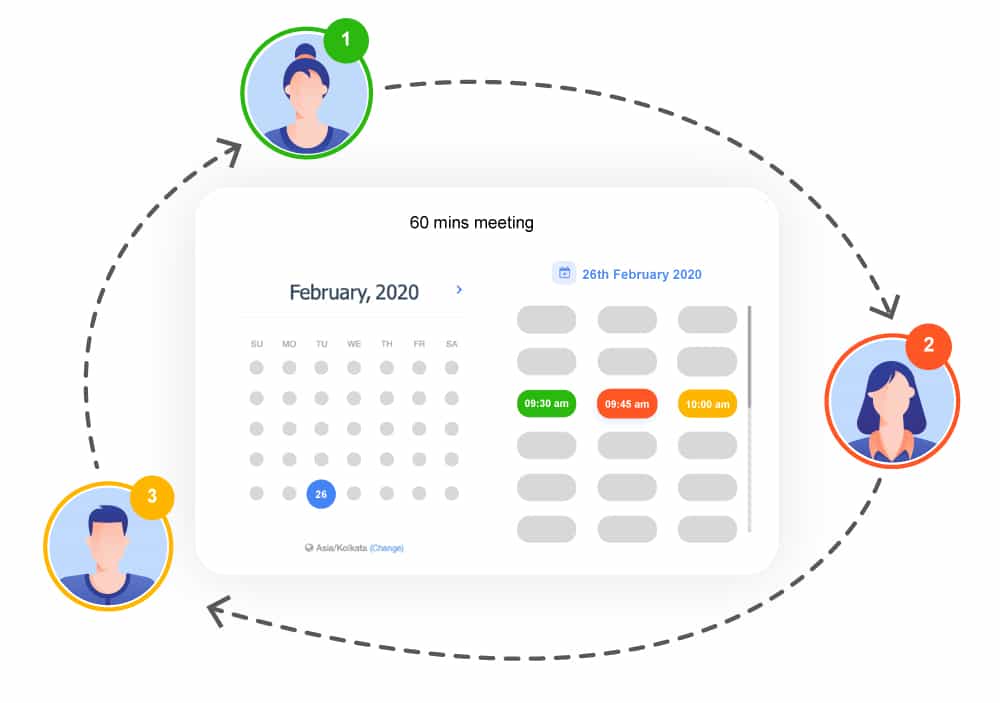
According to Craig Maxwell, CEO and co-founder of Salesbolt, « The Round Robin push method makes it possible to distribute new lead records evenly without having to assign them manually ».
With this method, your leads are distributed evenly among your sales reps. If you have five sales reps, each one receives a lead according to their position in the queue. Once this cycle is complete, the next series of leads is assigned in the same order.
Strengths
- A method seen as fair
- Easy to understand
- Easy to set up
Weaknesses
- Very simplistic
- Encourages an « I’m owed this » mindset (« it’s my turn »)
There can be a Push & Pull version of the Round Robin method. Reps are contacted in order and the first one to answer wins the lead. The order changes with each new lead to keep the distribution even. If nobody answers, the order is reversed.
Strengths
- More impartial
- More competitive
- Leads are called quickly
- No more reps called than necessary
Skimming prospects: the skimming method
With the skimming method, the manager or the top performer manually assigns each lead to the sales reps. In small organizations, this is fairly common to make sure a lead converts. The best leads go to the best rep.
It offers a lot of flexibility compared with an automated process. A human (all the more so an experienced salesperson) knows the teams, can read between the lines of a contact request, and so on.
Strengths
- Sales efficiency
- Flexibility
Weaknesses
- Demotivates sales reps
- Can breed mistrust
Also readGlossary of sales techniques
Pull lead distribution methods
Choosing your leads: the Cherry-picking pull method
Sales reps choose the leads they want to handle and leave the ones they don’t want.
Under this method, some leads are more attractive than others. If you let your reps choose their leads, you risk leaving smaller or more complex leads aside.
Strengths
- Very easy to implement
- « First to claim » stimulates competition
Weaknesses
- Leads are left pending until someone claims them
- Implies that some leads aren’t worth handling
Choosing leads blind: the Blind pull method
The blind pull method is similar to Cherry-Picking, except that agents can’t view a lead’s details before claiming it. With this method, reps choose their leads blind.
Strengths
- Requires agents to respond to every lead, which creates more competition
Weaknesses
- Leads that aren’t picked up immediately are considered unattractive
- Implies that some leads aren’t worth handling
Push & pull lead distribution methods
The Shark tank method
With the shark tank method, several sales reps are notified about a lead (push), but the first rep who calls it gets the lead (pull). A notification is sent to the reps and relies on their speed to win it.
Strengths
- Maximum competition
- Leads always get called quickly
- Encourages a form of meritocracy based on responsiveness
Weaknesses
- Several reps are contacted even though only one of them will get the lead
The Top producer method
Depending on the rep’s availability and performance, they will be offered a lead or not. If they answer, the lead is assigned to them; if they don’t, the lead is offered to another rep, and so on. This makes it possible to prioritize leads according to the rep’s performance.
Strengths
- The best reps get more prospects than the others
- Leads always get called quickly
- Motivates reps to reach the top spot
Weaknesses
- A rep’s performance can change over time
Factors to take into account when defining your lead distribution
Distributing leads based on availability
When you define your lead distribution, you can choose to base it on your sales reps’ availability. A sales rep can only work with a prospect if they can give them the attention they need or have the time to do so.
Setting activity quotas is a good way to ensure this.
Geographic sales territories
Depending on the business, you can split leads by geographic area. Some reps have assigned territories and only handle leads from their area.
Strengths
- A narrow focus, sharp expertise within a territory
- Rewards long-term prospecting in the region
Weaknesses
- Fewer reps available to respond
- Less competition
Distribution by language & time zone
Another method consists of distributing leads according to the language used. For example, assigning an English-speaking client to a rep who is fully fluent in English. Or by time zone, according to the reps’ working hours and availability.
It’s a method well suited to international companies organized by country.
Distributing prospects based on performance
You can also choose to distribute your prospects based on your sales reps’ performance. With this method, the best reps receive more leads to handle than the others.
The only problem with this method is that it can discourage some lower-performing reps from improving to increase their productivity.
Distribution by expertise
This method aims to distribute leads by product, service or industry. Each rep is assigned leads according to their expertise on a specific product.
Strengths
- Better understanding of leads’ problems
- Reps better able to build relationships
- Efficiency in closing deals
Distribution by expertise can go hand in hand with a social selling strategy. If it works, it will let you build a close relationship with your prospect. That relationship will be more likely to lead to a sale later on.
Distributing prospects by experience
Another method consists of distributing prospects according to the reps’ experience. For example, based on the complexity of a lead, the history the company may have had with it, the revenue per prospect, and so on.
With this method, more experienced reps can get more qualified leads to maximize revenue.
This method is mostly relevant for large companies with big sales teams. This kind of distribution isn’t necessarily well suited to start-ups, where teams are smaller.
Go furtherFeel free to browse our other articles on lead generation!
The questions we get over and over.
What is the difference between push and pull lead distribution methods?
The push method assigns prospects directly to a sales rep's queue. The pull method lets reps select the leads they want and handle them themselves. A combination of the two encourages competition.
How does the round robin method work?
Leads are distributed evenly among the sales reps: with five reps, each one receives a lead according to their position in the queue, then the next series is assigned in the same order.
What is the shark tank method?
Several reps are notified about a lead, and the first one who calls it gets it. Competition is at its maximum and leads are called quickly, but several reps are mobilized for a single lead.
What is the difference between cherry-picking and blind pull?
In both cases, reps choose their leads. With blind pull, they can't view a lead's details before claiming it: they choose blind.
What criteria should you consider when distributing leads?
Reps' availability, geographic area, language and time zone, performance, expertise on a product or industry, and reps' experience relative to the complexity of the lead.



What the community says.