



- An MQL has merely shown a sign of interest (form, email, mailing list signup): marketing still needs to nurture it.
- An SQL is an MQL that has reached a certain level of maturity, often qualified through a phone call. A lead who contacts a salesperson directly can become an SQL without going through the MQL stage.
- Lead scoring assigns a score to each lead; it is up to you to set the threshold that triggers the handoff to sales.
- Do not blindly trust the CRM: a validation call by a salesperson (the SAL stage) produces higher-quality SQLs.
- Define what an MQL and an SQL are for your company, with a high bar for MQLs.
You have probably already come across these terms:
- Marketing Qualified Lead, or MQL.
- Sales Qualified Lead, or SQL.
They refer to two levels of lead qualification. An organization’s ability to clearly tell these two levels apart is key to improving lead conversion and aligning the efforts of marketing and sales.
Find out what a Marketing Qualified Lead (MQL) and a Sales Qualified Lead (SQL) are, how they differ and how a lead moves from one to the other. We will also give you a few tips to speed up lead qualification and the handoff to the sales team.
What is a Marketing Qualified Lead or MQL?
Put very simply, the MQL is the marketers’ idea of what a qualified lead is. It is a lead qualified BY marketing and FOR (in the sense of « according to ») marketing.
For the marketing team, a lead is a contact who could potentially turn into a customer – but with no certainty at all. From a marketing point of view, there are two ways, two approaches, to detect when a « contact » or « prospect » can be considered a qualified lead:
- The « manual » approach. You know your target customers, you have built personas and, from there, you have created a list of people or companies that match your target criteria. By definition, these are contacts likely to be interested. This approach is widely used in B2B.
- The « marketing » approach. You have created landing pages or used other inbound marketing techniques to draw contacts to you. People who agree to give you their email, sign up for your newsletter, or try to reach you after reading an article or a landing page are by definition interested leads, deemed « qualified » by marketing.
Of course, these two approaches do not cover everything. There are other ways for someone to become a qualified lead in the marketing sense (think of contacts coming from word of mouth and referrals, for example). And the definition of an MQL inevitably varies from one company to another. But in general, a marketing team calls a qualified lead (and therefore an MQL) someone who matches the target and has shown interest in the company or its products in one way or another: by filling in a form, giving their email, subscribing to a mailing list, contacting customer service for information, etc.
Read alsoDiscover 15+ tools to build a prospect list.
The key thing to remember is that an MQL is a lead who « may » be interested in your products and who « could potentially » become a customer. But, deep down, you know nothing. An MQL has not clearly expressed a wish to buy. They have merely shown a sign of interest. An MQL is a lead that must be qualified and nurtured by the marketing team, and that must go through a marketing process before any handoff to the sales team.
What is a Sales Qualified Lead or SQL?
An SQL is a lead that sales teams consider qualified, relevant, interesting, and potentially able to turn into a customer. An SQL has been processed by the marketing team. And in general, its quality depends on the upstream work done by marketing. An SQL is an MQL that has reached a certain level of maturity. Usually, a phone conversation is what allows a lead to be qualified as an SQL after the fact. So an SQL is a lead qualified BY and FOR the sales team, to reuse the earlier definition.
Note that a lead can land directly in the SQL box without going through the MQL stage: this happens when the person contacts a salesperson without having been exposed to the marketing team, its operations or its content. In theory – and this holds true most of the time – an SQL is worth more than an MQL, meaning it has a better chance of turning into a customer. But in practice, an SQL may very well not convert.
It generally takes much longer for someone to be qualified as an MQL by the marketing team. Conversely, someone can be qualified as an SQL within a few minutes, the length of a phone call. The timeframes are different. To align and coordinate marketing and sales teams, you need a solid organization. The goal is to identify the right moment to hand leads over from marketing to sales. Getting that moment right is a key driver of sales performance.
Read alsoDiscover our complete guide to lead qualification.
Read alsoLead scoring: definition
When is an MQL ready to be handed over to the sales team?
How do you identify the key moment, the most opportune time when a marketing-qualified lead can be handed over to the sales team? One of the best approaches for pinpointing that moment has a name: Lead Scoring. To score leads, you need a good CRM. Nearly all « good » CRMs offer Lead Scoring features.
Lead Scoring means assigning a score to each lead. This makes it easy to identify and visualize the value of each lead and to know when a lead is ripe for a handoff to sales. Each lead’s score changes based on events on the lead’s side, on how they respond to marketing campaigns and actions. It is up to you to define the critical threshold (= the score) that triggers the handoff. Easier said than done because, as you know, the conversion process has become more and more complex. It is not always obvious where leads sit in the nurturing process. We will cover this difficult topic in other articles.
But you should not rely solely and blindly on the CRM to decide whether a lead is ready to be handed over to the sales team. In reality, many leads that marketing deems ready for handoff are in fact poor, insufficiently qualified leads. This can annoy salespeople, who end up handling leads that marketing has not nurtured enough. It can create conflicts between the two departments, and also have a significant impact on sales performance and therefore on the company’s revenue.
That is why a new approach is gaining ground: having salespeople validate MQLs before the handoff. Validation can happen through an interaction – for example a qualification call made by a salesperson. This call is anything but a sales call. Its purpose is to check whether the lead is ready for a sales call / a demo OR, on the contrary, needs more nurturing.
But the validation process also, and above all, requires better communication between the two departments, so that:
- Both agree on the right moment for the handoff from marketing to sales.
- The marketing team, on the advice of salespeople, improves its actions and the content it produces to nurture leads.
The goal is also to gradually refine lead scoring methods, in order to keep errors to a minimum.
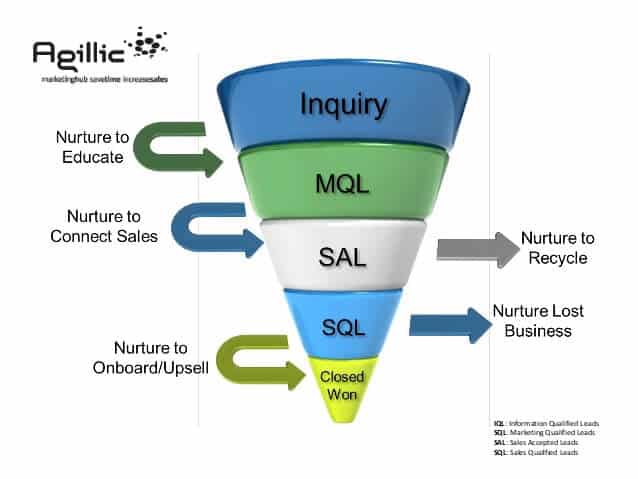
Source: Agillic
Once the lead has been validated by the sales team (this is called a Sales Accepted Lead), it can be considered an SQL. Going through this buffer stage (sales validation) generally makes the sale easier. During the validation call, the salesperson can for example schedule a sales meeting if they think the lead is ripe. More broadly, the SAL stage yields much higher-quality SQLs.
Read alsoDiscover our complete guide on the art of setting up effective sales processes.
To conclude, three tips:
- Take the time to define clearly what an MQL and an SQL mean for your company. A tip within the tip: set a high bar for MQLs.
- Put an effective lead evaluation system in place (Lead Scoring).
- Improve communication between the marketing team and the sales team.
The major problem many companies face today is that leads generated by marketing do not always meet the standards of sales teams. Applying these three tips will help you improve your conversion rates – potentially by a wide margin.
Going furtherIf prospecting and lead management interest you, I strongly encourage you to browse these articles:
The questions we get over and over.
What is the difference between an MQL and an SQL?
An MQL is a lead qualified by and for marketing: it matches the target and has shown interest, but has not clearly expressed a wish to buy. An SQL is a lead qualified by and for the sales team: an MQL that has reached a certain level of maturity, usually qualified after a phone conversation.
Can a lead become an SQL without going through the MQL stage?
Yes, when the person contacts a salesperson without having been exposed to the marketing team, its operations or its content.
What is a Sales Accepted Lead (SAL)?
It is a lead validated by the sales team before the handoff, for example through a qualification call. This call checks whether the lead is ready for a sales call or a demo, or needs more nurturing. Once validated, the lead can be considered an SQL.
How do you know when to hand an MQL over to the sales team?
One of the best approaches is lead scoring: each lead gets a score that changes based on how it responds to marketing campaigns and actions, and it is up to you to define the critical threshold that triggers the handoff. The score is not enough: having salespeople validate MQLs and improving communication between the two teams reduces errors.



What the community says.