



- A lead becomes an SQL when it crosses a threshold set by the lead scoring system, and that is when marketing passes it on to sales.
- Set precise response times: the more time passes, the lower the chances of converting a prospect.
- Train your salespeople on your leads’ typical buying journey.
- A mystery shopper experiment shows how your salespeople actually treat a prospect.
- Track conversion rates in the CRM and send salespeople’s feedback on the leads they handled back to marketing (closed-loop).
Generating leads is one thing. Qualifying them and turning them into customers is another. It is this second part of the job that we will talk about in this article. To describe this second phase, people often talk about the « sales funnel ».
The sales funnel describes the different stages leads go through, from simple prospect to loyal customer. In that sense, the funnel is synonymous with the buying journey. But the notion of funnel also covers all the processes, techniques and tools that marketing and sales put in place to move leads through these different stages.
Want to improve the sales performance of your B2B company? Then you need to optimize your sales funnel, and in particular work on the handoff of leads between the marketing team and the sales team. Here is how to get there.
Sales funnel – Organization and vocabulary
The sales funnel can be defined as the process of tracking and measuring how effectively the company attracts, engages, converts and retains its customers. The term « sales funnel » is sometimes replaced by another one: conversion funnel. From the customer’s point of view, the sales funnel defines the different stages a person goes through between the moment they are a simple prospect and the moment they become a customer of the company. The sales funnel, to give an alternative definition, is the set of processes, tools, techniques and resources used to move potential customers through the conversion funnel and turn prospects into customers.
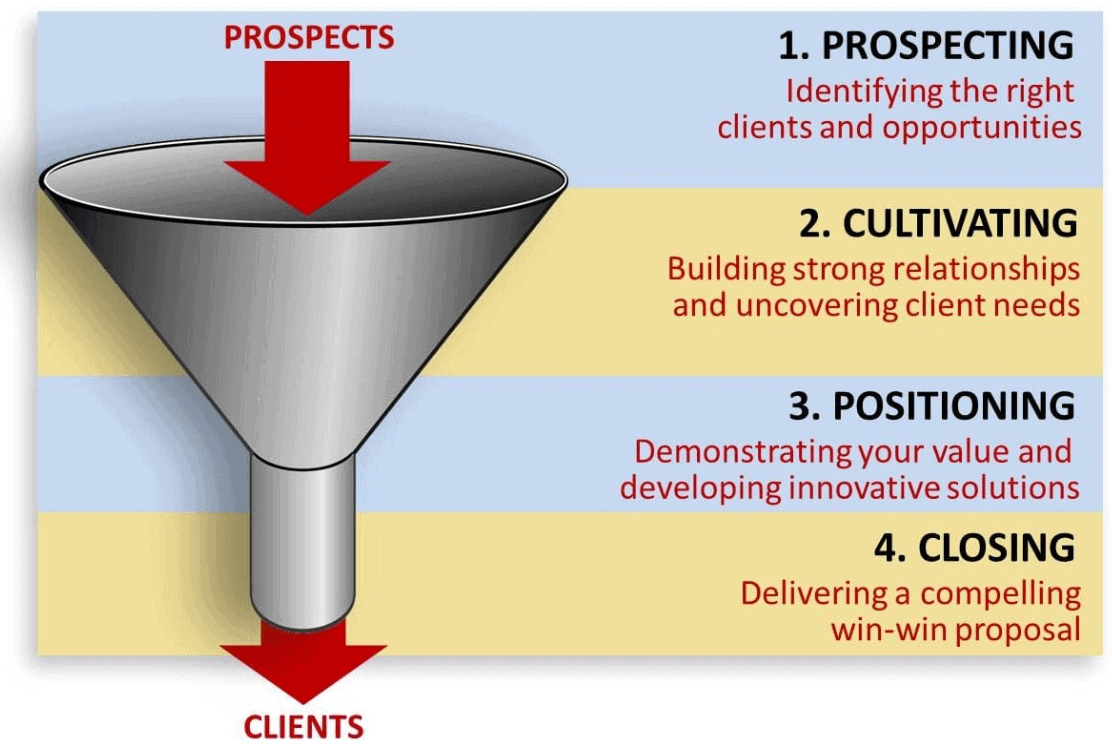
A company must constantly look to improve its sales funnel to acquire new customers. We will see in a moment, and this is the central subject of this article, that one of the main levers for optimizing the sales funnel is improving the handoff between the marketing team and the sales team. But first, let’s clarify a few pieces of vocabulary that you need to keep firmly in mind:
- Lead. A lead is a prospect who has shown interest in your brand or your products. For example: a person who clicked on one of your ads, filled in a form, signed up for your newsletter, etc. Leads can come from inbound channels or outbound channels.
- Outbound leads. These are generated by salespeople, when they target people who have potentially never heard of the company. In B2B, prospecting emails are one of the most effective techniques for generating outbound leads. There are other outbound channels, though: cold calls, postal mail, messages sent on social networks. In an « outbound » approach, the company goes to the customer. In B2C, the most widely used outbound channel is advertising.
- Inbound leads. These are leads that come to you. For example, a person who downloads one of your white papers and gives information about themselves in exchange: last name, first name, email address, company name, job title within the company… Or a person who signs up for the free trial of your service.
On the difference between these two categories of leads, we recommend reading this article (in French): « Inbound vs Outbound marketing – Which marketing strategy for your project? ».
Two actions are generally carried out once a lead (well, its data) enters the company’s database (marketing automation tool, CRM):
- The data, the leads are filtered.
- The leads are « enriched ». Lead enrichment means increasing the amount of information you have on your leads by using third-party data. For example: company revenue, industry, etc. Lead enrichment plays an important role in the lead qualification process.
Then comes the classic distinction between Marketing Qualified Lead (or MQL) and Sales Qualified Lead (SQL). To understand it properly, remember that not all leads have the same value. The lead scoring system identifies the leads with the highest probability of conversion and the highest lifetime value. Lead nurturing campaigns are used by the company to communicate with its leads, inform them and « educate » them (by sharing guides, white papers, webinar invitations, newsletters, etc.). Ultimately, the goal is to build their interest in the company and the services it offers. Lead nurturing helps qualify leads and is used to determine the right moment to get in touch with them.
Leads that react to the content shared, leads in which a purchase intent is detected, which in any case show a certain level of engagement and interest, are « Marketing Qualified Leads« . From the moment the marketing team, which is in charge of lead nurturing actions and runs lead scoring, judges that a lead is ripe for contact by the sales team, it becomes a « Sales Qualified Lead« . It is then passed on to the sales team. The verb « judge » is actually poorly chosen, because this is not done by guesswork. It is the lead scoring system set up in the company that determines, when a threshold is crossed, that a lead becomes an SQL. You can see right away why a good lead scoring system matters.
So, to sum up, it is when an MQL becomes an SQL that the handoff between the marketing team and the sales team takes place. We insist on this point, because it is this moment of the handoff that we will talk about in a moment. One of the keys to improving the sales funnel, once again, is to optimize this moment of transfer.
Once passed on to the sales team, the SQL goes through a qualification process by the salespeople. At this stage, the goal is to collect as much information as possible on the lead to clearly identify its challenges, needs, expectations and goals, so as to best adapt the sales pitch and the offers proposed, and maximize the chances of turning the lead into a paying customer. In this qualification work, you can use the BANT framework – Budget, Authority, Need, Timeframe. On the BANT framework and the other lead qualification grids, read the article: « The complete guide to lead qualification« .
To finish, here are a few more pieces of vocabulary about the stages after the handoff:
- Opportunity. A lead becomes an opportunity when it meets all the qualification criteria. At this stage, the salesperson can contact the lead to offer a demo by a member of the support team or an account manager. The investment, the level of support offered depends on the revenue potential the lead could generate for the company. The best leads should be pampered more than the others. Prioritization and smart allocation of effort are needed.
- Proof of concept (PoC). It refers to everything that convinces the lead of the value of the services offered for its company, of your solution’s ability to meet its challenges, needs and goals. The bigger the potential deal, the more important the proof of concept. If you sell SaaS software, you can provide the proof of concept by letting the lead test the solution for free.
- The sale. This is the nicest stage. The customer signs the contract, pays the first invoice or the first deposit. You celebrate with champagne. Except that this is where the real work begins. The sale is less the end than the start of a cycle. The Customer Success team must train and support the new customer in setting up and using the product.
- Onboarding. The onboarding process, which consists in supporting the customer in its first steps with the solution, is handled by the Customer Success team. This process is complicated when there are several types of users and several access levels to manage. Some companies offer weekly webinars open to all their customers. This tool is an opportunity to explain how the solution works and present new features. Sometimes companies offer individual support, remotely or on the customer’s premises. The support process never really ends, so it implies a certain investment on your side. But retaining a customer always costs less than acquiring new ones.
- Renewal / upsell. The performance of your Customer Success team is measured with a few simple KPIs: subscription / contract renewal rate, upselling, churn rate. In general, the CS team starts discussing renewal with customers two or three months before the contract expires. But if you keep up a regular dialogue with your customers, you will not, in principle, need to schedule a meeting specifically on this subject.
These different stages give a clear picture of the sales funnel, even if a very schematic and, in a sense, simplistic one. You need a clear view of your funnel and of the different mandatory stages your customers go through, so you can identify, at each stage, specific KPIs and the tools/techniques that make it easier to move on to the next stage.
Read alsoTo complete this article, check out our complete guide to lead qualification by marketing and sales teams (MQL vs SQL).
Optimizing the handoff – The main friction point in a sales funnel
As we said, the handoff between the marketing team and the sales team in processing leads is the most sensitive moment, the main friction point of the sales funnel. Salespeople sometimes complain about the poor quality of the leads marketing sends them. Conversely, marketing is sometimes surprised by the low number of deals won by the salespeople. Here are 5 tips to improve this handoff.
1. Set precise expectations for lead follow-up
When do you want salespeople to respond to or contact leads? How fast? What maximum response time after a given action by the lead? These are questions you need to put on the table and answer clearly and precisely. Several studies have shown the importance of response time and responsiveness in lead conversion rates. The more time you let pass, the lower your chances of turning a prospect into a customer. One example is the study by Inside Sales, whose results are below:
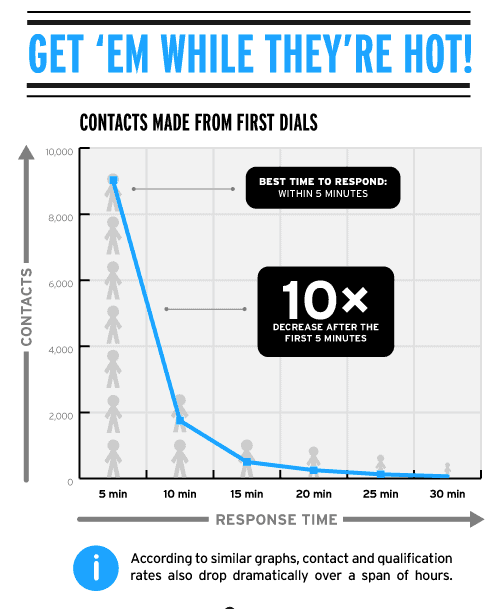
What response time should you set? There is no ready-made answer. It depends on your business, but also on your human resources. One tip: always try to put yourself in your leads’ shoes, it will help you find the right timing.
Read alsoCheck out the complete list of the best B2B prospecting tools.
2. Your salespeople must have an intimate knowledge of your leads’ buying journey
Telling your salespeople what you expect of them is a good start, but it will not get them far if you do not also train them on your leads’ typical buying journey. Your salespeople must clearly understand how your leads operate and what path they take before landing in the salespeople’s hands: how do they look for information? Which channels do they use? What content do they have access to? How is the decision made? How are they nurtured by marketing? This knowledge will help your salespeople become more efficient and relevant, delivering a better experience to prospects.
3. Run a mystery shopper experiment
Want to know how your salespeople handle the handoff? Why not go through a mystery shopper experience? The idea is simple, you probably know it already: you pose as a prospect (for example by filling in a contact request form) and see how you are « treated » by the salespeople. If you do not want to do it yourself, you can hand this work to a specialized company (such as Qualimétrie, in France).
You will learn lots of things: the waiting time before someone takes care of you, the salespeople’s skills, their people skills, their behavior, etc.
Read alsoCheck out our complete guide to qualifying, scoring and warming up your leads with automated scenarios.
4. Use data to measure performance
Want more insights? Analyze the KPIs that measure the performance of your sales department: number of leads sent to sales, conversion rate of these leads into « opportunities », conversion rate of these « opportunities » into sales proposals sent. Not forgetting, of course, the conversion rate into closed deals. Set up dashboards so that you and your teams can follow in real time the evolution of the KPIs we have just listed. Your CRM lets you track your salespeople’s activity day by day. Follow how lead statuses evolve, calculate the pipeline value, question your salespeople about this data. This work of analyzing data and KPIs will let you quickly identify the weak spots of the sales funnel and the ways to fix them.
5. Improve practices by setting up a feedback and reporting loop
Once you have applied the tips above and started to modernize your marketing & sales teams, you will already have a clearer view of your goals. We also recommend setting up what is known as a closed-loop system. It is an approach based on reporting and feedback that lets salespeople using the CRM send feedback to marketing about the leads they have handled. This approach helps marketing improve the way it qualifies and nurtures leads, and strengthens the dialogue between the two functions. This dialogue feeds on the analysis of CRM data and reporting.
Every prospect who enters the information system, every contact, every step of the sales process is recorded in the CRM. Every conversation, every email, every touchpoint is scheduled in the CRM. All the tools used by salespeople are integrated with the CRM. Since every stage of the buying journey is tracked, you have access to the data that lets you understand why a prospect moves back or forward in the funnel. The CRM is a gold mine of information. All these insights must be used to identify problems and improve your teams’ practices. All the knowledge you build up through these analyses will help you upskill your teams.
Read alsoCheck out the top 40 best sales practices.
You will find it easier to forecast, anticipate your revenue, identify the highest-value leads and remove the friction points in your sales processes. This work will make your salespeople’s lives simpler while making them more effective. Sales cycles will get shorter and conversion rates will go up.
Salespeople analyzing CRM data and sending feedback to marketing is the simplest way to align your marketing and sales departments. And it is not a very complicated approach to set up. You can see progress after just a few days.
We hope these few tips will help you improve your sales funnel and your company’s performance. Over to you!
The questions we get over and over.
What is a sales funnel?
The process of tracking and measuring how effectively the company attracts, engages, converts and retains its customers. It is also called a conversion funnel. From the customer's point of view, these are the stages they go through between the moment they are a simple prospect and the moment they become a customer.
What is the difference between an MQL and an SQL?
A Marketing Qualified Lead reacts to the content shared and shows a certain level of engagement. It becomes a Sales Qualified Lead when the lead scoring system, as a threshold is crossed, judges it ripe for contact by the sales team, to which it is then passed on.
Where is the main friction point of the sales funnel?
In the handoff of leads between the marketing team and the sales team. Salespeople sometimes complain about the quality of the leads passed on, and marketing is surprised by the low number of deals won.
How soon should you contact a lead?
There is no ready-made answer: it depends on your business and your human resources. Several studies, including the one by Inside Sales, have shown that the more time passes, the lower the chances of turning a prospect into a customer. Put yourself in your leads' shoes to find the right timing.
What is a closed-loop system?
An approach based on reporting and feedback, which lets salespeople using the CRM send marketing feedback on the leads they have handled. Marketing gets better at qualifying and nurturing leads.



What the community says.