



- Sales and marketing define the prospecting target together, based on firmographic and demographic data.
- There is no objective criterion for a qualified lead: it is up to the two functions to set the threshold together.
- An SLA formalizes the commitments of both departments on inbound leads.
- Tying marketers’ bonuses to the conversion rate rather than the number of leads makes it easier to drop the channels that do not convert.
- At a trade show, marketing spots the attendees and notifies them by email, then sales reps meet them on site.
There is more and more talk about the need to align sales and marketing in B2B. And rightly so. It is a fundamental question. You can also see that very few companies actually pull off this alignment. Keeping the two functions – sales and marketing – in separate silos remains the rule in most organizations.
How many sales reps complain about the poor quality of the leads handed over by marketing? And how many marketing teams toss the ball back into the sales force’s court? Conflicts between marketing and sales can cost a company dearly. Conversely, good alignment between marketing and sales improves lead quality and boosts conversion.
In this guide, we will look at how to actually improve this alignment, on specific cases and in very precise situations. But first, a quick word on what is at stake in aligning the two functions in B2B.
Why is sales and marketing alignment so important in B2B?
The answer is simple: aligning the two functions lets the company make more money, by increasing the value and the conversion rate of leads. Here are a few figures to back up that claim:
- B2B companies with aligned sales and marketing functions saw their three-year revenue grow 24% faster than other companies, and their three-year profits grow 27% faster (according to a SiriusDecisions study).
- If you look at customer retention, companies with the two functions aligned have a 36% higher retention rate and a 38% higher win rate than other companies (according to MarketingProfs).
- Act-On adds that 56% of aligned organizations meet their revenue goals and 19% exceed them. Conversely, only 37% of non-aligned organizations meet their goals, and only 7% exceed them.
Sales and marketing have always been interdependent. That is nothing new. If people have only been talking about breaking down the silos between the two functions for a few years, it is largely because the habits and expectations of modern buyers have changed. The result: the shape of the conversion funnel has mutated and the split of roles between sales and marketing has become blurred.
Modern buyers are much better informed. Almost all the information they need is a few clicks away on the internet. SiriusDecisions showed that 67% of the buyer’s decision-making process happens online, before the prospect has even been contacted. This has fueled the rise of marketing’s role as the supplier of digital content. And it has to be said that many companies have not yet grasped the scale of this shift.
The buyer has changed more in the last 10 years than in the last 100 years. The buyer controls everything. We are in the era of the consumer, no longer the era of the seller. From now on, the mindset is more about HELPING than SELLING (Jill Rowley, Chief Growth Officer, Marketo).
If you take the traditional conversion funnel, you can see that today buyers enter the sales cycle further along, further down than before, and that, as a result, marketing handles more stages than it used to:
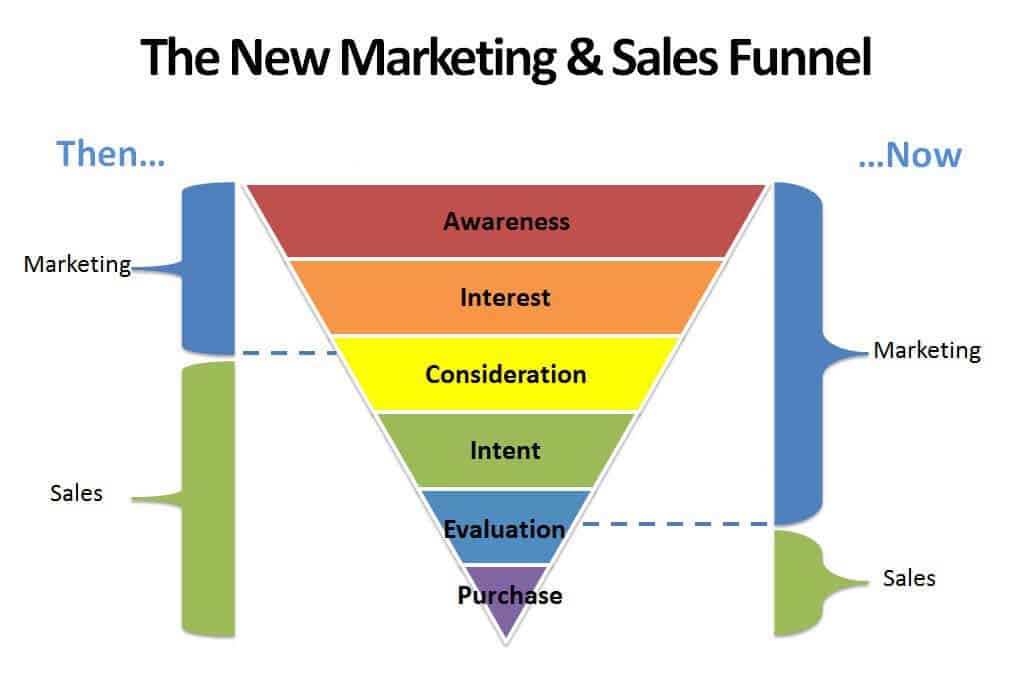
This shift has done a lot to blur the map of roles between the marketing function and the sales function. Nobody really knows who should do what anymore – especially at the “Interest” and “Consideration” stages. This blurring means rethinking the relationship between the two functions and, above all, tightening their coordination. More than ever, the two departments have to work together.
We will now present 7 concrete actions to improve sales and marketing alignment.
1. Jointly identify the criteria of the prospecting target
Before talking about leads, sales and marketing have to agree on the prospecting target, or the target customer base. Which customers is the company targeting? What type of companies? What size? What business? etc. If marketing sends sales a lead that does not match the company’s target, it means wasted time for sales, but also for marketing. It is very important for sales and marketing to be aligned on this point, to share the same view of what a valuable customer is for the company.
For lead scoring, two types of criteria have to be taken into account:
- Firmographic data: industry, company size, location. Does the company belong to an industry in which you have won customers in the past? Is the company big enough to afford the product you offer and get the full benefit of it? Does the company use tools that complement the one you sell?
- Demographic data: the contact’s title, role and responsibilities. Do they have decision-making power in the company? If the contact is not authorized to make the purchasing decision, your sales reps will be wasting their time if you hand them this lead.
These criteria for what makes an “interesting prospect” have to be identified jointly and shared between the sales and marketing functions. If you do not know what your ideal customer looks like, analyze your current and past customers. Identify what your best customers have in common (those who use the most services, who are very satisfied, who have been customers for a long time, etc.). Use this information to build a typical profile of the ideal customer.
2. Agree on what a qualified lead is
Every company has its own definition of what a “lead” is. For some, a list of names is a list of leads. For others, anyone who downloads an ebook ipso facto becomes a lead. Other companies again distinguish between hot leads and cold leads. Many conflicts between sales and marketing come from a lack of understanding of what a lead is.
Can someone who has read an article on your blog be considered a qualified lead? You think not? That is your right. And what if they have read 10 articles? And what if they have read an article and attended a webinar? And what if they have read an article, attended a webinar and downloaded an ebook? There is no objective criterion for saying when a “suspect” turns into a “qualified lead”. It depends on each company. On the other hand, it is essential that sales and marketing agree on what a qualified lead is, and that the two functions jointly define the threshold from which you can talk about a qualified lead. Nothing stops a company from opting for several qualification thresholds, distinguishing red-hot leads, hot leads, warm leads, cold leads… What matters is that marketing and sales agree.
It can be very worthwhile to hold a meeting with managers from both functions to agree on the qualification / scoring criteria. At what threshold does a cold lead become a hot lead? What conditions does a lead have to meet to be filed in the “hot lead” category? These are all questions to work through together.
Let’s sum up. Marketing and sales have to agree on the prospecting target. That is the first point. They then have to agree on what a qualified lead is, in other words a lead that can be handed over to sales. That is the second point.
Read alsoCheck out our complete guide to lead qualification by marketing or sales teams (MQL vs SQL).
3. Create an SLA for inbound leads
Inbound leads are a tremendous opportunity. These are leads that come to you without any action on your part. What more could you ask for! The growth of the internet has led to a tremendous boom in these leads. Except that automatically passing these leads on to sales reps and crossing your fingers that a few will convert is not the best strategy. Unsurprisingly, inbound leads are the ones that convert the worst. In most organizations, these “internet leads” are the lowest of priorities.
To ensure a consistent strategy for inbound leads, we recommend creating an SLA between the two departments. The SLA, or Service Level Agreement, is a document that formalizes the commitments the marketing and sales departments make to each other. It would take too long to go into the detail of what goes into an SLA. We refer you to HubSpot’s excellent article on the subject, which explains the different points to cover in your document.
Read alsoFind out how to evolve your B2B sales processes to meet the demands of the modern decision-maker.
4. Drop the channels that convert the least
There is no point in continuing to work channels that generate leads that do not convert: Facebook, X (formerly Twitter), Google Ads, etc. Even if those channels bring you tons of leads. If this idea shocks you, it is probably because sales and marketing are not aligned. Marketing-specific KPIs generally revolve around lead volume, number of views, click-through rate. From that point of view, a channel that generates a lot of leads is seen as a good thing – a priori.
But if instead you look at it from the company’s point of view, you will quickly admit that it is absurd to spend resources on ineffective actions and that it would be better to reallocate those resources elsewhere, to generate a better ROI. What is the point of generating hundreds of leads if sales cannot manage to convert a single one… Marketing and sales must both keep their sights on the company’s overriding interest: generating revenue. This mindset is indispensable for setting up an aligned organization… and avoiding wasting time and money.
Read alsoDiscover 15+ tools to build a prospecting list.
5. Boost conversion with shared goals
One of the major reasons sales and marketing are misaligned is that the two departments have different goals. Sales reps are generally paid partly on commission or get bonuses tied to their performance (number of demos, win rate…). On the other side, marketing KPIs are often tied to website traffic, click-through rates and the number of leads generated. Marketing’s goals, by design, are not always aligned with the company’s goals. As we have seen, generating tons of leads is not necessarily a “good thing”.
One of the simplest ways to align sales and marketing is to use shared goals tied to conversion rates. If marketers’ bonuses are tied to the conversion rate rather than the number of leads, you probably won’t need to tell them twice to drop a channel that does not convert…
6. Retarget cold or dormant leads
This idea sometimes raises eyebrows: “Retarget cold leads, meaning people who have shown they were not interested, what is the point?”. We will see why this strategy is worthwhile and how putting it into practice requires sales and marketing to be aligned.
Here is the approach. Together, sales and marketing can identify the cold leads. Once these leads are identified, the first part of the “reactivation” work falls to marketing. Marketing takes care of targeting these leads again, by sending them an email marketing campaign, targeting them in display campaigns, sending them a letter… It is then up to sales to take over, using their favorite communication channel: the phone. In a retargeting strategy, sales and marketing alignment is the main success factor. Putting such a strategy in place will help you better understand why some leads go cold. Maybe it is because they were not part of your target?
Read alsoFind out which B2B lead generation strategies work best.
7. Take part in events
Taking part in events is expensive, but events such as trade shows are a gold mine of qualified leads. You can meet hundreds of leads in person who are already qualified simply by being at the event. But to get the most out of events, it is fundamental that the sales and marketing teams are perfectly aligned and work hand in hand.
Let’s take an example to illustrate this necessary complementarity. Suppose you are the head of the company’s marketing department. You decide to take part in a trade show for recruiters in Paris. You start by researching the attendees. To do so, you use social networks (LinkedIn). You identify the attendees who might be interested in the services you offer. You draw up a list, noting the job title and location for each profile.
Read alsoFind out how to become a sales negotiation pro.
A few days before D-day, you send every contact on the list a personalized email, explaining that you saw they would be attending, that you are delighted, that you offer solutions that might interest them, that you are also taking part in the show, that you will have a booth, etc. You pass the list of contacts on to the sales reps who will be on site on the day of the event. Based on your research and the location of the different booths, you can even organize the visit schedule of each sales rep attending. That is an example of effective collaboration between marketing and sales. When the sales reps meet the prospects, the prospects will already have heard of the company and will know about the value proposition. They are much more likely to agree to have a coffee. In this specific case, you can even create a list of all the existing or former customers attending the event, so that the sales reps can visit them at their booths (to strengthen the relationship or get back in touch).
This last example illustrates once again how much there is to gain from aligning sales and marketing. More and more, companies’ sales performance will depend on their ability to get marketing and the sales force working together. There is no doubt about that.
The questions we get over and over.
Why align sales and marketing in B2B?
Because aligning the two functions lets the company make more money, by increasing the value and the conversion rate of leads.
What is a qualified lead?
There is no objective criterion for saying when a suspect turns into a qualified lead: it depends on each company. Sales and marketing have to jointly define the threshold from which a lead can be handed over to sales.
What is an SLA between sales and marketing?
The SLA, or Service Level Agreement, is a document that formalizes the commitments the marketing and sales departments make to each other, especially on how inbound leads are handled.
How do you reactivate cold leads?
Sales and marketing identify the cold leads together. Marketing targets them again by email, display or letter, then sales reps take over by phone.



What the community says.