The tool in detail
Claap after real-world use: feature scope, integrations, pricing and concrete limits.
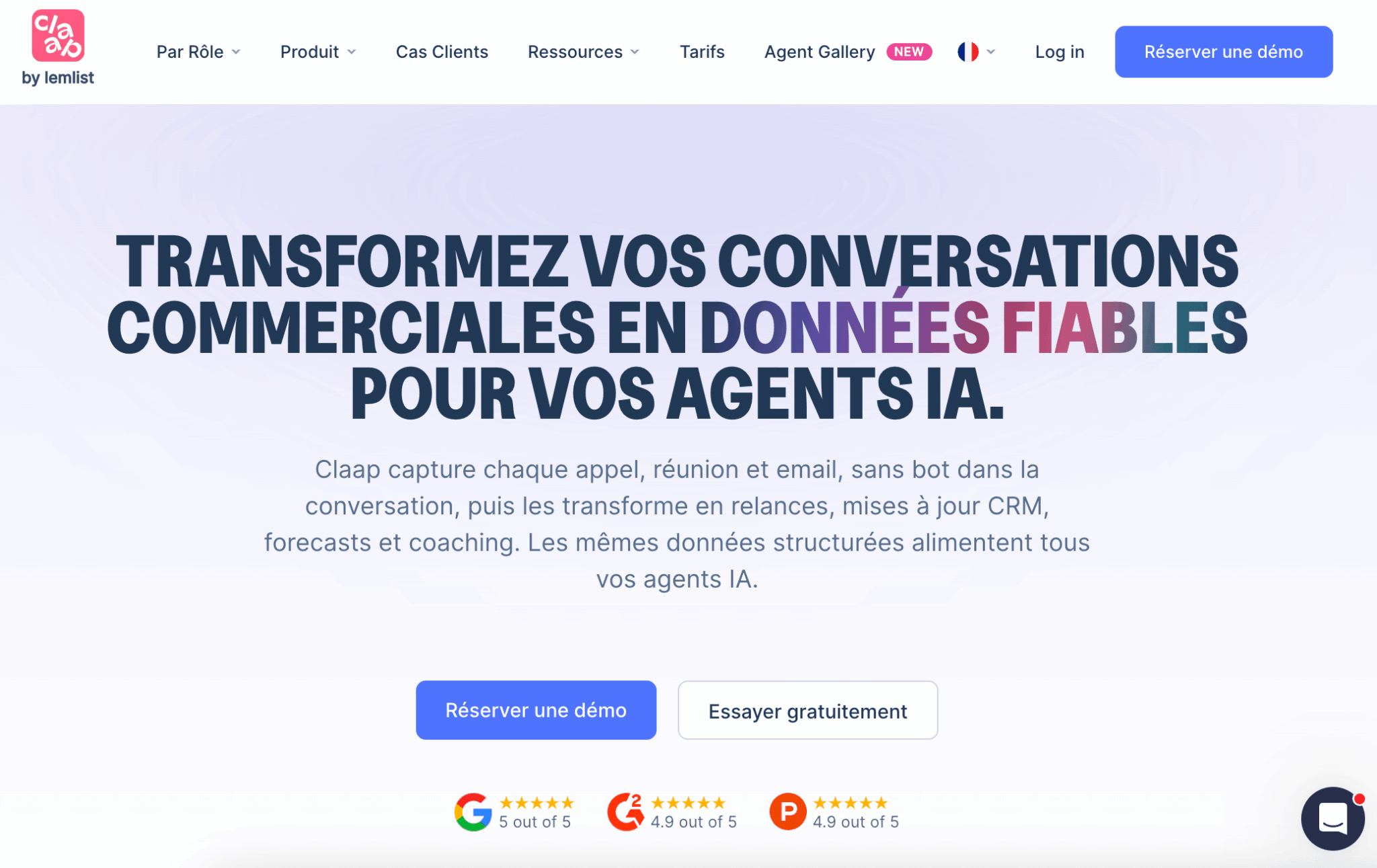
Claap was born in 2021 as an asynchronous video tool, a kind of French Loom. Five years and a complete pivot later, it has become a revenue intelligence platform acquired by lemlist, which promises to turn every one of your sales calls into data your CRM and your AI agents can actually use.
The promise is appealing, but the free plan is token and everything that really justifies the purchase starts at €48 per user per month.
Can Claap replace Modjo for a French sales team? Are Smart Tables a real breakthrough or a nice marketing argument? And what does the lemlist acquisition change if you don’t use lemlist?
Claap: three lives in four years (and why it matters to you)
To evaluate Claap properly, you need to understand where the tool comes from. Its history explains both its most original strengths and its main area of uncertainty:
- First life, 2021. Robin Bonduelle and Pierre Touzeau, a 360Learning alumnus raised on the zero-meeting culture, launch an asynchronous video collaboration platform. The pitch at the time fits in one line: a mix of Loom, Gong and YouTube for startups. Kima Ventures (Xavier Niel’s fund), LocalGlobe and Headline put in 3 million dollars.
- Second life: the pivot. The asynchronous video market closes up (Loom itself ends up acquired by Atlassian at the end of 2023) and Claap switches entirely to sales teams. Call recording, AI notes, CRM enrichment, coaching: growth follows, profitable, with around 700 customers in autumn 2025 and references such as Qonto, Revolut, Payfit or Brevo.
- Third life: on October 20, 2025, lemlist acquires Claap. An eight-figure deal, entirely self-funded by a scale-up that has never raised a single euro, with the historical investors exiting. The official story has a name, « smartbound »: the buying signals captured in your conversations trigger targeted prospecting sequences at the right moment, the opposite of mass campaigns.
Why does this history matter to you?
- First, because the video heritage hasn’t disappeared: Claap keeps editing, cutting, clip sharing and video library features that no competitor in its category offers.
- Second, because the acquisition raises a real buyer’s question. Resources and the roadmap are speeding up, prices and contracts officially stay unchanged, but nothing guarantees that product priorities won’t gradually lean toward the lemlist ecosystem.
If you already use lemlist, that’s a very positive signal. If not, it’s a point to watch, and we come back to it in the verdict.
What really sets Claap apart: your conversations become a database
In 2026, recording and transcribing a call is no longer a differentiator. Fathom does it for free, Teams and Meet do it natively, your CRM is starting to do it too. The battle has moved to what you do with the raw material.
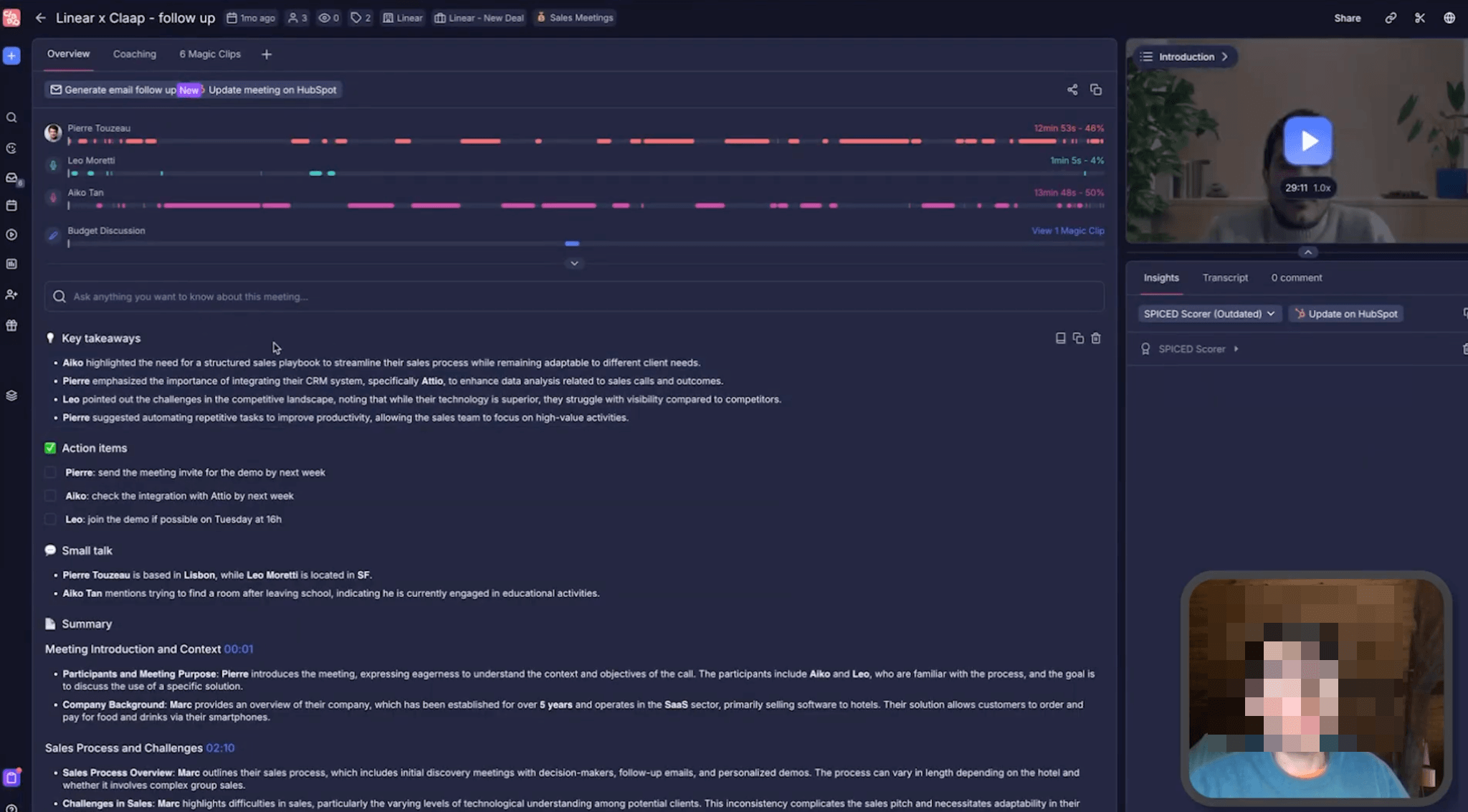
The classic approach produces one summary per call. Neatly filed notes that you open one by one. Claap’s approach is different: every conversation feeds Smart Tables, tables in which each call becomes a row and each piece of information extracted by the AI becomes a column.
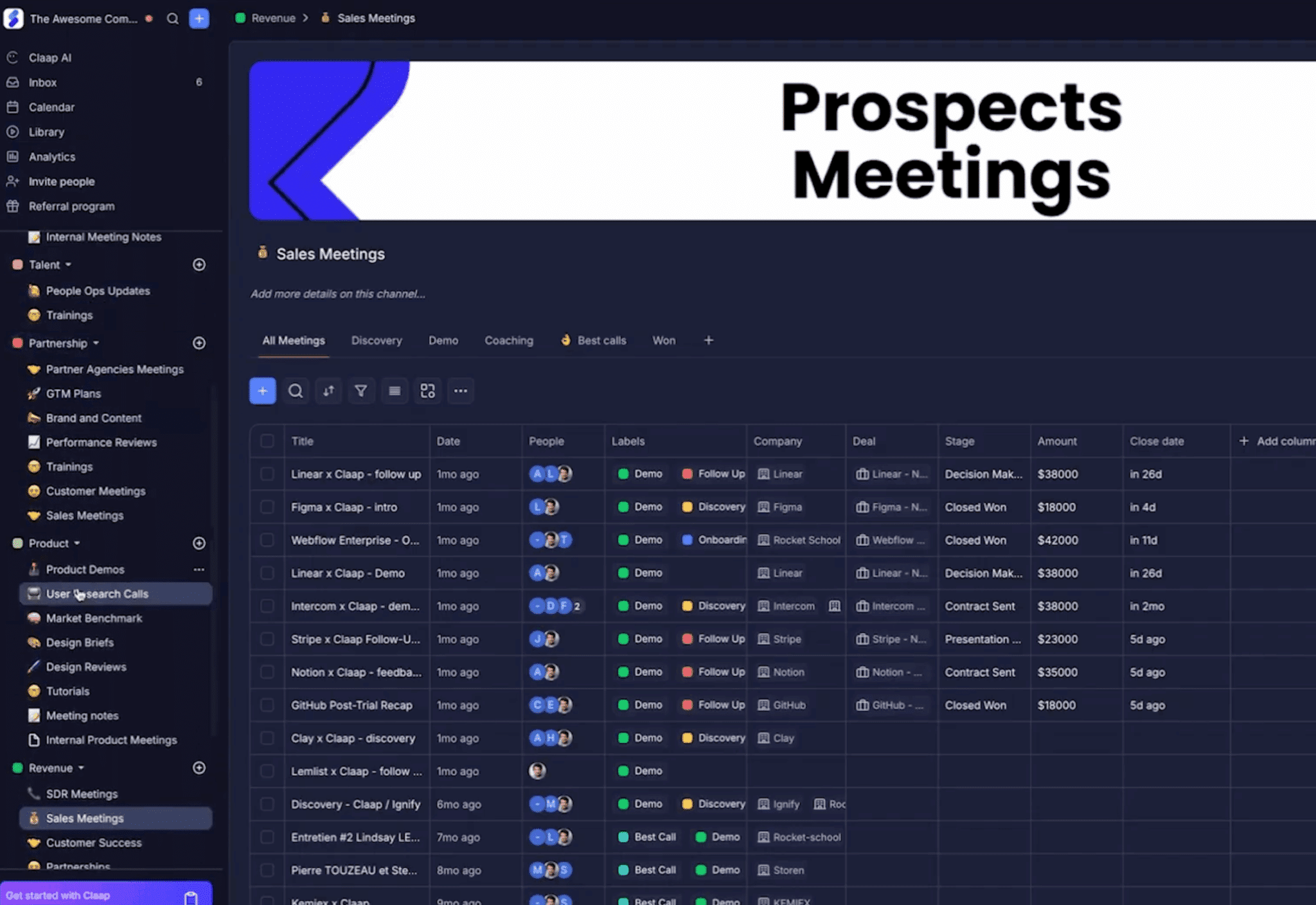
In practice, you define a field (budget mentioned, competitor cited, level of urgency, decision-maker identified) and Claap fills it in automatically on every new call.
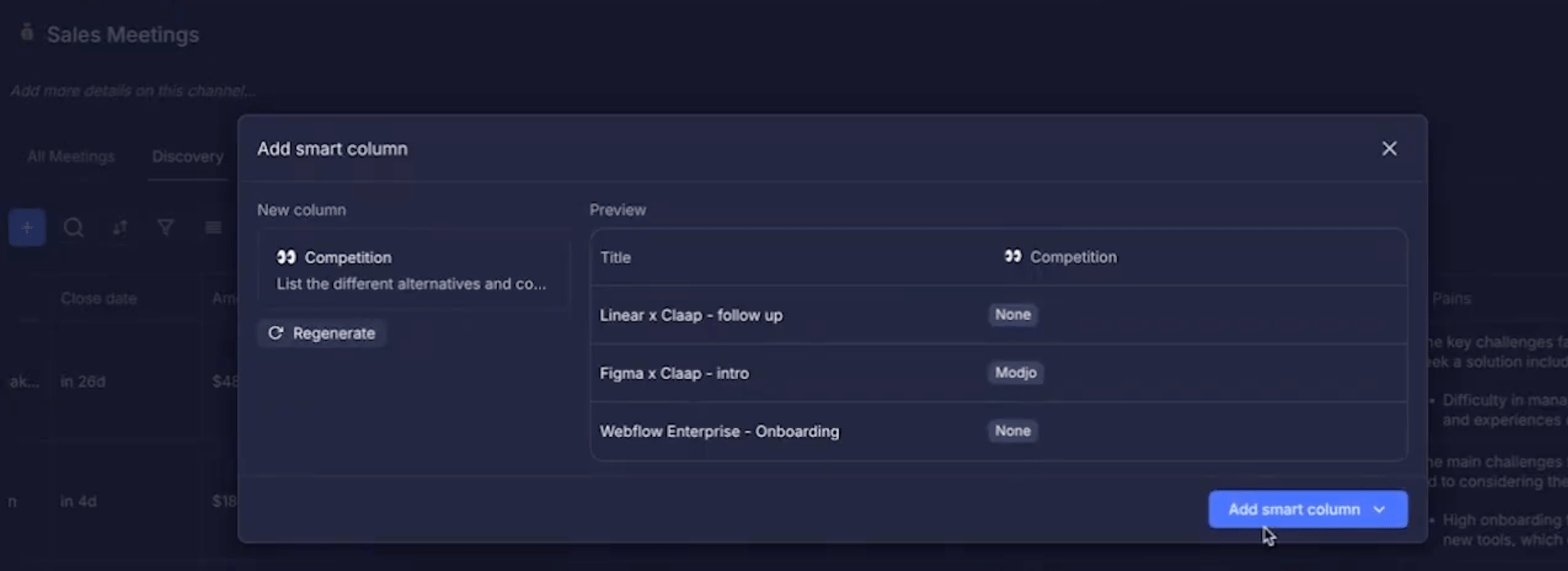
Two properties make the difference:
- Fields apply retroactively. You create a « competitor mention » field today and Claap applies it to your entire call history. Your qualification process evolves, your data follows, without re-listening to anything.
- Data is aggregated by deal and by account, then synced to HubSpot or Salesforce. A question like « all deals lost in Q2 where Salesforce was cited as a competitor » gets an answer in a few seconds.
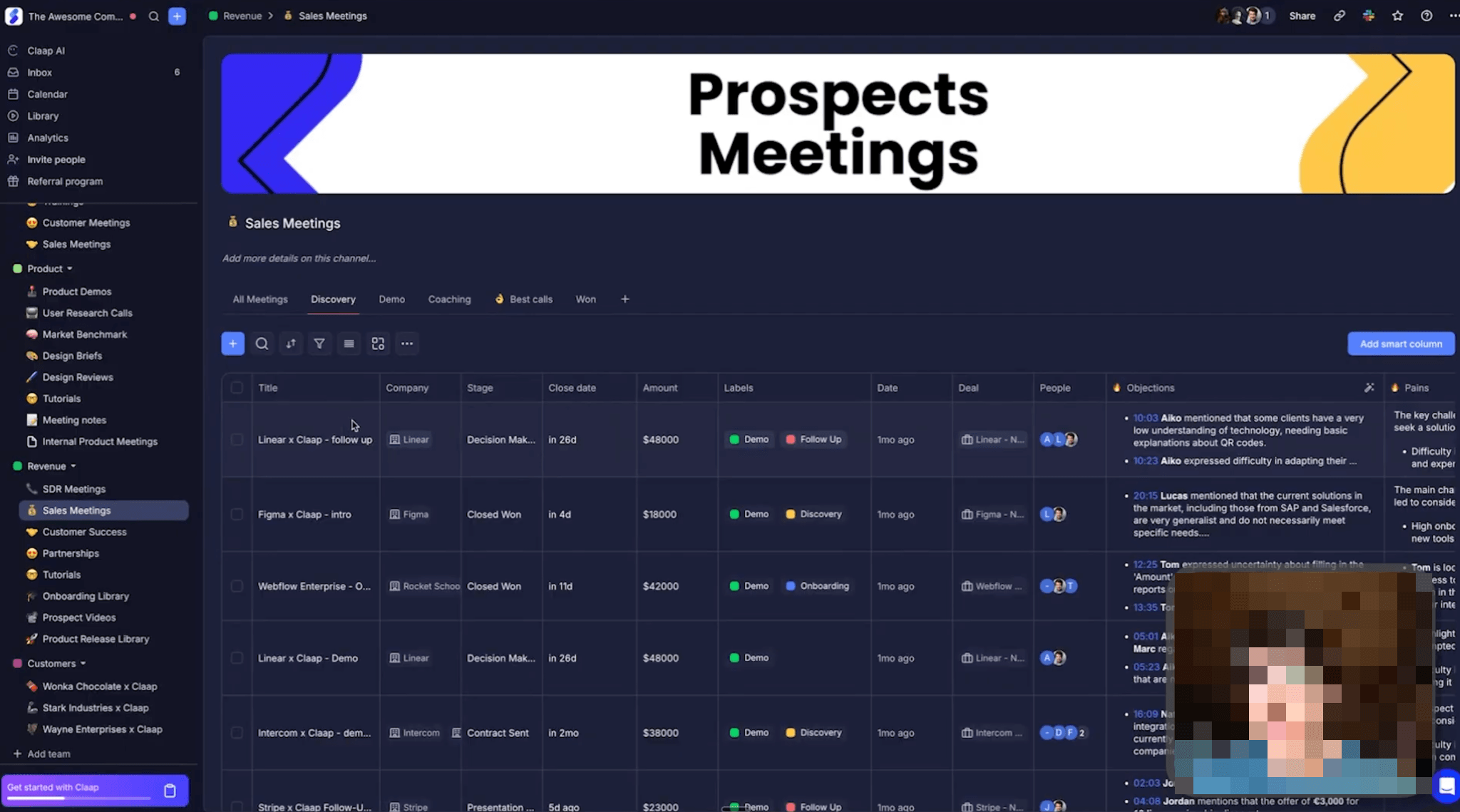
The second building block is MCP (Model Context Protocol), a standardized connector that lets external AI agents, such as Claude, ChatGPT or lemlist’s agents, query your structured conversation data directly rather than 40-page transcripts.
You can generate a competitive battlecard from your real calls, feed a follow-up sequence with the exact context of the last exchange, or analyze the quarter’s recurring objections. Claap’s MCP has been in production since June 2025, roughly a year ahead of its direct competitors.
Salesdorado’s takeThis is Claap’s most interesting bet and the one furthest ahead of its market. But let’s be honest: without a minimum appetite for AI agents or someone playing the RevOps role, you will only use a fraction of this machinery. If your need stops at automatic call summaries, a simple note-taker is enough, for much less money.
Bot-free recording: great for selling, needs a legal framework
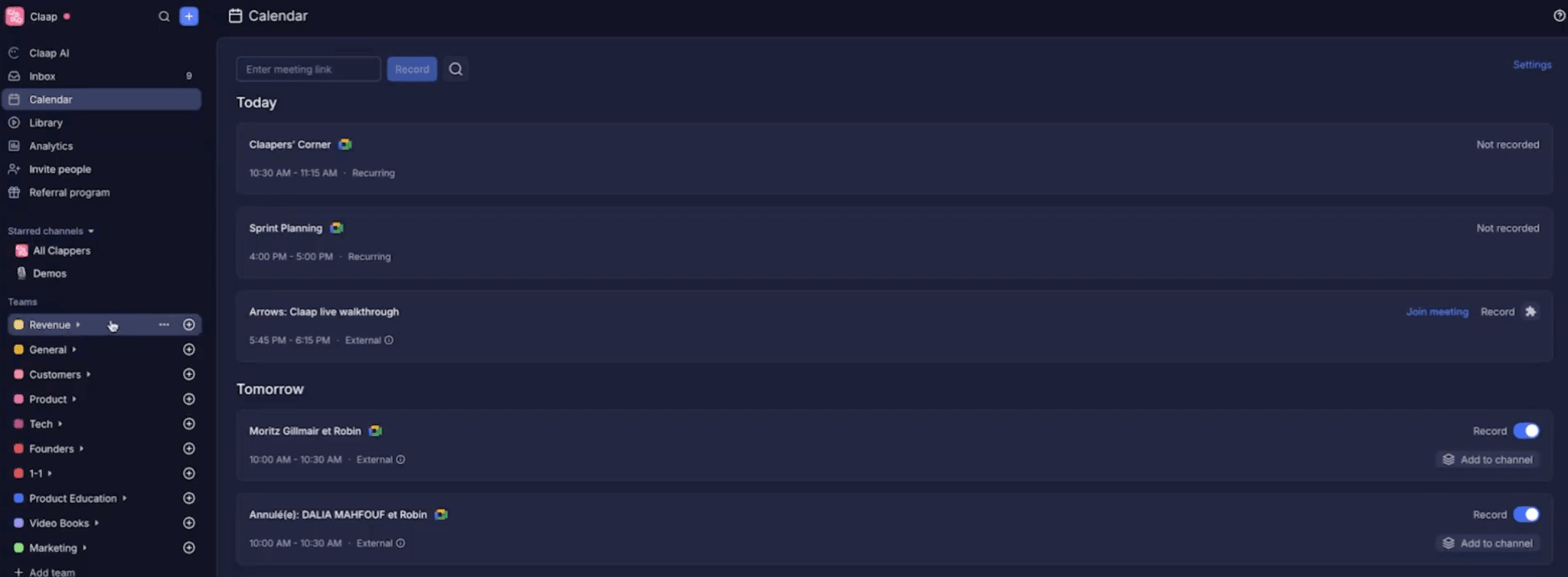
Claap records natively on Zoom, Google Meet and Microsoft Teams, with no ghost participant in the meeting. Calls made through Aircall or Ringover are captured at the source, and email threads linked to the deal are synced. A Chrome extension, a desktop application and a mobile app cover the rest, in-person meetings included via import or direct recording. No blind spot in capture, which is rare. And in the field, it changes the mood of video sales meetings.
But this comfort shifts a responsibility. A visible bot de facto informs participants that they are being recorded. Native recording does not. Claap automatically notifies participants and provides recording indicators as well as consent management tools, but the vendor says it itself: final compliance remains on your side.
WarningIn France, as in most European countries, recording a sales conversation without informing the other party exposes you on GDPR grounds and on the right to privacy. The tool helps you notify, it does not consent in your place. Frame the topic with your lawyer before rollout, not after the first complaint from a prospect.
Day to day: the CRM fills itself, every call gets coached
The core of the value proposition is the end of post-call admin.
After each meeting, Claap generates structured notes following the appropriate template (discovery, demo, renewal meeting) and updates CRM properties, custom fields included, in HubSpot, Salesforce, Attio or Pipedrive. It also drafts the follow-up email in your style.
On coaching, the philosophy breaks with Modjo’s. Rather than equipping call review by managers, Claap has the AI evaluate every conversation: a scorecard based on your sales framework, talk-time split, objections automatically identified.
Every sales rep gets feedback on every call, without tying anyone up. It’s a real sales enablement lever if you are a small team without a full-time sales director. For an organization that has built its coaching program on managers re-listening to calls, it’s a culture change to anticipate.
Our test revealed a few frictions:
- Summaries are solid on structured calls, but sometimes stay on the surface on rambling conversations. We also observed unbalanced summaries when one speaker monopolizes the conversation.
- Transcription, excellent in clean conditions and available in 99 languages, still stumbles on strong accents and highly specialized jargon.
Nothing deal-breaking for the target audience. But if your meetings last 90 minutes with international counterparts, test seriously before signing.
Claap pricing: clear, but the real Claap starts at €48
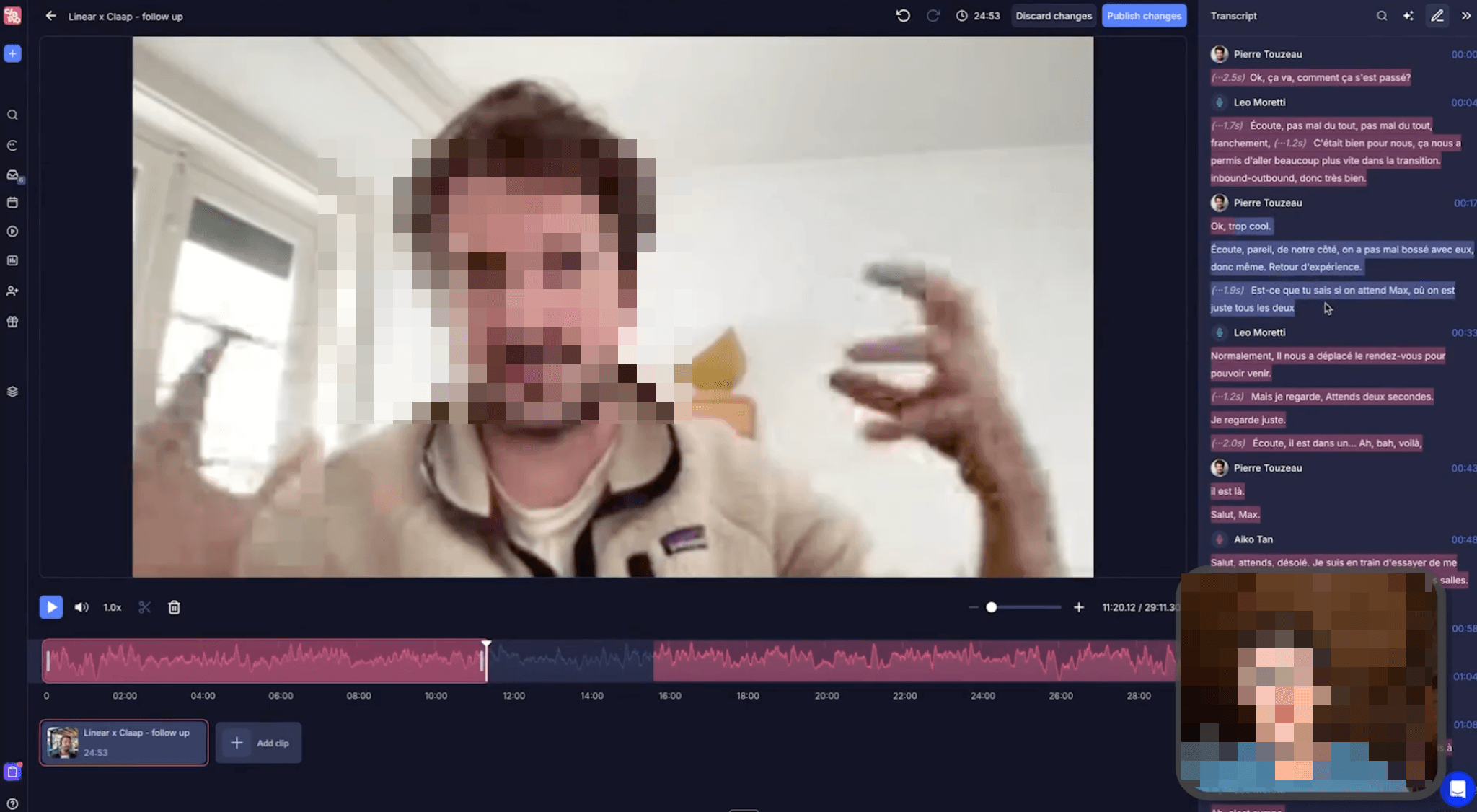
Claap displays its prices publicly, with no mandatory annual commitment and no setup fees. In this market, that is a positioning in itself.
| Plan | Price (annual billing) | What to remember |
|---|---|---|
| Basic | €0 | 10 recordings and 300 minutes in total (not per month), 3-month storage. A discovery plan, used up in one week of active selling. |
| Pro | €24/user/month | Unlimited recordings but capped at 1,000 minutes per month, 500 AI credits per license, advanced summaries and custom prompts. An excellent upgraded note-taker. |
| Business | €48/user/month | Unlimited duration, 1,000 AI credits per license. This is where automatic CRM filling, AI coaching, Smart Tables, deal insights and generated follow-up emails live. |
| Enterprise | On quote | SSO, SCIM, unlimited Basic licenses, tailored onboarding and migration. For organizations with strong security requirements. |
A few subtleties deserve your attention before you pull out the calculator:
- AI credits are pooled at the workspace level, which gives flexibility between heavy and light users.
- You can also mix licenses within the same workspace: your sales reps on Business, observers (management, marketing, product) on free Basic. Smart.
- A last, more surprising detail: the free trial of paid plans is unlocked by contacting the sales team, a small paradox for a tool that claims self-service against Modjo.
Salesdorado’s takeThe Pro plan at €24 is a very good note-taker, nothing more. Claap’s entire sales promise lives in the Business plan at €48, and that is the price to keep in mind when comparing. At that level, Claap remains much more accessible than a platform on quote with an annual commitment, but don’t expect to equip your team for the price of a note-taker.
Claap, Modjo or Fathom: how to decide
Claap fights on two fronts at once, and that is precisely what makes the choice interesting.
Below it, AI note-takers. Fathom offers unlimited recording and transcription for free, while Claap’s free plan runs out in a few days. If your need stops at automatic summaries, don’t pay €48.
Above it, conversation intelligence platforms. Modjo, the French benchmark, goes further than Claap on pipeline analytics and call review workflows, with rollout support that many structured organizations genuinely need. But the bill comes on quote, with an annual commitment. And the product is designed for teams where managers coach by re-listening to calls. Gong plays in the same league, at an even higher price.
| Criterion | Claap | Modjo | Fathom |
|---|---|---|---|
| Ideal for | SMBs and mid-market companies that want to structure their conversation data | Structured organizations with a real managerial coaching program | Freelancers and teams that just want summaries |
| Price | Public, from 1 user, no commitment | On quote, annual commitment | Free and unlimited, paid plans for team features |
| Main limitation | Less depth in analytics, lemlist uncertainty | Heavy budget and rollout for an SMB | No deal intelligence or coaching |