



- Sales enablement gives reps training, tools, processes and content to improve their performance.
- Better training is more relevant training: tailored to your products, your services and your culture.
- No need for a sales guru: a manager or an employee on the team can act as coach.
- Useful content for reps ranges from the sales action plan to email templates, including case studies, presentations and sales scripts.
- It strengthens alignment between sales and marketing, which is often the source of that content.
Sales enablement is not a new concept, just a new name. The idea is to give your sales teams the resources they need to excel.
Some people are naturally gifted at sales. But that does not mean the others cannot perform just as well, or even that they are not already high performers. They just need a little help developing their skills, and that is where sales enablement comes in.
Sales enablement definition
Our definitionSales enablement is the process of providing training, tools, proven processes and content to your sales teams in order to improve their individual performance, and therefore the overall sales performance of the organization.
If you give someone a task along with a set of resources to use and refer to while they work on it, you can probably assume they will complete it more efficiently than someone who does not have those resources.
The same goes for your sales team. Give your reps training, content and optimized sales processes (the well-known sales operations). They will close more deals and generate more revenue for your company.
But in practice, how do you make sure your reps have the resources they need to drive conversions and handle more leads throughout the buyer’s journey?
The missions of sales enablement
Sales enablement mission 1: train your reps better
Many companies have been using the same onboarding process for new sales reps for more than 25 years. Yet the company is no longer in the same situation at all. Goals have probably changed, products and services have probably changed, and the average customer has almost certainly changed.
In this context, “better training” means more relevant training. Hire the most skilled rep you can find: if they are not used to your products, your services and your culture, they will not perform as well as you think.
Sales enablement is essentially about putting proven leaders at the service of your sales and marketing teams. Then letting those leaders guide your reps toward better performance. For companies that offer no coaching at all, any kind of coaching is an improvement.
When we talk about coaching, many sales directors probably picture professional speakers who travel the world giving live presentations. Of course, it helps to have one of these sales and marketing gurus speak to your teams in person, but it is not always necessary.
You probably have one or two employees on your staff right now who are ready to step up and take on this role. You probably have a manager who could take the initiative and help your teams achieve more success.

Sales enablement mission 2: help your reps use the right content at the right time
Your sales team therefore needs to be ready with different collateral for the different stages of the buyer’s journey. Let us introduce some of the best sales collateral out there and how you can use it to close more deals:
Sales action plan
This is the reference document for new and existing salespeople alike. It contains all the resources, company information, target market information, software tips, strategies and much more to help salespeople do their job easily.
Case studies
Case studies are more about laying out the facts than about selling your product or service. They describe the problems faced by the “case” (that is, the customer), the solution they used (that is, your product) and the result of using that solution.
Brochures
Brochures are age-old sales tools that keep their value in our digital world. In the age of social media, traditional brochures and flyers still do their job! They are especially important in the services sector and do an excellent job of making first contact with a prospect.
Blog posts
Marketers often use content marketing and blog posts to attract visitors to the company website, in the hope that they will sign up for their product offer or contact the sales team.
One-pager
One-pagers are used to present an overview of your company, or information about your products or services, on a single page. It is like a presentation page for your company, or a new-age brochure.
Sales presentations and pitches
Sales presentations are nothing more than PowerPoints you use to persuade prospects and customers in a sales meeting. They are used for the first important meeting with a prospect and describe your sales proposal: the customer’s problems and how your product solves them.
Explainer videos
While sales decks can only help you convert one prospect at a time, explainer videos can scale infinitely thanks to the internet. Videos are an excellent way to explain your product or service to prospects visually.
Sales script
Sales scripts work wonders in such cases, making sure the sales rep stays on topic and that all of the product’s value propositions are covered.
Also readCheck out our best cold calling script examples.
Email templates
Before you click “Send”, make sure these emails are pleasant to read, informative and extremely targeted.
Go further
4 good reasons to build sales enablement into your sales strategy
The benefits of a sales enablement strategy are considerable, provided your sales team is competent and the products or services sold have value.
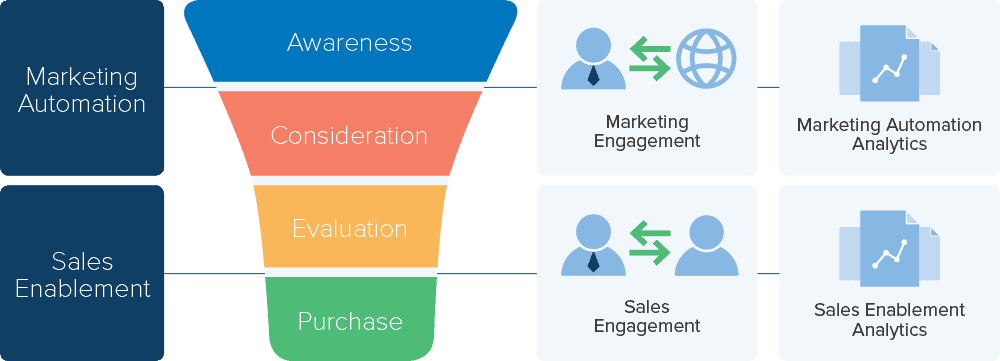
1. Better teamwork
Sales enablement strengthens the team as a whole, not just the top sellers and not just those who need help. By putting sales enablement strategies in place, companies no longer have to rely on their top sellers to carry the sales team.
2. Better data
With a sales enablement strategy, you provide a better framework for collecting and organizing data from interactions between your reps and your customers. Data on pain points, customer personas, buyer intent, past behavior and so on all combine to help salespeople personalize every interaction.
3. More efficiency
Better data and organization also make teams more efficient. With valuable resources at hand, salespeople can make data-driven decisions faster, which shortens the time it takes to turn a prospect into a customer.
4. More collaboration
Sales enablement increases alignment between sales and marketing teams. Reps need to provide valuable, personalized content to prospects to persuade them to close the deal. The marketing team is often the source of that content. That is why marketing is inseparable from the sales process.
The questions we get over and over.
What is sales enablement?
It is the process of providing training, tools, proven processes and content to sales teams in order to improve their individual performance, and therefore the overall sales performance of the organization.
What are the missions of sales enablement?
Training reps better, with training tailored to the company's products, services and culture, and helping them use the right content at the right moment of the buyer's journey.
What content should you give your reps?
A sales action plan, case studies, brochures, blog posts, one-pagers, sales presentations, explainer videos, sales scripts and email templates.
Do you need an outside coach?
Not necessarily. You probably have one or two employees, or a manager, ready to help your teams achieve more success.
What are the benefits of sales enablement?
Better teamwork, better data on customer interactions, more efficiency and more collaboration between sales and marketing teams.



What the community says.