Top 12 HubSpot alternatives

Twelve HubSpot alternatives, sorted by the part of the platform you want to replace. The whole platform (CRM and marketing): Brevo, Zoho CRM, Odoo and Salesforce. The sales CRM alone (Sales Hub): Pipedrive, Freshsales and monday CRM.

Maxime Ben Bouaziz
Maxime Ben Bouaziz
CEO Salesdorado, IA & Sales Tech
May 14, 2024, updated November 10, 2026, 1 min read
See all tools

HubSpot brings CRM, marketing automation, customer service and CMS together on a single contact database. The CRM is free up to 2 users, but the bill climbs as soon as you want the advanced features: Starter costs €20 per seat per month, Pro €90 and Enterprise €175. Custom reports, recurring tasks and advanced automations require a paid plan.

Few teams leave HubSpot entirely. More often, they replace the piece that costs the most or no longer keeps up. Depending on your need:

  • keep CRM and marketing in one tool, for less: Brevo or Zoho CRM;
  • add quotes, invoicing and management to the CRM: Odoo;
  • a complex sales organization: Salesforce;
  • a simpler sales CRM: Pipedrive or Freshsales;
  • sell, then track projects: monday CRM;
  • replace Marketing Hub and keep your CRM: ActiveCampaign, or Webmecanik with support in French;
  • B2B marketing connected to Salesforce: Account Engagement, formerly Pardot;
  • a SaaS vendor: Customer.io for automated messages, Intercom for in-product chat and support.

SalesdoradoSimulate your CRM choice
Free tool, 2 minutes
Simulate your CRM choice

Answer 10 targeted questions and find the tools that actually fit your situation.

15
tools analyzed
10
targeted questions
€0
no sign-up
Methodology published by the Salesdorado editorial team

The 12 tools, side by side

# Logos tool Score Price Best for
Alternatives to HubSpot's marketing automation tools
01 Brevo 4.6/5 ★ €7 SMBs looking for full-featured emailing and a CRM with automation features Visit site
02 ActiveCampaign 4.5/5 ★ €15 B2B teams that want full marketing automation, lighter than HubSpot Visit site
03 Intercom 4.5/5 ★ $29 SaaS vendors who want to engage their users on their site: chatbots, pop-ups, chat Visit site
04 Marketing Cloud Account Engagement (ex-Pardot) 4.3/5 ★ €1,250 B2B companies that already use Salesforce as their CRM Visit site
05 Customer.io 4.3/5 ★ $100 SaaS and mobile apps that segment on their product's events Visit site
06 Webmecanik 4.7/5 ★ €450 French-speaking B2B SMBs that want scoring, nurturing and support in French, with no per-user billing Visit site
Alternatives to HubSpot's sales CRM
07 Salesforce 4.5/5 ★ €25 Organizations that run complex sales processes and want a 360-degree view of the customer Visit site
08 Pipedrive 4.5/5 ★ €14 B2B sales teams that prospect heavily and manage a large flow of deals Visit site
09 Zoho CRM 4.2/5 ★ €14 Under-equipped B2B SMBs that want a complete, affordable CRM at the heart of a software suite Visit site
10 monday CRM 4.0/5 ★ €12 Companies that sell projects or complex services and track their progress Visit site
11 Freshsales 4.5/5 ★ €9 Teams that want a CRM that is simple to set up, with AI-based contact scoring Visit site
Alternatives to HubSpot as an all-in-one platform
12 Odoo 4.0/5 ★ €24.90 SMBs that want CRM, marketing, quotes and invoicing in one piece of software, at the same price per user Visit site

Alternatives to HubSpot's marketing automation tools

01

Brevo

4.6/5 From €7

Best for: SMBs looking for full-featured emailing and a CRM with automation features

+ Strengths
  • Emailing, SMS, WhatsApp, chat and sales CRM on the same platform
  • Better value for money than HubSpot
  • Appointment booking and live chat included from the free CRM
  • Free plan up to 300 emails a day
− Downsides
  • CRM features lag behind HubSpot's
  • Weak lead capture: forms and landing pages not robust enough
  • Contact scoring reserved for the Pro plan, from €499 per month
★ Brevo in brief

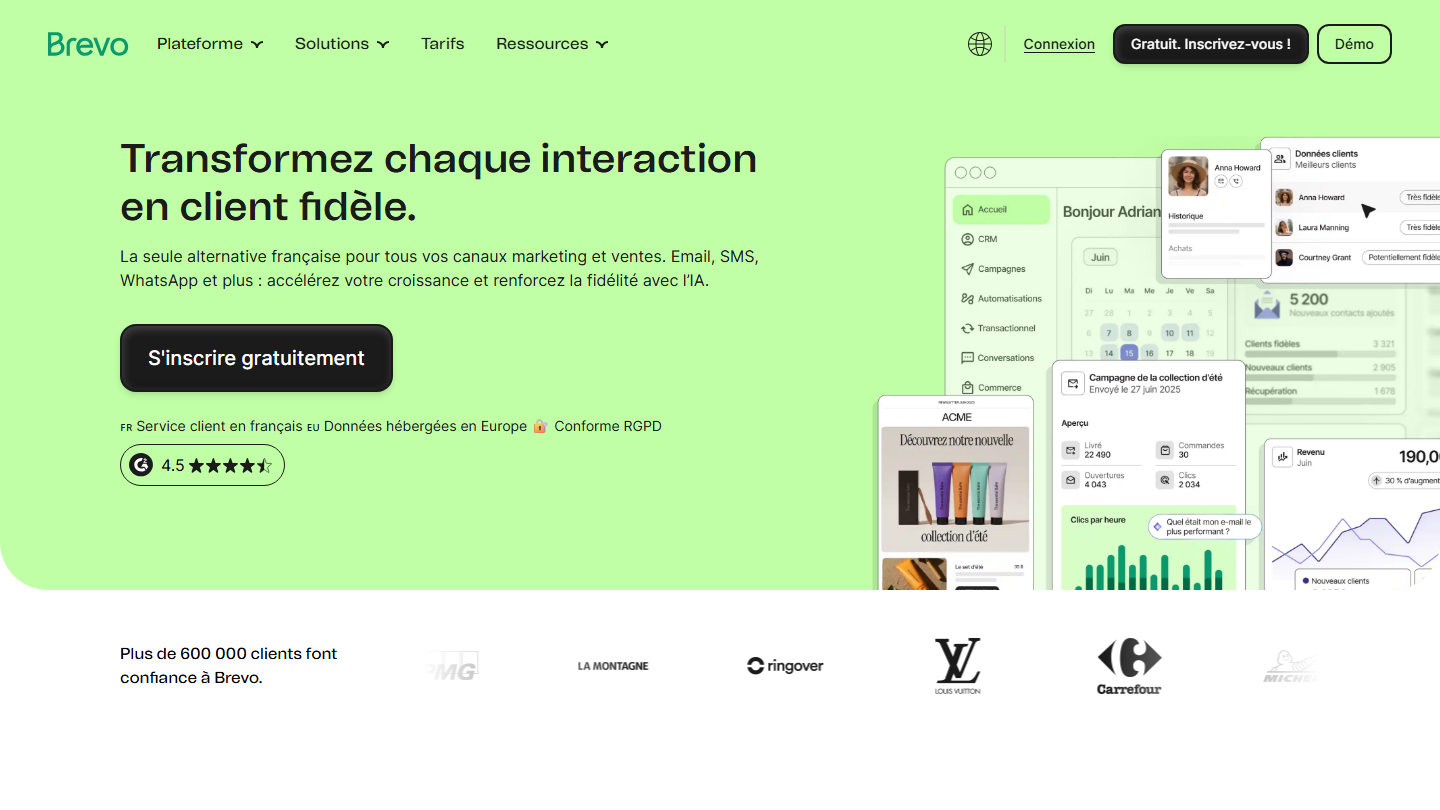
Brevo home page: «Turn every interaction into a loyal customer»

Brevo, formerly Sendinblue, is the French vendor that comes closest to the HubSpot model on a small budget: emailing, SMS, WhatsApp, automation, chat and a sales CRM in the same account.

For a team leaving HubSpot, the move happens in two steps: the contact database and the marketing scenarios first, then the pipeline in the Sales module. The free version of this CRM includes appointment booking and live chat, but only one user and 50 deals.

What you lose along the way: the depth of HubSpot’s CRM, its reports linking campaigns to sales, and lead capture as solid, since Brevo’s forms and landing pages are more limited. Contact scoring only arrives with the Pro plan.

The free plan sends 300 emails a day. Starter costs €7 per month, Standard, which adds marketing automation, €15, and Pro €499. On the sales side, Sales Essentials costs €26.08 per month billed annually, with one user included.

02

ActiveCampaign

4.5/5 From €15

Best for: B2B teams that want full marketing automation, lighter than HubSpot

+ Strengths
  • Good lead scoring and nurturing features
  • Deeper customization than HubSpot, down to reporting widgets
  • Easy to pick up, intuitive interface
  • Multi-step automations from the first plan
− Downsides
  • Oversized if you only want basic email sequences
  • Transactional emails as a paid option
  • Sales CRM as a paid module (Advanced CRM), only from Plus
★ ActiveCampaign in brief

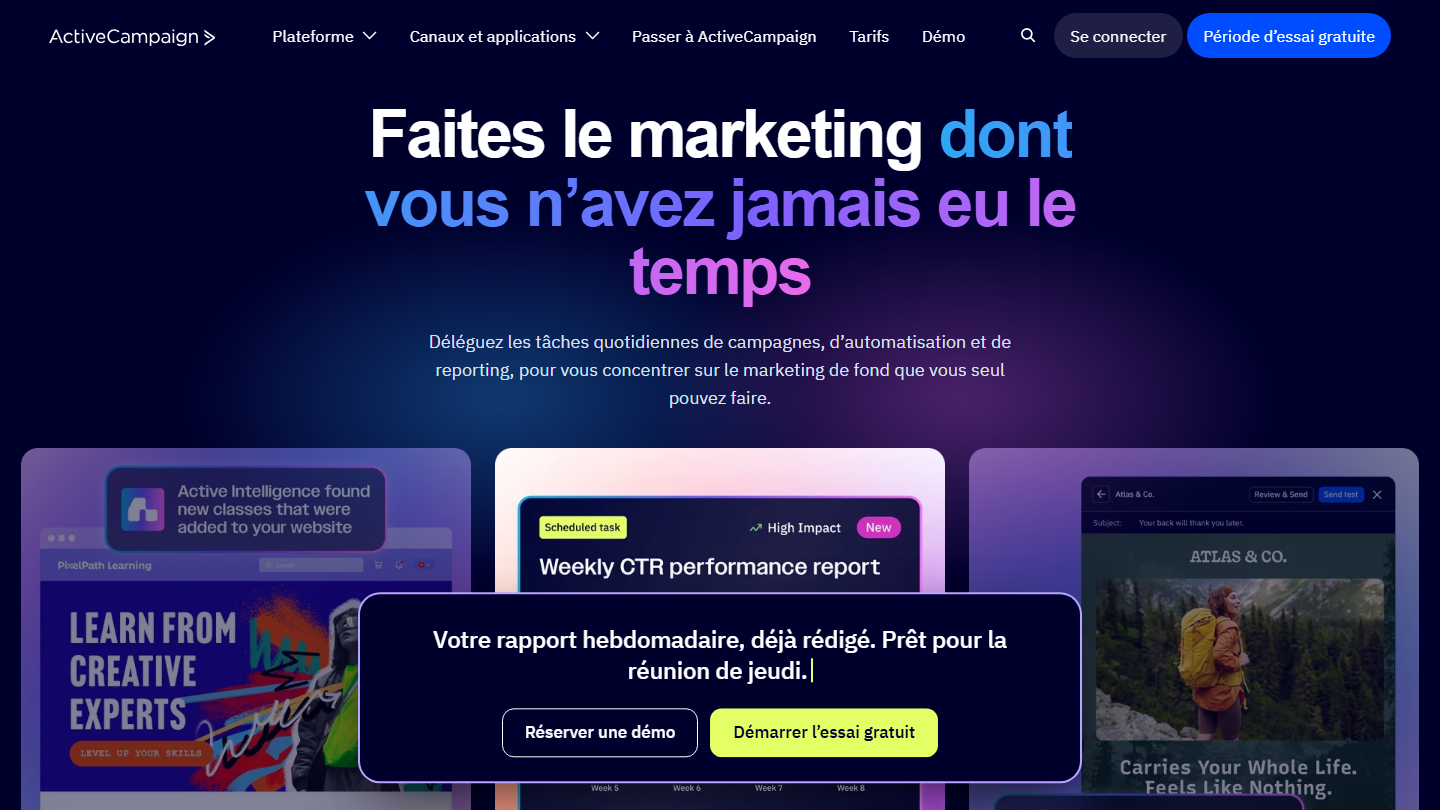
ActiveCampaign home page: «Do the marketing you never had time for»

ActiveCampaign is an American emailing and marketing automation platform, built for SMBs. Its scenario builder is one of the richest on the market, for a very low entry price.

For a team that keeps its sales CRM and only leaves Marketing Hub, it is the most direct replacement: nurturing sequences, contact scoring, if/else conditions and goals inside automations, A/B testing of journeys. These features arrive with the Plus plan; Starter is limited to multi-step automations.

The sales CRM is not included: it is the Advanced CRM module, offered from Plus. If you keep another CRM, check that the sync covers the fields your scenarios need.

Starter costs €15 per month billed annually for 1,000 contacts (€19 monthly), Plus €49, Pro €79 and Enterprise €145. 14-day trial with no credit card.

03

Intercom

4.5/5 From $29

Best for: SaaS vendors who want to engage their users on their site: chatbots, pop-ups, chat

+ Strengths
  • Powerful, intuitive segmentation engine based on behavioral targeting
  • Advanced tracking and event creation
  • Fin AI agent, billed only when it resolves the request
  • On-site channels (rich pop-ups, chatbots), plus email and SMS
− Downsides
  • A bill that adds up seats, AI resolutions and modules
  • Steep learning curve
  • Proactive messages (product tours, campaigns) sold as a separate module
★ Intercom in brief

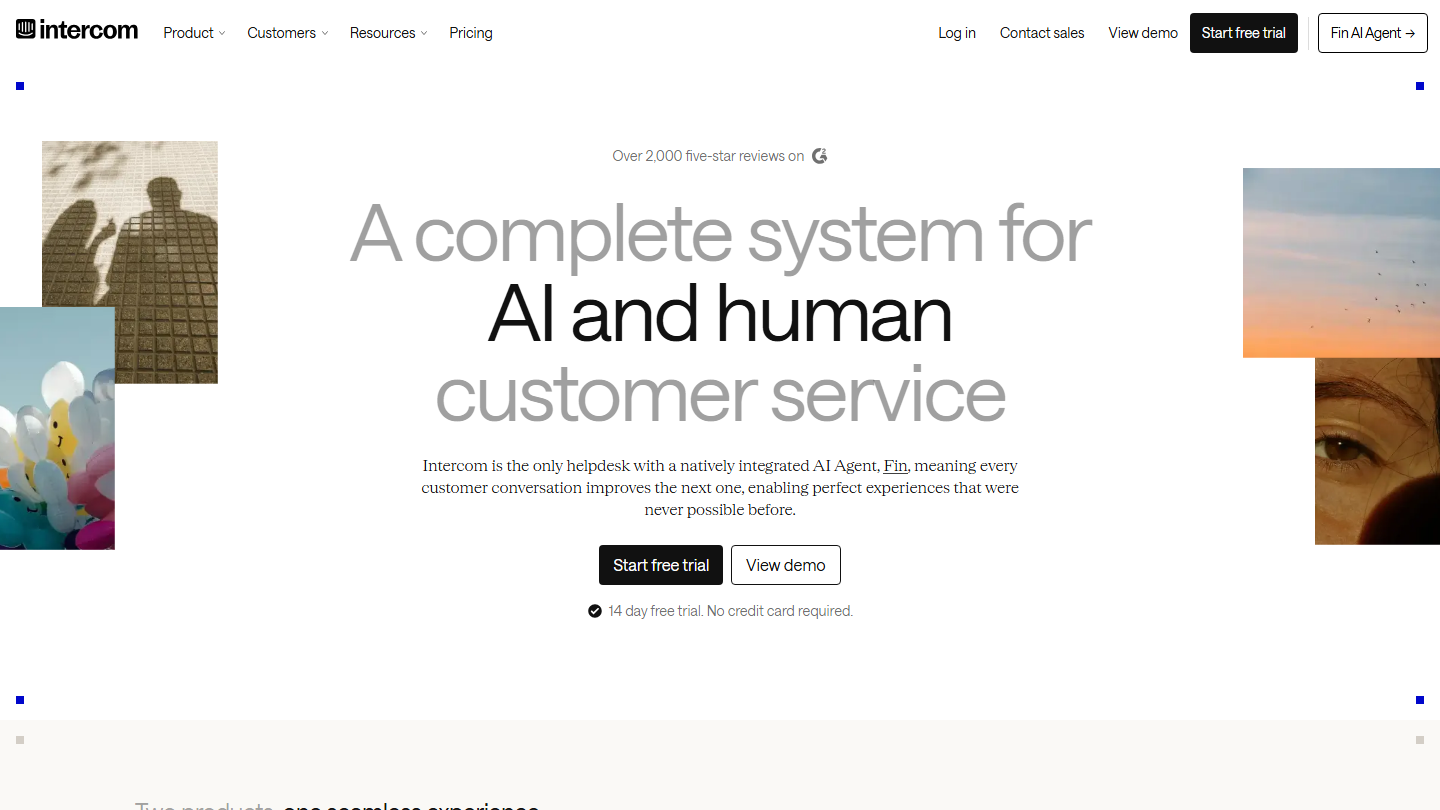
Intercom home page: «A complete system for AI and human customer service», 14-day free trial

Intercom is a customer relationship tool designed for digital products. It combines a messenger built into the software, a shared team inbox, tickets, a help center and an AI agent, Fin.

It replaces the conversational part of HubSpot (chat, chatbot, Service Hub) at a SaaS vendor. Messages are targeted based on what the user does in the product: a banner for a feature never opened, a guided tour at first login, a survey after a resolved request.

It is neither a sales CRM nor a mass emailing tool: it complements a CRM rather than replacing all of HubSpot. Proactive messages are sold as a separate module, and the bill becomes hard to predict when the AI handles a lot of requests.

Essential costs $29 per seat per month billed annually, Advanced $85 and Expert $132. Fin is billed $0.99 per resolution on all plans. 14-day trial.

04

Marketing Cloud Account Engagement (ex-Pardot)

4.3/5 From €1,250

Best for: B2B companies that already use Salesforce as their CRM

+ Strengths
  • Leads and actions synced automatically with Salesforce
  • AI lead scoring with Einstein from Plus+
  • Very effective in account-based marketing
  • Journey builder and campaign personalization
− Downsides
  • High entry ticket: €1,250 per month
  • Outside the Salesforce ecosystem, you have to hack together the connections
  • Limited landing page and email design
★ Marketing Cloud Account Engagement (ex-Pardot) in brief

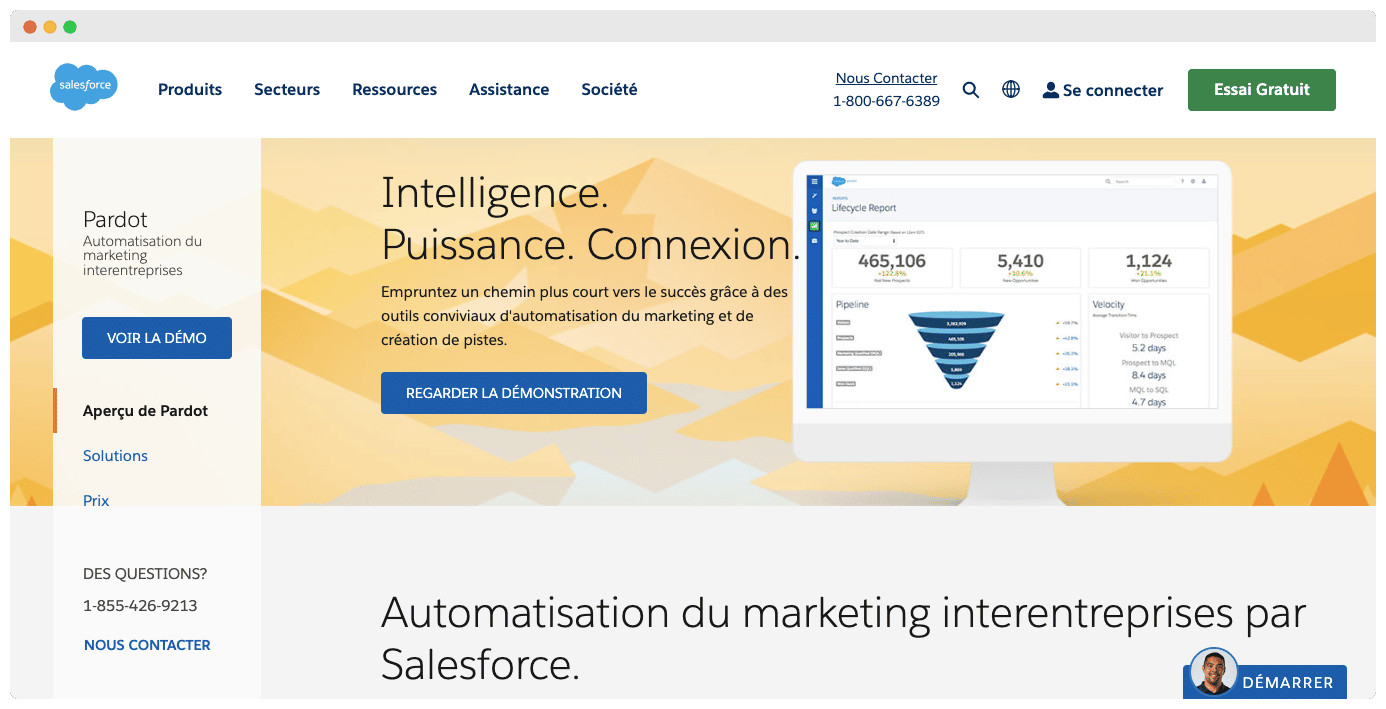
Former Pardot page on the Salesforce site: «Intelligence. Power. Connection.», with a lifecycle report

Marketing Cloud Account Engagement, formerly Pardot, is Salesforce’s B2B marketing automation tool. It handles emails, forms, landing pages, nurturing and scoring, and works directly inside the Salesforce CRM.

It makes sense in one specific case: the company leaves HubSpot for Salesforce on the sales side and wants marketing plugged into the same database. Leads and their actions flow up to the salesperson with no sync to monitor, and Einstein AI scoring ranks prospects by behavior.

Outside Salesforce, it loses its appeal: you have to hack together the connections with another CRM. It also requires an annual contract and a budget out of proportion with Marketing Hub Starter.

Growth+ costs €1,250 per month billed annually for 10,000 contacts and unlimited emails, Plus+ €2,750, with AI scoring, Advanced+ €4,400 and Premium+ €15,000. The annual contract is mandatory.

05

Customer.io

4.3/5 From $100

Best for: SaaS and mobile apps that segment on their product's events

+ Strengths
  • Unlimited segmentation, built on raw events
  • Sync with Google and Facebook audiences and with a data warehouse
  • iOS and Android SDKs to push in-app messages on mobile
  • Very developed integration catalog, Zapier connection
− Downsides
  • Requires clean event data and technical support
  • Abrupt jump from $100 to $1,000 per month between the two main plans
  • Not a CRM: no pipeline or deal management
★ Customer.io in brief

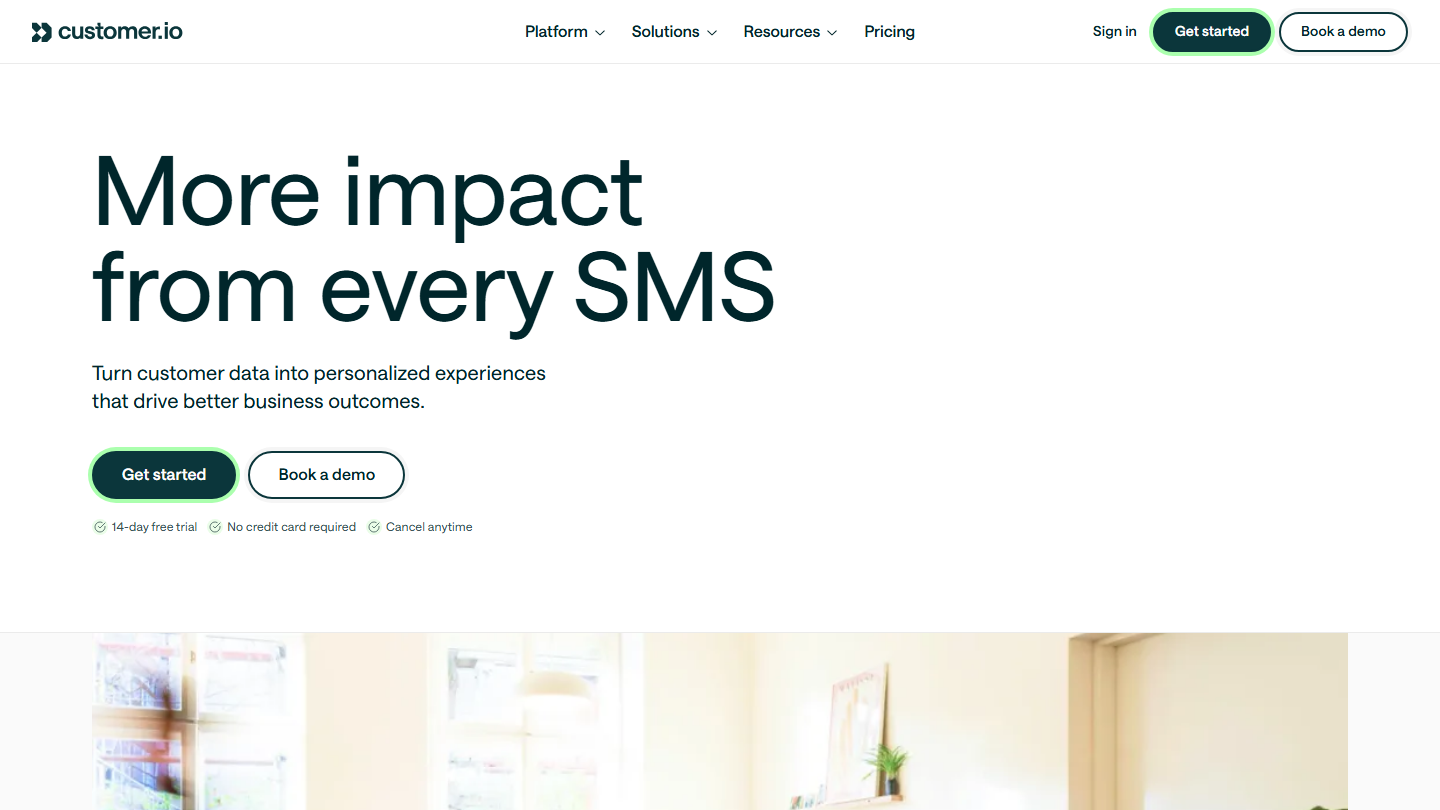
Customer.io home page: «More impact from every SMS», automated messaging platform

Customer.io is an American automated messaging platform (email, SMS, push, in-app) triggered by what users do in a digital product.

A SaaS team that uses Marketing Hub for onboarding and retention gains precision here: the app sends its events (account created, feature used, subscription about to expire), and each event can start a journey or feed a segment. HubSpot reasons mostly in contacts and properties, Customer.io in events.

It is not a CRM: no pipeline or deal tracking, so you need to keep a sales tool alongside it. You also need a developer to wire up the events properly.

Essentials costs $100 per month with no commitment for 5,000 profiles and one million emails a month, with unlimited seats; Premium starts at $1,000 per month billed annually. 14-day trial.

06

Webmecanik

4.7/5 From €450

Best for: French-speaking B2B SMBs that want scoring, nurturing and support in French, with no per-user billing

+ Strengths
  • Unlimited users and emails: only the contact database is billed
  • Lead scoring and segmentation from the first tier
  • Dedicated account manager and support in French
  • Data hosted in France, Pipeline CRM free up to 2 users
− Downsides
  • Entry ticket of €450 per month, with no small plan
  • No free trial, only a demo
  • Smaller integration catalog than HubSpot's
★ Webmecanik in brief

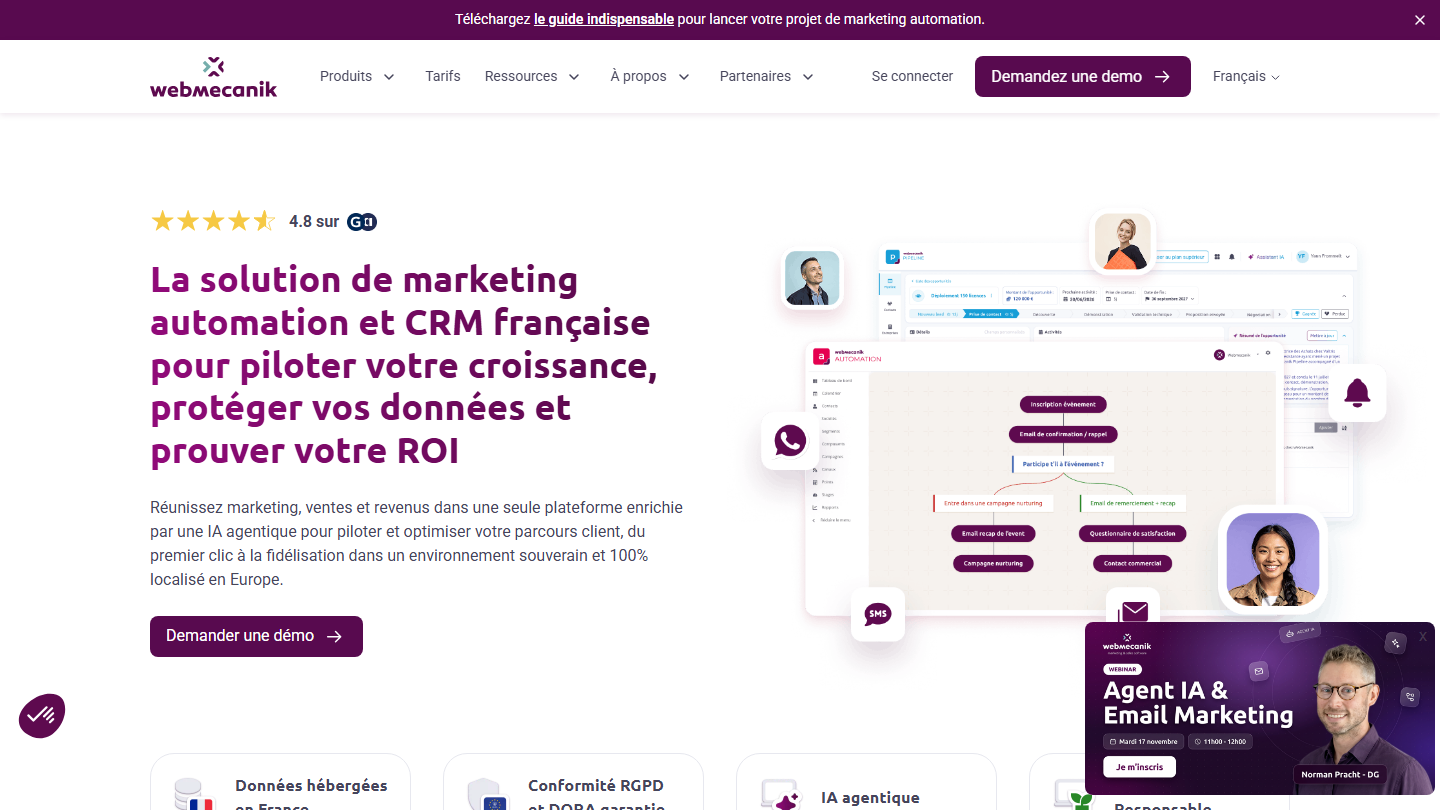
Webmecanik home page: «The French marketing automation and CRM solution to drive your growth»

Webmecanik is a French vendor based in Annecy, built on Mautic, the open source marketing automation software. It sells two products, Automation for marketing and Pipeline for the CRM, with data hosted in France.

It is the closest alternative to Marketing Hub Pro for a B2B SMB: forms, landing pages, nurturing scenarios, lead scoring and segmentation are included from the first tier. The difference is in the billing model: Webmecanik counts contacts, not users, which changes the math for a large marketing and sales team.

For a small company, the entry ticket is high and there is no trial. Pipeline remains a simpler CRM than Sales Hub: it suits classic deal tracking, not a complex sales organization.

Automation Entreprise costs €450 per month billed annually (€500 monthly) for 10,000 contacts, with unlimited emails and users, and Premium €563. Pipeline is free up to 2 users and 1,000 contacts, then €20 per user per month billed annually. Demo on request.

Alternatives to HubSpot's sales CRM

07

Salesforce

4.5/5 From €25

Best for: Organizations that run complex sales processes and want a 360-degree view of the customer

+ Strengths
  • Very complete functional depth and ecosystem of integrations and apps
  • Reporting, sales forecasts and customer tracking among the best on the market
  • Agentforce AI agents built into the platform
  • B2B marketing connected to the same customer base with Account Engagement
− Downsides
  • Complex to implement and use, less accessible than HubSpot for small teams
  • Complex pricing grids, each software suite billed separately
  • Customer support with a mediocre reputation
★ Salesforce in brief

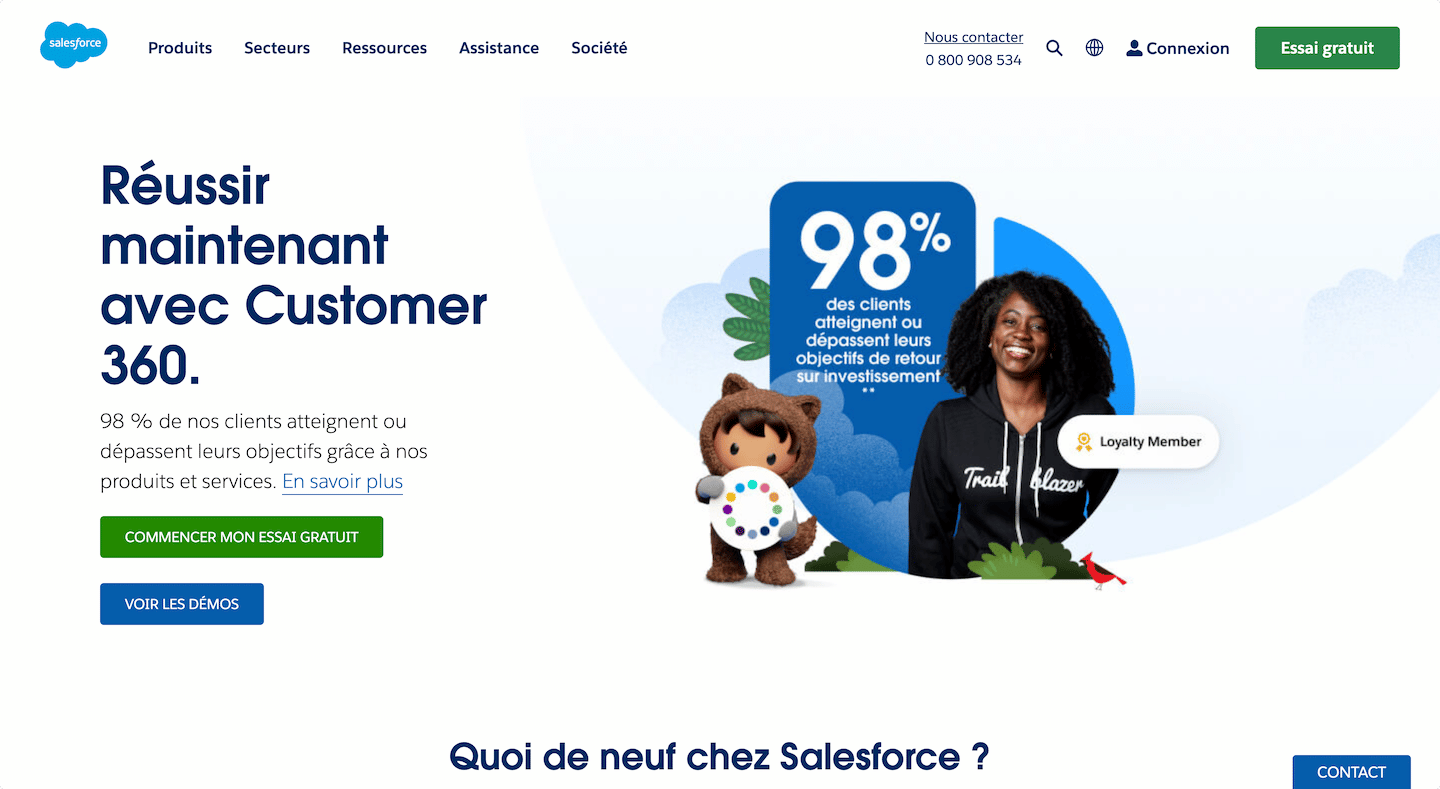
Salesforce home page: «Data + AI + CRM + Trust = better sales and happy customers»

Salesforce publishes the most widely used CRM in large sales organizations. Each need is a product: Sales Cloud for sales, Service Cloud for support, Agentforce Marketing and Account Engagement for marketing.

You leave HubSpot for Salesforce when the CRM no longer keeps up: territories, several sales teams, long cycles with many contacts per account, forecasts to consolidate. Salesforce structures everything around the customer account, and its AppExchange marketplace covers the cases that HubSpot’s integrations leave aside.

The downside is well known: a real deployment project, often with an integrator, and a total cost that adds up product by product. For a small team, HubSpot remains simpler to run.

There is a free Suite, with no mobile app. To replace HubSpot Starter, the Starter Suite, emailing included, comes to €25 per user per month; count €100 billed annually for the Pro Suite and from €195 for Sales Cloud. The trial lasts 30 days.

08

Pipedrive

4.5/5 From €14

Best for: B2B sales teams that prospect heavily and manage a large flow of deals

+ Strengths
  • Deal-centric CRM with a very intuitive interface and a well-crafted Kanban view
  • Very capable mobile app
  • Good management of sales tasks and reminders
  • Very good quality integrations
− Downsides
  • Less powerful than HubSpot in automation
  • Marketing emailing as a paid add-on (Campaigns, from €13.33 per month)
  • Limited reporting for very analytical use
★ Pipedrive in brief

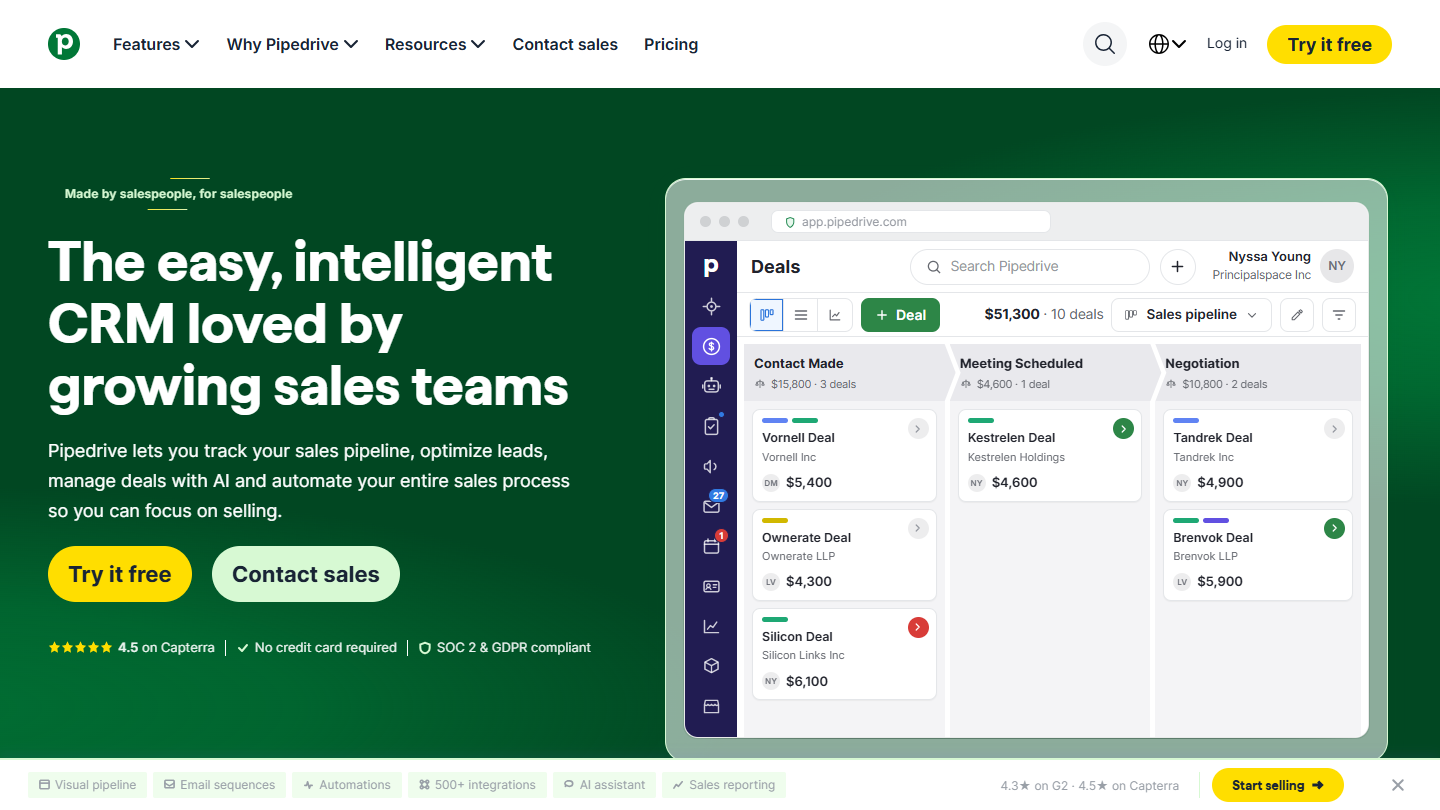
Pipedrive website: “The easy, intelligent CRM loved by growing sales teams”

Pipedrive is a sales CRM built around the pipeline: each deal moves from stage to stage, and the tool reminds the salesperson of the next action to take.

For a team that only uses HubSpot’s Sales Hub, the switch is simple: contacts, companies and deals are found in a Kanban view, with follow-ups, email tracking and a polished mobile app. Marketing can stay in an emailing tool plugged in through an integration.

It is less powerful than HubSpot in automation, and its native marketing features are thin: emailing goes through the Campaigns add-on, lead capture through LeadBooster. The reporting is enough to run a pipeline, less so for fine analysis.

Lite costs €14 per seat per month billed annually, Growth €39, Premium €59 and Ultimate €79. Campaigns starts at €13.33 per month, LeadBooster at €32.50. 14-day trial.

09

Zoho CRM

4.2/5 From €14

Best for: Under-equipped B2B SMBs that want a complete, affordable CRM at the heart of a software suite

+ Strengths
  • Very complete in sales automation and sales process building
  • More affordable alternative to HubSpot
  • Zoho One gives access to all the apps in the Zoho suite
  • Free edition up to 3 users, one more than HubSpot
− Downsides
  • Less intuitive interface and more limited dashboard than HubSpot
  • Lighter reports and less powerful automations than HubSpot
  • 7-day support as a paid option, and in English
★ Zoho CRM in brief

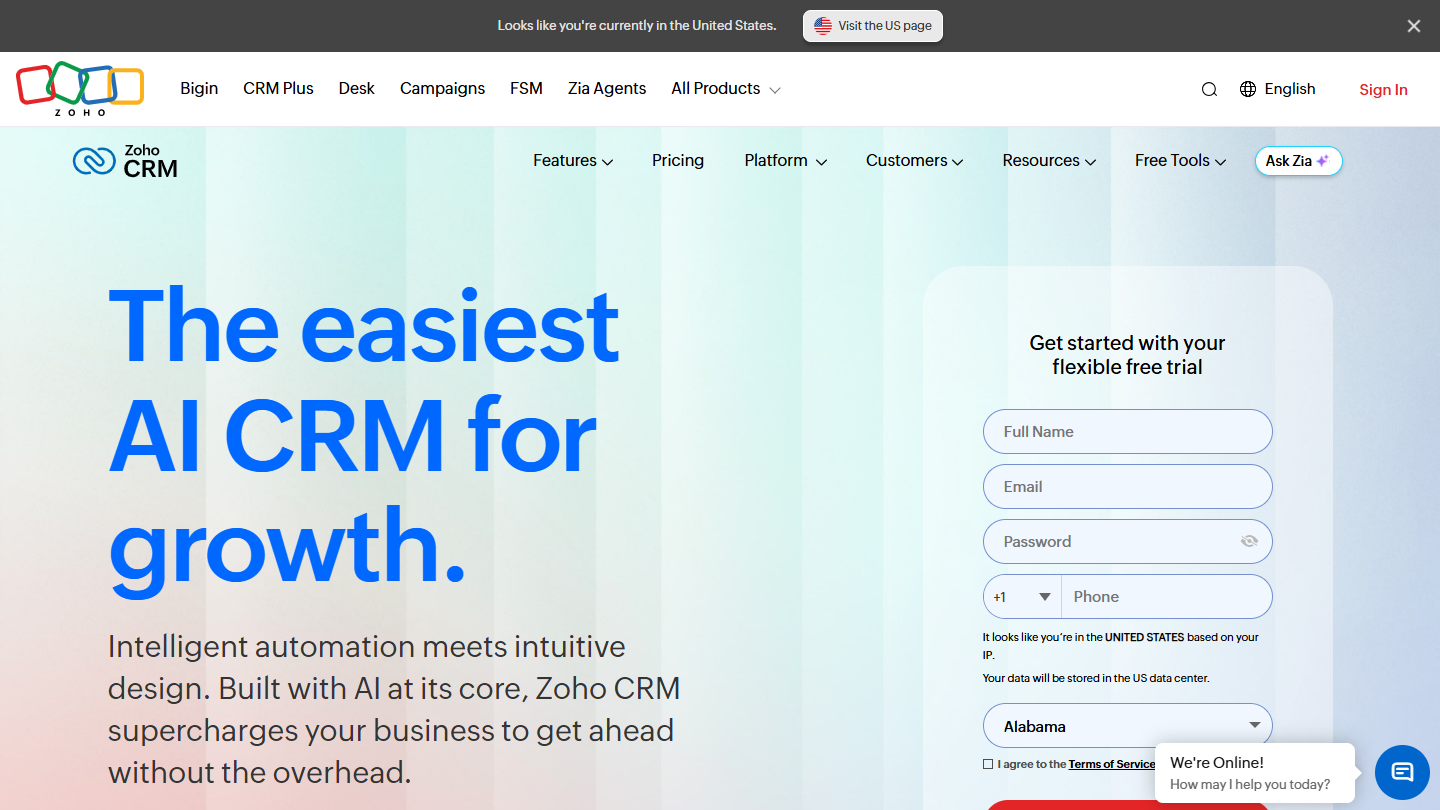
Zoho CRM website: “The easiest AI CRM for growth.”

Zoho CRM is the CRM from Zoho, an Indian vendor whose suite includes dozens of apps: emailing with Zoho Campaigns, marketing automation, support, invoicing, projects. The Zoho One offer bundles them under a single subscription.

It is the closest way to rebuild HubSpot piece by piece: the CRM handles the pipeline, automated sales tasks and reports, and the other Zoho apps plug into it with no third-party connector. Importing lists and files makes the move from HubSpot easier.

Compared with HubSpot, the interface is less intuitive, dashboards and reports are lighter, and automations are harder to build. The price gap, on the other hand, becomes clear as soon as you go beyond a few users.

Three users can work on the free edition. Billed annually, count then €14 per user per month on Standard, €23 on Professional, €40 on Enterprise and €52 on Ultimate. Zoho One can be tried free for 30 days.

10

monday CRM

4.0/5 From €12

Best for: Companies that sell projects or complex services and track their progress

+ Strengths
  • Hundreds of CRM and project templates
  • Intuitive interface, well-done sales pipeline management
  • Better than HubSpot for tracking complex projects
  • Fully customizable boards and field types
− Downsides
  • Sales features less powerful than HubSpot's: sales floor, reporting, forecasting
  • No free plan, 3 users minimum
  • Limited native integrations, reliance on Zapier
★ monday CRM in brief

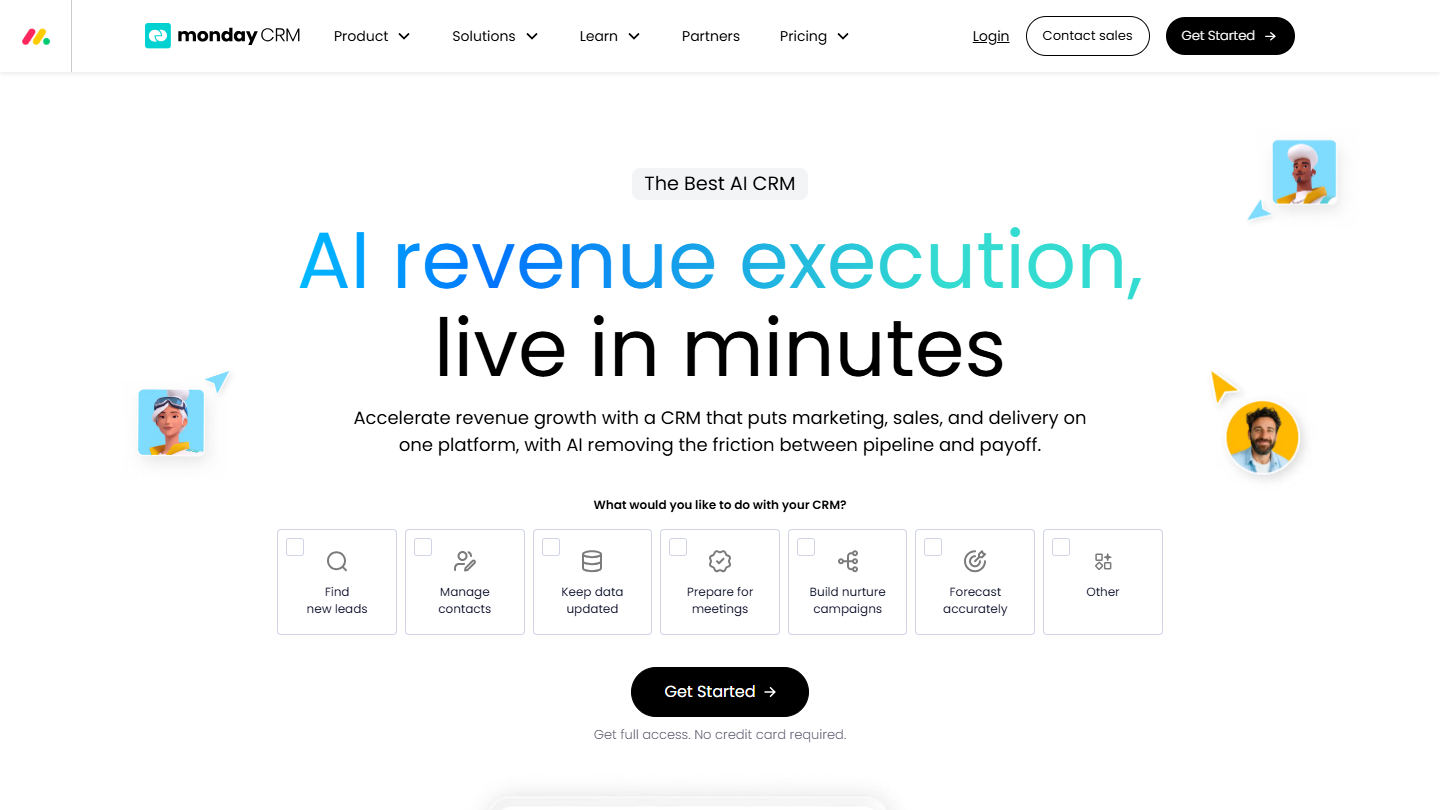
monday CRM website: “AI revenue execution, live in minutes”

monday CRM applies the logic of monday.com boards, known for project management, to sales. Each deal is a row, each column a piece of information: stage, amount, follow-up date, owner.

It replaces HubSpot well when what comes after signature matters as much as the sale: the won deal becomes a project tracked by the delivery team, with no re-entry. Automations move items, assign tasks and send reminders.

On pure sales, it stays below HubSpot: sales floor, reports and forecasts are less advanced, and there is nothing comparable to Marketing Hub. You also have to pay for at least 3 seats, whereas HubSpot starts free at 2 users.

Basic costs €12 per user per month billed annually (€18 monthly), Standard €17 and Pro €28. No free plan, 14-day trial.

11

Freshsales

4.5/5 From €9

Best for: Teams that want a CRM that is simple to set up, with AI-based contact scoring

+ Strengths
  • Simpler to use and configure than HubSpot, with better assistance
  • AI contact scoring on all paid plans
  • Drag-and-drop pipeline view and customizable dashboards
  • Phone and email support 24 hours a day on weekdays
− Downsides
  • Support and documentation in English only
  • Only about thirty native connectors
  • No free plan, 21-day trial
★ Freshsales in brief

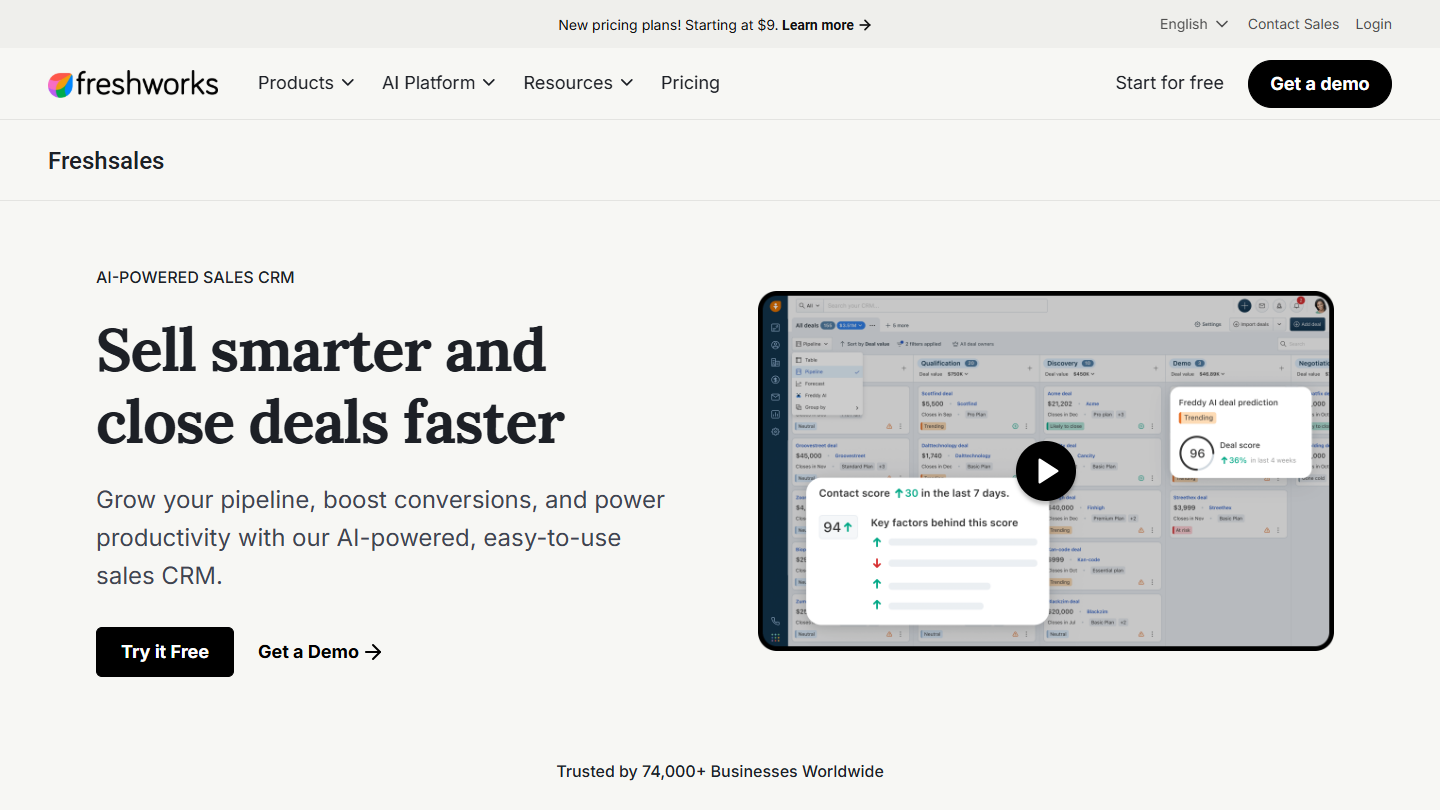
Freshsales website: “Sell smarter and close deals faster”

Freshsales is the sales CRM from Freshworks, the vendor behind Freshdesk. It brings together contacts and accounts, pipeline, telephony, emails and sequences, with an AI assistant, Freddy.

To leave HubSpot, it is a Sales Hub alternative that is easier to configure: the pipeline view is adjusted by drag and drop, contacts receive an AI-calculated score, and dashboards are built without needing a high-end plan.

Freshworks also sells a marketing tool, Freshmarketer, but the whole remains less integrated than the HubSpot platform, and the integration catalog is clearly shorter.

Billed annually, Growth comes to €9 per user per month, less than half of HubSpot Starter, Pro at €39 and Enterprise at €59. No free plan: the trial lasts 21 days.

Alternatives to HubSpot as an all-in-one platform

12

Odoo

4.0/5 From €24.90

Best for: SMBs that want CRM, marketing, quotes and invoicing in one piece of software, at the same price per user

+ Strengths
  • CRM, emailing, SMS, marketing automation and live chat among the apps in the Standard plan
  • One price per user for all apps, with no contact tiers
  • Quotes, invoicing and accounting in the same software
  • One app of your choice free, unlimited users
− Downsides
  • ERP interface and vocabulary, heavier than HubSpot's
  • Marketing less polished than Marketing Hub
  • Only one free app: adding emailing to the CRM makes the whole team start paying
★ Odoo in brief

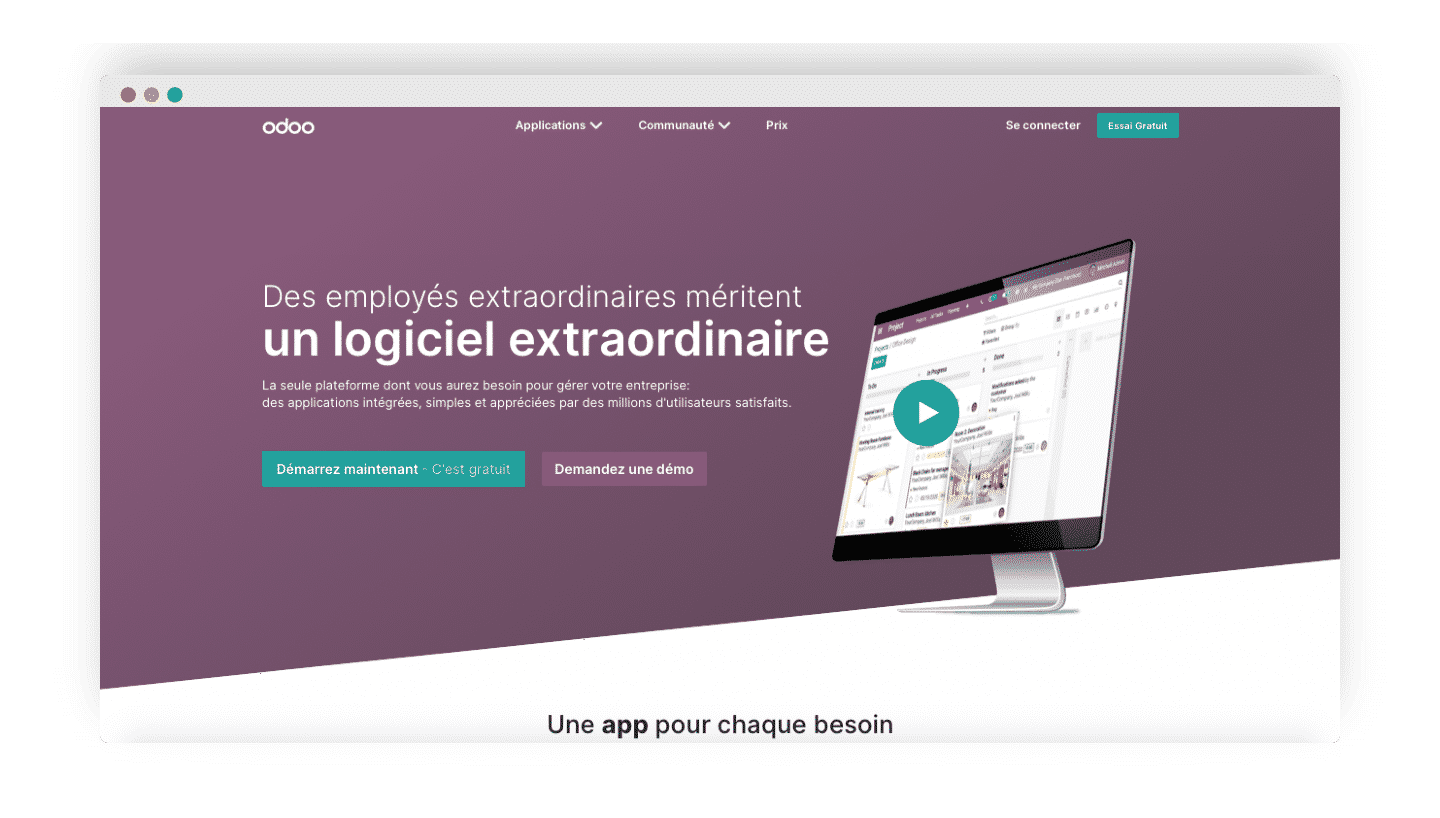
Former Odoo home page: «Extraordinary employees deserve extraordinary software»

Odoo is a Belgian business management software organized into apps you activate on demand: CRM, emailing, marketing automation, SMS, website and live chat, but also sales, invoicing, accounting or inventory.

For a company leaving HubSpot, the benefit is to bring together what HubSpot leaves to other tools: a lead captured by a website form enters the CRM, receives automated emails, then becomes a quote and an invoice without changing software.

Odoo is justified if you also plan to equip management. For marketing alone, it remains less advanced than HubSpot, and its ERP interface takes a while to get used to for salespeople used to a pure CRM.

One app of your choice is free, with no user limit. For CRM and marketing together, you need the Standard plan: €24.90 per user per month billed annually, €31.10 with no commitment. The customization studio and hosting on your own servers are reserved for the Custom plan, at €44.90.

How we chose these 12 tools

Every tool in this selection has been used in real conditions by our team or by a Salesdorado consultant, in a B2B sales and marketing setting. No ranking built from a marketing deck. The order of the list is not a ranking: the right tool depends on your needs.

  1. 01
    Benchmark scope

    Broad identification of the tools on the market (G2, Capterra, Salesdorado customer feedback, LinkedIn signals). Initial filtering, then a short list based on a 2-hour setup per tool.

  2. 02
    Test conditions

    3 to 4 weeks of active use per tool, with data representative of a B2B sales use case. When a tool targets a specific profile (SDR, AE, Ops, Marketer…), we match the tester accordingly.

  3. 03
    Weighted criteria

    For each category, 5 to 7 axes weighted according to what matters in the segment: UX, feature depth, native integrations, support, pricing at scale, compliance (GDPR, security), and roadmap quality.

  4. 04
    Independence

    No tool is scored in exchange for payment. Partner links (affiliate) are marked as such and do not influence the score. Non-partner tools are included when their place in the ranking is deserved.

  5. 05
    Updates

    The ranking is reviewed every 6 to 12 months or on every major release of a tool mentioned. The date of the last check is shown at the top of the article.

The questions we get over and over.

Why look for a HubSpot alternative?

HubSpot is free up to 2 users, then billed per seat: €20 per month on Starter, €90 on Pro and €175 on Enterprise. Advanced automations and custom reports require a paid plan, and the bill climbs fast with team size. If you only use part of the platform, a specialized tool often costs less.

What are the limits of HubSpot's sales CRM?

In the free version, you cannot create custom reports, and recurring tasks require a paid seat. The old limit of a single email address per contact is gone, though: all plans accept several.

Which HubSpot alternative for marketing automation?

Brevo for a tight budget, ActiveCampaign for advanced scenarios at a reasonable price, Webmecanik for a French vendor with hands-on support. Account Engagement (formerly Pardot) suits B2B Salesforce users, and Customer.io and Intercom suit SaaS vendors who target their messages based on product usage.

Which alternative to HubSpot's CRM?

Salesforce for complex sales processes, Pipedrive for a simple pipeline and a high volume of deals, Zoho CRM for a complete suite at a lower price, Freshsales for its easy setup, and monday CRM for those who sell projects.

Which alternative to HubSpot as an all-in-one platform?

Brevo for freelancers, very small businesses and small SMBs; Zoho, whose Zoho One offer bundles all of the vendor's apps; Odoo if you also want to manage sales, invoicing and accounting; and Salesforce for large organizations, which put sales, service and marketing on a single customer base.

★ The conversation, 0 comments

What the community says.

Basic Markdown, moderated within 24 h
Loading…

    In the same category