


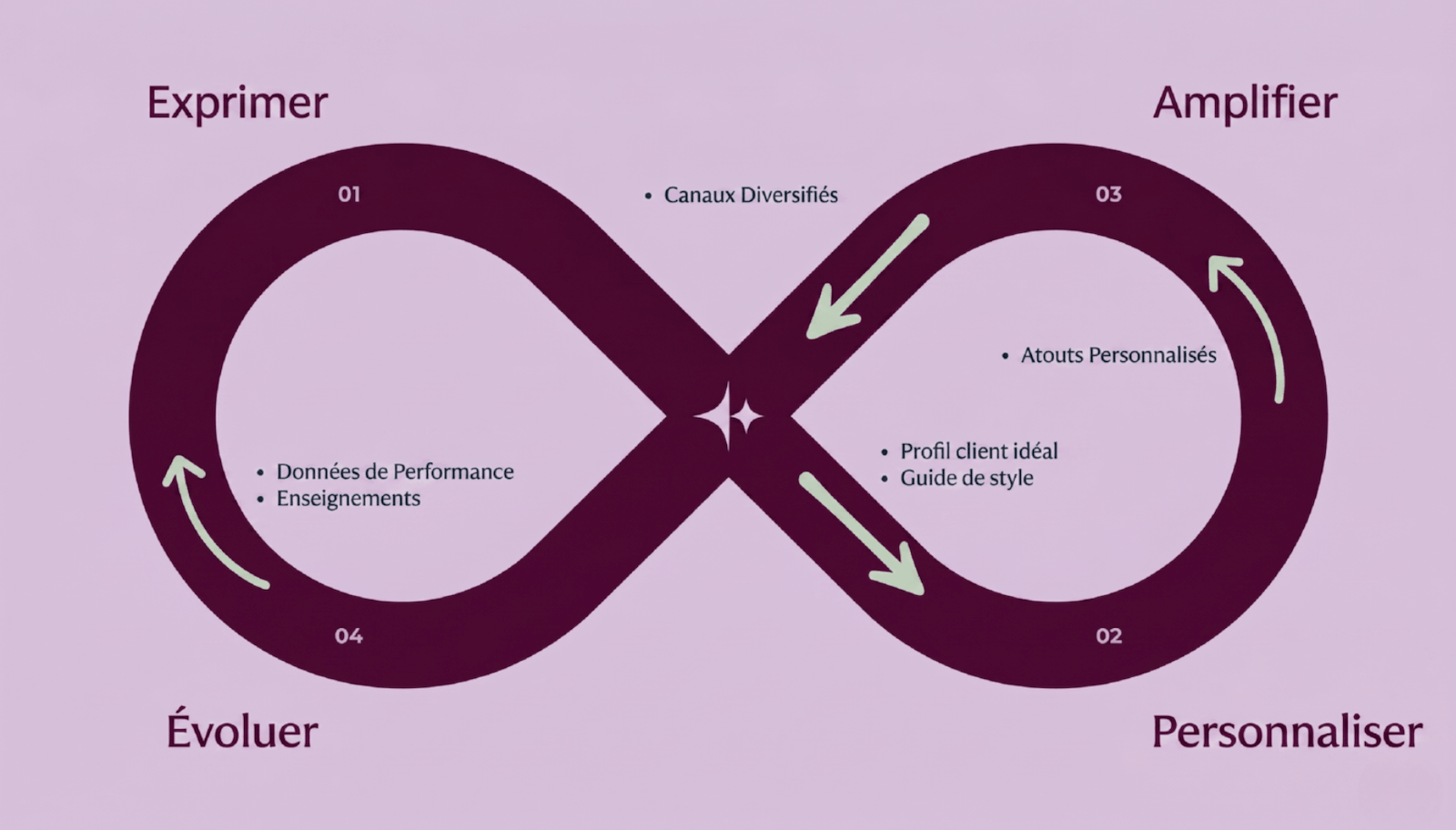
- Four phases in a loop: Express, Tailor, Amplify, Evolve. Each cycle feeds the next.
- AEO, to get cited in the answers of ChatGPT, Perplexity or Gemini, is the only truly new topic in the framework.
- ICP, style guide, intent-based segmentation, A/B tests: a repackaging of practices already known.
- You don’t need HubSpot to apply it, but you then have to orchestrate around ten tools.
- Without a structured marketing strategy, start with the foundations: this is an optimization framework, not a starter framework.
In 2025, HubSpot declared the marketing funnel dead. In its place, a new framework called Loop Marketing, presented as the go-to strategy for the AI era. Four phases, a loop that learns, AI everywhere. On paper, it sounds like a revolution.
After a close read, we honestly wonder whether it’s a real break or a nice repackaging. The honest answer: a bit of both. There is real change (notably around AEO and the role of AI), there are concepts already known under other names and, above all, there is a strong strategic stance that every B2B marketing team should understand, whether or not it uses HubSpot.
In this article, we break down the framework, identify what really changes, walk through a concrete phase-by-phase rollout with the HubSpot tools involved and the plans required, and tell you honestly who all of this is for.
HubSpot’s official Loop Marketing guideHubSpot offers a complete strategic guide to Loop Marketing with more than 100 free AI prompts, designed for each phase of the framework. A good starting point for anyone who wants to test the approach.
What is HubSpot Loop Marketing?
Loop Marketing is the 4-phase strategic framework HubSpot launched in 2025 to respond to the changes marketing is going through in the AI era.
The 4 phases of the framework are:
- Express: express your brand identity.
- Tailor: adapt the message.
- Amplify: extend multi-channel reach.
- Evolve: adjust in real time.
Together they form a continuous loop that learns with each cycle, as opposed to the classic linear funnel.
The central idea: combine human authenticity (strategy, creativity, judgment) with AI efficiency (execution, personalization, optimization). Loop Marketing isn’t a product or a feature, it’s a methodological infrastructure. HubSpot specifies that you don’t need to change your marketing environment to apply it: the tools already in place (CRM, email sequences, content library) fit into it.
As HubSpot puts it: “The loop turns. It learns.” And each pass makes the next one more precise.
Why did HubSpot replace the funnel with a loop?
To judge whether HubSpot Loop Marketing is relevant, you have to understand the strategic diagnosis behind it.
It all starts from 3 observations:
- Buyers no longer click the way they used to. In B2B as in B2C, a growing share of searches starts on ChatGPT, Perplexity, Gemini or Claude rather than on Google. These answer engines respond directly to the question, without sending people to websites. As a result, click-through rates on traditional SERPs are falling. Traditional SEO is still useful, but it’s no longer enough.
- Channels have exploded. On top of websites and email came YouTube, TikTok, Reddit, podcasts, Slack and Discord communities, vertical platforms like G2 or Capterra, and more.
- A B2B buying journey now runs through several of these channels. Put plainly, the linear funnel that assumes an ordered journey (awareness, consideration, decision) no longer captures reality.
AI speeds up execution cycles. What used to take a quarter now takes a few days thanks to AI agents. A strategy reviewed once a quarter is behind the market. You need a much tighter iterative logic.
Hence HubSpot’s response: replace the linear funnel with a continuous loop, make AEO a strategic dimension on a par with SEO, and put AI at the heart of execution.
Salesdorado’s takeHubSpot’s diagnosis is right, and it goes well beyond HubSpot. Any B2B marketing team that hasn’t started building AEO into its strategy is falling behind. Whether or not you adopt the Loop Marketing framework, you have to think through these three shifts.
The 4 phases of HubSpot Loop Marketing, explained simply
Here are the 4 phases of Loop Marketing in detail, with what you do at each stage, the HubSpot tools involved and the minimum HubSpot subscription plan required to run the phase end to end.
Phase 1, Express: express your brand’s unique identity
AI can generate content in seconds, but without a clearly defined brand voice, it produces flat, generic content. The Express phase means giving AI a clear framework so that it reflects your identity, your tone and your point of view.
What you actually do:
- Define the ideal customer profile (ICP) by running AI on customer reviews, call transcripts, comments and community discussions. See our article on the method for creating an actionable ICP.
- Build a brand style guide that sums up your mission, your tone, the dos and don’ts, your must-haves.
- Generate campaign concepts aligned with your identity.
HubSpot tools involved:
- Breeze Assistant to use CRM data and generate concepts and personas.
- Brand Identity tool (Beta) to create an AI style guide you can reuse across all materials.
- Marketing Studio (Beta) to turn a brief into multi-channel assets.
Plan required: Pro plan (€90 per month per seat billed annually, €100 billed monthly) for Marketing Studio and brand identity, which the price list calls “brand voice”. Marketing Studio is only partial on this plan: the full version requires the Enterprise plan. Breeze Assistant is included starting with the free tools.
Phase 2, Tailor: adapt your message to each audience
Classic personalization (“Dear {First name}”) is no longer enough. The Tailor phase aims to deliver truly personal messages, based on behavioral data, intent signals and unified context.
What you actually do:
- Enrich data with behavioral signals, intent data and contextual information (company size, industry, technologies used, hiring signals).
- Define audience segments by intent rather than by demographics alone.
- Personalize content dynamically (landing pages, emails, CTAs, ads) based on industry, role and timing.
- Keep human quality control to make sure personalization stays accurate and CTAs match the lifecycle stage.
HubSpot tools involved:
- AI-powered segmentation (Beta) to identify high-intent segments.
- Personalization (Beta) to create targeted content variants.
- AI-optimized emails (Beta) to generate personal emails from CRM data.
Plan required: Pro plan for AI segmentation and personalization of nurturing emails (nurturing agent). Company intent signal tracking is included from Starter.
The trapThe temptation is to personalize everything, everywhere, automatically. Bad idea. Poorly calibrated personalization (for example, mentioning a prospect’s exact job title in a cold email) tips over into “creepy” very quickly. Keep human control over AI-generated variants, especially on the first emails of a sequence.
Phase 3, Amplify: extend your reach across every channel (including LLMs)
Publishing quality content is no longer enough. The Amplify phase pushes your message to every channel where your buyers search (ChatGPT, YouTube, TikTok, Reddit, LinkedIn, Capterra, communities) and to the voices they trust (creators, peers, experts).
What you actually do:
- Optimize content for answer engines (AEO) by tracking brand visibility on ChatGPT, Perplexity and Gemini, and adjusting content so it gets cited.
- Diversify channels and formats: one main asset becomes a ChatGPT-optimized article, a vertical TikTok video, a LinkedIn carousel, a podcast episode.
- Work with trusted creators in the target industry.
- Launch smart ads (Google Performance Max, Meta, LinkedIn).
- Optimize each touchpoint with contextual CTAs.
HubSpot tools involved:
- Marketing Studio (Beta) to plan and deploy multi-channel assets.
- AEO (Beta) to analyze and improve visibility in AI engines.
- Video marketing, including short video clip creation.
Plan required: Pro plan for HubSpot AEO and short video clips. Enterprise for full Marketing Studio.
Phase 4, Evolve: adjust your strategy in real time
The phase that closes the loop. The goal: turn each campaign into a source of learning for the next one and move from a quarterly rhythm to short cycles.
What you actually do:
- Anticipate before publishing by using AI to predict likely performance and spot weaknesses.
- Monitor performance in real time by automatically highlighting anomalies.
- Run quick experiments (A/B tests on headlines, offers, audiences).
- Document what you learn for the next cycle.
HubSpot tools involved:
- Marketing analytics for unified multi-channel reporting.
- Email engagement optimization (Beta) to predict the recipients most likely to engage.
- ChatGPT deep research connector to use HubSpot context in external analyses.
Plan required: Pro plan for customer journey analytics (15 steps per report), custom reports and A/B tests. Email engagement optimization doesn’t appear in the price list.
AEO: what really changes with HubSpot Loop Marketing
If you had to remember just one thing about Loop Marketing, it would be the serious integration of AEO as a strategic dimension. It’s probably the framework’s most far-reaching new element.
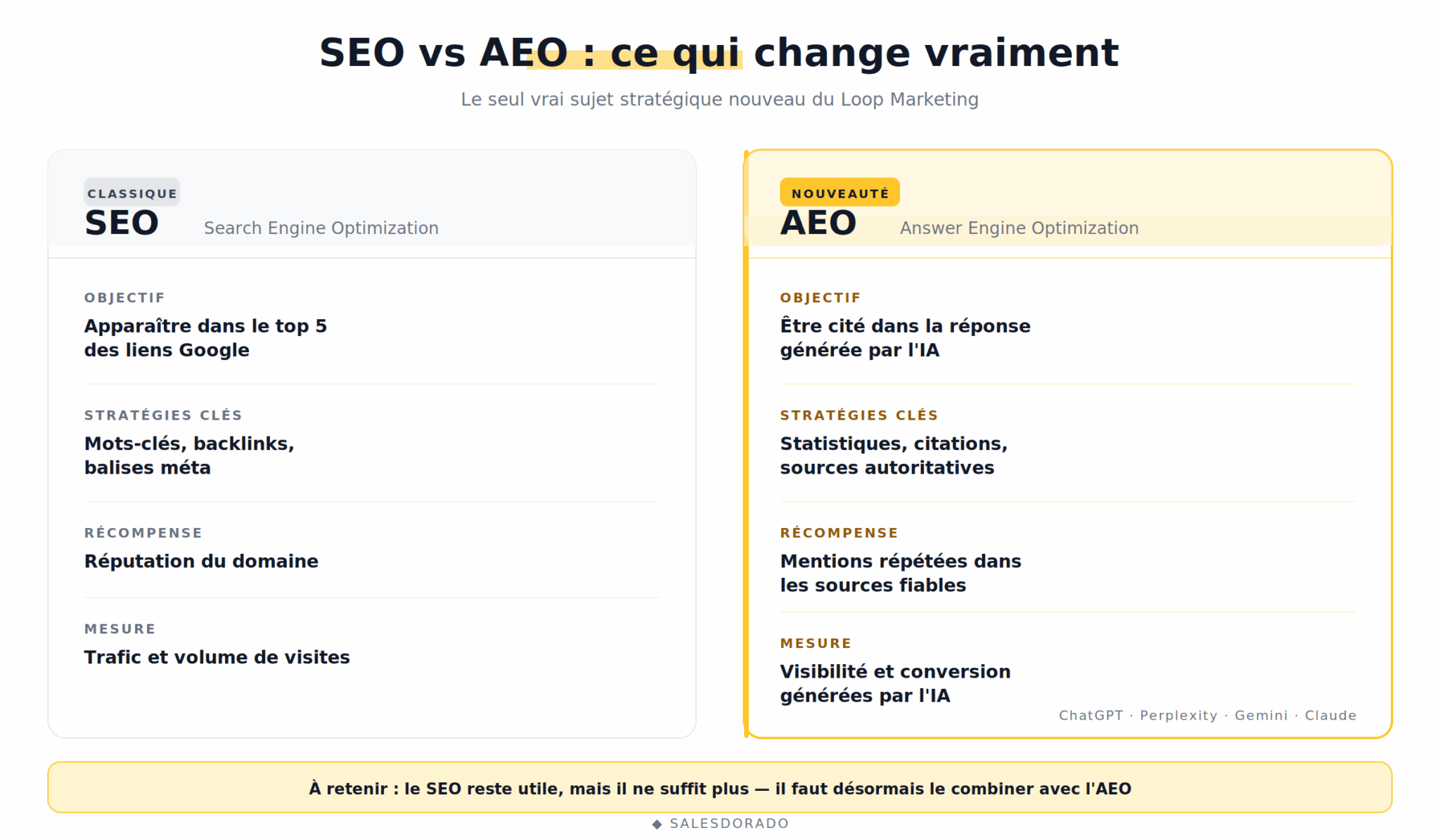
AEO (Answer Engine Optimization) means optimizing for AI answer engines (ChatGPT, Perplexity, Claude, Gemini). Where SEO aims to appear in the top 5 Google results, AEO aims to be cited in AI-generated answers. It’s a deep change of logic.
| Dimension | SEO | AEO |
|---|---|---|
| Goal | Appear in the top 5 links | Be cited in the answer shown |
| Key strategies | Keywords, backlinks, meta tags | Statistics, citations, authoritative sources |
| Reward | Domain reputation | Repeated mentions in reliable sources |
| Measurement | Traffic and visit volume | Visibility and AI-driven conversion |
HubSpot has released a dedicated AEO tool called AEO Grader (free) that analyzes how ChatGPT, Perplexity and Gemini present a brand, positions it against its competitors and takes into account the sources these engines use. The tracking version, HubSpot AEO, is included in the Pro and Enterprise plans.
In practice, for a B2B marketing team, this means structuring content around specific questions (FAQs, guides, comparisons), favoring sourced statistics and authoritative citations, and taking care of your presence on reliable third-party sources.
SEO is still useful, but it now has to be complemented by a dedicated AEO strategy.
Salesdorado’s take on AEOWhether or not you adopt Loop Marketing, AEO has become a topic you can’t ignore. If your marketing team hasn’t started structuring its content for AI answer engines, now is the time. It’s probably the only truly new strategic topic in Loop Marketing and, in our view, the one that will have the greatest impact on your visibility over the next 18 months.
Loop Marketing vs inbound marketing: what really changes
HubSpot officially states that Loop Marketing doesn’t replace inbound marketing but complements it for the AI era.
That’s fair, and you have to separate what’s truly new from what’s repackaging:
- What’s truly new: AEO as a strategic dimension in its own right (with dedicated tools and its own KPIs), the central role of AI in execution (and not just in content production), the logic of a loop that learns as opposed to the linear funnel, and the faster optimization cycle (days instead of quarters).
- What’s repackaging: the ICP and the style guide already existed in any serious inbound strategy. Growth teams have been handling intent-based segmentation and personalization for years. Continuous optimization and A/B testing are classic growth marketing.
The real value of the framework therefore doesn’t lie in its conceptual originality, but in its ability to structure a coherent response to a paradigm shift that many marketing teams are enduring without a framework. Loop Marketing offers a shared vocabulary, an organized checklist and an integrated vision. That’s useful, even if it isn’t revolutionary. For the fundamentals, see our content marketing examples.
Does Loop Marketing work without HubSpot?
Fair question. HubSpot doesn’t make its platform a condition: you don’t need to change your marketing environment, the tools already in place can fit into the approach. It’s a methodological infrastructure, a “framework”, not a product. But unifying everything in one platform brings real value, especially for the phases that rely on cross-referenced real-time data.
If you’re not on HubSpot, here are the functional equivalents by phase:
- Express: ChatGPT or Claude for generation, Notion for the style guide.
- Tailor: Clay or Apollo for enrichment, your CRM for segmentation, Hyperise for landing page personalization.
- Amplify: Buffer or Hootsuite for distribution, specialized AEO tools, Opus Clip for video clips.
- Evolve: Google Analytics 4, VWO or AB Tasty for A/B testing.
The trade-off: you manage 10 to 15 different tools instead of a single platform. It’s doable, but it takes a RevOps team able to orchestrate all of it. This is precisely the tension between the best-of-breed approach and the integrated platform HubSpot advocates. To dig into this debate, see our comparison of marketing automation software and our HubSpot alternatives.
How much does it cost to implement Loop Marketing in HubSpot?
For a broader analysis of HubSpot pricing, see our complete guide to HubSpot costs.
HubSpot has revised its price list: a single platform, billed per seat, with HubSpot credits included for AI agents (10,000 per month on Pro, 15,000 on Enterprise). The prices below are for annual billing.
| Loop Marketing phase | Minimum plan | Indicative price |
|---|---|---|
| Express | Pro for Marketing Studio and brand voice | €90 per month per seat |
| Tailor | Pro for AI segmentation and the nurturing agent | €90 per month per seat |
| Amplify | Pro for HubSpot AEO and short video clips | €90 per month per seat |
| Evolve | Pro for customer journey analytics and A/B tests | €90 per month per seat |
| Full implementation | Enterprise for full Marketing Studio, the sandbox account and approvals | €175 per month per seat |
Salesdorado’s take on costA full Loop Marketing implementation on HubSpot requires at least the Pro plan, at €90 per month per seat, and Enterprise, at €175, to get the most out of Marketing Studio. It’s an investment that makes sense for structured B2B SMEs with a marketing team of 5 to 10 people. For smaller organizations, the partial approach (Express and Tailor on the Pro plan) is still relevant. For freelancers or very small businesses, the framework remains useful as a lens, without necessarily going for the full set of HubSpot tools.
Should you adopt Loop Marketing now?
Our verdict, by team profile:
- If you’re already on HubSpot Pro or Enterprise, yes, learn Loop Marketing and test it phase by phase. You already have most of the tools, the additional investment is minimal. Start with the phase you’re weakest on today (often Tailor or Amplify for B2B teams).
- If you’re starting a structured marketing project, build AEO and the loop logic in from the design stage. It will be simpler to start with this framework than to migrate a linear strategy in 18 months.
- If you’re on a stack other than HubSpot, you can perfectly well adopt the philosophy without the platform. The Amplify phase with AEO is unavoidable today anyway, regardless of your tool.
- If you don’t have a structured marketing strategy yet, don’t start with Loop Marketing. Lay the foundations first: ICP, quality content, basic automation, marketing-sales alignment. Loop Marketing is an optimization framework, not a starter framework.
A useful framework, as long as you keep a critical eye
HubSpot Loop Marketing is a useful framework to know, because it acknowledges real changes that every B2B marketing team has to deal with today. The diagnosis is right, the structure is relevant and the integration of AEO is probably the most far-reaching development of the decade for digital marketing.
That said, you shouldn’t adopt it naively. It’s a framework published by a vendor with every interest in you adopting its full platform. Part of the model is a repackaging of ideas that already existed under other names. Full implementation is expensive, and many of the tools are still in beta.
Our recommendation: adopt the philosophy without necessarily adopting the entire platform:
- Build AEO into your content strategy now.
- Think in terms of a loop that learns rather than a linear funnel.
- Industrialize the use of AI in your execution cycles.
If you’re already on HubSpot, roll it out phase by phase. If not, think in line with your existing stack.
Implementing Loop Marketing with HubSpotHubSpot offers free tools, with no credit card, and a complete Loop Marketing guide with more than 100 AI prompts. It’s probably the best way to test the framework before committing to a paid plan.
The questions we get over and over.
What exactly is HubSpot Loop Marketing?
Loop Marketing is the 4-phase strategic framework HubSpot launched in 2025 to adapt marketing to the AI era. The phases are Express (brand identity), Tailor (personalization), Amplify (multi-channel and AEO), Evolve (real-time optimization). It’s a methodological infrastructure, not a product: HubSpot specifies that you don’t need to change tools to apply it.
Does Loop Marketing replace inbound marketing?
No, HubSpot Loop Marketing doesn’t replace inbound marketing, it complements it. Inbound principles (informing customers, creating value, building relationships) still hold. Loop Marketing adds the AI dimension and optimization for answer engines (AEO), while moving from a linear funnel logic to a continuous loop that learns.
How much does it cost to implement Loop Marketing in HubSpot?
Most of the tools associated with the four phases (Marketing Studio, brand voice, AI segmentation, HubSpot AEO, customer journey analytics) require the Pro plan, at €90 per month per seat billed annually. Full Marketing Studio requires the Enterprise plan, at €175 per month per seat.
Can you do Loop Marketing without HubSpot?
Yes, Loop Marketing can be applied without HubSpot. The framework is a methodological infrastructure. You can use ChatGPT for the Express phase, Clay or Apollo for Tailor, specialized AEO tools for Amplify and Google Analytics 4 for Evolve. The trade-off: orchestrating 10-15 tools instead of a unified platform.
What is the difference between SEO and AEO in Loop Marketing?
SEO aims to appear in the top 5 Google links through keywords, backlinks and meta tags. AEO (Answer Engine Optimization) aims to be cited in the answers of AI engines such as ChatGPT, Perplexity or Gemini, relying on sourced statistics, citations and authoritative sources. Loop Marketing recommends combining the two in a coherent strategy.


What the community says.