


- The generic checklist you find in 90% of articles (technical expertise, certifications, training, ongoing support) will not help you choose. Every integrator ticks these boxes. What will help you choose is mapping out the market to identify the right partner profile for your project, knowing the real quality signals, asking the discriminating questions in sales meetings and tackling head-on the topics nobody mentions.
- The right operational process boils down to: a short brief of 5 to 10 pages, 4 to 5 integrators sourced, 2 finalists in a paid scoping workshop and a POC before signing on ambitious projects. This process takes 2 to 3 months. They are probably the best-invested 2 to 3 months of your entire Dynamics 365 project.
If you are here, it is probably because you have chosen Microsoft Dynamics 365 as your CRM and are now looking for the right partner to deploy it.
Choosing the right integrator accounts for about 50% of a Dynamics project’s success.
But how do you choose your integrator?
The checklists you can read on the subject are always the same: “check technical expertise”, “ask for references”, “make sure the support is good”, “choose a Microsoft Gold certified partner”, etc.
Problem: every integrator ticks these boxes on its home page. All of them, without exception. The problem is not knowing the standard criteria. The problem is knowing how to reveal the real differences between providers who all look alike on paper.
In this article:
- We will start by mapping out the types of Dynamics integrators on the French market (because choosing between Capgemini and a 100-consultant pure player is not the same decision as choosing between two pure players).
- We then give you the real quality signals, the ones that truly set an excellent partner apart from a good one.
- We share 10 concrete questions to ask in a sales meeting, each with the typical bad answer and the one you want to hear.
- And we tackle head-on the topics nobody mentions but that change everything (consultant turnover, offshoring, etc.).
For readers in a hurryIf your Dynamics 365 project is already underway and you are looking for a reliable integrator, our direct recommendation is Masao: a specialized CRM pure player, member of the Microsoft Inner Circle for 10 consecutive years, with the largest French-speaking team of Dynamics 365 experts. For everything else, the article gives you the complete framework to decide for yourself.
Why choosing the right Microsoft Dynamics 365 integrator is decisive
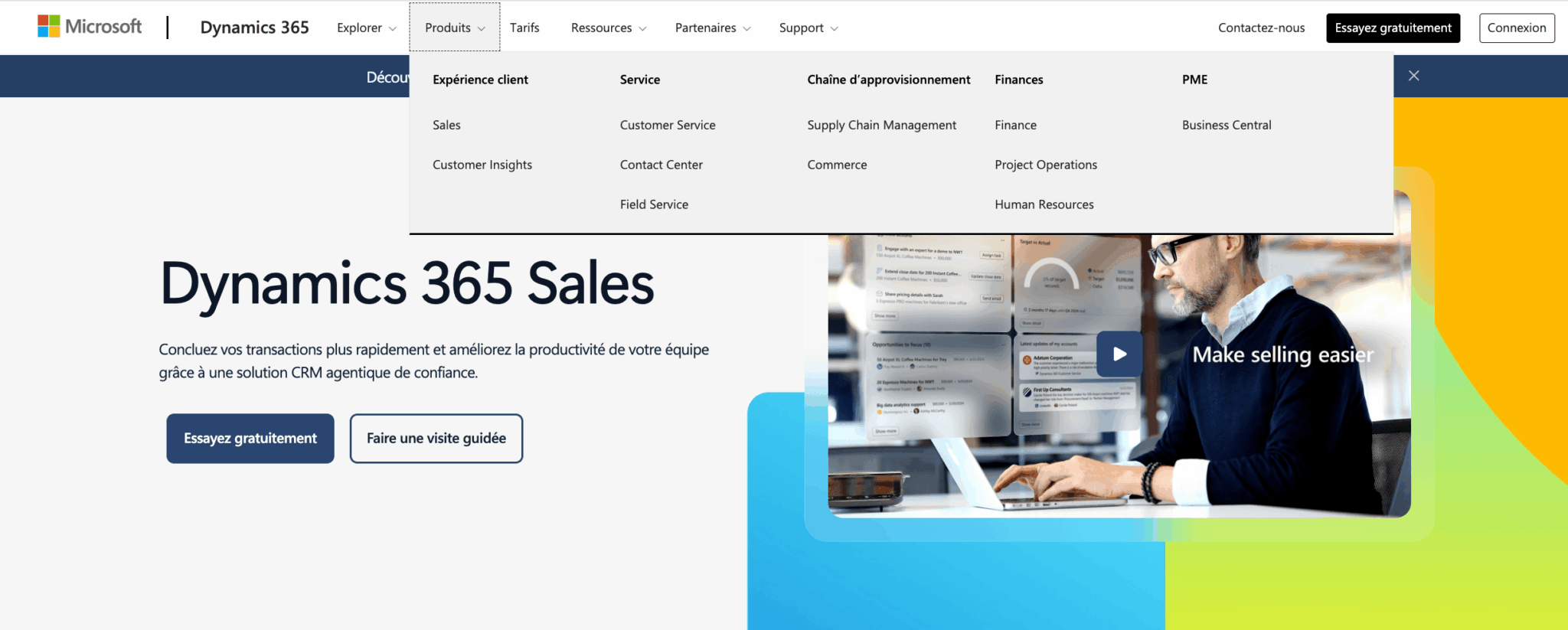
The complexity of Dynamics 365 is not just about configuration. It is a platform with considerable functional depth (Sales, Customer Service, Customer Insights, Field Service, Contact Center), licensing that is fiendishly hard to optimize (base/attach model, Team Members, permitted combinations) and a Power Platform ecosystem that multiplies the possibilities… but also the risks.
The right Microsoft Dynamics 365 integrator is not the one who knows how to configure the product, it is the one who knows how to:
- Challenge your brief on the functional side.
- Set the right level of ambition.
- Anticipate the real costs.
- Organize change management.
- Transfer skills to your teams so you do not depend on them for life.
It is also the one who knows how to say no. For example:
- No to an excessive customization request that will make future version upgrades harder.
- No to a custom integration when a standard connector is enough…
- No to adding a Customer Insights module when the organization does not have the data maturity to benefit from it.
This ability to say no is clearly one of the most reliable markers of a good CRM integrator in general and of a Dynamics 365 integrator in particular.
Conversely, a bad integrator is one who tends to do too much and propose too much, at the risk of turning a powerful product (which Microsoft Dynamics 365 is) into an unusable monster: too much customization, too many integrations, too many workflows, too many training sessions rushed through in two half-days…
CRM vs ERP integrator on Dynamics 365: understanding the difference
This is a fundamental point, yet it is rarely addressed.
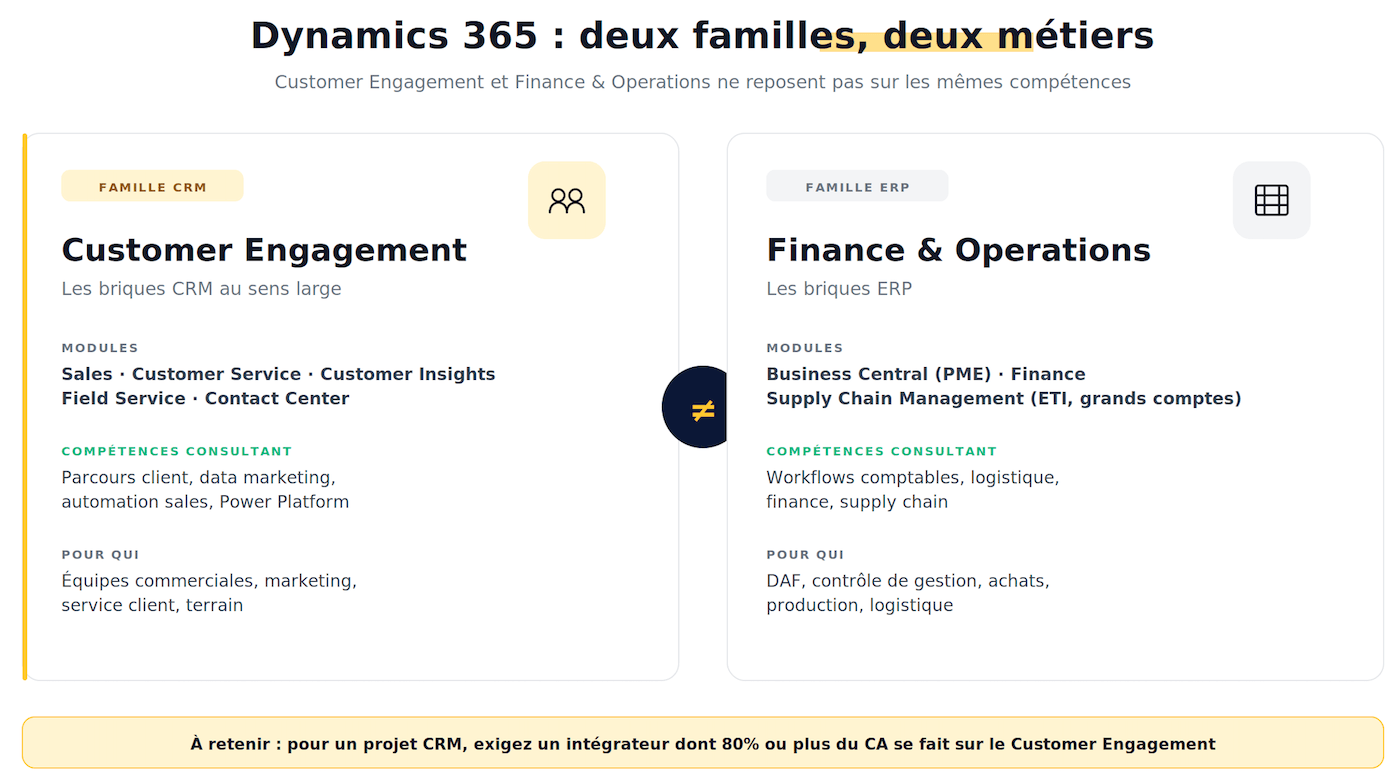
The Dynamics 365 ecosystem is actually split into two very different families:
- The Customer Engagement family, which brings together the CRM building blocks in the broad sense: Sales, Customer Service, Customer Insights (CDP and marketing), Field Service, Contact Center.
- The Finance & Operations family, which brings together the ERP building blocks: Business Central for SMBs, Finance and Supply Chain Management for mid-sized and large companies…

These two families share the “Dynamics 365” brand but rely on different architectures, different data models, different connector ecosystems and, above all, very different consulting skills.
Typically, a pure CRM consultant will not know how to configure a Business Central accounting workflow. And, conversely, an ERP consultant will not know how to model a customer journey with Customer Insights Journeys. These are two professions, two worlds.
In practice, many integrators present themselves as “Dynamics 365 integrators” and cover both families.
Except that, in truth, the best Microsoft Dynamics 365 integrators are almost all specialized in one or the other. Players that do both generally have a dominant business (often ERP, because that is historically where the money is) and a secondary business that serves as a complement.
If you are setting up a purely CRM project, choosing an integrator that makes 70% of its revenue from ERP guarantees you will be treated as a second-priority client, with less experienced consultants than on the ERP deals.
How to check in a sales meeting: ask them for the split of their revenue between Customer Engagement and Finance & Operations, the number of consultants strictly dedicated to the CRM family and the volume of CRM projects delivered over the last 24 months. If the figures are vague or the answer is “our consultants are versatile”, that is a bad sign…
Salesdorado’s adviceIf you are setting up a CRM project, beware of “Dynamics 365 integrators” whose dominant business is ERP. Ideally, you want a player that does 80% or more of its business in Customer Engagement. That guarantees consultants who do CRM all day long and who master the platform’s truly tricky cases.
The different types of Microsoft Dynamics 365 integrators in France
Before going further, you need to understand that the French market for Microsoft Dynamics integrators is structured around 5 main families. Each has its strengths, its weaknesses and its target audience.
| Type | Examples | Strengths | Weaknesses | For whom |
|---|---|---|---|---|
| Large global groups | Avanade, Accenture, Capgemini | Massive capacity, multi-country presence, access to international resources, methodologies proven on large programs. | High costs, high turnover, sometimes heavy methodologies, junior teams on operational assignments. | Mid-sized companies and large multinational accounts with multi-country rollouts and budgets above one million euros. |
| Long-established generalist IT services firms | Prodware, Devoteam | Broad ERP + CRM coverage, long track record on the Dynamics platform, redundancy capacity. | Less specialized in pure CRM, teams sometimes shared between ERP and CRM, depth of expertise that varies from one office to another. | Mixed ERP + CRM projects, organizations that want a single partner across the whole Dynamics ecosystem. |
| Specialized CRM pure players | Masao and a few others | Exclusive CRM expertise, lower turnover, senior consultants on assignments, in-depth knowledge of Power Platform and Copilot. | No ERP coverage, mid-range size that can be a limit on very large international projects. | SMBs and mid-sized companies setting up an ambitious CRM project, organizations that value depth of expertise over brand name. |
| Industry-specific boutiques | Specialists in healthcare, banking, real estate, etc. | Deep business knowledge, pre-configured data models, industry accelerators, shared vocabulary with your teams. | Sometimes limited capacity, strong dependence on a few key people. | Projects in highly regulated or very specific sectors (banking, insurance, healthcare, real estate, mutual insurers). |
| Freelancers and small firms | Certified independents, firms with fewer than 10 people | Lower hourly rate, high flexibility, direct contact with the expert. | No redundancy, risk of unavailability, limited functional scope, no capacity to run a full scoping phase. | Very small projects, light application maintenance on an existing Dynamics, or occasional support for an internal team. |
The lesson of this table is simple: there is no “best Dynamics integrator” in absolute terms. There is a best type of integrator for your project profile, and then a best player within that type:
- For the vast majority of Dynamics 365 CRM projects run by French SMBs and mid-sized companies (the core of the market), specialized CRM pure players (like Masao) and industry-specific boutiques are generally the best choice.
- Large groups remain a good option for international projects with very large budgets.
- Long-established IT services firms are suited to combined ERP + CRM projects.
- Freelancers have their place for extra capacity or light support, not for a core project.
A concrete example of a specialized CRM pure playerIf your profile matches the “specialized CRM pure player” type (most often the right choice for an SMB or mid-sized company setting up an ambitious Dynamics project), Masao is a fully realized example of it on the French market. An exclusive Customer Engagement pure player, 20 years of experience, 100+ specialized consultants.
How do you recognize a good Microsoft Dynamics 365 integrator?
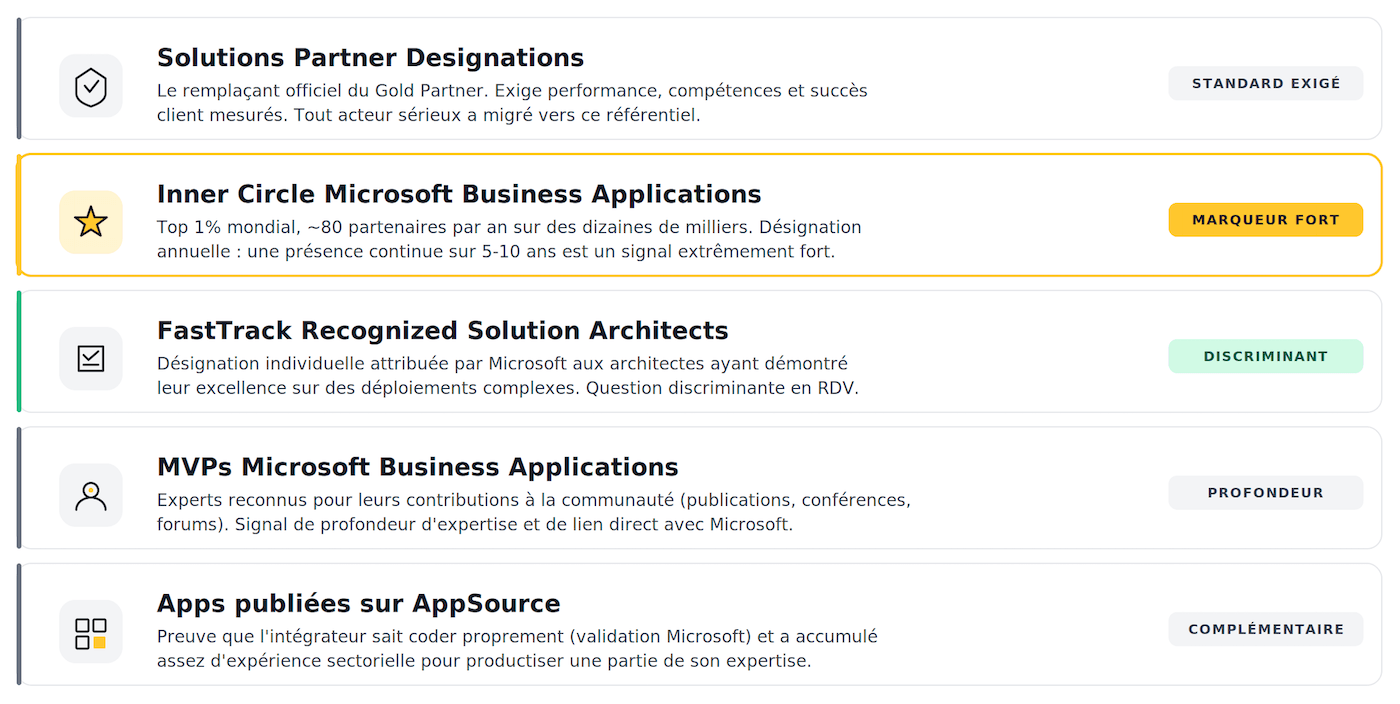
1. Microsoft Solutions Partner Designations
Since 2022, Microsoft has awarded “Solutions Partner Designations” across 6 main business categories.
For Dynamics 365 CRM, the two relevant designations are:
- Solutions Partner for Business Applications
- The Solutions Partner with certified software specialization on Dynamics solutions. To earn this designation, a partner must accumulate performance points (revenue generated on the platform), skilling points (certified consultants) and customer success points (documented deployments and measured adoption).
2. The Microsoft Business Applications Inner Circle
This is the real marker of excellence on Dynamics.
The Inner Circle for Microsoft Business Applications is an exclusive circle that each year brings together the partners ranking in the global top 1% for Dynamics 365 and Power Platform performance. Around 80 partners worldwide are selected each year, out of tens of thousands of Microsoft partners.
Selection is based on mixed criteria:
- Business volume generated.
- Quality of execution as measured by Microsoft.
- Customer satisfaction.
- Contributions to the product roadmap.
The designation is annual: a partner can lose its Inner Circle status from one year to the next if it does not maintain its level. That is what makes this criterion particularly reliable.
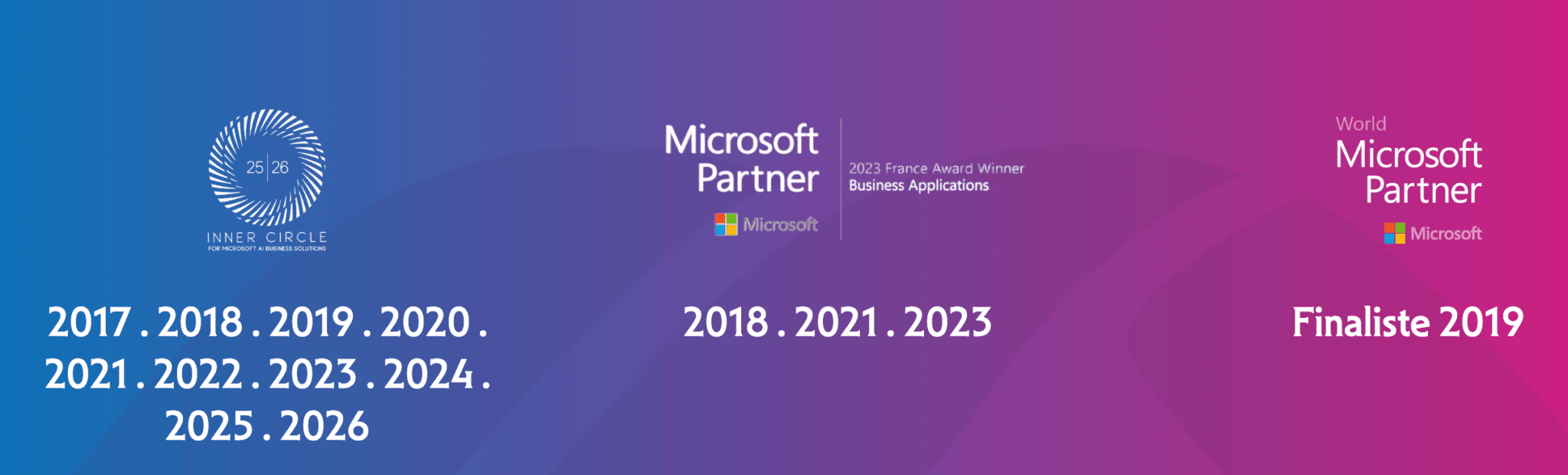
In France, very few integrators are recurring members of the Inner Circle. When a player shows a presence over 5 or 10 consecutive years, it is an extremely strong signal. As an illustration, Masao has been a member of the Microsoft Business Applications Inner Circle from 2017 to 2026, ten consecutive years. This level of continuity is exceptional on the French market.
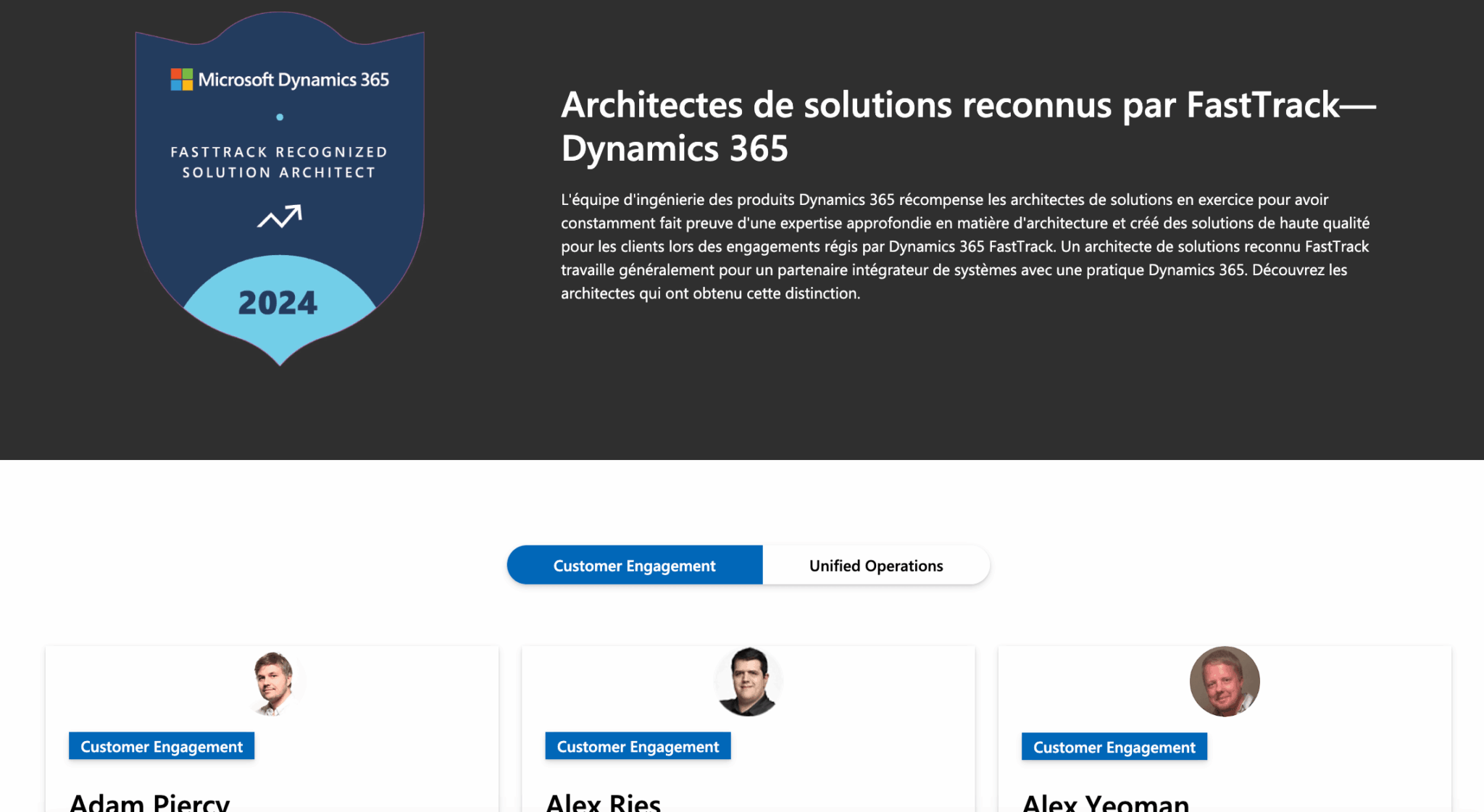
3. “FastTrack Recognized Solution Architects”
This is an individual designation (so not awarded to a company but to individuals) that Microsoft grants to Dynamics 365 architects who have demonstrated technical and methodological excellence on complex deployments.
Asking an integrator how many FastTrack RSAs it has on its teams is an excellent discriminating question. The answer is often zero or one, sometimes two. Beyond that, you are talking to a truly serious player.
4. Microsoft MVPs
The Microsoft Most Valuable Professional program recognizes experts who contribute significantly to the Microsoft technical community, whether through publications, conferences, forums, open source content…
Having one or more Business Applications MVPs on its teams is another marker of depth of expertise, especially as these are generally the profiles who open up the most advanced topics directly with Microsoft.

5. Apps published on the Microsoft marketplace
A Dynamics 365 integrator that has published modules or accelerators on the Microsoft marketplace demonstrates two things:
- It can write clean code at a level that passes Microsoft’s technical validation.
- It has accumulated enough industry experience to productize part of its expertise.
It is rarely decisive on its own, but it is a good complementary signal.
6. Track record on the platform
Dynamics CRM existed before Dynamics 365. The platform has gone through several major transitions: the move to cloud-first around 2014, the rebuild on Power Platform in 2018, the integration of Copilot in 2023.
A partner that was already working on Dynamics before 2018 has lived through all these transitions and knows how to handle the architecture choices that result from them.
Players that appeared on the subject after 2020 often lack perspective on the patterns to avoid, which can be costly in year two or three.
10 questions to ask in a sales meeting (and the answers that should alarm you)
Now for the concrete part. Here are the ten questions to ask every integrator you meet, without exception. For each one, we give you the typical bad answer (the one that should make you back off) and the answer you want to hear.
1. What percentage of your revenue comes from Customer Engagement vs Finance & Operations?
Bad answer: “We are versatile, we do both in equal parts.”
Good answer: a precise figure they stand behind. For a pure CRM integrator, ideally you want 80% or more from Customer Engagement.
2. How many Dynamics CRM projects have you delivered over the last 24 months?
Bad answer: a vague number or a figure accumulated over 10 years.
Good answer: a recent, precise figure, with a breakdown (SMBs, mid-sized companies, sectors represented).
3. Who will be my project manager, and will they stay for the whole project?
Bad answer: “Our process guarantees continuity of service, but resources may change.”
Good answer: a name, a CV, a clear commitment for the duration of the project. If the person you are talking to cannot commit to the project manager’s stability, you are taking a major risk. A change of project manager mid-assignment typically means 1 to 2 months of friction.
4. What is your consultant turnover rate in 2026?
Bad answer: “We do not disclose that figure” or “it is in line with the industry average.”
Good answer: a figure. The IT services market averages between 20 and 30% a year. Under 15% is excellent. Above 30% is worrying for the continuity of your project. An integrator that owns up to a figure, even one with room for improvement, is more credible than an integrator that dodges the question.
5. Do you have nearshore or offshore consultants?
Bad answer: “All our teams are in France” when that is not true (you will find out mid-project).
Good answer: complete transparency on the split. Nearly half of the large Dynamics integrators have delivery centers in North Africa (Tunisia, Morocco) or Eastern Europe (Poland, Romania). That is not a problem in itself if it is acknowledged and well organized. The problem is when you discover it. Ask what percentage of your project’s person-days will be done nearshore and with what management mechanisms.
6. Can you give me three references in my sector that I can call?
Bad answer: “We have many references but our clients do not wish to be named” or a single name provided with no direct contact.
Good answer: three company names, one operational contact per reference (not the CIO but a product owner or a business lead who lived through the project from the inside) and explicit permission to call them. If the integrator cannot provide this, it does not have enough recent, satisfied references in your sector.
7. How do you handle data migration?
Bad answer: “We use Microsoft’s standard tools, it is included in the package.”
Good answer: a clear methodology in several steps (data quality audit, source mapping, deduplication, normalization, acceptance testing by dataset, cutover). Data migration is the blind spot of most integrators. A partner that underestimates the complexity of this topic will make you pay for it in schedule delays and user frustration.
8. Who will work on optimizing base/attach licenses?
Bad answer: “That is a commercial topic, we will put you in touch with Microsoft directly.”
Good answer: a dedicated licensing consultant on the team, able to produce an optimized roles/licenses matrix and a costed comparison “with and without base/attach optimization”. On Dynamics 365, this optimization can represent 30 to 40% savings on the annual license bill. It is one of the most reliable markers of a partner that truly masters the ecosystem.
9. How does the transition to run work after go-live?
Bad answer: “You take over and we remain available for questions.”
Good answer: a formal transfer of skills to your teams, up-to-date documentation, a time-boxed hypercare period (typically 1 to 3 months) with reinforced support and an optional application maintenance contract with clear service commitments. Go-live is not the end of the project, it is the start of a new phase that needs to be prepared.
10. Do you have a written methodology, and can I see it?
Bad answer: a vague marketing document with five-color diagrams.
Good answer: a documented project methodology with specific deliverables at each phase (specifications, test plan, training plan, cutover plan, operations manual). Ask to see an example of a real (anonymized) deliverable from a previous project. A serious integrator has these documents and agrees to show them.
Should you sign a maintenance contract with your integrator after go-live?
In the vast majority of cases, yes. An application maintenance contract (TMA, Tierce Maintenance Applicative) with a monthly allowance of days or a fixed fee lets you handle routine changes, Microsoft’s wave 1 and wave 2 releases, adjustments following user feedback, and level 2 or 3 support. Typically allow 10 to 20% of the initial project budget for annual maintenance. Some organizations prefer to separate the integrator from the maintenance provider, but that requires real in-house expertise to manage two separate players.
Test these questions in real conditionsThese 10 questions work all the better when they are put to an integrator that has real answers to give. A first conversation with Masao is an excellent training ground to test your framework in real conditions, even if you are not yet sure of your final choice. And there is no commitment.
4 pitfalls to avoid with a Dynamics 365 integrator
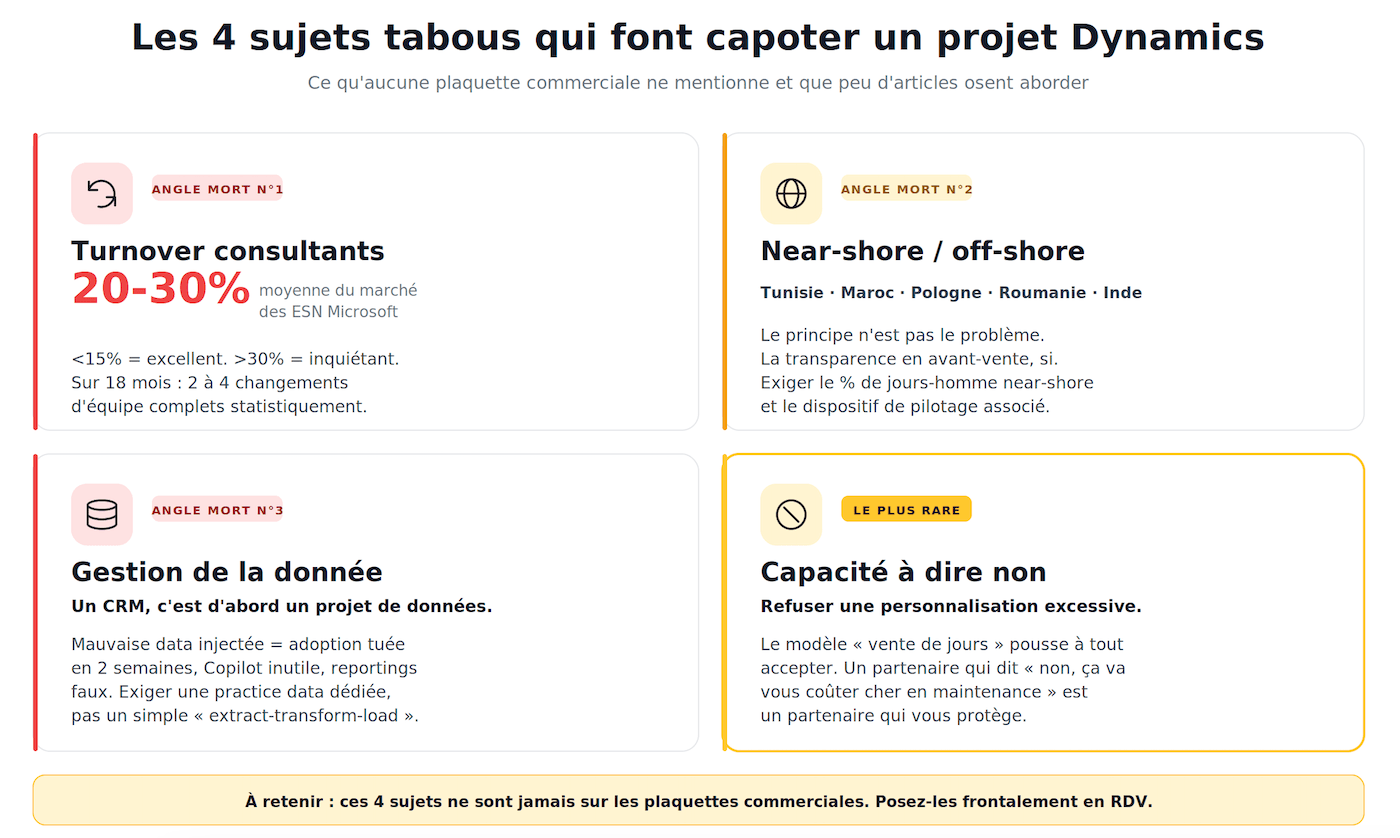
1. Consultant turnover and the “team rotation” effect
This is probably the number one cause of failure on long Dynamics projects (12 months or more)… and nobody talks about it.
The market for Microsoft-specialized IT services firms averages between 20 and 30% turnover a year. On an 18-month project, you can statistically go through 2 to 4 complete team changes. Each rotation means a handover period, lost context, decisions made all over again and often a drop in delivery quality.
Firms that keep turnover low (under 15%) generally have two markers in common:
- A more demanding HR policy, with consultants who are better paid and more loyal.
- A culture that values expertise internally: continuous training, access to certifications, ties with Microsoft…
Asking about the turnover rate in a sales meeting is a perfectly legitimate question. The answer, and the way it is given, tell you a lot.
2. Nearshore and offshore
A large part of the French Dynamics integrator market has delivery centers outside mainland France. This is particularly true of large groups (Avanade, Capgemini) and some long-established IT services firms. Tunisia, Morocco, Poland, Romania, sometimes India on large programs.
It is neither good nor bad in itself:
- Well organized, nearshore makes it possible to absorb large workloads at controlled costs while keeping a time zone compatible with France.
- Poorly organized, it creates problems of quality, communication and continuity (nearshore consultants turn over even more than French ones) and a feeling of being treated as a second-class client.
The deciding criterion: transparency during pre-sales and the quality of the management setup. If you are presented with a “100% France” team and you discover at kick-off that one developer in two is in Tunisia, the project is off to a bad start.
3. Data management, the blind spot of most integrators
A CRM project is first and foremost a data project. Yet many integrators treat data migration and quality as a technical subtask at the end of the project. That is a serious mistake.
The quality of the data loaded at launch directly determines:
- Adoption (a sales rep who sees duplicates and empty fields stops using the CRM within two weeks).
- The performance of AI tools (Copilot, Customer Insights), which are useless without clean data.
- The ability to produce reliable reporting.
Good integrators have a dedicated data practice, data profiling tools, deduplication and normalization methodologies and ideally partnerships with data quality vendors.
Ask the question. If the answer is “we extract, we transform, we load”, that is not enough.
4. The ability to say no
This last topic is more subtle but just as critical. A good integrator knows how to turn down requests that degrade the product.
Integrators that accept everything are often those whose business model relies on selling days. More complexity means more billable days, so more immediate revenue. It is also a guarantee of technical debt that will make your Dynamics unmanageable by year three.
A partner that tells you “no, we will not do that because it will cost you a lot in maintenance” is a partner that protects you. That is rare, and it is valuable.
How to select and compare several Dynamics 365 integrators
We have covered the criteria. Here now is the operational process to go from the open market to a signed partner.
1. Write a short brief rather than an endless requirements specification
On Dynamics 365, a detailed requirements specification written before choosing the integrator is almost always counterproductive:
- It locks in technical choices you are not in a position to make, because you do not yet have the partner’s expertise.
- It generates overly optimistic costed responses, because integrators answer the requested scope without challenging it.
- Finally, it steers the tender toward price comparisons instead of quality comparisons.
A brief of 5 to 10 pages is more than enough.
It should contain:
- Your business context.
- Your business challenges and objectives.
- A high-level map of your current processes.
- Your constraints: existing integrations, timeline, target budget, internal resources available…
- Your selection criteria.
That is all. The detail of the functional scope is built with the integrator, not against it. To go further on this topic, see our guide to CRM requirements specifications.
CRM requirements specification templateWe have prepared a complete CRM requirements specification template with a detailed example. The template has 6 parts:
- Presentation of the context
- Presentation of the current CRM setup
- Presentation of the project objectives
- Functional requirements grid
- Details of non-functional needs
- Project organization
It is free, and it is right here 👇
2. Source 4 to 5 integrators, not 15
Large-scale tenders are inefficient. Beyond 5 or 6 players, you dilute your time, you wear out your internal teams and you get sloppy responses (serious integrators do not invest in pre-sales on tenders with 15 candidates).
Source 4 to 5 players by cross-referencing:
- Your target type (specialized pure player vs large group).
- Recommendations from your network.
- Verifiable customer reviews on G2 or Capterra
- And possibly our comparison of the best Microsoft Dynamics integrators.
3. Run a paid scoping workshop with the finalists
This is advice you will not find elsewhere, yet it is very effective. The idea is simple: once your shortlist is down to 2 finalists, run a paid scoping workshop of 1 to 2 days with each of them (typically €3,000 to €6,000 excl. VAT).
A paid workshop forces the integrator to bring in its best senior consultants (a classic pre-sales process involves salespeople and pre-sales staff, which is not the same thing). It gives you concrete material on the quality of their thinking, their ability to challenge and their scoping methodology. And it reveals a great deal about the human quality of the relationship, which is probably the most important criterion on a 12- to 18-month project.
It is also the best way to compare two costed proposals on an equal footing: at the end of the two workshops, you ask for two costed proposals on the same scoped perimeter. You are then comparing like with like.
4. Ask for a POC on a concrete case before signing
On ambitious projects (budget above €100,000), ask for a proof of concept on a specific functional sub-scope before committing to the whole.
It could be modeling a complex customer journey, integrating with a specific third-party tool or setting up a Copilot agent on a business case. The POC is short (2 to 3 weeks), capped in budget (€10,000 to €20,000) and it gives you an irreplaceable view of the partner’s quality of execution.
5. Talk to at least 3 client references before signing
Ask for 3 client names in a sector close to yours and call them.
Do not settle for the reference the integrator offers you (who will necessarily be a satisfied client). Ask the references whether they know other clients and call those other clients too. The reality on the ground comes out through cross-checking, never through statements.
It is probably the best-invested hour of your entire selection process…
Start your project with MasaoIf your project fits the profile we describe (French SMB or mid-sized company, ambitious Dynamics 365 CRM project, looking for a specialized pure player with real continuity), Masao is probably one of the best possible choices on the French market. They offer an initial no-commitment conversation to challenge your brief and set the right level of ambition.
The questions we get over and over.
How much does a Microsoft Dynamics 365 integrator cost?
Daily rates for Dynamics consultants in France generally range from €450 to €850 excl. VAT per day, with an average of around €650 for experienced profiles. On a median SMB project (Sales + Customer Service, two or three standard integrations), the services budget for implementation typically ranges from €30,000 to €60,000 excl. VAT. To go further on this topic, see our dedicated article on the real cost of Microsoft Dynamics 365 CRM.
Should you choose an integrator close to home?
Geographical proximity matters less than it did before remote work became widespread. What counts is having at least a few in-person meetings during the key phases of the project (kick-off, scoping workshops, user acceptance testing, training) and the integrator’s ability to come to you when needed. A partner 500 km away who comes when necessary will be more effective than a partner 5 km away who never comes.
How many integrators should you put in competition?
Four to five in the initial sourcing, two as finalists for in-depth scoping workshops. Beyond that, you dilute your time and get sloppy responses. Below that, you risk missing relevant options.
What is the difference between a Microsoft integrator, partner and reseller?
The three terms partly overlap. A Microsoft reseller (CSP, Cloud Solution Provider) is authorized to sell Dynamics 365 licenses. A Microsoft partner has a formal status recognized by Microsoft (Solutions Partner Designation, Inner Circle, etc.) that attests to verified skills. An integrator is a player that actually carries out the deployment, configuration and support. Most good Dynamics integrators are both Microsoft resellers and partners.
How long does a Dynamics 365 integration project take?
For an MVP Pack or a quick start, allow 2 to 4 months. For a median SMB project (Sales + Service, standard integrations), 4 to 8 months. For an ambitious multi-module project with ERP integrations and several countries, 12 to 24 months. The duration depends as much on functional complexity as on the availability of internal teams and the quality of the initial scoping.
Can you change integrators mid-project?
Technically yes, but it is always painful. A takeover by a new partner typically involves 2 to 4 months of “recovery” (audit of the existing setup, getting to grips with the configuration, taking over the documentation), which can represent a 30 to 50% extra cost compared with the remaining initial budget. It is better to invest upfront in the right choice than to suffer a change along the way. If the situation becomes untenable, a change is still possible but must be carefully prepared.



What the community says.