



- On lifecycle emails and abandoned carts in B2C, Klaviyo or Brevo do better than HubSpot.
- The Shopify integration is native and free: contacts, products, orders and carts flow into the CRM. It also exists for WooCommerce.
- The unified customer record lets you segment by actual purchase and follow up with a customer before they drift away.
- As soon as there is B2B, wholesale or large carts with human selling, HubSpot becomes the foundation, via Revenue Hub.
- On Marketing Hub, the bill depends on the number of marketing contacts: only mark as “marketing” the contacts you actually reach out to.
Most of the time, when an e-commerce merchant looks for a “CRM”, what they are really looking for is an email marketing tool, and they end up choosing Klaviyo or Brevo to send campaigns and recover abandoned carts.
On that specific ground, these tools do better than HubSpot, let’s say it right away. But don’t miss the main point: in e-commerce, you burn budget on acquisition, while the money is made after the first purchase, in repeat purchases and customer lifetime value. And that is not an email problem. It is a customer relationship problem, a CRM problem.
So when does HubSpot really belong in an online store? What does its native Shopify integration actually change? At what point does your e-commerce business need a real CRM and not just a sending tool? We answer these questions and give you our honest opinion on HubSpot CRM for an e-commerce business.
What you will find in this article:
- Why the “CRM = email tool” reflex makes you miss what matters in e-commerce.
- The two precise moments when HubSpot becomes indispensable to an online store.
- When to keep Klaviyo, when to switch to HubSpot and when to run both.
CRM or email marketing tool? The e-commerce misunderstanding
This misunderstanding deserves a closer look, because it shapes everything else. In e-commerce, “CRM” and “email marketing tool” have become synonyms in people’s minds. We think of platforms like Klaviyo, Brevo, Mailchimp or Omnisend, built for transactional B2C, which plug into your store’s events and trigger the right messages at the right time.
So let’s be clear right away. If your need is limited to sending email flows to individual shoppers, HubSpot is not necessarily the best choice, and that’s fine. We won’t tell you otherwise.
The problem lies elsewhere. An email tool sends messages, but it does not build a customer relationship. And in e-commerce, the real battle is not acquiring a customer, it is getting them to come back. Acquisition is expensive, and it gets more expensive as advertising costs rise. Profitability therefore depends on the second purchase and on customer lifetime value.
And here, one simple question reveals the limit of the email tool: do you know, for a given customer, what they bought, how much they have spent in total and whether they are drifting away? A sending tool sees campaigns and open rates. A CRM sees a customer. That is the whole difference.
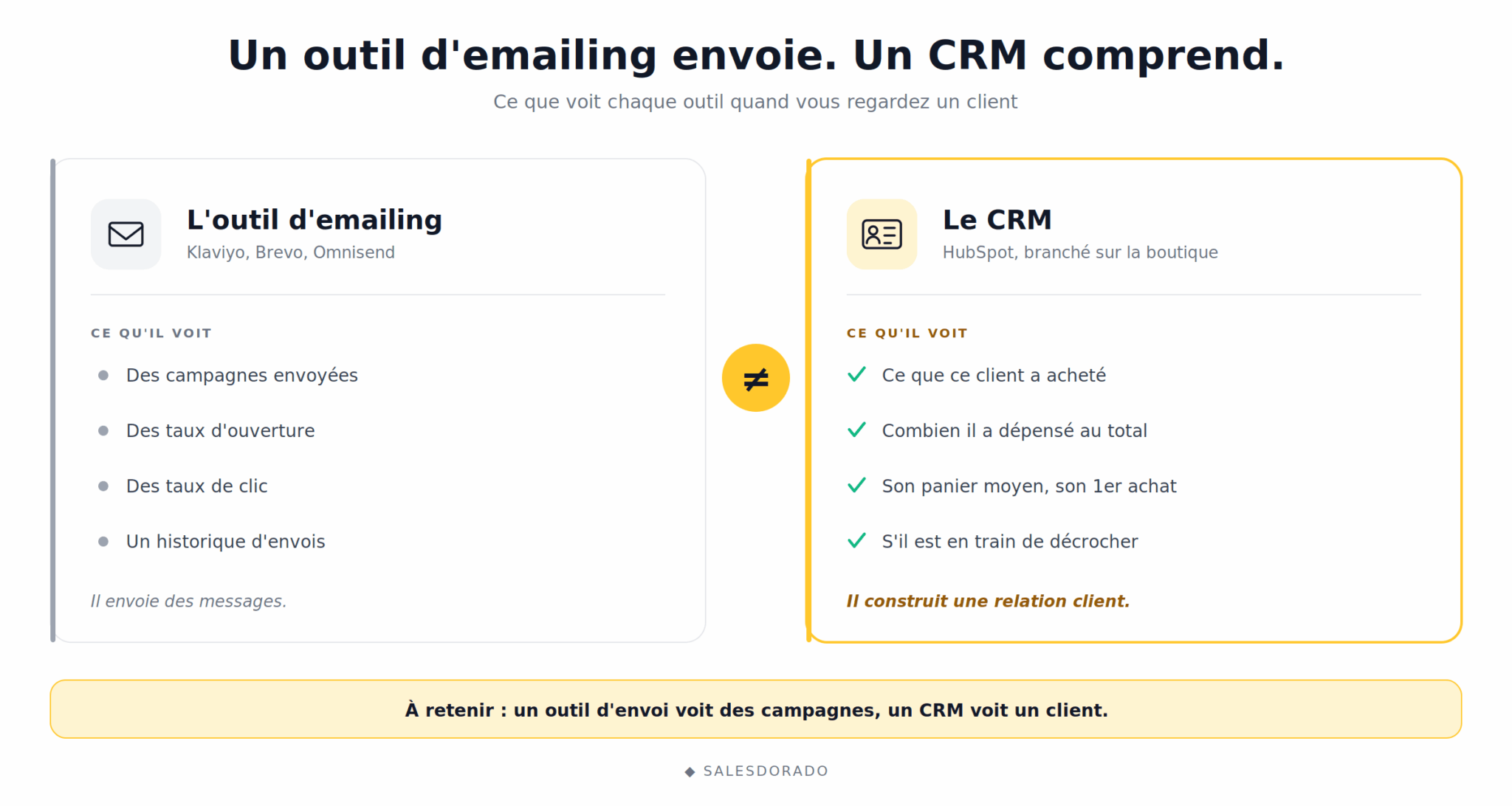
The “campaign” thinking trapRunning your e-commerce business campaign by campaign means optimizing open rates without ever looking at customer lifetime value. You can have excellent emails and disastrous retention. The day you want to know who your best customers are and which ones are about to leave, you need a customer record, not a sending history.
What the HubSpot CRM – Shopify integration actually changes
Before going further, let’s settle the technical question, because everything else depends on it. HubSpot connects natively to Shopify, for free, and installation takes a few clicks. Once connected, the integration moves your data in both directions and turns your CRM into the control center of your store.
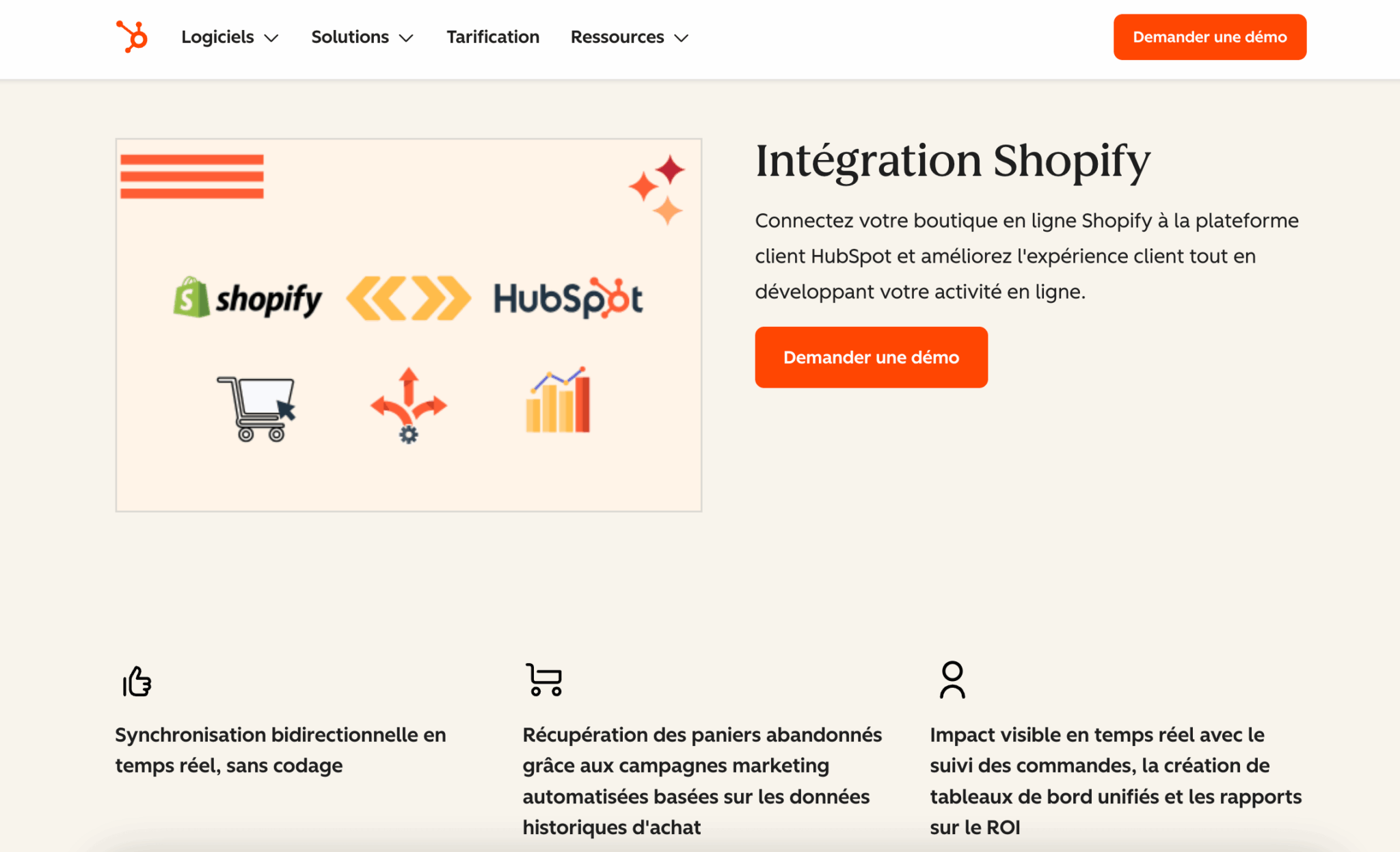
In practice, here is what happens:
- Your contacts and products sync both ways between Shopify and your CRM, in real time.
- Your orders and abandoned carts flow automatically into a dedicated “ecommerce” pipeline.
- Each customer record shows its Shopify properties: total amount spent, average order value, first purchase date, products ordered…
- Ready-to-use e-commerce dashboards track your sales and engagement.
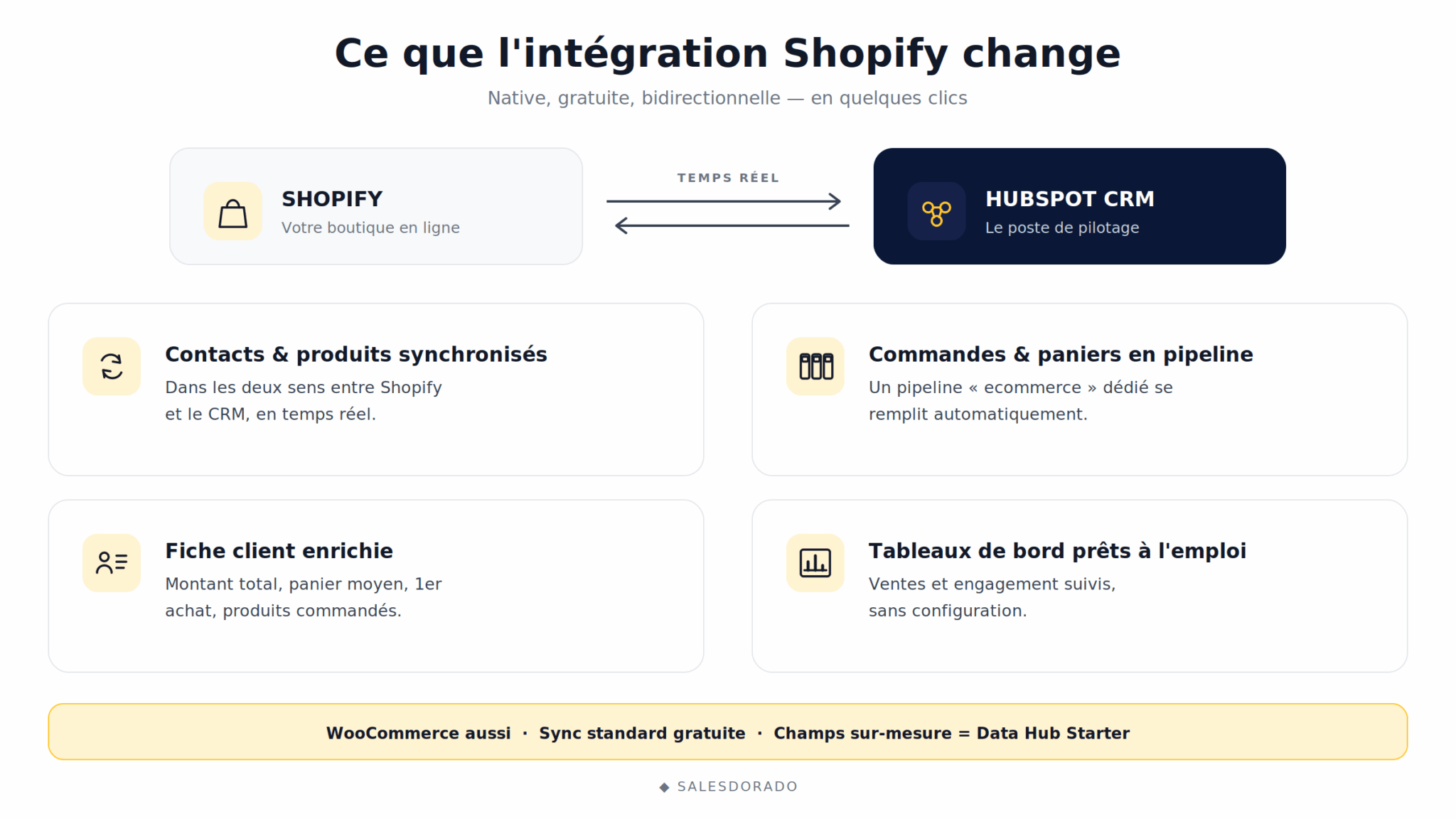
Two useful details:
- The integration also exists for WooCommerce, so stores running on WordPress are not left out.
- If you want to customize the synced fields in detail, you need a Data Hub Starter subscription, but the standard sync remains free.
This technical foundation is what makes everything that follows possible.
HubSpot CRM as the retention engine for your e-commerce customers
The unified customer record in HubSpot lets you manage retention as an asset, not as a series of campaigns.
Let’s take a concrete example. You sell photo equipment. Thanks to the Shopify properties pulled into the CRM, you segment your customers by what they actually bought: those who invested in a camera body, those who only bought accessories. A few weeks later, the first group receives a sequence on compatible lenses. That is data-driven cross-selling, not a newsletter sent to the whole list.
The mechanism goes further than segmentation. HubSpot CRM updates each customer’s lifecycle stage automatically, based on their actions: first order placed, second purchase, subscription renewed, signs of disengagement. You can trigger a re-engagement follow-up before a customer drifts away, not after. That is exactly where customer loyalty is won, and it is what an email tool alone cannot do, because it does not see the customer as a whole.
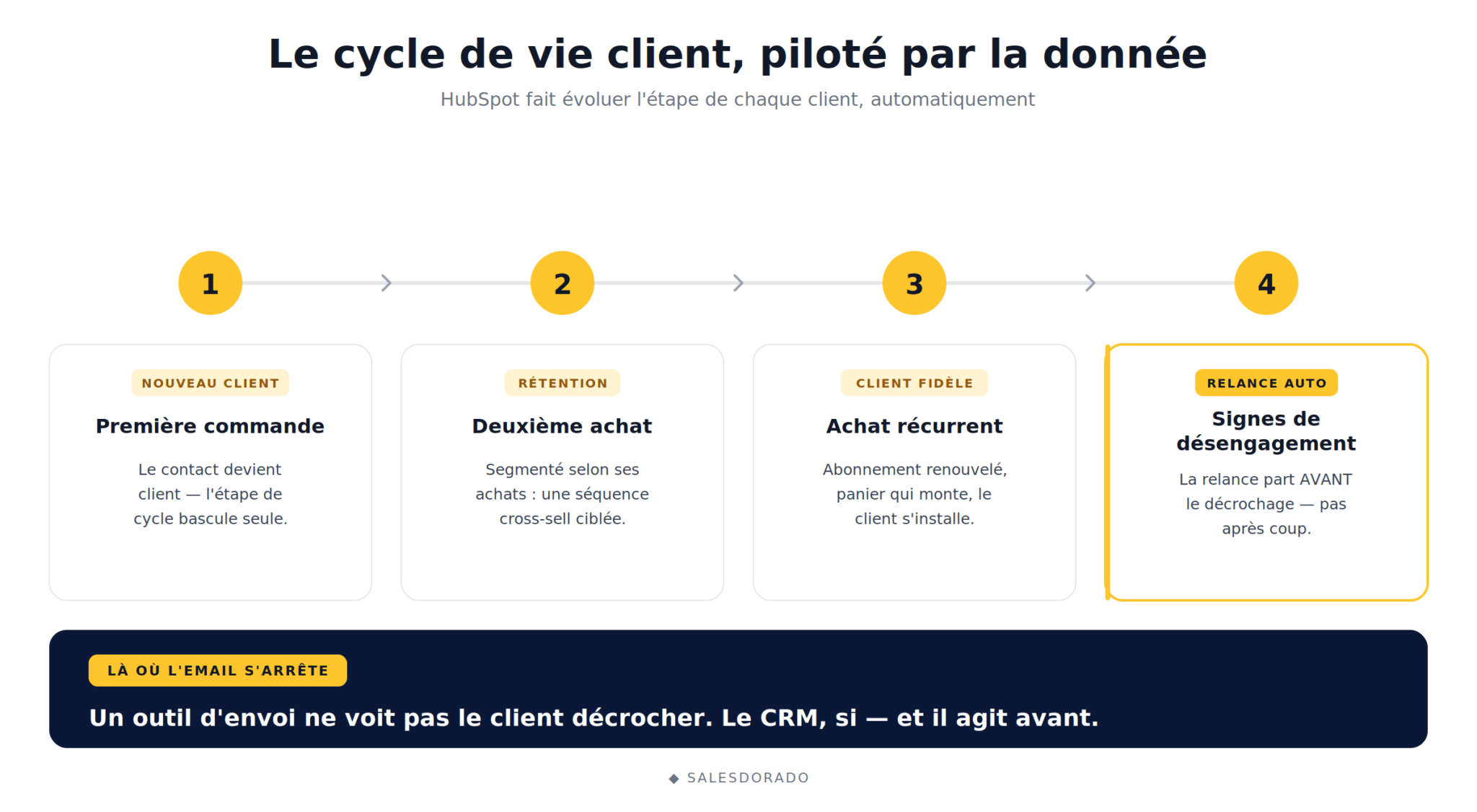
And when a customer slips into inactivity, you still have to notice it. By centralizing purchase history and engagement, HubSpot makes the real churn rate visible, customer by customer. You know who is leaving and you can act before it is too late.
To dig deeper into the revenue mechanics, our article on upselling and cross-selling explains how to turn a one-off buyer into a repeat customer.
Test HubSpot on your storeHubSpot’s CRM and the Shopify integration are free. You can connect your store and watch your customer data come in before investing in any paid plan.
HubSpot’s real playing field: B2B e-commerce
As soon as your e-commerce business involves human selling, HubSpot becomes the foundation, not an accessory.
And this case is far from marginal.
It concerns a growing share of e-commerce:
- Wholesale and B2B, where orders are tied to a company account and not to a single contact, with a history at the account level.
- Negotiated prices and customer-specific catalogs, which the platform handles through its quotes where a standard store gets stuck.
- Large, high-value carts, which are better followed up by a sales rep calling back than by an automated email.
For these uses, HubSpot has a dedicated module: Revenue Hub, its B2B sales suite built into the CRM. It brings together quote generation (CPQ), invoicing and payment collection, with Stripe usable directly in the CRM.
In other words, the whole journey from quote to payment lives in the same place as the customer record, without juggling three pieces of software. This is where structuring a real sales pipeline makes full sense for an e-commerce business.
No e-commerce email tool does this. That is the clear line between Klaviyo and HubSpot: one orchestrates messages, the other orchestrates a sale.
HubSpot or Klaviyo (or both)? How to choose
The choice is not about “which one is best”, but about “what your e-commerce business needs”.
Here is how to decide.
| Need | HubSpot | Email tool (Klaviyo, Brevo) |
|---|---|---|
| B2C lifecycle emails and abandoned carts | Decent | Excellent, it is their specialty |
| Unified customer record (purchases, engagement, history) | Excellent | Limited to sending behavior |
| Data-driven segmentation and retention | Advanced | Good on email, without a CRM view |
| Customer service linked to the record | Yes, via Service Hub | No |
| B2B e-commerce, quotes, accounts | Yes, via Revenue Hub | No |
| Unified view of marketing, sales and service | Native | No |
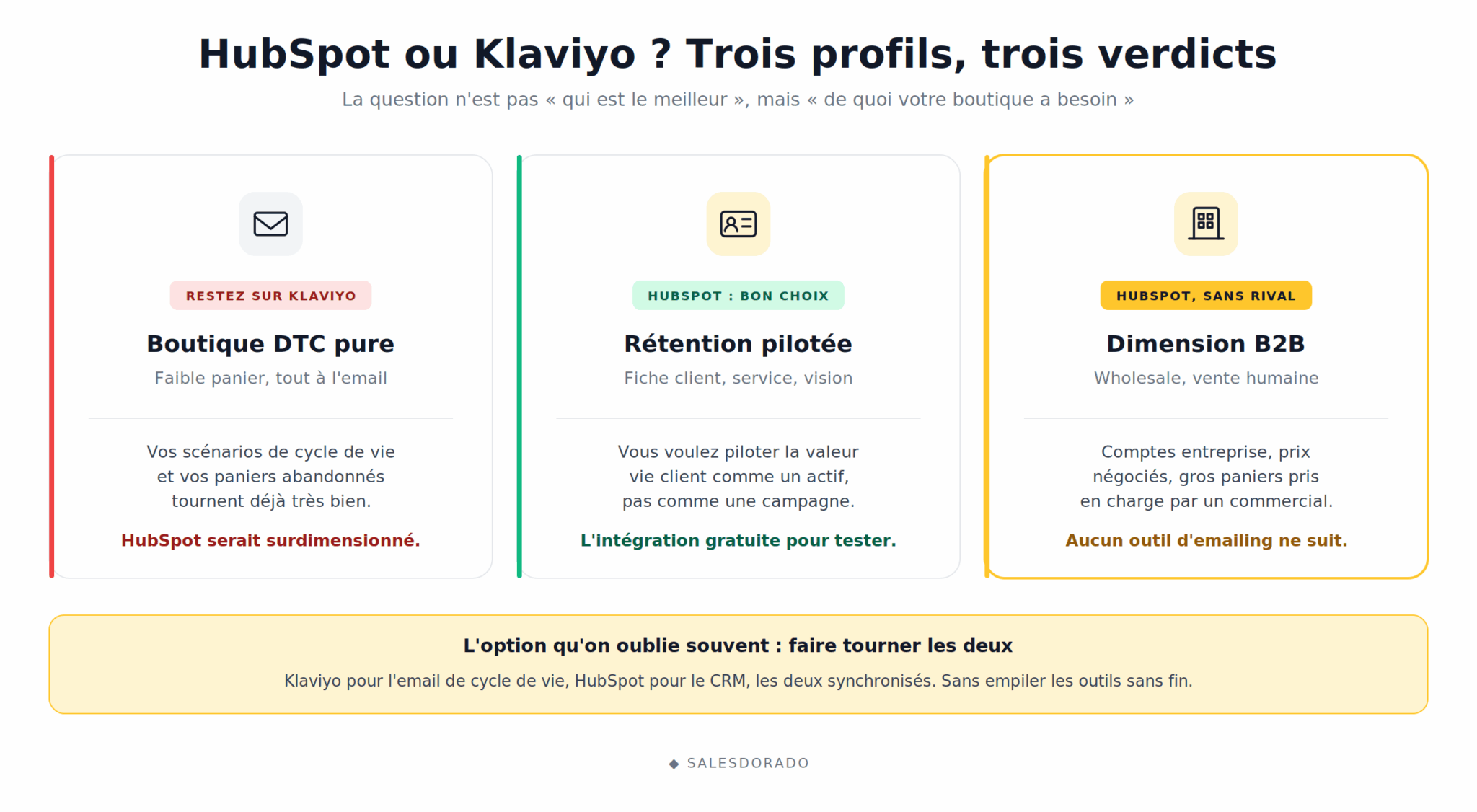
There are in fact 3 scenarios:
- If you do pure B2C, with small carts, centered on email: Klaviyo is enough, stay with it.
- If you want to manage retention around a unified customer record, with service and a real overall view: HubSpot is the right choice.
- If you have a B2B dimension or large carts with human selling: HubSpot has no serious competitor among email tools.
There is one option people often forget: running both. Many brands plug in Klaviyo for lifecycle email and HubSpot for the CRM, with the two synced. You keep the best of B2C email and you add customer intelligence. That is also what we weigh up in our HubSpot vs Brevo comparison, useful for deciding between the two approaches. Be careful, though, not to stack tools endlessly: our guide to reducing your SaaS stack sets the right limits.
How much does HubSpot cost for an e-commerce business?
Short answer: connecting HubSpot to your store costs nothing. The CRM and the Shopify integration are free and are enough to centralize your contacts, your orders and a first segmentation. You only pay the day you want to automate seriously.
| HubSpot module | Starting at | What for |
|---|---|---|
| CRM + Shopify or WooCommerce integration | Free | Centralize contacts, orders and carts, then segment |
| Marketing Hub | €20 / month (Starter) | Automate follow-ups and retention flows |
| Sales Hub Pro | €100 / user / month | B2B sales, sequences, lead scoring, advanced pipeline |
| Revenue Hub | Billed per transaction | Quotes, invoicing and payment for B2B e-commerce |
On Marketing Hub, the bill depends on the number of marketing contacts, and an e-commerce list grows fast. Keep an eye on that volume and only mark as “marketing” the contacts you actually reach out to.
For the full breakdown of tiers, we have dissected everything in our article on the cost of HubSpot and on what the free version covers.
Our verdict on HubSpot for e-commerce
Strengths
- A unified customer record that links purchases, engagement and service in one place.
- A native, free Shopify and WooCommerce integration.
- The only serious choice as soon as there is B2B, wholesale or large carts.
- Data-driven retention, well beyond the simple campaign.
Weaknesses
- Weaker than Klaviyo on pure B2C lifecycle email.
- A Marketing Hub bill that climbs with the number of contacts.
- Limited value for a small DTC store centered on email.
- A real learning curve to exploit its full potential.
Our recommendation depends on who you are:
- Pure DTC store, small carts, all about email: stay with Klaviyo, HubSpot would be oversized.
- E-commerce business that wants to manage retention as an asset, with service and an overall view: HubSpot is an excellent choice, and its free Shopify integration lets you start without risk.
- E-commerce with a B2B dimension, wholesale or human selling: here, HubSpot has no equivalent among email tools, go for it.
For a full test of the platform beyond e-commerce, here is our detailed review of HubSpot.
Salesdorado’s takeRun the test this week. Connect HubSpot to your store for free and look at one thing only: the record of one of your best customers, their total amount spent and the date of their last purchase. If you are missing that view today, you have your answer, whatever your email tool.
Connect HubSpot to your storeHubSpot’s CRM and Shopify integration are free. It is the simplest way to see your customer data other than through open rates, and to decide with full knowledge.
The questions we get over and over.
Is HubSpot suitable for e-commerce?
Yes, as long as you understand its role. HubSpot is not an e-commerce email tool like Klaviyo, it is a CRM that connects to your store through a native Shopify or WooCommerce integration. It excels at data-driven retention, a unified customer view and B2B e-commerce, less so at pure B2C lifecycle email.
HubSpot or Klaviyo for an e-commerce business?
Klaviyo remains the best for lifecycle emails and abandoned carts in B2C. HubSpot takes the lead as soon as you want a unified customer record, built-in service or a B2B dimension. Many brands use both, synced: Klaviyo for email, HubSpot for the CRM.
Is the HubSpot–Shopify integration free?
Yes. The native integration between HubSpot and Shopify is free and installs in a few clicks. It syncs contacts, products, orders and abandoned carts. Only advanced customization of the synced fields requires a paid subscription. WooCommerce also has an integration.
Is HubSpot free for an e-commerce business?
The CRM and the integration with your store are free, with no time limit. You can centralize your contacts, your orders and a first segmentation without paying anything. Advanced automation features belong to Marketing Hub or Sales Hub, starting at around €20 per month.


What the community says.