


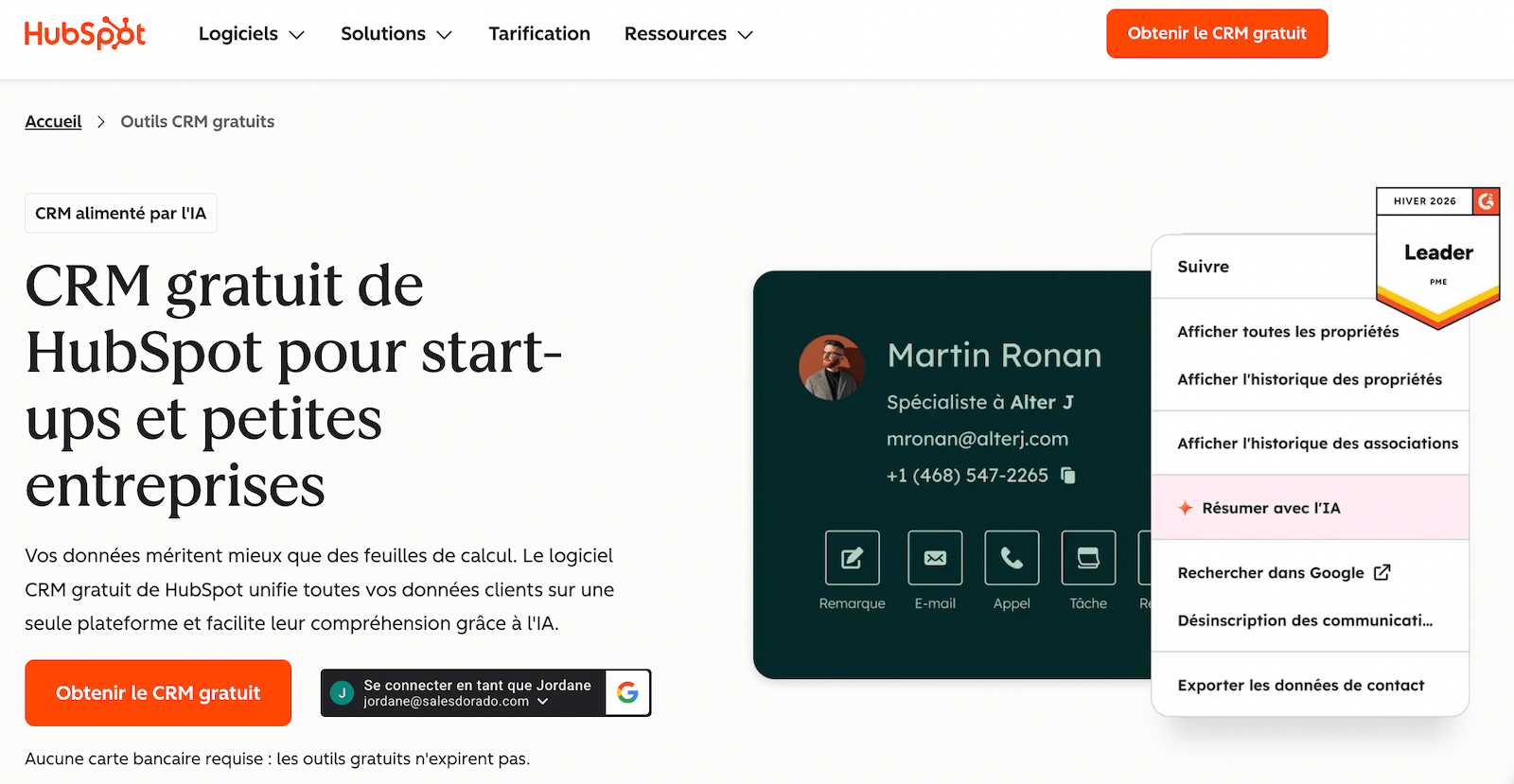
- Free with no time limit: no credit card, no expiry date.
- The free CRM stores up to 1,000 contacts and Marketing Hub sends up to 2,000 marketing emails per month.
- Five limits push you towards paying: 2 users, 1 pipeline, 1 action per workflow, HubSpot branding and a 30-day history on the timeline.
- Starter costs €15 per month per licence with no commitment, i.e. €45 per month for 3 users.
- Upgrading to a paid plan keeps your contacts, deals and history.
The free version of HubSpot CRM is a genuine offer (no credit card, no expiry date…), but it has specific limits that will block you sooner or later.
In this article, we tell you exactly what the free version of HubSpot lets you do, the precise numbers that define its limits and, above all, the 5 concrete signals that tell you it’s time to move to a paid plan (+ the real cost of that switch).
Our take on HubSpot free CRM at a glance
| Scope | Score | Our take |
|---|---|---|
| Overall rating | 4.3 | One of the most generous free CRM offers on the market. It is more than enough to get started solo or as a pair, build a first sales database and test the ecosystem. The limits come quickly as soon as the team grows. |
| Generosity of the offer | 4.7 | Hard to beat: 1,000 contacts, deal management, 2,000 marketing emails per month, 30 landing pages, ticketing, live chat, Gmail and Outlook integrations. No direct competitor offers as much for free. |
| Fit for small businesses and freelancers | 4.8 | The ideal target! A solopreneur or a 2-person sales team at launch will get plenty out of it without spending a single euro. Unbeatable value for money for this profile. |
| Blocking limits | 3.5 | Five limits really hurt: 2 users max, only 1 deal pipeline, 10 custom properties, 1 action per workflow and HubSpot branding everywhere. If any of these blocks you, you have to pay. |
| Upgrade path | 4.5 | A real strength: moving to Starter (€15/month) or Pro (€50/month) happens with no migration and no disruption. You keep your entire history. This is the major strategic advantage of the offer. |
Try HubSpot CRM for freeHubSpot offers its free CRM with no credit card, no commitment and no expiry date. Creating an account takes less than 5 minutes and everything runs directly in your browser.
HubSpot free CRM: is it really free?
Yes, HubSpot‘s free CRM is 100% free, with no credit card required and no expiry date. The free version gives access to a full CRM + lighter features from five modules: Marketing Hub, Sales Hub, Service Hub, Content Hub and Data Hub.
What you need to understand: « free » does not mean « time-limited trial ». HubSpot made a strategic bet to offer a genuine free plan with no time limit to bring small businesses and start-ups into its ecosystem, betting that customers who grow will naturally move to the paid versions. It’s this upgrade path, with no data migration, that makes the model so strong.
What you can really do with HubSpot free CRM
The free version covers five modules. We go through them in order of what will be useful to most sales and marketing teams.
The CRM (the foundation of the whole HubSpot experience)
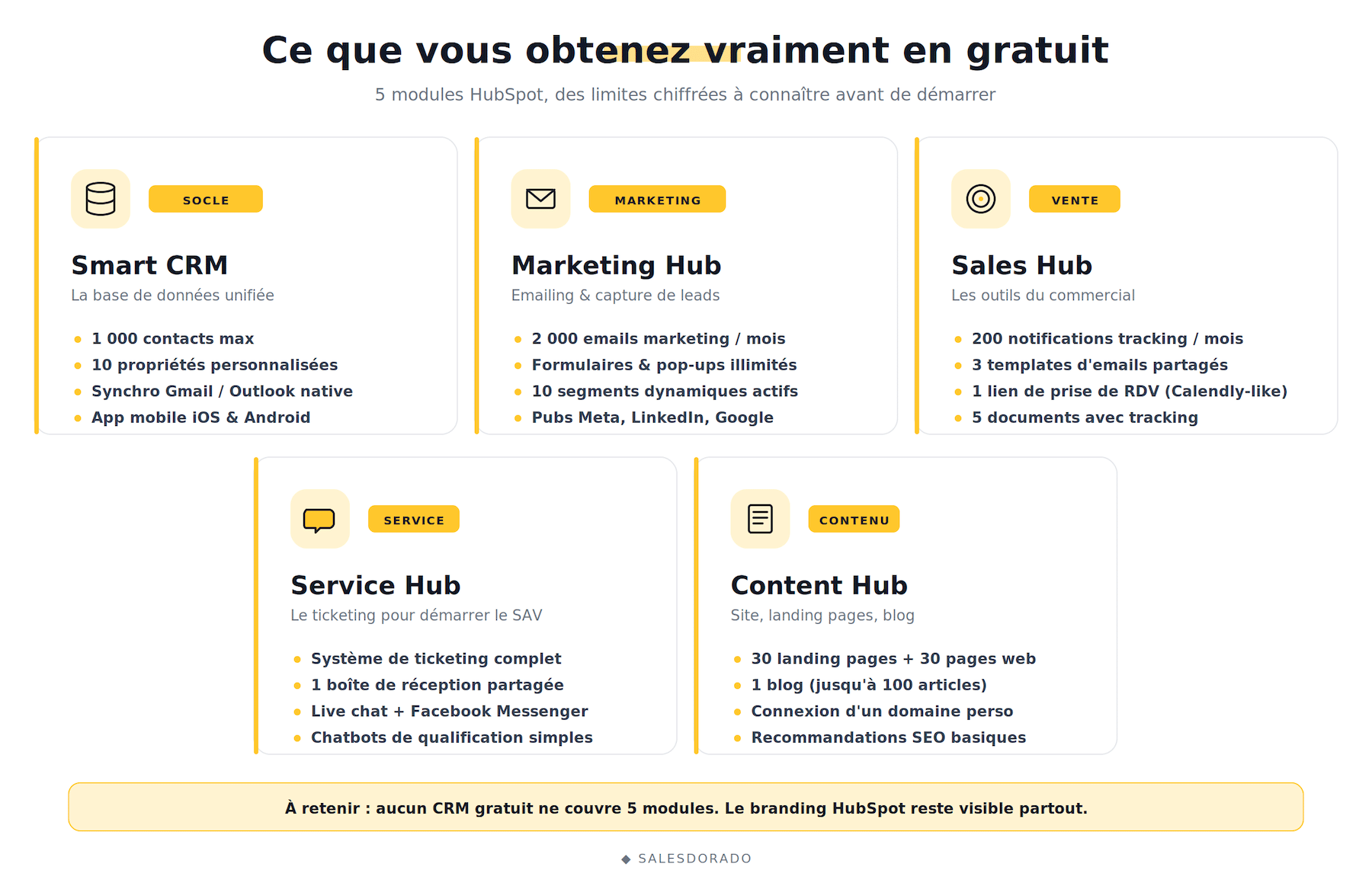
This is the base that makes everything else possible. The free CRM gives you a unified customer database with contact management (up to 1,000 records), company management, deal tracking in a visual pipeline, task management, plus native connection to Gmail, Outlook and Exchange. You can create up to 10 custom properties, and the iOS and Android mobile app is included.
Important bonus: Breeze Assistant, HubSpot’s AI, is available in beta even on the free plan to summarize contact records or help write emails. To give you a concrete idea: a freelancer managing 200 clients and prospects, or a 2-person sales team just starting out, will get plenty out of this free CRM to structure a first sales pipeline.
Free Marketing Hub (up to 2,000 marketing emails per month)
The free version of Marketing Hub lets you send up to 2,000 marketing emails per calendar month. This is the knockout argument of the offer: no need to pay for Brevo or Mailchimp on the side to send a newsletter to your database.
For lead capture, you get forms (standalone, embedded, pop-ups), ad management on Meta, LinkedIn and Google with 3 connected accounts, CRM segmentation with 10 active dynamic segments, and ad retargeting. If you want to go further with B2B emailing, it’s a solid launch pad.
Limitations: all emails and forms display HubSpot branding, and marketing automation is limited to a single workflow per form with a single action.
Free Sales Hub (the salesperson’s everyday tools)
The sales side of the free plan is surprisingly well stocked: email open and click tracking (200 notifications/month), shareable email templates (3 max), a Calendly-style meeting scheduler with 1 personal link, document sharing with tracking (5 max) and basic quote generation.
For a new salesperson or an independent consultant, this replaces several paid tools at once: Calendly for meetings, Yesware for tracking, DocSend for documents. All built into the same contact record.
Free Service Hub (ticketing to get customer support started)
HubSpot offers a complete ticketing system, a shared inbox to centralize incoming emails, live chat with HubSpot branding, Facebook Messenger integration and simple chatbots to qualify leads or book meetings.
That’s enough for a small team that wants to professionalize its customer relationship without investing in Zendesk or Intercom from day one. The hard limit: only 1 shared inbox, no custom branching logic on chatbots and no service AI.
To go further, see our HubSpot Service vs Zendesk comparison.
Free Content Hub (a website, landing pages, a blog)
Probably the most surprising free module. You can create up to 30 landing pages, 30 web pages and 1 blog with up to 100 posts, all with the drag-and-drop editor, premium hosting included, a custom domain connection and basic SEO recommendations. That’s more than enough to host a showcase site and launch a content strategy. HubSpot branding is displayed everywhere, which can be a problem for an established brand.
Salesdorado’s takeHubSpot’s bet with its free CRM is a smart one: give you access to the whole ecosystem so you get used to the platform, but with limits tight enough that any business gaining momentum gets pushed towards paying. It’s the right strategy for a small business in its launch phase, but be aware that prices climb as soon as your business takes off.
The 5 signals that HubSpot free CRM is no longer enough for you
Rather than dryly listing every limit of the free plan, here are the 5 concrete situations where you’ll hit the wall and where moving to a paid plan becomes mandatory.
If you recognize your situation in any of these signals, expect to have to switch within a few weeks.
1. Your team has grown beyond 2 users
The simplest and most brutal limit.
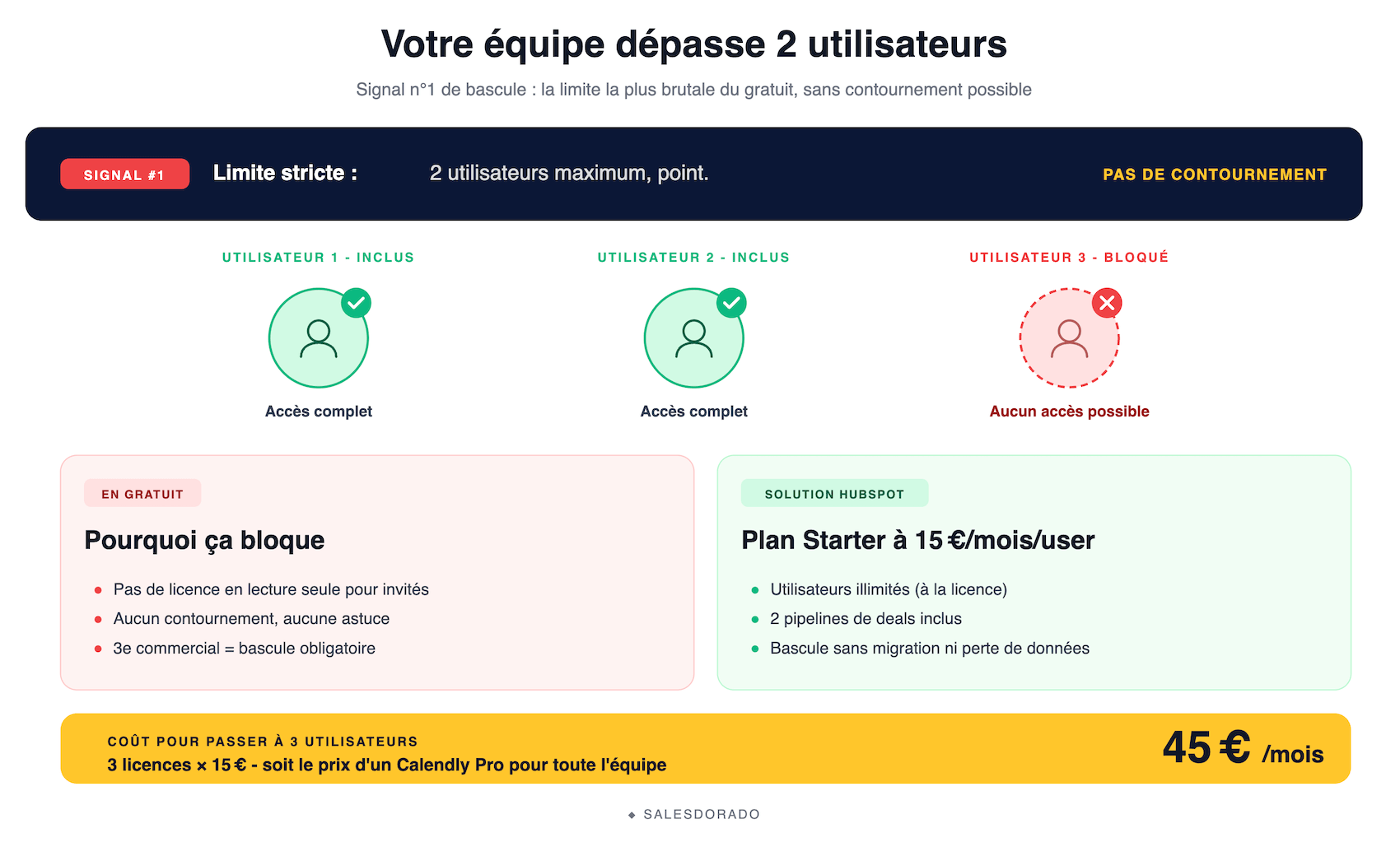
The free CRM allows 2 users maximum, full stop. No workaround, no read-only licence for the others. As soon as you hire your third salesperson or want to give your director access, it’s over.
The minimum plan that unlocks it: Starter at €15/month/licence with no commitment (or €9/month/licence with an annual commitment). With 3 users, you pay €45/month (or €27/month with a commitment). Very affordable for a growing team.
2. You need a second deal pipeline
The free plan is limited to a single deal pipeline. That’s enough if you sell a single product or service with the same sales cycle.
As soon as you diversify (for example: product sales + support subscription, or B2B + B2C, or several service lines), you need separate pipelines so you don’t mix up the metrics.
The minimum plan that unlocks it: Starter (2 pipelines included) or Pro (15 pipelines) depending on the level of complexity.
3. You really want to automate your processes
The free version only allows 1 action per workflow, and only triggered by a form. In practice, you can send a confirmation email when someone fills in a form. That’s it. No nurturing sequence, no conditional branch, no trigger based on sales activity.
To do real marketing automation on HubSpot (follow-up sequences, scoring, progressive qualification, automated sales alerts), you have to move to Pro. It’s unavoidable as soon as your volume justifies industrializing.
The minimum plan that unlocks it: Marketing Hub Pro at €880/month for full workflows, or Sales Hub Pro at €50/month for individual sales sequences.
4. Your brand can no longer live with HubSpot branding
This signal is often underestimated. In the free version, the HubSpot logo and branding appear on marketing emails, forms, landing pages, live chat and your website’s favicon.
For a freelancer or a small business starting out, that’s acceptable. For a brand that wants a consistent, professional customer journey, it no longer works.
The minimum plan that unlocks it: Starter at €15/month removes HubSpot branding from almost all assets. It’s probably the most common reason for upgrading.
5. You need a complete CRM history
The free version limits the activity history visible on a contact’s timeline to the last 30 days. Beyond that, older interactions become less accessible. To manage a long-term customer relationship (a 6 to 12-month B2B sales cycle, strategic accounts in account management, customer loyalty over several years), that’s far from enough.
The minimum plan that unlocks it: the paid versions (Starter and above) give access to an extended history and complete timeline reports.
Salesdorado’s take on upgradingIf you recognize 1 or 2 signals in this list, you’re still at a point where the free plan makes sense (or where moving to Starter at €15 is easy to justify). If you recognize 3 signals or more, you’re already beyond the free plan in real life: the workarounds you’re putting in place cost you more than the paid plan.
How much does it cost to move from HubSpot free CRM to a paid plan?
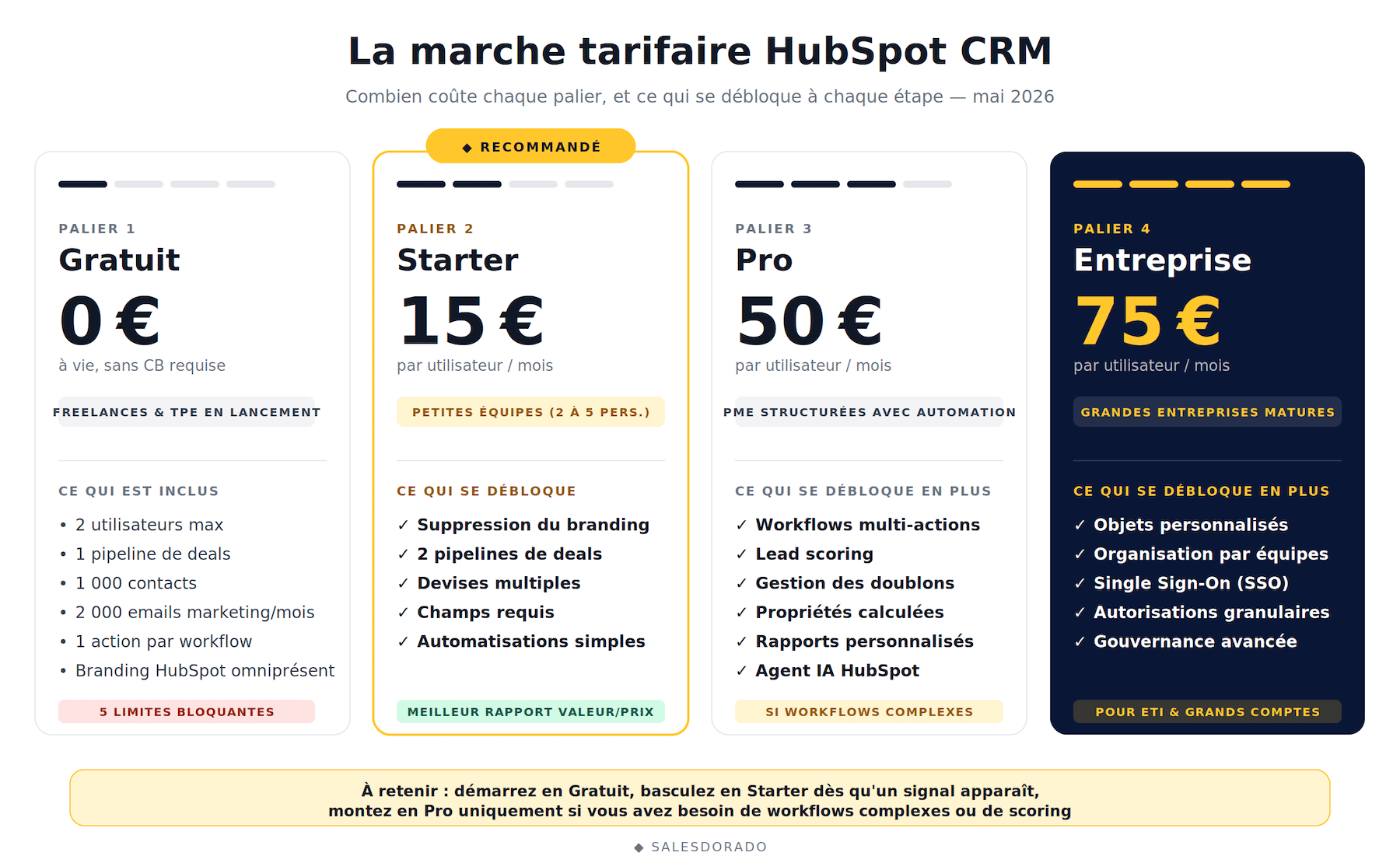
Good news: the entry-level price step is very affordable. Here is the full grid of HubSpot CRM Suite plans in 2026 and what they unlock compared with the free plan.
For a detailed analysis, see our complete guide to HubSpot costs.
| Plan | Price (no commitment) | What it unlocks vs free | Who it’s for |
|---|---|---|---|
| Free | €0 | 2 users, 1 pipeline, HubSpot branding, 1 action per workflow | Freelancers, solopreneurs, small businesses at launch |
| Starter | €15/month/licence | HubSpot branding removed, 2 pipelines, multiple currencies, required fields, simple automations | Small sales teams (2 to 5 people), growing small businesses |
| Pro | €50/month/licence | Advanced multi-action workflows, lead scoring, duplicate management, calculated properties, custom reports, AI agent | Structured SMEs using automation every day |
| Enterprise | €75/month/licence | Custom objects, team-based organization, SSO, granular permissions | Large companies and mature organizations |
Salesdorado’s take on the price stepThe Starter plan at €15/month is probably one of the best CRM offers on the market at that price. For €45/month (3 users), you get a professional CRM without branding, with several pipelines and basic automations. Our advice: start on the free plan, move to Starter as soon as the 5 signals appear, and go up to Pro only when you need complex workflows or scoring.
Who is HubSpot free CRM really for?
- HubSpot free CRM is for you if you are a B2B freelancer or solopreneur, an independent consultant managing a client portfolio, a founder at seed stage or a micro-business with a sales team of 1 to 2 people. In these cases, the free plan covers 90% of your needs and saves you from paying during the most fragile phase of your development.
- HubSpot free CRM won’t be enough if you have a sales team of 3 or more, you sell several product lines with different sales cycles, you really want to industrialize your acquisition with lead scoring and automated sequences, or your brand already has a strong identity that no longer tolerates HubSpot branding. In these cases, moving to Starter or Pro will be almost immediate.
If you’re hesitating between the free plan and another CRM, see our comparison of free CRM software and our free CRM vs paid CRM analysis.
What we like (and like less) about HubSpot free CRM
What we like
- Truly free, truly unlimited in time: no credit card, no expiry. Promise kept.
- The complete ecosystem: 5 modules for free (CRM, marketing, sales, service, content). No other free CRM offers as much.
- 2,000 marketing emails per month included: on its own, that replaces Brevo or Mailchimp when you’re starting out.
- Native Gmail and Outlook connection with built-in tracking, templates and meeting scheduler.
- Breeze Assistant included in beta: HubSpot’s AI available even on the free plan to speed up writing.
- Painless upgrade to paid: no migration, no data loss. The major strategic advantage.
What we like less
- 2-user limit: no flexibility at all.
- Only 1 deal pipeline: not enough as soon as you have several offers or sales cycles.
- 1 action per workflow: that’s not marketing automation, it’s email confirmation.
- HubSpot branding everywhere: on emails, forms, landing pages, chat, favicon.
- History limited to 30 days on the contact timeline. Short for long-term management.
- Community support only: no email or chat access to HubSpot support before the Starter plan.
Verdict: should you start with HubSpot free CRM?
Our recommendation is clear: yes, start with HubSpot free CRM, without hesitation. It’s one of the best ways to get a concrete feel for a modern CRM without spending a cent, and the ecosystem is rich enough to cover the first months (or even first years) of a new business.
The biggest asset isn’t the free price itself, it’s the frictionless upgrade path to the paid plans.
You start for free, you structure your sales database, you find your feet with the tool. When one of the 5 signals appears, you move to Starter for €15/month without losing anything.
The only case where we advise against HubSpot free CRM is if you already know you’ll need Pro within 3 months. In that case, you may as well start directly on Starter to avoid an internal migration and work without HubSpot branding.
Our final verdict on HubSpot free CRMHubSpot free CRM remains the best entry point on the market for structuring a first B2B sales approach with no budget. Get started in less than 5 minutes, with no credit card, and move to Starter the day your needs require it. No disruption.
The questions we get over and over.
Is HubSpot's free CRM really 100% free?
Yes, HubSpot free CRM is completely free, with no credit card required and no expiry date. You can use it indefinitely in its Free Tools version. Advanced features (complex workflows, lead scoring, branding removal) are reserved for the paid Starter, Pro and Enterprise plans.
How many contacts can you store in HubSpot free CRM?
HubSpot free CRM lets you store up to 1,000 contacts in its database. For other standard objects (companies, deals, tickets), the limit goes up to 1 million records. Honestly, that's more than enough for a freelancer or a small business starting out.
Can you remove HubSpot branding on the free version?
No, HubSpot branding appears on all assets created in the free version: marketing emails, forms, landing pages, live chat, website favicon. Removing the branding is one of the main features unlocked by the Starter plan at €15/month/licence.
Is HubSpot free CRM enough for a B2B SME?
HubSpot free CRM is enough for a micro-business with 1 or 2 people in sales, or for an SME in its start-up phase structuring its first sales approach. For an established B2B SME with 3+ salespeople, several product lines or automation needs, upgrading to Starter or Pro quickly becomes necessary.
How do you move from HubSpot free CRM to a paid plan without losing your data?
Upgrading from free to paid at HubSpot happens with no migration and no data loss. All your contacts, deals, custom properties, emails and histories are kept intact. You simply change plan in your HubSpot account settings and the new features unlock immediately. It's one of the biggest strategic assets of the offer.


What the community says.