



- The rate depends on the channel: the portal of your partner VC or accelerator leads to 90%, while applying directly often caps out at 30%.
- Do not open a free HubSpot account before applying, it can make you ineligible.
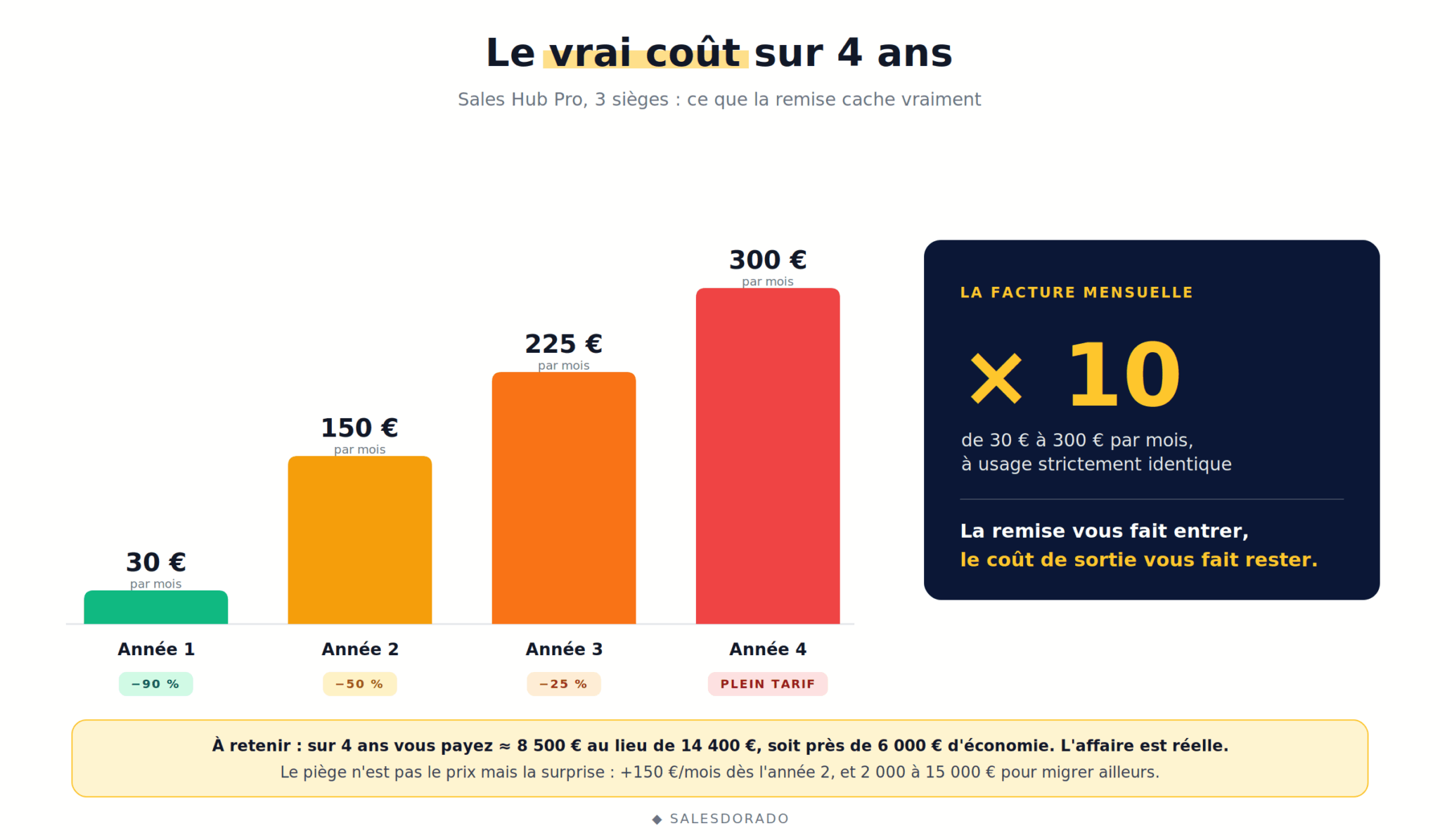
- On Sales Hub Pro with three seats, the bill goes from €30 to €300 a month between the first and the fourth year.
- Over four years, you pay about €8,500 instead of €14,400.
- Budget for year 3 from the day you sign and prepare the renewal as a negotiation.
You may have already come across the HubSpot for Startups offer, promising up to 90% off the first year. On paper, it is one of the best deals in B2B SaaS.
Except people often forget to mention that:
- That famous 90% is not automatic: depending on how you apply, you can end up with 30% and leave several thousand euros on the table.
- The discount shrinks year after year, 90% then 50% then 25%, until it disappears, exactly when you are most dependent on the tool.
So how do you land the best tier and not the first one you are offered? What will HubSpot really cost your startup over four years, once the discount has evaporated? And how do you make the most of the window without ending up bound hand and foot at renewal? We ran the full numbers. Here is our take on HubSpot for Startups.
What you will find in this article:
- The tactic to land the 90% tier, and the silly mistake that locks you into 30%.
- The real cost of HubSpot over four years, with a detailed calculation.
- Which HubSpot level to activate depending on your startup’s stage, from pre-seed to Series A.
HubSpot for Startups, what it really is (and its three tiers)
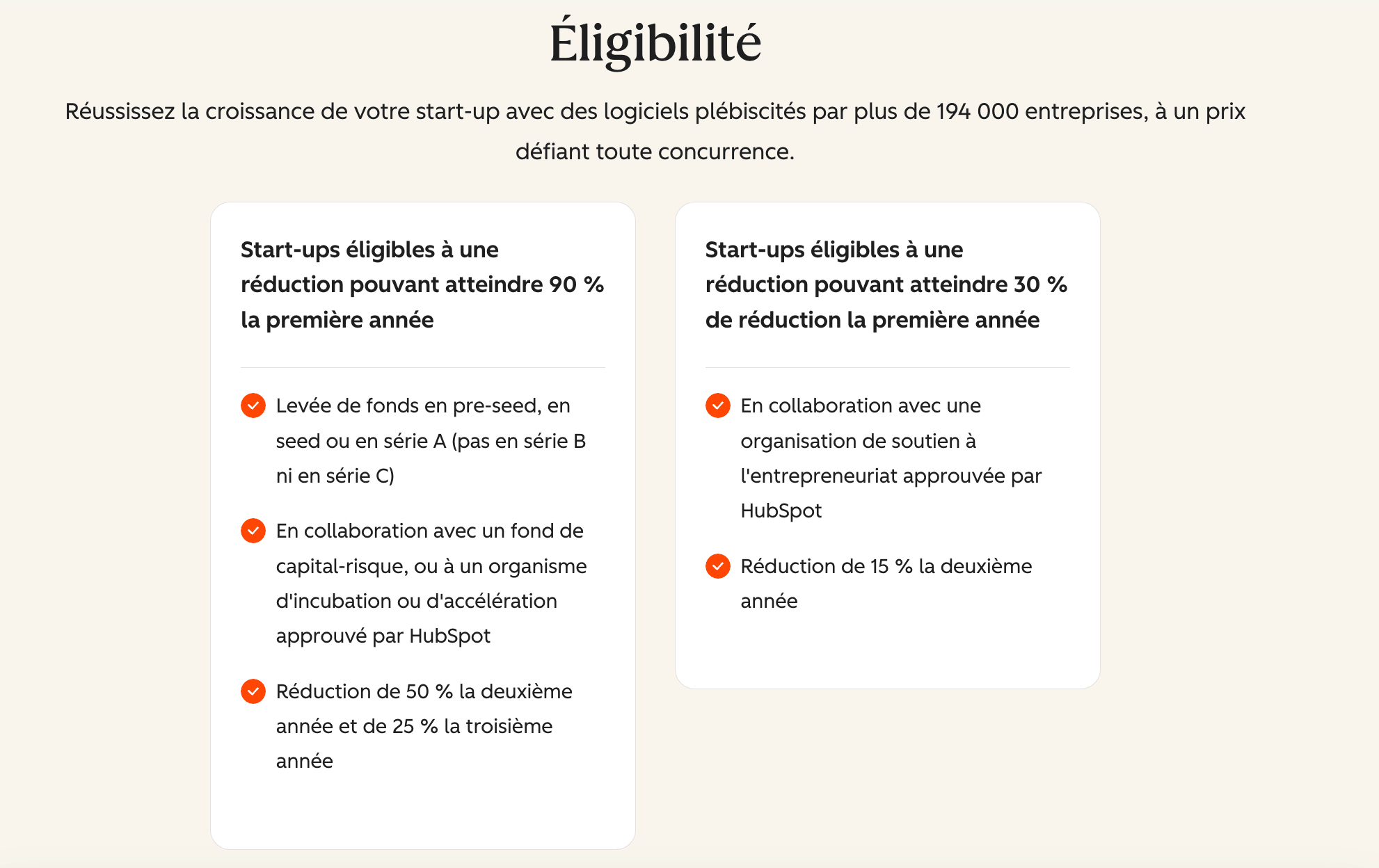
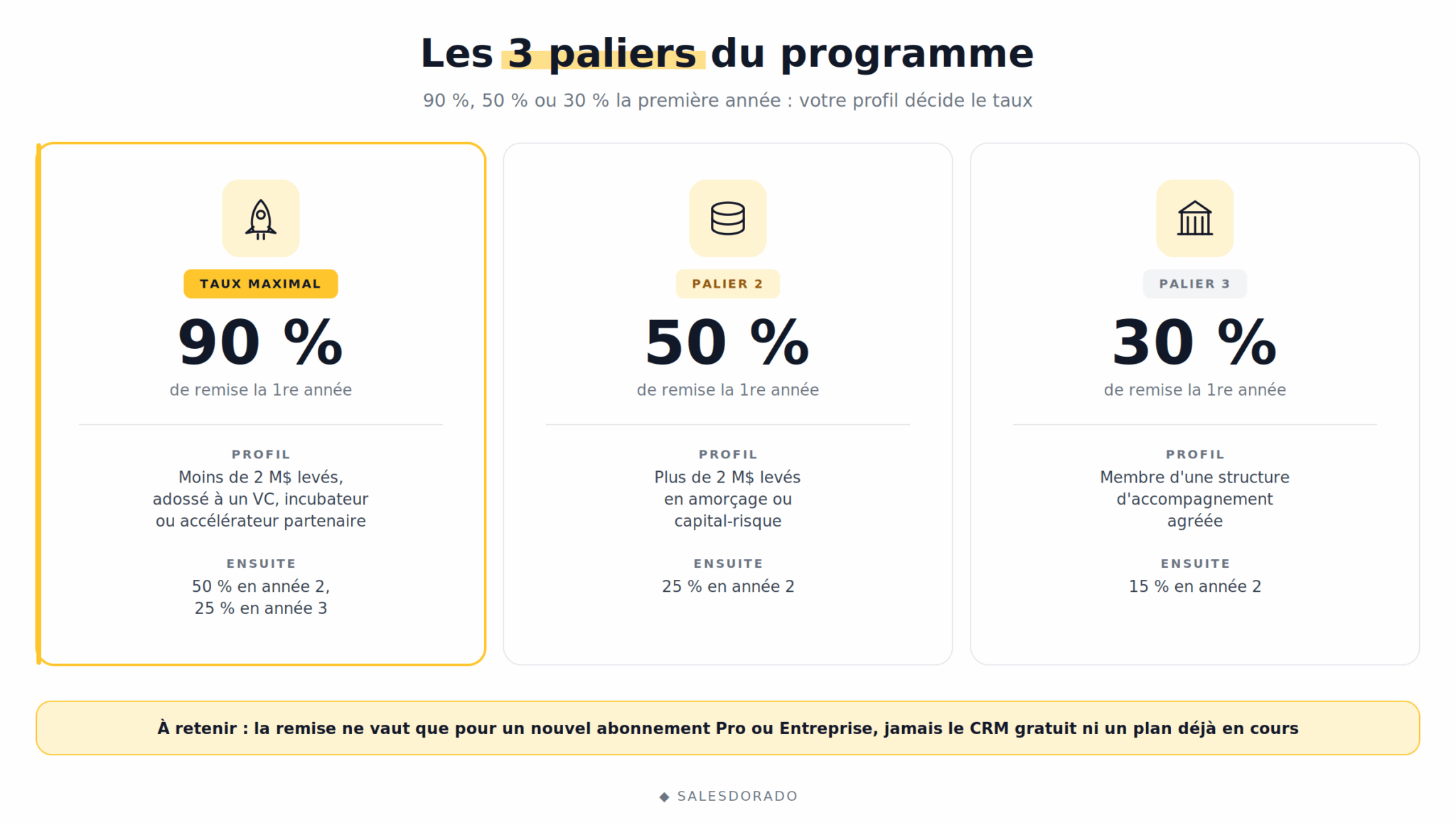
Let’s start with the specifics. HubSpot for Startups is a discount on HubSpot’s paid subscriptions, reserved for eligible young companies, that can reach 90% in the first year. The program applies to new Pro or Enterprise subscriptions, never to the free CRM or to a plan already in progress.
But talking about « 90% » without spelling out the rest is misleading. The rate depends on your profile, and there are three tiers.
| Your profile | Year 1 | Following years |
|---|---|---|
| Less than $2M raised, backed by a partner VC, incubator or accelerator | 90% | 50% in year 2, 25% in year 3 |
| More than $2M raised in seed or venture capital | 50% | 25% in year 2 |
| Member of an approved support organization | 30% | 15% in year 2 |
Two conditions to keep in mind before going further:
- The program is reserved for new customers: if you already have a HubSpot account, even a free one, you risk being ineligible.
- You must be backed by an approved partner or show a verifiable funding round. In France, most major accelerators and funds are on the list: Station F, Bpifrance, French Tech and Village by CA.
The channel trap: how to get 90% and not 30%
One important thing to know is that the tier you get depends on the door you come in through.
There are 3 channels:
- The « startup perks » portal of your VC or accelerator, if it is a partner. This is the royal road to 90%.
- A HubSpot Solutions partner who sponsors your application. Useful if your fund is not on the list, or if you are bootstrapped but otherwise eligible.
- HubSpot’s public page, applying directly. This is the fastest route and often the one that caps you at 30%.
Applying directly when a partner could have sponsored you means giving up thousands of euros without knowing it. On a Pro subscription, the gap between 30% and 90% in the first year runs into thousands of euros. A simple conversation with the right person before signing changes the bill completely.
The mistake that disqualifies youDo not create a free HubSpot account « to test it » if you plan to apply to the program. The program is reserved for new subscriptions, and a simple free account already opened under your domain name can be enough to make you ineligible. Check your eligibility first, open the account second.
One last practical point: whatever the channel, billing is annual, in one payment, at the discounted rate. Plan your cash flow accordingly.
HubSpot CRM for Startups: the real math over four years
The first year’s 90% hides a ramp. As mentioned above, the discount decreases every year, then stops dead. Let’s take a concrete case to see what it really looks like: a three-person sales team on Sales Hub Pro, i.e. €3,600 a year at full price (annual commitment).
| Year | Discount | Annual cost | Monthly cost |
|---|---|---|---|
| Year 1 | 90% | €360 | €30 |
| Year 2 | 50% | €1,800 | €150 |
| Year 3 | 25% | €2,700 | €225 |
| Year 4 | full price | €3,600 | €300 |
Look at the right-hand column. Your monthly bill is multiplied by ten between the first and the fourth year, even though nothing has changed in how you use it. The most painful jump is not even the last one: it is the move from year one to year two, when « almost free » becomes €150 a month.
Should you conclude that the program is a trap? No, and it is important to say so. Over four years, you pay about €8,500 instead of €14,400, a saving of nearly €6,000. That is a genuinely good deal. The problem is not the amount, it is the surprise. Too many founders budget for the first year’s price and get caught out in the second.
And getting out is not that simple. The day full price starts to hurt, switching CRMs means migrating your data, workflows and integrations again, a project billed between €2,000 and €15,000 depending on complexity. In other words, the discount gets you in, the exit cost keeps you there. It is a formidably effective acquisition model, and you need to go in with your eyes open.
Salesdorado’s adviceBudget for year 3 from the day you sign, not year 1, and prepare your renewal as a negotiation: a multi-year commitment, going through a partner or reviewing the seats you actually use can keep the bill in check. The full list price is almost never the final price when you negotiate it. We break down the whole price grid in our article on HubSpot pricing.
Which HubSpot CRM plan to activate depending on your startup’s stage?
The right HubSpot level is not the most complete one, it is the one that matches your stage. Stacking hubs « just in case » is the surest way to inflate the bill without gaining efficiency.
Pre-seed: the free CRM, and nothing else
Before your first funding round, you do not need to pay for HubSpot. The free CRM handles your contacts, your pipeline, your emails and a capture form, which is more than enough to structure your first sales.
Be careful though (and this is counter-intuitive): if you plan to apply to the program right after your round, you are better off not opening that free account right away, because it could compromise your eligibility. To decide between the two, our comparison free CRM VS paid CRM sets out the right criteria.
Seed: the program, on Sales Hub Pro
This is when the program makes the most sense. After a seed round, you become eligible and the 90% makes the move to Pro almost painless in the first year.
It is also the stage where you really need the paid features: follow-up automation, sequences and above all lead scoring to prioritize your prospects when volume climbs. This is where you build a real sales pipeline instead of steering by gut feeling.
Series A: scale and keep an eye on the bill
At this stage, the discount has already started to melt and your team is growing.
Two reflexes are a must:
- Pay only for the seats actually used, keeping paid licenses for the salespeople who really use the advanced features.
- Challenge every extra hub before adding it to the bundle. This is when budget discipline makes all the difference between a profitable tool and a heavy fixed cost.
Try HubSpot before applyingWant to see the interface before applying to the program? Your best bet is the demo or a conversation with a partner, which preserves your eligibility, rather than opening a free account on your own.
Is HubSpot worth it for a B2B startup?
Let’s ask the real question: compared with HubSpot, what is the alternative for a B2B startup? It is almost never Salesforce, too heavy and too expensive at this stage. The real competitor lies elsewhere.
In practice, a young startup hesitates between two options: a light, modern CRM like Pipedrive or Folk, or a homemade setup built on Notion, a spreadsheet and a separate emailing tool. Each has its own logic, and its limits.
| Criterion | HubSpot (through the program) | Light CRM (Pipedrive, Folk) | DIY stack (Notion + spreadsheet) |
|---|---|---|---|
| Starting price | Almost zero in year 1, then rising | Low and stable | Close to zero |
| Feature coverage | Very broad (CRM, marketing, service) | Mostly CRM and sales | Depends on your setup |
| Automation and scoring | Advanced from Pro | Basic to decent | To build yourself |
| Ability to grow with you | Excellent | You often end up migrating | Breaks down past a certain size |
| Lock-in risk | Real, high exit cost | Low | None, but guaranteed chaos as you grow |
A light CRM costs less and locks you in less, but you will probably leave it as soon as you scale. The DIY setup costs nothing and slows you down as soon as you grow. HubSpot ends up more expensive over time, but it is the only one of the three designed to support you from the first sale to the hundredth hire.
This is exactly where the program changes the game: it lets you adopt early the tool you would only have migrated to later, spreading the cost over your first years. What remains is to avoid the opposite pitfall, stacking useless hubs. On that point, our guide to cutting down your SaaS stack and our overview of HubSpot alternatives are worth a look before you sign.
Our verdict on HubSpot for Startups
HubSpot for Startups is a genuinely good deal. The discount is real, the savings over four years run into thousands of euros, and you adopt early a CRM built for growth. It is not a trap. It is an excellent deal, as long as you do not sign it blindly.
Strengths
- A discount that can reach 90% in the first year, real and significant.
- The best CRM to grow with, adopted before you can even afford it at full price.
- A complete ecosystem that spares you from stacking tools.
- Plenty of French partners to maximize your tier.
Weaknesses
- A tapering discount that multiplies the bill by ten in four years.
- A 90% tier that is easy to miss if you apply through the wrong door.
- A free account opened too early can disqualify you.
- A high exit cost once your data and workflows are in place.
Our recommendation: if you have just raised and you are eligible, go for it, but use the right channel and budget for the ramp. The program remains one of the best ways to equip a B2B startup with a serious CRM without sinking your early cash flow. For a full review of the platform beyond the program, see our detailed HubSpot review.
Salesdorado’s takeBefore applying, spend five minutes checking one thing only: whether your fund, accelerator or incubator is on the list of HubSpot for Startups partners. If it is, apply through their portal. This check is potentially worth several thousand euros in discount. Hard to find a better return on five minutes of your week.
Take advantage of the HubSpot for Startups programIf you are eligible, the program gives access to HubSpot’s Pro and Enterprise tools at a fraction of the price in the first year. Check your eligibility and the tier you are entitled to before signing anything.
Going further
The questions we get over and over.
Who is eligible for the HubSpot for Startups program?
The program is aimed at seed or Series A startups backed by a VC, incubator or accelerator that partners with HubSpot, or able to show a verifiable funding round. You must also be a new HubSpot customer, on a Pro or Enterprise subscription. Companies past Series B are no longer eligible for the top tier.
How do you get the 90% discount (and not 30%)?
To aim for the 90% tier, apply through the startup portal of your partner VC or accelerator, or get sponsored by a HubSpot Solutions partner. Applying directly on the public page often limits you to the 30% tier. The channel determines the rate, so choose it before submitting your application.
What happens after the first year?
The discount decreases gradually. Depending on your starting tier, it goes from 90% to 50% in the second year, then 25% in the third, before full price. On a three-seat Pro subscription, the bill goes from about €30 to €300 a month in four years. Plan for this increase from the day you sign.
Is HubSpot for Startups worth it?
Yes, if you are eligible and play it well. Over four years, the savings often exceed €5,000 on a Pro subscription, and you adopt early a CRM designed to grow. The real risk is not the price, it is the second-year surprise and the exit cost.



What the community says.