



- Start from your key performance indicators and your sales goals before you think about emails.
- To build your list, you have two options: buy a prospecting list or develop a nurturing cycle, which takes longer.
- Create personas to know where to reach your target, online and offline.
- A welcome automation of 3 to 5 emails, sent at short intervals, keeps new subscribers interested.
- Don’t follow a purchase with a new offer right away: wait, depending on the length of your sales cycle.
Want to use email to communicate better with your prospects? Feel like you’re only capturing a tiny fraction of your potential customers? This step-by-step guide will help you put a real email strategy in place for your B2B company and move your prospects through your conversion funnel.
Step 1: Set your goals
The first step is to define your goals.
Think about what you want to get out of your email campaigns: is it converting more or less active leads who have been following you for years? Is it building authority around a key topic for your business? Or is it rather generating a pipeline of inbound leads that you can qualify & work commercially?
These goals will determine:
- Your target
- The type of campaigns you send
- The substance and form of your emails
- The criteria for measuring your campaign’s success
TipStart with your key performance indicators and your sales goals, then think about how you can align them with your B2B email campaigns.
Email is the most powerful channel for reaching your audience. But without clear goals, you won’t get the results you want. So when you’re starting out, take the time to build a real strategy.
Step 2: Choose an email marketing tool
Once you’ve defined your goals and built a strategy, it’s time to choose email software that will help you reach them.
The right platform, paired with a solid strategy, can save you time and money and increase your sales.
Here is a list of things to consider when choosing an email tool:
- Does it have an easy-to-use drag & drop email editor?
- How can I import and export my contact database?
- Does the company offer a free migration service?
- How can I manage my contacts?
- What kind of analytics and reporting does it offer?
- Can I create sign-up forms? And can I easily integrate my existing ones?
- Can I easily create automation workflows?
- Does it integrate with other software, for example landing page builders?
- Can I run A/B tests?
- What is the deliverability rate?
- Is there a free trial?
- Is customer support fast and effective?
Choosing your email software with Salesdorado
Step 3: Build your email list
Now it’s time to build your mailing list.
Depending on your sales processes, you have two options:
- You can go for buying a prospecting list and create pure prospecting campaigns. If so, we recommend choosing your provider carefully. For that case, we have another complete guide to B2B prospecting emails, which has nothing to do with this one 😬.
- You can build your own list and develop a whole nurturing cycle. Don’t worry, it’s much simpler than it looks. Still, let’s be honest, it’s a medium-term investment.
The first thing you’ll need is a clear understanding of your target.
I recommend creating buyer personas that represent your ideal customers.
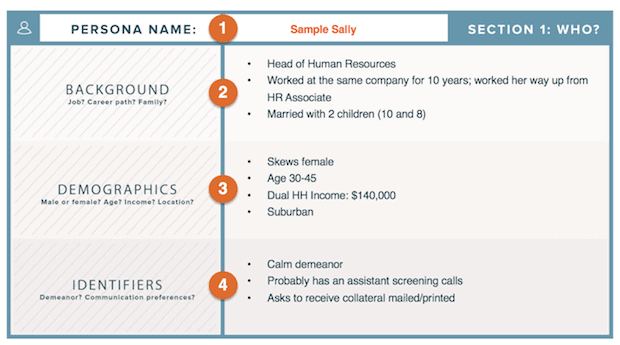
Source: OptinMonster
This will help you know where you can reach them. Without knowing that, you’ll struggle to collect emails.
Email is an online channel, but you can build your list both online and offline.
There are more than 3.7 billion email users worldwide, and many of them are probably not avid internet users. So, depending on your business and your personas, you can decide which path you’ll take to build your list.
Here are a few examples of ways to collect emails:
1. Optimize your website for opt-ins
When someone visits your website, they show some interest in your product or services. By setting up newsletter sign-up forms, you can add interested people to your mailing list.
2. Put forms on your blog
The same goes for your blog. Readers of your articles are very likely interested in the topics you cover. If they like your content, a good percentage will want to subscribe to your newsletter.
3. Use lead magnets
You can go even further. Create ebooks, checklists, spreadsheets, templates or videos on the topics you cover on your blog.
These will be your main magnets or your content upgrades. This type of content should provide extra value in an actionable form.
Create landing pages where users can sign up to receive your lead magnets. Put CTAs (calls to action) in your blog posts so that people who want to learn more about a specific topic can get to them.
An email course is the best type of lead magnet for growing an email list. For one thing, it attracts the right traffic, and subscribers will look forward to your emails. That makes relationship-building and qualification easier. On top of that, it’s easy to implement.
4. Create pop-ups or contextual forms
Contextual pop-ups and behavior-based forms are ideal for growing your list. If you set them up properly, you can significantly increase your number of subscribers. One thing to consider when setting them up is context.
For example, set a pop-up to appear when someone is halfway through your article. Even better, set it to appear in a fixed position on the part of the screen where it’s most relevant.
5. Use social media
Social selling isn’t just a trend. Social networks (LinkedIn in particular) are a very effective way to grow your list. Put links to your landing pages in your profile descriptions. Go a bit further and think about which lead magnet works best for each platform.
Also create posts or ads with links to your lead magnets.
6. Team up with business partners
You can swap a mailing list with other companies. Make sure you do it with relevant companies: the audience has to be the right one.
I recommend using the same sender name they usually use for their newsletter. Otherwise, your open rate could suffer, because most people will have no idea who sent the email.
In the subject line or preview text, you can mention that this isn’t just a regular newsletter. Some new content with a fresh perspective can intrigue subscribers.
You can also share their content on your social media and in your newsletter, and ask them to put a link to your landing page in their newsletter.
7. Build a community
Getting an email address today is much harder than it used to be. You have to offer real added value for people to choose to hand it over.
Building an online community is a great way to show people what you can bring them, and it’s a smaller commitment. Today, people will rather join a Facebook or Slack community, then give you their email.
8. Be active on blogs and communities
By liking or commenting on content from other people in your industry, you can position yourself as a leader in your field. And that can help you grow your list. If it’s relevant, include a link to a blog post or mention your company.
Don’t spam, and don’t forget to include a link to your blog or to landing pages where people can sign up.
9. Create email-only promotional offers
By offering promotions by email only, you can give people a strong incentive to hand over their address. On top of the good deals, it gives subscribers a sense of exclusivity.
10. Ask people who are already engaged to refer new subscribers
If you already have engaged subscribers on your list, ask them to refer their friends or colleagues: it’s an easy way to give your list an extra boost.
11. Host or attend events
Growing your lead harvest outside the web is a great way to build relationships that will help you grow your business. If you host an event, you can ask people to reply to your invitation by email.
You can even ask guests to leave their email on a paper form. However, I don’t recommend this option, because it takes too much manual work and you can run into difficulties in many ways. There will be typos when people fill in the sheet and when you import the contacts into your database.
12. Direct mail
If you have the physical address of some people but no email, send them a direct mail offer they can only get by opting in on your blog or a specific landing page.
13. Join business groups
Look for and join relevant professional networking groups. Then ask around whether it’s possible to include a link to your opt-ins in their newsletters.
14. Add a QR code or a URL to your print materials
Print isn’t dead! If you use print ads, make the most of them to grow your list by adding a QR code or a short URL that’s easy to type and remember. You can also do it on your invoices.
15. Use a viral marketing tool
With a viral marketing tool like UpViral or Viral Loops, you can run contests and giveaways. These campaigns can quickly add contacts to your mailing list.
16. Collect business cards at trade shows, conferences and workshops
Trade shows, conferences and workshops are a chance to collect business cards. After the event, send an email with a sign-up confirmation. You can even link to a dedicated landing page where they can sign up.
This matters because people don’t hand you their cards so you can add them to your marketing list. So I recommend getting permission first.
17. Don’t forget paid ad campaigns
Run paid ad campaigns on your lead magnets and your best blog posts. If you offer main magnets, send the traffic to a landing page and optimize the campaign for conversions. For blog posts, drive traffic to that page with a pay-per-click campaign and optimize it with calls to action that point visitors to the magnets.
This list should give you an idea of the areas to focus on, based on your persona, your business model and your resources.
Step 4: Pre-qualify and engage your leads with automation workflows.
Once you’ve managed to get a mailing list for your emails, it can be worth sending a series of automated emails to build a relationship with your prospect, who will then be more inclined to look at your offer.
This is where all the brainstorming from step 1 really pays off. The goals you set will determine the type of campaigns you run.
Read alsoWant to learn more about pre-qualifying and engaging your leads? Check out our complete guide to lead nurturing to qualify, score and warm up your leads with automated workflows.
You can send hundreds of types of prospecting emails, but we’ll now focus on the two main groups: email campaigns and automation workflows.
1. Email campaigns
Newsletters and marketing offers are the most common examples of email campaigns. But for some companies, using lead magnets is enough, without resorting to weekly or monthly newsletters.
The main things to consider when selecting the types of emails you should send are the following.
Campaign purpose
Is it better to send newsletters, announcements, marketing offers, customer and brand testimonials, event invitations? None of them? All of them? It’s up to you!
Sending schedule
How often will you send emails? Weekly, monthly, quarterly?
It can make sense to send a weekly newsletter, but sending emails with a discount coupon every week may not be a good idea.
Weekly emails are great because they are regular enough that subscribers don’t forget you, without flooding them with useless emails. If you produce enough content to send an email with real added value every week, go for it!
Monthly emails also work very well for marketing offers and newsletters. But it’s better to send other types of email in between. Otherwise, your subscribers could forget you exist, and your emails will get lost among competing emails.
2. Automations
According to the Epsilon Email Institute, automated emails show on average 70.5% higher open rates and 152% higher click rates than standard marketing messages.
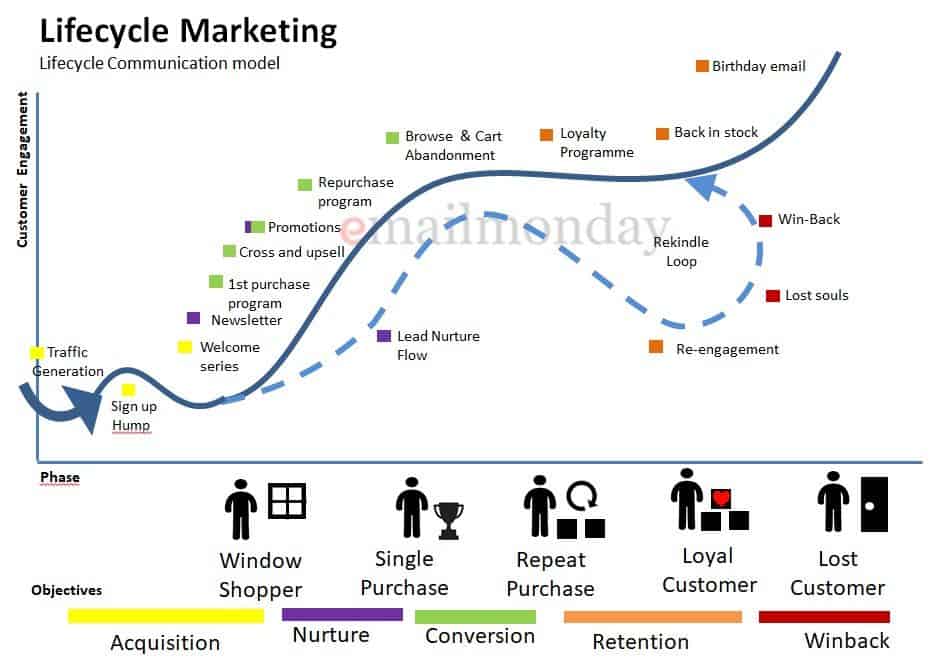
Now I’ll go over the most common email automation campaigns:
Welcome automation for blog subscribers
Someone has chosen to receive your newsletter. You’ve turned a blog visitor into a subscriber. That means they are really interested in your content. But over time, that interest will start to fade, so you need to build on that initial momentum.
Did you know that about 75% of users expect a welcome email after signing up? What’s more, 90% of users become inactive after one hour.
Your automated welcome emails shouldn’t be spaced too far apart. That lets you keep your subscribers engaged and interested for longer.
According to our internal data, new subscribers are the most active and engaged during the first six months. After that period, you have to work harder to reactivate them.
Why a welcome automationA welcome automation is very effective, because:
- Your subscribers can learn more about you.
- You build momentum and lead new readers to your older content.
- A deeper relationship forms.
I would recommend using about 3-5 emails in a welcome automation. First send a welcome email in which you introduce yourself or your company. You can also ask a relevant question in the first 2 emails. It’s a great way to gather valuable feedback on your content and your product, which you can use to refine your strategy.
In the following emails, share some of your most popular blog posts. In the final emails, you can even add a CTA (call to action) to your most relevant main magnet.
Lead magnet follow-up automation
Create an automation for each of your lead magnets, in which you share additional resources on the topics they cover.
The first email in the automation should contain the download link to your magnet, and I recommend a short introduction to your brand.
In the following emails, share additional resources on the same topic as your magnet. These can be blog posts, white papers, podcasts, etc.
Email course
Email courses can be a good strategy for qualifying your leads. Especially if you have an ebook or a very long blog post. You can simply split it into 5 to 7 parts, and you already have most of the content.
Start with a welcome email containing an overview of the course and the first lesson.
Then, depending on the number of emails in your course, set up the automation so that an email goes out daily or every other day.
Cross-sell and upsell automation
Use cross-sell and upsell automations to increase the commercial value of your existing customers. Take a look at what they bought and tailor your offers accordingly.
However, I don’t recommend following up with a new customer with other offers right after a purchase.
After a customer has made a purchase, wait a little before reaching out again. Of course, this depends on your industry and in particular on the length of your sales cycle.
In the emails, mention the person’s previous purchase and describe the clear benefits of the new product / service you’re recommending. If you have other related products, you can include them in the next emails.
In the last emails, I would suggest offering a discount as a final push toward a purchase.
Add your offline prospects to your email workflows
Let’s say you generated prospects at an event. Of course, you want to turn those prospects into paying customers. The best way to do that is to use an advanced automation.
Start by importing the contacts you collected at the event.
Create an automation with a few follow-up emails. In the first email, thank them for coming to the event and recap what happened there. Also write a short summary of the following emails so they know what to expect.
Conclusion
Once you’ve built a real relationship with your prospect, the last step is to write your prospecting emails.
The main factors that will make your email campaigns successful will be the personalization of your emails, their subject lines, and the analysis of your campaigns to adjust your content.
We’ve already written articles on these topics to help you implement them properly:
You now hold all the cards to create your email prospecting campaign! Let us know what you think in the comments.
The questions we get over and over.
Where do you start with a B2B email campaign?
With your goals: converting leads who have been following you for a long time, building authority on a key topic or generating a pipeline of inbound leads. They will determine your target, the type of campaigns, the substance and form of your emails and the criteria for measuring their success.
What criteria should you look at when choosing an email tool?
The email editor, contact import and export, migration, reporting, sign-up forms, automation workflows, integrations, A/B tests, deliverability rate, free trial and the quality of customer support.
How do you collect emails in B2B?
With sign-up forms on your website and blog, lead magnets, contextual pop-ups, social media, partners, a community, events, subscriber-only offers, referrals or paid ad campaigns.
How many emails should a welcome automation include?
About 3 to 5 emails. The first introduces the person or the company, the first two can ask a question, the next ones share the most popular articles and the last ones can add a CTA to the most relevant lead magnet.
How often should you send a B2B newsletter?
A weekly newsletter is regular enough that subscribers don’t forget you, if you have enough valuable content. A monthly rhythm also works, as long as you send other types of emails in between.


What the community says.