



- A list with too many invalid emails damages deliverability: run it through a cleaning tool before the campaign.
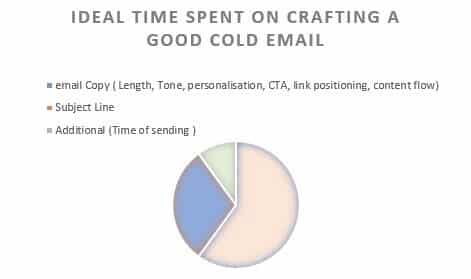
- Spend 40% of your writing time on the subject line, and test several subject lines in an A/B test.
- Take care of the sender: a first name and a last name rather than “The Salesdorado team”.
- A short first email, between 50 and 125 words according to Boomerang, with a single call-to-action.
- Plan at least 4 to 5 follow-ups, at least 2 days apart, and track the positive reply rate rather than the raw reply rate.
“You only get one chance to make a good first impression”.
Email is a fundamental channel in sales, and it is here to stay.
In this article, we go through all the best practices of B2B email prospecting.
1. It all comes down to the quality of your cold mailing list
A good prospecting list will always be the keystone of a successful prospecting campaign. Here are a few ways to check that your list is good quality.
The invalid email rate
If you have too many invalid emails, your mailings won’t get through the most aggressive spam filters from the very start of the campaign.
Your open rates will stay mediocre (under 80%), and in the worst cases, your reputation with ISPs (and with your SMTP relay) will decline, until you run into serious deliverability problems.
Getting out of that will take a considerable amount of energy.
It’s the nightmare of a failed campaign.
In real life, a prospecting list with a high invalid rate will almost always be a list that is too old. If you can’t trust the email data point, don’t trust the other data points either (First name, Company, Job title, etc.)
TipTo assess the quality of your list, run it through an email list cleaning tool like Emailable (formerly DataValidation) before starting your campaign.
The number of personalization elements
Personalization is a fundamental element of successful prospecting campaigns. It has even become something of an obligation under the GDPR, which requires a legitimate reason to contact someone by email without their consent (in B2B).
But to personalize your prospecting emails, you need material, elements you can reuse in your emails.
That’s where a good prospecting list makes all the difference.
If you have, for example, the date your prospect started in their role, you can adjust your message to congratulate everyone who recently took up their position.
You could even decide to target only those people at first if the conversion rates are better.
Salesdorado’s tipIf your list is a bit thin, take a look at B2B data enrichment tools. At Salesdorado we like dropcontact for the French market.
As you will have gathered, email prospecting saves you time compared with phone prospecting, but it definitely does not let you skip the qualification step.
On the contrary, the more you automate your sales processes, the more fundamental your qualification becomes
2. Your email’s subject line is worth 40% of your email
Forget the fine words along the lines of “Don’t judge a book by its cover”. In real life, that’s exactly what we all do, all the time.
A person receives 120 emails a day on average.
In a fairly serious study, Constant Contact (the Mailchimp before Mailchimp in the United States) found that 47% of emails are opened or ignored based solely on their subject line.
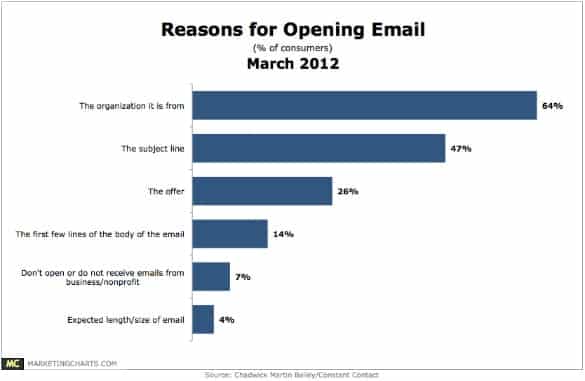
When creating your cold mailing campaign, we advise you to spend 40% of your time writing the subject line.
Salesdorado’s tipThe best approach is still to run A/B tests regularly with different subject lines to identify the ones that work best. Most email prospecting tools like Woodpecker or Reply.io let you do this, on top of automating the sending of your emailings (and your follow-ups)
You’ll find email subject line ideas here or there. A few tips for the road:
- Keep it simple: be clear and concise. Being original is good, but it’s dangerous.
- Be transparent: It’s called a subject line for a reason… Be honest, it will pay off
- Personalize: Personalization applies to your email’s subject line too.
- Overuse referrals: According to Sales Insights Labs, fewer than 19% of sales reps systematically ask for a referral. And yet LinkedIn lets you identify a mutual connection with a prospect in three clicks, and a referral is an extremely powerful lever. Use it to excess!
- Don’t over-optimize for opens: make sure you track the only KPI that really counts: the positive reply rate. Overly limited experimentation could mislead you, especially if you run A/B tests focusing on a single KPI.
We won’t go into detail here, but take care of your “sender” too. Make sure you are easy to identify, and avoid anonymous, generic senders such as “Salesdorado” or “The Salesdorado team”. An email is a personal communication, sent by one person with a first name & a last name to another. In the same Constant Contact study, it is even the number 1 factor in the decision to open an email or not.
If your name says less than your brand, you can use ready-made formats such as “Axel @ Salesdorado” or “Axel from Salesdorado”.
3. Get your timing right
The moment you choose to send your emailings can influence their open rates. The custom is to send emails when people are settling in at their desk or when they check them at the end of the day, that is, between 7am and 10am, then around 4pm, in the recipient’s local time.
The problem is that everyone knows this, and competition can be fierce in those time slots. The best practice is to run tests to find the best timing. It’s not hard with the analytics tools we have at our disposal.
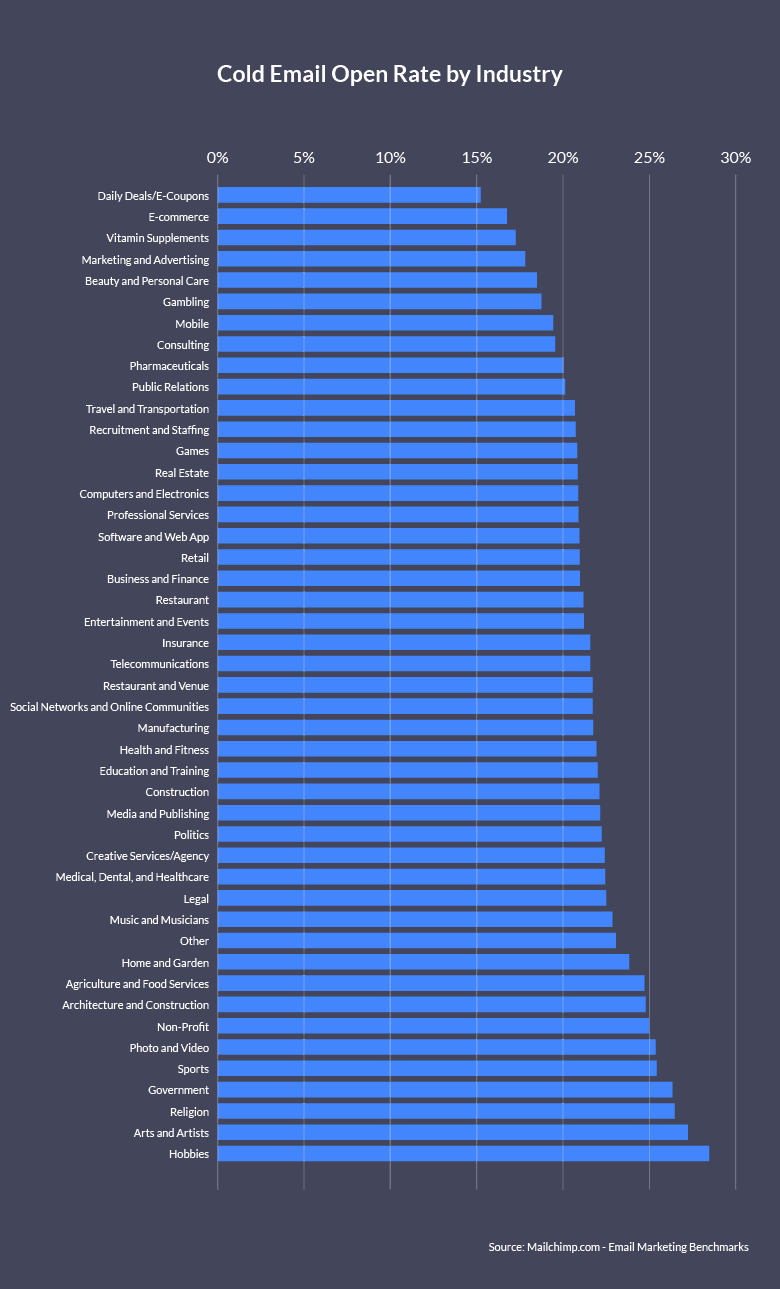
The day of the week also matters for sending your cold emails. Mondays are almost always the worst days to reach customers. It’s the back-from-the-weekend effect, schedules, etc. Aim for Tuesday – Thursday to be very targeted.
4. Copy others
“Good artists copy. Great artists steal” – Pablo Picasso
If the subject line matters for making people want to open, the content matters a great deal too. Spend a lot of time personalizing your content, with THE right call-to-action (just one), the right length (5 lines, signature included). Note that the average click-through rate is nearly 4 times higher when the email is personalized.
Here is the guideline to follow to plan the time you should spend on the key elements of unsolicited emails:
If you want to work seriously on your cold emailings, pay attention to the emails you receive, and follow every software vendor that has anything at all to do with email prospecting. Resources like TheSalesGame, or the Lemlist blog are full of examples and best practices. We have also published an article with a few prospecting email examples, and some concrete tips for getting a reply to your prospecting emails on Salesdorado.
5. A few tips for the body of your cold mailing campaigns
Cold emails help break the ice with prospects and introduce a slight degree of familiarity.
For your emailings to work, make sure their content matches the prospect’s position in your sales funnel (top, middle or bottom of the funnel).
Here are a few best practices for organizing the sending of your emails:
The 1st email
If you’re sending a very first cold email to a potential customer, the person is most likely at the top of the funnel. At this stage, the goal of your email should be to let the person get familiar with your brand name, with you, or with both.
Here are a few key points to keep in mind for the first email:
- ALWAYS personalize! Avoid sending an email that says “Dear Sir”. A referral from a mutual connection is a very powerful way to compel interest.
- Introduce yourself – Before you start talking about your proposal, tell them who you are, and it will make you more likeable. For example, always start with “I’m Martin and I head up marketing at Brevo” – In an instant, the recipient of the email knows who you are and what you do. If you didn’t get a referral, find a common link, such as a friend, a group or a conference you both attended.
- Show the recipient that you can solve a problem without saying too much.
- Have a Call-To-Action – at this stage, your request must be in line with the state of your relationship with the prospect. Keep it light. Give more than you ask for. You can, for example, share a white paper or a blog post, and ask a concrete question about the content you shared.
- Keep it short and simple. The shortest emails always get much higher reply rates. The ideal length of a sales email would be between 50 and 125 words … And that’s already long in my opinion 🙂
Follow-ups
Now, let’s imagine that for some reason, your first email didn’t get a reply. Don’t get discouraged: get creative to get a reply.
The goal is to have respectable gaps between emails. I would recommend a minimum of 4 to 5 follow-ups after the first email, with a minimum interval of 2 days between 2 consecutive sends.
Woodpecker’s results put the ideal sequence at 4 to 7 emails, first email included. It’s important to know whether your emails are being read. If they aren’t, you can try contacting your prospects through other channels.
Here is an example of a best practice from Steli Efti, founder of Close CRM:
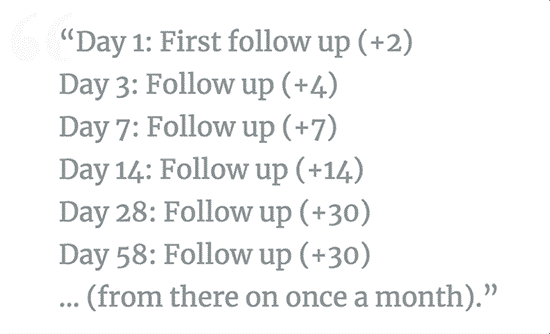
Another key point to remember here is clarity of objectives. What do you want to get out of your follow-up emails? (Example: a meeting, a white paper download, a video view, a sign-up, etc.). Here are a few points to watch when following up:
First follow-up email
- Don’t send a new email, chain it to the previous one instead (you’d be surprised, but many people still don’t realize this mistake). Most email sequence automation tools let you do this automatically.
- Add context and remind them that you’ve already sent an email. For example:
- End your email cleanly. Humanizing the content of your email will get you a better reply rate.
- Always have a call-to-action. Even if the recipient hasn’t replied to the previous emails, you absolutely must add another call-to-action. The action to take after reading must be very clear to the reader.
- Automate your follow-ups. It’s important to personalize your cold emailings, especially the first one. But we’re human, and nobody has the discipline needed to send 7 follow-ups at fixed intervals. Automating your follow-ups (which are much lighter emails) will guarantee that they are sent at the right time, and will let you optimize the delays between each email.
For the 3rd and 4th follow-up emails – Email follow-up
If you still haven’t received a reply, it means either that the prospect is unavailable (for whatever reason), or that they are hard to motivate.
To get a reply, you’ll now need to get creative with the content of your email. It’s a good time to take back control manually.
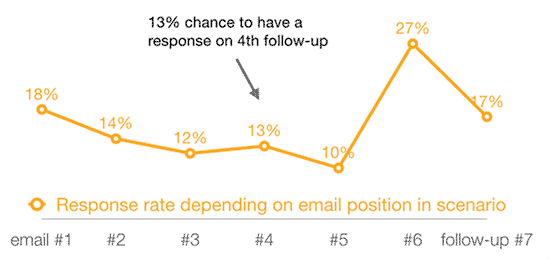
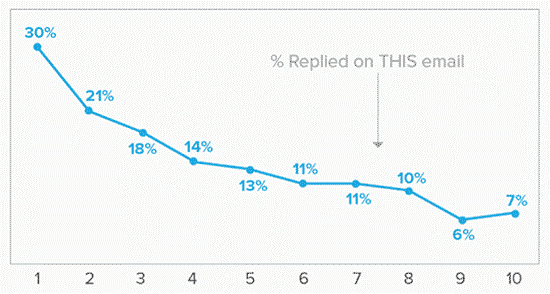
Be careful, though: what these statistics fail to measure is the positive reply rate. It’s fairly easy to understand intuitively why, after 5 emails with no reply, some prospects are suddenly motivated to reply, to ask you to leave them alone…
To help you identify which prospects to follow up with, you can for example filter out the prospects who haven’t opened any of your emails. On the face of it, your proposal doesn’t interest them. No point insisting.
Patience and persistence are the key to following up. It’s important that you come across as confident and humble at the same time in your emails. Here are a few suggestions for working on the content of your follow-up emails:
1. Add social proof
The prospect doesn’t know you, they have no reason to trust you (I’ll stop going on about referrals…). You need to dig deeper and earn their trust by adding social proof. A few examples:
- Such-and-such customer (a competitor, or preferably an easily recognizable brand) says this about us.
- Our community of {prospect’s role or industry} says this, this and this about our product (with links each time)
- Such-and-such comparison from {trusted third-party source on the market} has just come out, I thought you’d be interested!
2. Get yourself noticed
This is where we get into multichannel prospecting, which has a very good press today. We’ve written it all over Salesdorado, but I’ll write it again here: Adding a channel to your processes means multiplying the complexity of the process. If you’re still at the stage of validating the validity of your emails, forget it right now.
You can only reasonably add a channel once you have a process that’s already well oiled, and you shouldn’t expect to hit the jackpot because you’re taking a €400 course from a guru who has never written an email by hand.
However, in your prospecting, you’ll come across leads who simply don’t deal with cold emails. And in that case, contacting them on LinkedIn, by phone, or in a slightly more inventive way, can be worthwhile.
Right after this, we also cover a method for creating more closeness with your prospects. Even if, once again, a referral is much easier to get, and much more effective.
6. Cold calling 2.0
Cold calling 2.0 is a technique developed by Aaron Ross when he was at Salesforce (in 2003… for context). This technique reportedly allowed Salesforce to generate 100 million dollars in revenue, the core principle being to “make cold calls without cold calls”.
Cold calling 2.0 is a systematized lead generation process in which you create internal referrals in the prospect’s company before contacting them directly.
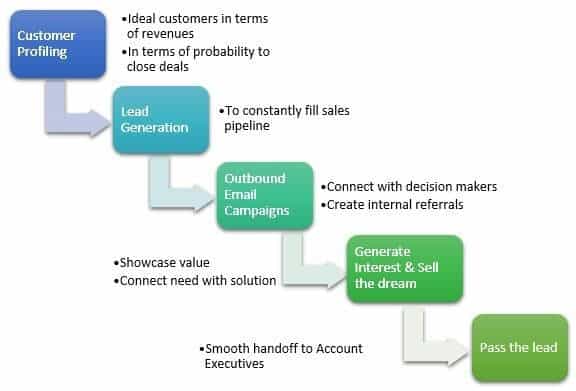
The good news is that this method works for cold emails too!
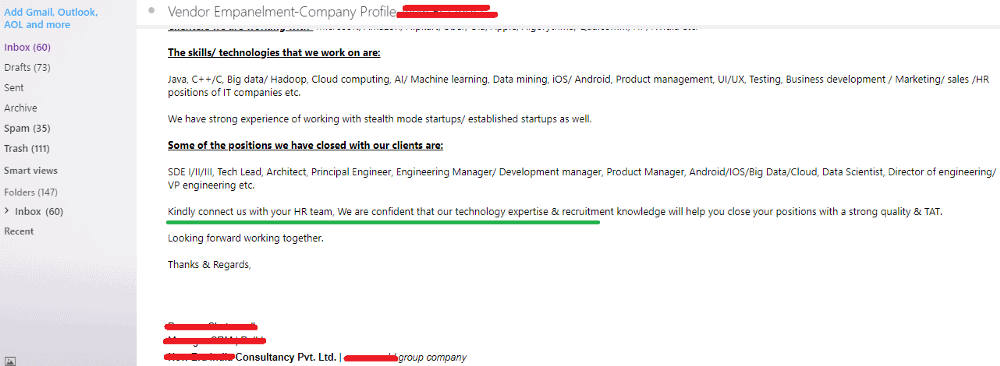
For example, a manager at a recruitment agency contacts you on LinkedIn, and sends this email after you’ve given him your email address.
His goal was to reach the startup’s HR manager through you. At this stage, when the marketing employee puts the person in touch with human resources, all he needs to tell the HR manager is that the marketing person referred him to her. That breaks the ice and gives the illusion, in the reader’s mind, that the person is an acquaintance.
7. Cold mailing content – Best practices
- Humility – Use a humble tone, not an insolent or loud one. Humility is a virtue even in sales.
- Confidence – A confident tone reflects confidence in your product offer as well as an insightful mind.
- Data and facts – Telling figures will always beat abstract talk. Just don’t overdo it.
- Don’t be pushy in your selling – Salespeople have an image of being pushy. People are fed up with this attitude, so it’s important to give the impression that you’re not a salesperson ready to do anything to sell their product. Be polite, not invasive.
- No spam – Don’t spam prospects if they have disengaged from your prospecting emails or your offer. Bombarding them with regular emails or calls when they’re not interested could simply irritate them and expose you to bad press or negative word of mouth.
- Personalize your emails – Always personalize your emails to get a better reply rate.
- Consistency – Be consistent in your outreach. Don’t send follow-up emails weeks after the first one, etc. Also, be consistent in your objective and in what you offer.
In conclusion
Sending cold emailings can work!
Email is nothing more and nothing less than a virtual interaction, and it still works when it’s well designed. The more time you spend building a prospect list and tailoring your message to that list, the better your conversion rates will be.
Don’t forget that it’s above all about breaking the ice and laying the foundations of a human interaction in the days that follow. Your cold email must inspire trust, calm, humility, contain figures, etc. Always know what your campaign’s objective is and how relevant your outreach is relative to your prospect’s position in the sales funnel (top, middle or bottom).
Finally, always have a call-to-action in your cold email and track its statistics (open rate, open time, etc.).
The questions we get over and over.
How do you know if a cold mailing list is good quality?
Look at the invalid email rate and the number of personalization elements available. A high invalid rate almost always signals a list that is too old, and your mailings may not get through spam filters. Run the list through an email list cleaning tool before starting the campaign.
When should you send a B2B prospecting email?
The custom is to send between 7am and 10am, then around 4pm, in the recipient's local time, but competition is fierce in those slots: the best thing is to test. Mondays are almost always the worst days; aim for Tuesday to Thursday.
How many follow-ups should you send after a cold email?
A minimum of 4 to 5 follow-ups after the first email, with at least 2 days between two sends. According to Woodpecker, the ideal sequence has 4 to 7 emails in total, first email included.
How long should a prospecting email be?
Keep it short: the ideal length of a sales email would be between 50 and 125 words according to Boomerang. The article recommends 5 lines, signature included, with a single call-to-action.
What is cold calling 2.0?
A technique developed by Aaron Ross at Salesforce starting in 2003: a systematized lead generation process in which you create internal referrals in the prospect's company before contacting them directly. It also works for cold emails.



What the community says.