



- A template only works once adapted to the industry, the target, the product and the prospect’s context.
- Give the AI the prospect, the history, the news and the tone you want, then always rework the generated text.
- Each follow-up recalls the context, gets straight to the point, brings something new and carries a single CTA.
- No more than 4 or 5 follow-ups: beyond that, you put the prospect off.
- The simplest follow-up, a « Hello Cédric, following up. », is often enough.
If you’re reading this article, you’ve probably already gone through a dozen follow-up email examples… without ever really managing to use them.
That’s the problem with ready-made templates: too generic, they never quite fit your context, your target or your goals. The result? They stay in the drawer.
Here, we do things differently. Rather than drowning you in 50 interchangeable templates, we give you 10 examples that really work, and above all a simple method to adapt them to your situation with AI.
In a few clicks, you’ll be able to personalize each follow-up with a ready-to-use prompt.
And to go further, we share the fundamentals of a successful follow-up email and 5 approaches to test.
10 follow-up email examples for every situation
Here are 10 concrete follow-up examples suited to all the classic situations of email prospecting. Further down, we explain how to personalize the ones you’re interested in with AI.
2 follow-up email examples after an encouraging first contact
1. A follow-up email example after a trade show
Follow-up email exampleSubject: [name] show: shall we dig into what we said about [specific topic]?
Hi [first name],
Following up on our conversation at the [name] show about your [precise topic] issue.
I’ve been thinking about what you told me about [specific point mentioned] and I have an approach to suggest that worked well at [similar client].
Shall we do a 20min call so I can show you? Available [suggested slots].
Best,
[Signature]
2. A follow-up email example after interest signals picked up during a call
Follow-up email exampleSubject: Following our call – A few concrete resources on [issue]
Hello [first name],
Quick follow-up after our conversation yesterday about [topic].
You told me about [specific challenge] – here are two resources that should interest you:
- [Resource 1]: Focus on how [similar client] solved exactly this problem
- [Resource 2]: A step-by-step guide to implementing the solution we talked about
Can we have a quick catch-up next week to see how to adapt this to your context?
[Signature]
2 follow-up email examples to reactivate a prospect who has gone cold
3. A follow-up email to gently re-engage after a long silence
Follow-up email exampleSubject: [first name], shall we get this back on track?
Hi [first name],
I see our discussion about [topic] has been on hold since [date].
I just saw that your competitor [name] has just launched [similar initiative]. Maybe it’s the right time to pick the topic back up?
If it’s still relevant, I suggest we have a quick catch-up.
If it’s no longer a priority, tell me frankly – it’ll save me from spamming you 😉
[Signature]
4. A follow-up email to go all in, with humor
Follow-up email exampleSubject: The last one before archiving [company]
Hello [first name],
Here goes: this is my last message before I move on.
I know [issue] is still a challenge for you – I saw that you just [news signal: hiring/fundraising/new project].
If it’s no longer a priority or if you went with another solution, no problem. Just a quick word to let me know and I’ll leave you alone 😉
If the topic is still current but the timing just wasn’t right, tell me when to get back to you.
Best,
[Signature]
Go further
- Our take on the best email prospecting tools: La Growth Machine, Lemlist, Apollo.
- 70+ punchy email subject line examples and 6 psychological hacks.
- How to find anyone’s email address (for free)
2 follow-up email examples after sending information
5. A follow-up email after sending a tailored quote
Follow-up email exampleSubject: Quick feedback on the [project] quote?
Hi [first name],
I’m getting back to you about the quote sent yesterday for [specific project].
The part on [key point of the quote] can be adjusted if needed – several clients have asked us for more flexibility on that point.
We can do a 15min call if you’d like us to fine-tune it together? Available tomorrow 11am or Friday 2pm.
[Signature]
6. A follow-up email after a product demo that sparked interest
Follow-up email exampleSubject: Next steps after the [product] demo?
Good morning [first name],
2-3 points following our demo yesterday:
- The use case we talked about for [specific feature]: here’s how [similar client] uses it → [link]
- The question about [technical point]: I checked with the team, it’s possible via [solution]
- Small bonus: a ready-made template to present the project internally → [link]
Shall we set up a call with [decision-maker mentioned] for the next steps?
[Signature]
2 follow-up email examples when the other person stops replying altogether
7. The last-chance follow-up
Follow-up email exampleSubject: Should I hand over to [main competitor]?
[first name],
After 3 months of radio silence, I’m thinking you may have signed with [competitor].
If so, I’d welcome a quick word on what tipped the balance – it always helps us improve.
Either way, thank you for taking the time to talk with us!
[Signature]
8. The « last dance » follow-up email
Follow-up email exampleSubject: Shall we take stock before archiving?
Hi [first name],
I see we haven’t moved forward on the [project] file since [date].
If you’ve opted for another solution or if your priorities have changed, I completely understand. A quick word on what tipped the balance would help us improve.
If the topic is still in the pipeline but the timing wasn’t right, tell me when to get back to you.
Either way, thank you for the time you gave us!
[Signature]
2 follow-up email examples to restart a sales negotiation
9. A follow-up email to unblock a negotiation by offering a small commercial gesture
Follow-up email exampleSubject: A different approach for [project]
Hi [first name],
I’ve been thinking about where we got stuck on [specific point].
We just deployed the same solution at [client in the same sector] with a slightly different approach:
- Setup in 2 phases instead of big bang
- Sliding-scale pricing based on actual usage
- POC on a reduced scope
Would you like us to look at whether this could unblock things on your side?
[Signature]
I clearly have a software bias in my examples, but you can adapt this email template to almost any sector. For example, in HR consulting:
Follow-up email exampleSubject: A tailored approach for [HR transformation project]
Hi [first name],
I’ve been thinking about our discussion on your [management overhaul] project and the sticking point around [specific point: e.g. implementation time].
We just deployed a similar program at [client in the same sector] with a more flexible approach:
- Diagnosis and training of the pilot team over 2 months
- Modular support depending on the needs of the different departments
- Test phase on one BU before global rollout
Would you like us to look at how to adapt this format to your context?
[Signature]
10. A follow-up email to get past inertia by offering a « pilot » option
Follow-up email exampleSubject: A step-by-step approach for your [management transformation] project?
[first name],
What if we tested the approach on a small scale?
Instead of the full transformation program we talked about, I suggest a 2-month pilot with a test team:
- Intensive training for 10 key managers
- Hands-on workshops on 3 priority skills
- Impact measurement on HR KPIs defined together
We can even include an adjustment clause if the indicators we choose (turnover, engagement, performance) don’t deliver.
That would let you validate the impact concretely before rolling out more widely.
Shall we discuss it?
[Signature]
An AI prompt to personalize these follow-up email examples
Description of the approach
Let’s be frank: the templates we just showed you, however effective they are, can’t be used as is. And that’s actually the problem with all the email templates you find online.
Why? Because a template that works is a template that has been adapted to:
- Your industry
- Your target
- Your product/service
- The specific context of each prospect
That’s where AI (ChatGPT, Claude, Gemini…) comes in. These tools have become extremely good at adapting existing templates to your specific context.
I recommend using this 3-step method:
- 1/ Choose the template that matches your situation. For example, our template #3 to re-engage after radio silence.
- 2/ Feed the AI with context. The more elements you give the AI, the more relevant the result will be.
An example prompt:
Adapt template #3 (below) for a follow-up in this context:

PROSPECT

- Marc Dupont, CIO of Technix Industries (800 employees, manufacturing)

- Pain point: SAP migration under way until June

HISTORY

- Demo of our predictive solution on 15/01

- His main interest: ROI of €250K/year

NEWS

- New site opening in September

- 2024 goal: -30% machine breakdowns

TONE

- Industry 4.0 expert, focus on performance
- 3/ Add the finishing touch. The AI will give you a working base, but the difference between a « good » follow-up email and one that converts is your personal touch. I recommend you systematically rework the generated texts.
A concrete example
Let’s take a real case to see how it works in practice. We’ll adapt our template #5 (the post-quote email) to a digital marketing context.
Here’s the prompt:
Adapt template #5 (below) for a follow-up in this context:

PROSPECT

- Julie Martin, CMO of Digital Retail (fashion pure player, €50M revenue)

- Pain point: losing momentum on acquisition vs competitors

HISTORY

- Proposal sent on 05/02 on acquisition overhaul

- Her interest: our data-driven methodology

NEWS

- New funding round under way

- H2 2024 goal: double marketing ROI

TONE

- Growth marketing expert, focus on performance and scalability
And here’s the result:
Follow-up email exampleSubject: Quick feedback on the acquisition proposal?
Hey Julie,
I’m getting back to you about our proposal on overhauling your acquisition strategy.
I noted your interest in our data-driven approach, and I wanted to share an insight that might interest you: one of our pure player clients just went from 2.1 to 3.4 ROAS in 3 months with this methodology.
We can do a 15min call if you’d like to dig into how to adapt this to Digital Retail? Available tomorrow 11am or Friday 2pm.
Best
Salesdorado’s tipTo be effective in your follow-ups, nothing beats cold emailing software to automate intelligently. At Salesdorado, we use and always recommend Woodpecker, by far the best on the subject.
The 5 fundamentals of a follow-up email that converts
Email follow-up is a bit like cooking: there are essential ingredients for a successful recipe. Here are the 5 main ones you absolutely must use:
1. Context, always context
It’s THE foundation of an effective follow-up. Your prospects are drowning in emails (on average 30 work emails received per day, twice as many for executives).
So no way you send a vague « Just circling back ». You need to remind them quickly and effectively who you are and why you’re contacting them.
2. Get straight to the point
No beating around the bush. The goal? A sentence that grabs attention from the start of your follow-up email.
In short, your prospect must understand in 3 seconds what you expect from them. Something like: « Following [context], I’m getting back to you to [precise goal] ». Simple, effective, no fuss.
3. Added value isn’t optional
Every follow-up must bring something new to the table. Inspiring content, a client case that speaks, an offer…
In short, give your prospect a real reason to reply.
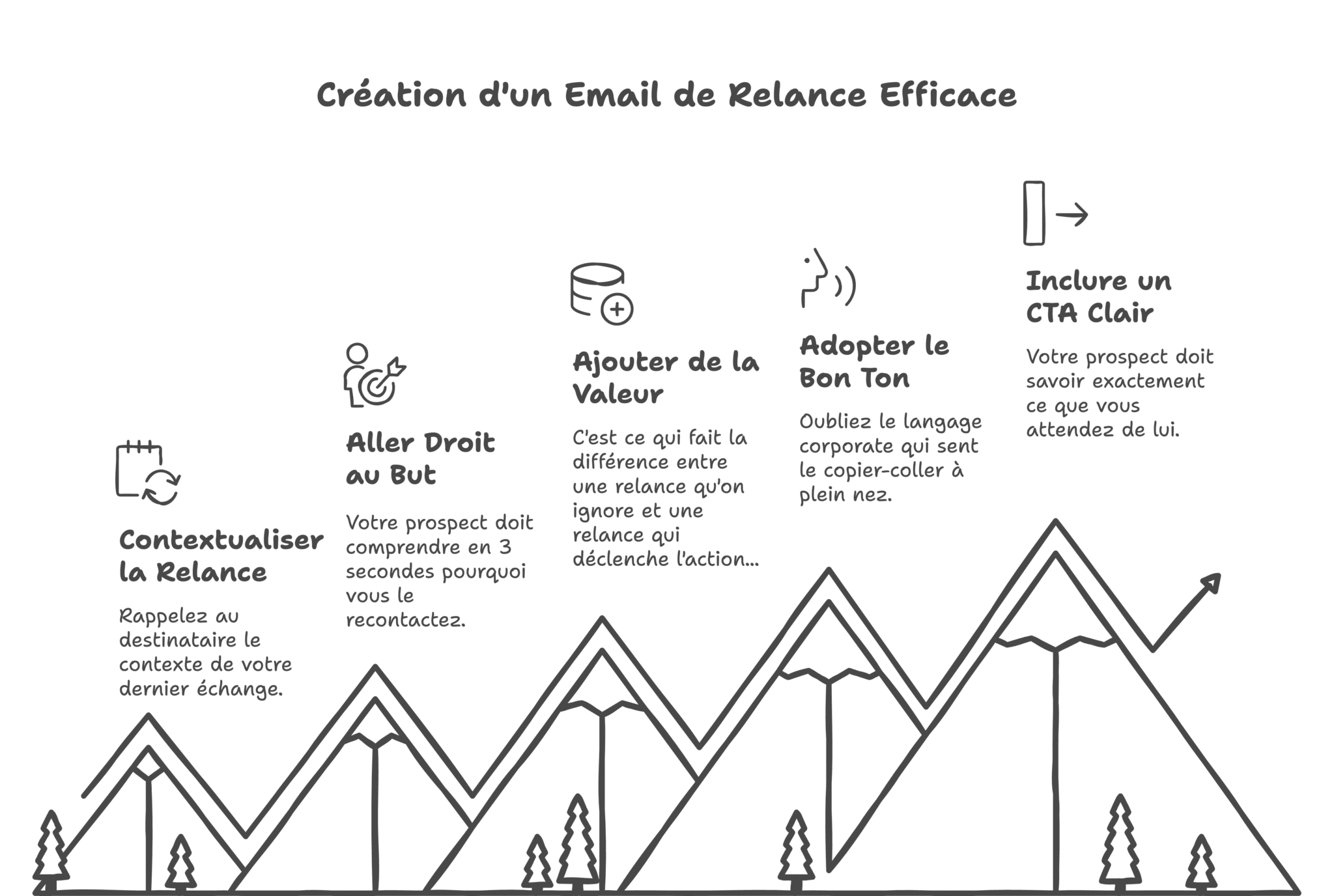
4. The tone
Forget the corporate style that reeks of copy-paste. But careful, no slipping into overly casual either. Aim for a relaxed professional tone: the tone of an expert who masters their subject but knows how to stay approachable.
5. One CTA (just one)
This is the moment of truth: what do you want your prospect to do? Schedule a call? Test your product? Put you in touch with the right decision-maker?
Choose ONE goal and express it clearly.
Salesdorado’s tipDon’t overdo the follow-ups. The golden rule? No more than 4-5 attempts. Beyond that, you’re more likely to put your prospect off than to get a reply.
Should you always include a call-to-action in a follow-up email?
Yes. Always. Even if it’s just a question or a suggested time slot. Without a CTA, nothing will happen.
BONUS: 5 effective approaches for your follow-up emails
Whatever the context of the follow-up email, there are always several possible types of approach. I’ve selected 5. They all have their merits (but my favorite is the first one).
1. The poke
It’s my favorite follow-up template.
I use it and abuse it.
It’s very simple, and it’s actually very often better than all the other forms on this list. It’s a bit like the LinkedIn invitation without a message.
Either the message is great, and it’s worth adding one. Or it isn’t, and it’s better to let the other person build their own reasoning to explain the connection request.
I’ve flat-out got into the habit of scheduling them on somewhat important threads from my Google Workspace (formerly GSuite). I reply. And instead of leaving it unread and having it in front of my eyes all the time. I schedule two follow-ups. At D+7 & D+28.
Hello Cédric, following up.
Thanks,
Another version, even a bit more direct
Hello Cédric, shall we go?
Thanks,
2. Use a (real) pretext
I use it a lot at Reviewflowz to increase sales pressure after a demo. It’s fairly easy with Posthog to see when someone logs into the app.
After the demo I tell them that all of it was on a free trial account I created for them, which lasts 14 days. And that they can log in by doing a password reset.
In 80% of cases, they do.
And when they do, bam.
Hello Gabrielle, I saw you logged into the application today.
Were you looking for something in particular? Can I help?
Don’t hesitate if I can be of use.
Best,
Half the time they have a real question. The other half, they usually reply with an « I’ll discuss it with So-and-so on Wednesday », or « I need to talk to the support team about it, I’ll keep you posted ».
Either way, I’ve opened an email thread and started a conversation. It converts or it doesn’t, but at least we’re talking about it.
Go further
3. Is this still relevant?
No ulterior motive.
No fake pressure like I’m going to archive your file or whatever.
Just an honest question.
Hi Renaud, is this still relevant for you?
If so, would you like to block a slot next week to discuss it? I’m available Tuesday afternoon & Wednesday morning.
Thanks,
And without begging for a reply by asking them to just answer 1, 2 or 3, as if taking 2 seconds to reply to you were insurmountable.
In fact, generally speaking, it’s a mistake to try to minimize the engagement required from the person in front of you. The more you ask, the better. Then it’s up to you to sort yourself out so people want to give you what you’re asking for. Overall, it’s better to make them gain more (value) than spend less (time).
4. The existential threat
In some deals, there’s an existential threat to the deal.
The great classic is « We’re evaluating two solutions: yours and competitor XYZ’s ».
Here too, if your discovery process stinks, you won’t get the info.
But if everything goes well, and you have the info, then normally you can use it fairly easily. Not 50 times, and rather in the 2nd follow-up than the first, to give yourself a second chance.
Hello Christian, did you end up signing with XYZ?
Is there anything I can do to influence the decision?
Thanks,
It’s pretty simple at heart, and I’m still super transparent about my intention – selling, it’s no secret anymore – but it’s that authenticity that pays off, I think.
In general, people reply either with good news or with bad news. Either way, I have answers to do better next time, and that’s pure gold, especially early on.
5. The breakup email, but a non-lousy version
The breakup email is a stupid invention. The idea that you never want to talk to someone again because they refused to buy something at a given moment is absurd.
At 20 it’s not that obvious, but once you have a bit of experience under your belt you know you always cross paths with people again. One way or another.
That said, if you want to speed up the deal a little, it’s not a bad idea to give it a somewhat final feel.
Hello Gabrielle, looks like it’s not going to happen this time.
If you’d be willing to tell me more about what happened, and the elements that swung the decision, it would be super useful to me and to the team.
That would be really kind.
Thanks a lot!
It’s a breakup email in fact – Looks like it’s dead, I’m going to stop following up with you.
That said, it’s the beginning of something: an invitation to a relationship other than seller & buyer.
And that works like a charm. In the same vein as the previous example, it’s an email that almost always gets me a reply.
The questions we get over and over.
How many follow-up emails should you send?
No more than 4 or 5. After that, you officially move into the "harassment" category. And above all: 3 good personalized follow-ups are better than 10 empty copy-pastes.
What is the right timing to follow up with a prospect?
D+2 after a first exchange, then D+7, then D+14 if nothing moves. It may seem pushy, but if you bring value each time, it's just good follow-up.
Should you always follow up by email?
No. Sometimes a phone call or a LinkedIn message is more suitable. If you feel your emails are falling on deaf ears, switch channels.
How do I know if my follow-up email is too pushy?
If you follow up without ever adding anything new, yes, it's too much. Each follow-up must have a different angle, content or piece of info. Otherwise, it's just polite spam.
What is the best hook for a follow-up email?
The one that hooks in 3 seconds, by relying on a precise context. "Following our conversation about [X]", "A few ideas for [issue mentioned]" or "Where are we on [project]?" are classics that work. You can also test more direct or slightly provocative variants: "Should I hand over to [competitor]?" or "Shall we get this back on track?": the idea is to open a door without forcing things.
How do you adapt a follow-up email to your context with AI?
Give the tool as much context as possible (prospect, history, stakes, tone…). The AI won't do the work for you, but it can give you a solid base to personalize.



What the community says.