

- The waterfall method plans sequential steps that never overlap: it suits projects whose end product is unlikely to change, such as construction.
- Agile follows an iterative process, but demands abundant communication and a high level of autonomy from everyone.
- Lean, born in Toyota’s factories, eliminates everything that does not directly create value for the end customer.
- Kanban relies on a board made of columns (stages) and cards (work items), useful for remote teams.
- Six Sigma often relies on the DMAIC method: define, measure, analyze, improve, control.
Project management sits at the heart of every organization, whatever its size, its industry or its location. From a real estate construction project to organizing an event or developing software: if you do not follow a management method rigorously, the expected results do not follow either.
Several well-known methods exist today, and many people are familiar with « Agile teams » or the Kanban board. But you still have to master them and pick the one (or ones) best suited to your organization and your project.
In this article, we go back over 10 must-know project management methodologies, and we give you the keys to figure out which one to adopt.
The 3 key approaches to project management: Waterfall, Agile or Lean
In project management, people often confuse the approaches with the methodologies used to put them into practice.
While academics still debate the question, at Salesdorado we chose to split project management into 3 broad approaches, each then tied to different implementation methodologies.
The Waterfall method: planning and predictability
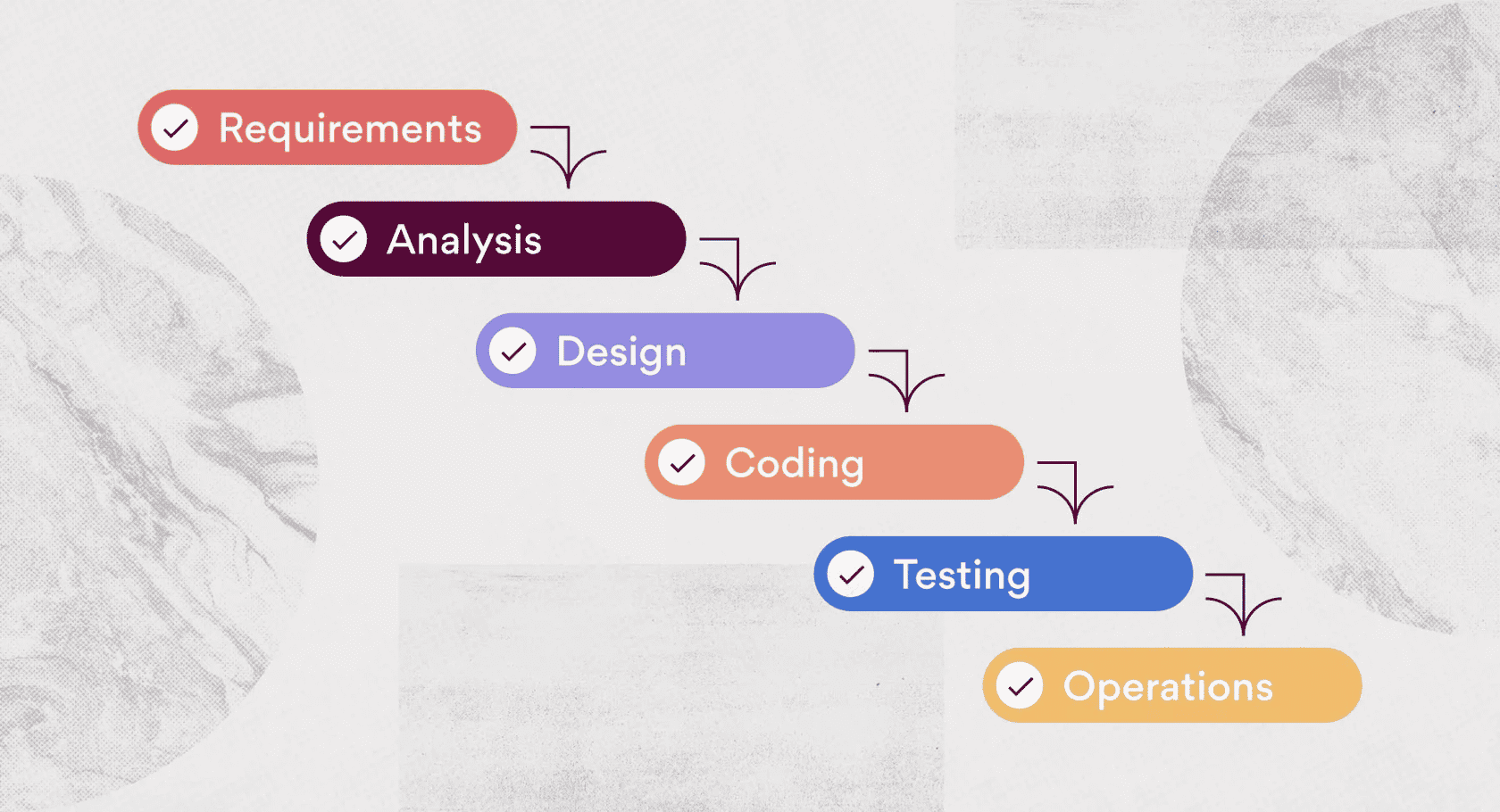
This method is often associated with the most traditional way of running a project and managing it.
- The principle: The project manager sets up a transparent project plan that lays out the steps to follow very precisely, with a schedule and a resource allocation to stick to. Each step comes with a timeframe, a delivery technique and team members. The approach here is sequential: the steps follow one another and never overlap (like a waterfall).
- When it shines: This approach is very useful in industries where the expected end product has a very low chance of changing (construction, for example). It is ideal for very large projects with many stakeholders, to make sure the growing number of intermediate elements does not undermine the success of the project and the expected deliverables.
- The limits: This method is not compatible with projects that go through many changes and shifts in direction. Its very top-down approach may not suit organizations used to collaborative ways of working. And in this setup, the client relationship shrinks to setting expectations upfront and delivering the product/service, so there is little interaction.
The Agile method: collaboration and flexibility
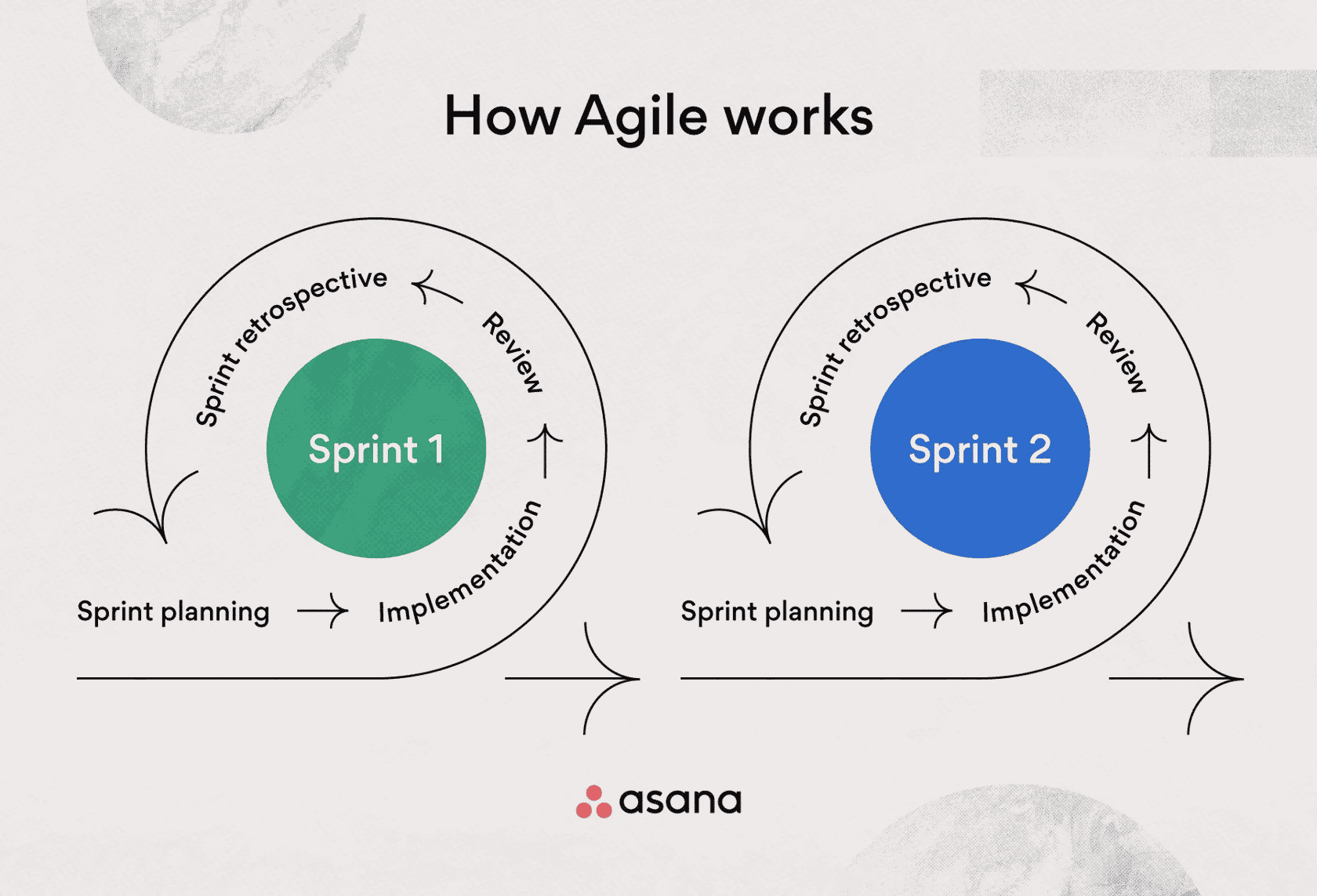
The birth of the Agile method is closely tied to that of the software development industry. More precisely, to the limits of the waterfall method when faced with the reality of software development.
- The principle: The idea of the Agile method is to take the opposite stance to waterfall project management. Here, the focus is on improving communication within teams, to deliver faster and with better quality. You follow an iterative (cyclical) process that values people’s involvement in the constant (re)definition of the remaining steps needed to reach the expected end result. And the expected end result itself keeps evolving. You decide to put a button here, then you realize it will not work well with some other button, so it has to go over there instead, and so on.
- When it shines: It is an ideal method for activities that are unpredictable by nature, where it is hard to foresee the full scope of the process in advance. That is why the method is often popular in marketing, IT and events.
- The limits: It is a method that requires constant, close collaboration with all stakeholders and demands abundant (and time-consuming) communication. On top of that, agile assumes a high level of autonomy from everyone involved in the project. We are a long way from the 20th-century « Thinking / Execution » split. It is fundamentally an elitist model that will not fit every organization. Finally, the agile method is obviously very hard to apply in contexts with heavy investments. You cannot really « iterate » on building a power plant: either you pour the concrete or you do not, but you cannot do it halfway and then change your mind or your approach.
The Lean method: optimization and quality control
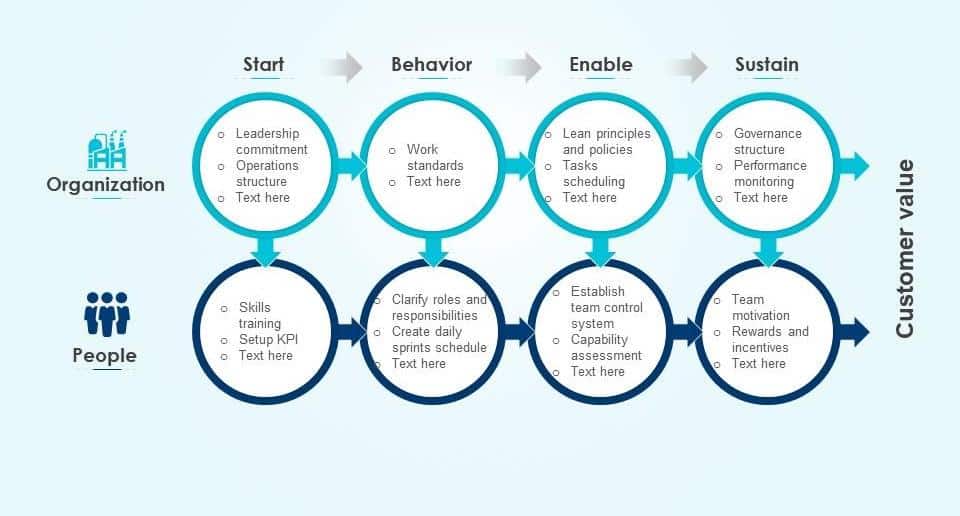
The Lean approach comes from the industrial world. It was born from the process of improving the production line in Toyota’s factories in Japan in the 1950s, with one watchword: eliminate everything that does not directly create value for the end customer.
- The principle: This approach rests on precise, ongoing control of the quality of the expected end product or service. The idea is to optimize the process to achieve more with less effort. To do so, you try to eliminate waste (of time or resources), irregularities in the process and the risk of overload (of financial and human resources). The solutions found must then be made permanent to ensure constant improvement.
- When it shines: It is an approach built for very large projects with processes that are already established and unlikely to change. So you naturally find it in industry (product manufacturing plants), which follow assembly-line work and need finished products to be identical.
- The limits: In practice, it is a method that fits a specific industry (manufacturing identical products) and a particular organization (assembly-line work or a related way of working).
Top 5 waterfall project management methodologies
1. Classic waterfall: simple and effective
This is the traditional method of the Waterfall approach: the project is split into linear phases, and each phase must be completed to trigger the start of the next one.
The most widely used tool for this method is the Gantt chart. It gives a view of the whole project and identifies the milestones (or key steps) that unlock the following phases.
Who is it for? Teams working on projects that are highly structured and defined in advance (construction or manufacturing plants).
2. Critical path: mapping for complex projects
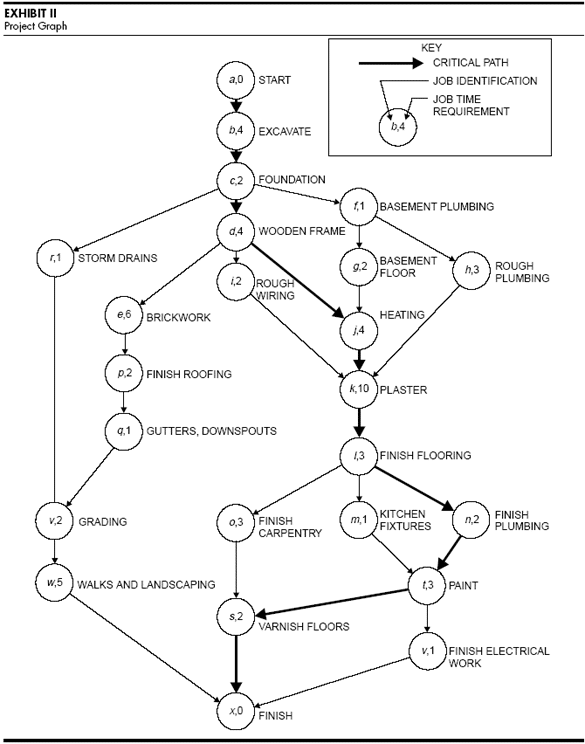
It builds on the Waterfall approach model and on the interdependence of project phases, but adds an extra subtlety.
The idea here is to break project phases down into tasks tied to intermediate deliverables. Each move from one phase to the next therefore requires handing in those deliverables within the allotted time to validate the milestone.
Who is it for? Smaller teams, for whom a growing number of intermediate deliverables does not create organizational problems. Overall, it is a method meant for small to mid-sized projects.
3. Critical chain: detail in the service of efficiency
This method is closely tied to the critical path method, but it adds an extra level of detail.
The idea is that each task to complete is tied to a deliverable (as in the critical path method), but also to a precise timing and an allocated budget. This method then lets you track any resource overrun accurately, and spread the workload better or rebalance the budget.
Who is it for? Teams of any size with heavy reporting needs toward their management.
4. The PERT method: estimating durations when everything is uncertain
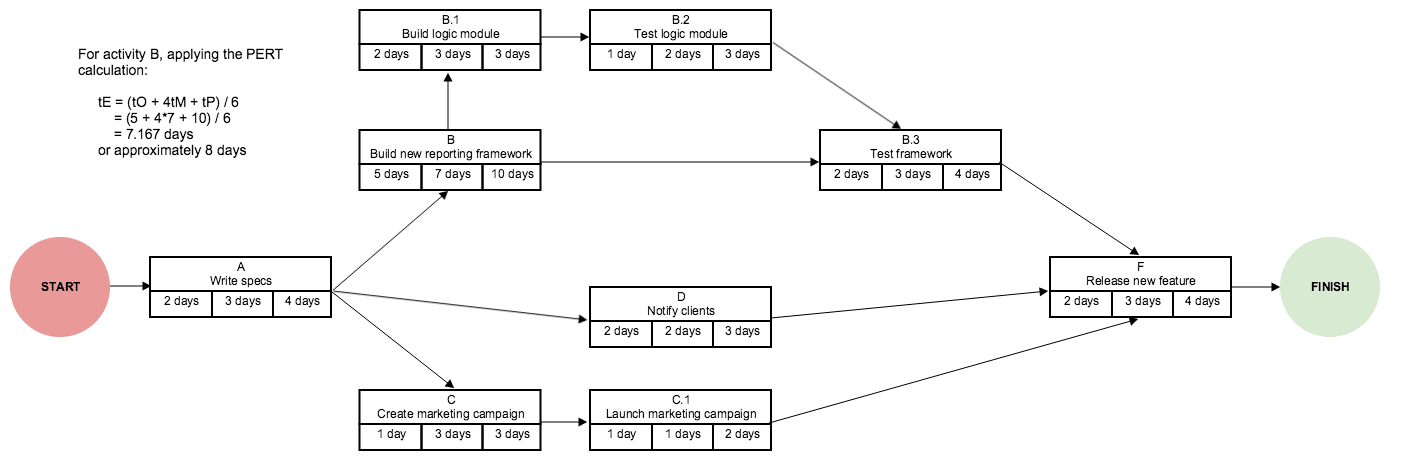
This method differs from the other methods presented here, because it starts from the premise that you do not know the exact duration of each task in advance. It was developed for the US Navy in 1958.
The idea is not to give each task one duration, but three: an optimistic estimate, a most likely estimate and a pessimistic estimate. From these you derive an expected duration: (optimistic + 4 × most likely + pessimistic) / 6.
To do so, you represent the project as a network, where each task is linked to the ones it depends on, which brings out the critical path. The Gantt chart model can then be used to plan and track progress.
Who is it for? Research and development projects, and more broadly new kinds of projects where you have no reliable track record to estimate task durations, and where meeting deadlines matters more than cost.
Go furtherRead our article on the best Gantt chart software.
5. PRINCE2: the method that came out of the British government
PRINCE2 stands for « PRojects IN Controlled Environments » and was designed by the British government for IT projects.
The idea is to split a project into 7 steps: preparation, defining governance, initiation, controlling progress, managing deliverables, managing timing and closing the project.
Who is it for? Large teams with many stakeholders, for whom the complexity and level of detail required is not a risk in terms of resource management. In practice, it remains a widely used method in IT.
Top 5 Agile project management methodologies
1. Scrum: the Agile approach in action, par excellence
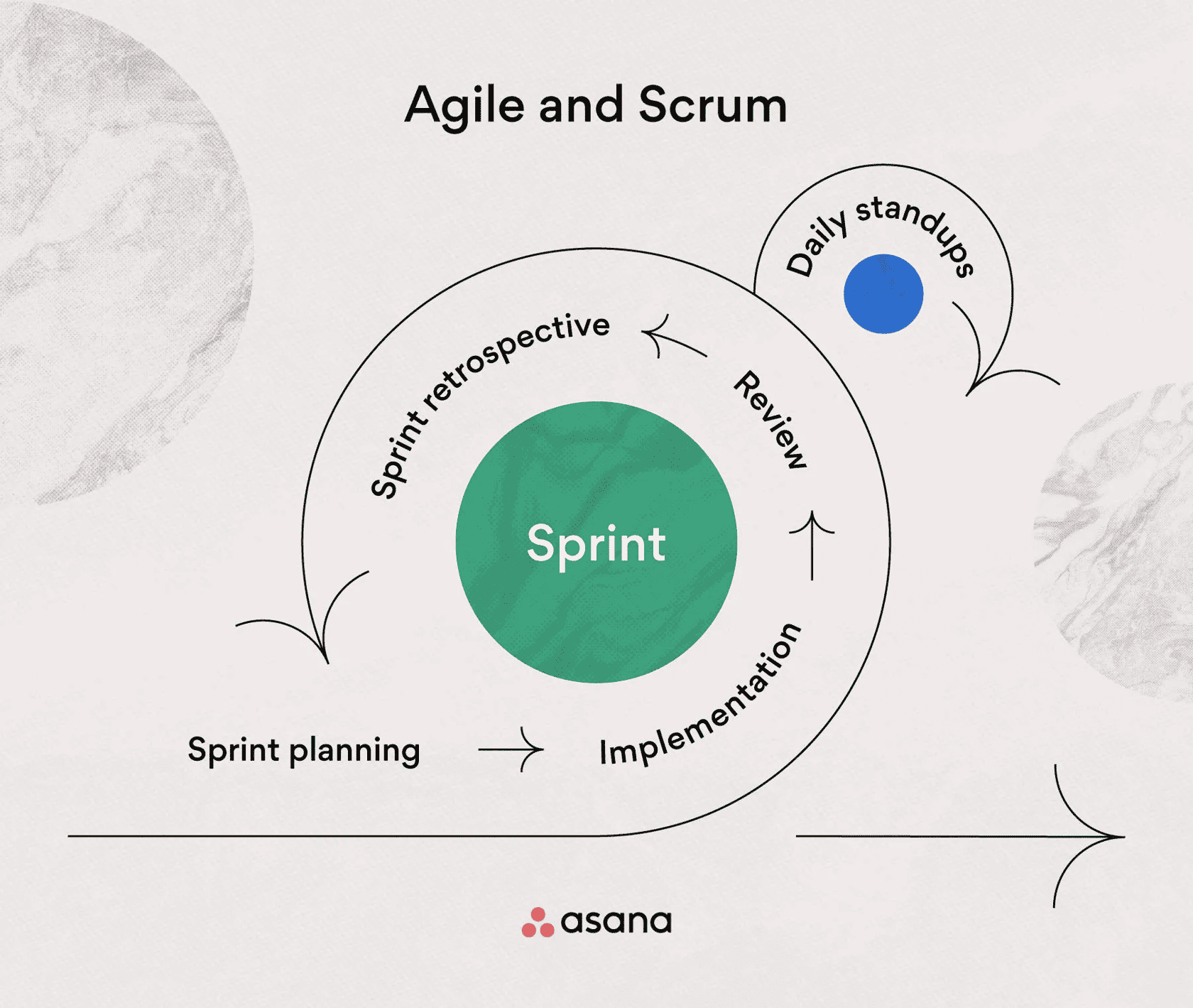
The idea is to split project cycles into very short phases (called « sprints »), which last one month at most (often 1 to 2 weeks) and involve a small number of stakeholders (10 people at most, as a rule).
Each phase is made up of individual tasks that do not depend on one another and can therefore move forward at the same time (unlike the Waterfall approach).
To work well, the project must be led by a person in charge of making sure all team members communicate, by organizing regular meetings and progress check-ins.
Who is it for? Organizations that opt for an Agile approach, whatever their size.
2. Kanban: visualization first and foremost
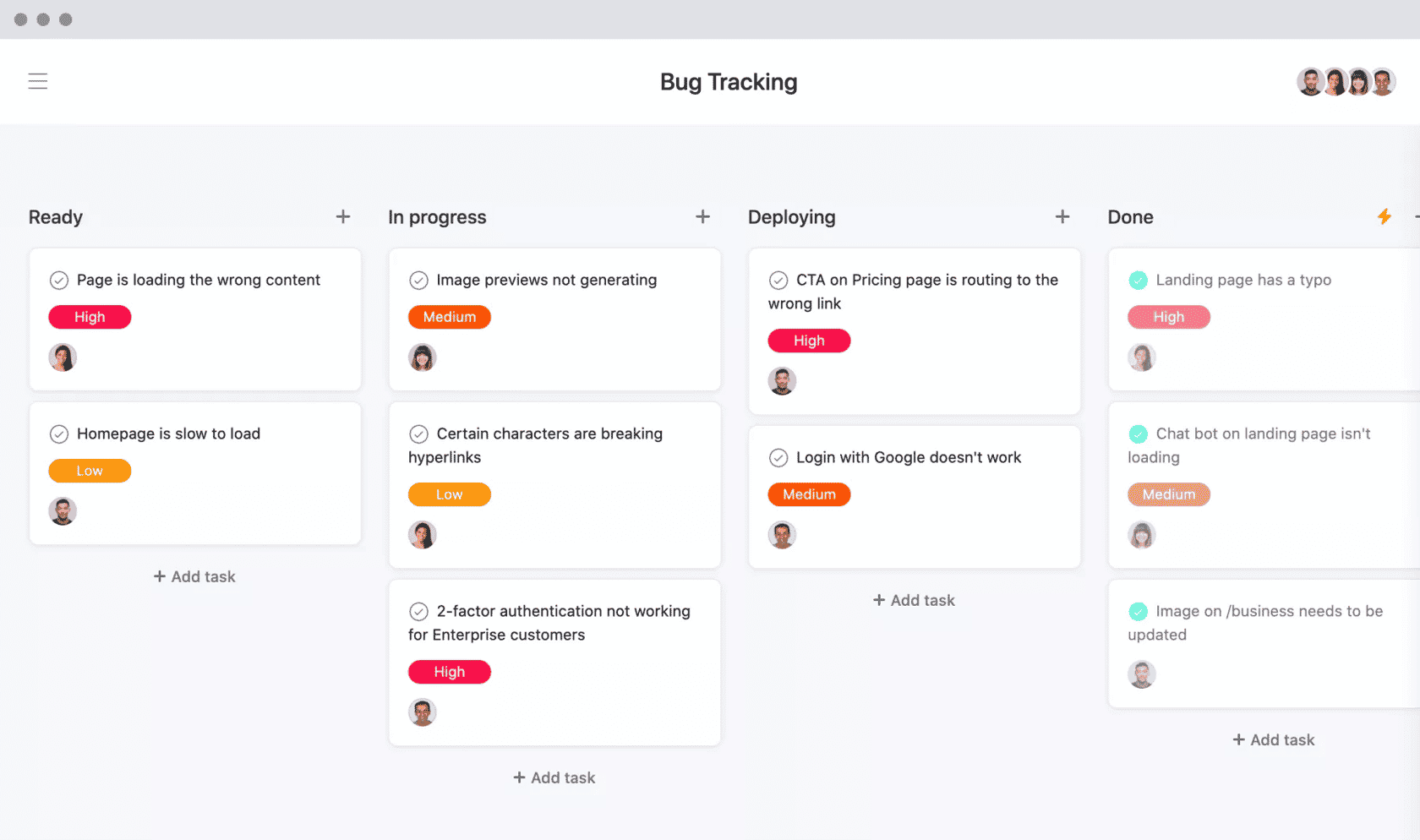
Unlike the Scrum method, Kanban is not precisely defined in its content, and can therefore be implemented differently from one organization to the next.
Most often, it takes the form of a Kanban board, divided into columns (your work stages) and cards (your work items). You first have to identify all the stages needed to reach a deliverable product. Once a task is done, you move the card to the next column.
To work well, you must not clutter the columns with too many tasks (flow management), and you must make sure the delivery pace keeps improving, by setting up regular check-ins with the project team.
Who is it for? All teams, especially those that work remotely a lot. The focus on visualization lets everyone stay on course with the project without much difficulty.
The Kanban method was widely popularized by Trello, a simple, lightweight kanban tool bought in 2017 by the Australian software company Atlassian.
3. Extreme Programming: formidably effective, but use it sparingly
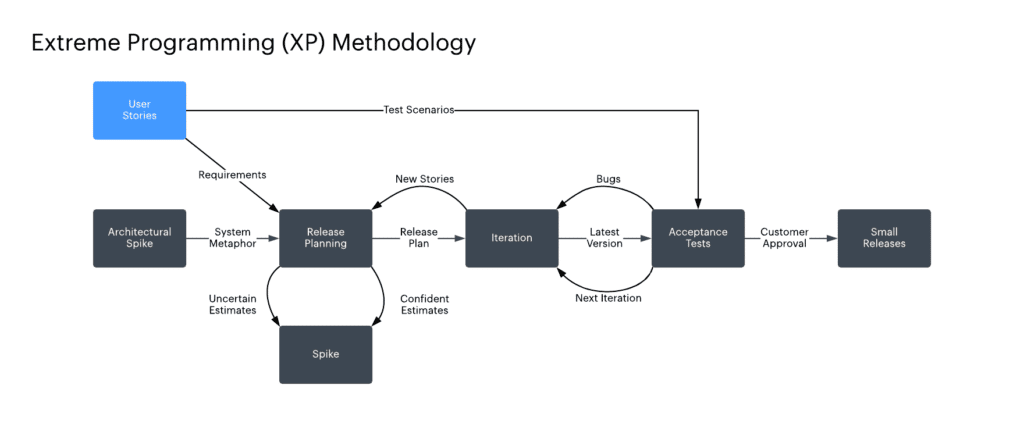
This method was designed for fast-paced projects with very tight deadlines. In practice, it is only used in software development.
This method rests on 5 values that underpin its effectiveness:
- communication, which must be adapted to the topic at hand and the people involved
- simplicity, which must be a permanent goal so as not to overload teams, or waste time or money
- constant feedback between teams to improve
- courage, in particular to raise any problems in project management and fix them as quickly as possible
- respect between members of the project team
Who is it for? Software development players with small headcounts and a tight schedule to meet.
Go furtherWe recommend reading Don Wells’ rules of Extreme Programming to understand the method better.
4. Scrumban: hybridity in the service of performance
This hybrid method draws on both the Scrum method and the Kanban method.
The idea is to keep the very short project phases (sprints) of the Scrum method, while going into the detail of the individual tasks to complete (Kanban). All of it with a simple, quickly understood view of the project plan, using a system of cards and columns.
Here again, as with any method of the Agile approach, regular and efficient communication between team members is a must.
Who is it for? Those who are drawn to the Agile approach and want to strike the right balance between a simple process (Scrum) and clear task detail (Kanban).
5. Adaptive Project Framework (APF): unbeatable adaptability
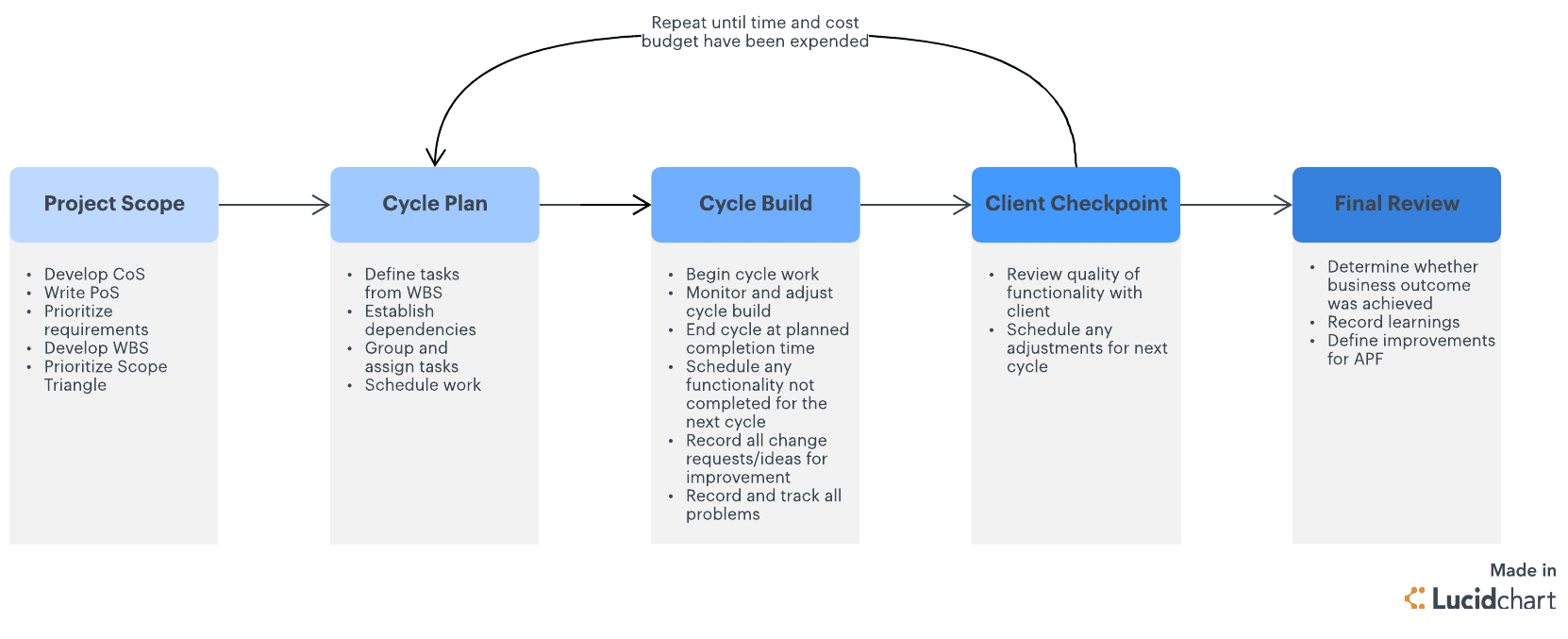
This method puts the emphasis on the ability to react quickly and well to any change that may come up while running a project.
It means devoting a large share of project management to anticipating risks and possible changes. By spending a significant amount of time on it upfront and reassessing the project plan (or even its objectives) as needed, what is unpredictable becomes predictable and gets dealt with quickly and effectively.
Who is it for? Agile teams with a very strong habit of collaboration and a clear view of their objectives, for whom an almost permanent change of the project plan is not a burden.
Six Sigma: the methodology for applying Lean management to project management
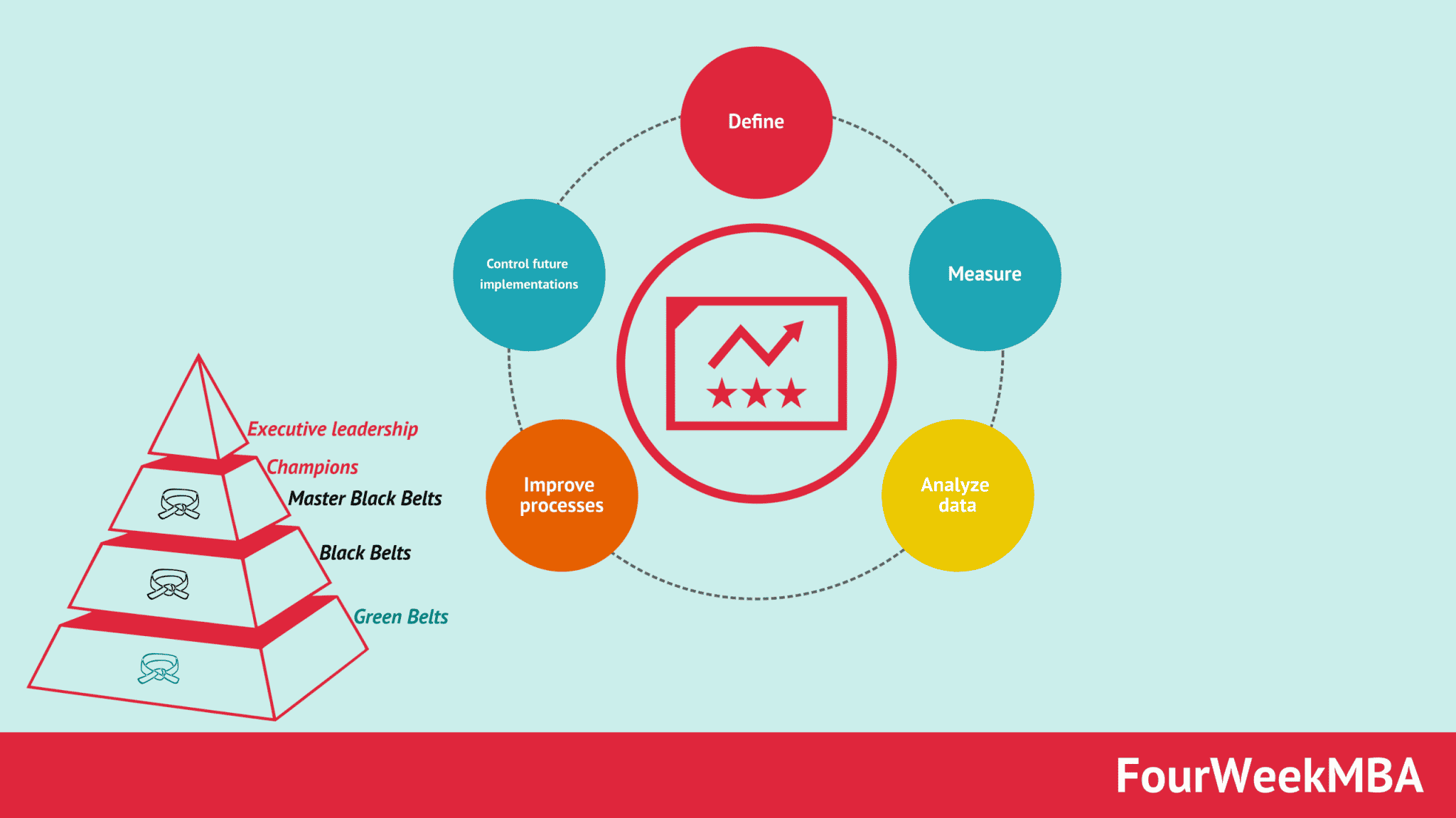
The Six Sigma method is the version of the Lean approach applied to project management. Its basic idea is to aim for permanent process improvement and to eliminate every form of irregularity or waste of resources.
To put it into practice, teams often use the « DMAIC » method, which breaks down into several phases: defining the project scope, measuring the data collected along the way, analyzing the causes of the problems identified, improving based on the analysis, and controlling that the improvement lasts.
Who is it for? Project teams with enough resources to outsource the analysis of irregularities and the improvement recommendations. It is particularly suited to large teams whose projects are similar in how they are run and in their end goals.
Go further
- Top 15 best project management tools
- Top 10 best free project management tools
- Top 10 best project management training courses
- Gantt charts: the best software
- Top 10 Kanban software tools
The questions we get over and over.
What are the 3 main approaches to project management?
Waterfall, focused on planning and predictability; Agile, focused on collaboration and flexibility; Lean, focused on optimization and quality control.
When should you choose the Waterfall method?
In industries where the expected end product has a very low chance of changing, such as construction, and for very large projects with many stakeholders. It does not suit projects that go through many changes and shifts in direction.
What are the limits of the Agile method?
It requires constant, close collaboration with all stakeholders, abundant and time-consuming communication, and a high level of autonomy from everyone involved. It is very hard to apply in contexts with heavy investments.
What is the difference between the critical path and the critical chain?
The critical path ties each task to an intermediate deliverable. The critical chain adds a precise timing and an allocated budget for each task, which lets you track any resource overrun.
What is Scrumban?
A hybrid method that takes the sprints of the Scrum method and the individual task detail of the Kanban method, with a view of the project plan in cards and columns.

What the community says.