


Ringover and Aircall are two excellent cloud phone solutions. They sit at the top of our comparisons of the best calling software and the best VoIP software.
Both perform well, both are French, and both integrate very well with the main tools on the market (CRM, ticketing…). The real question isn’t “which one is better?”: it’s which one is made for you.
In this article, we help you decide by comparing features, integrations, support, pricing and customer reviews in detail.
Ringover vs Aircall: key feature comparison
#1 Call management
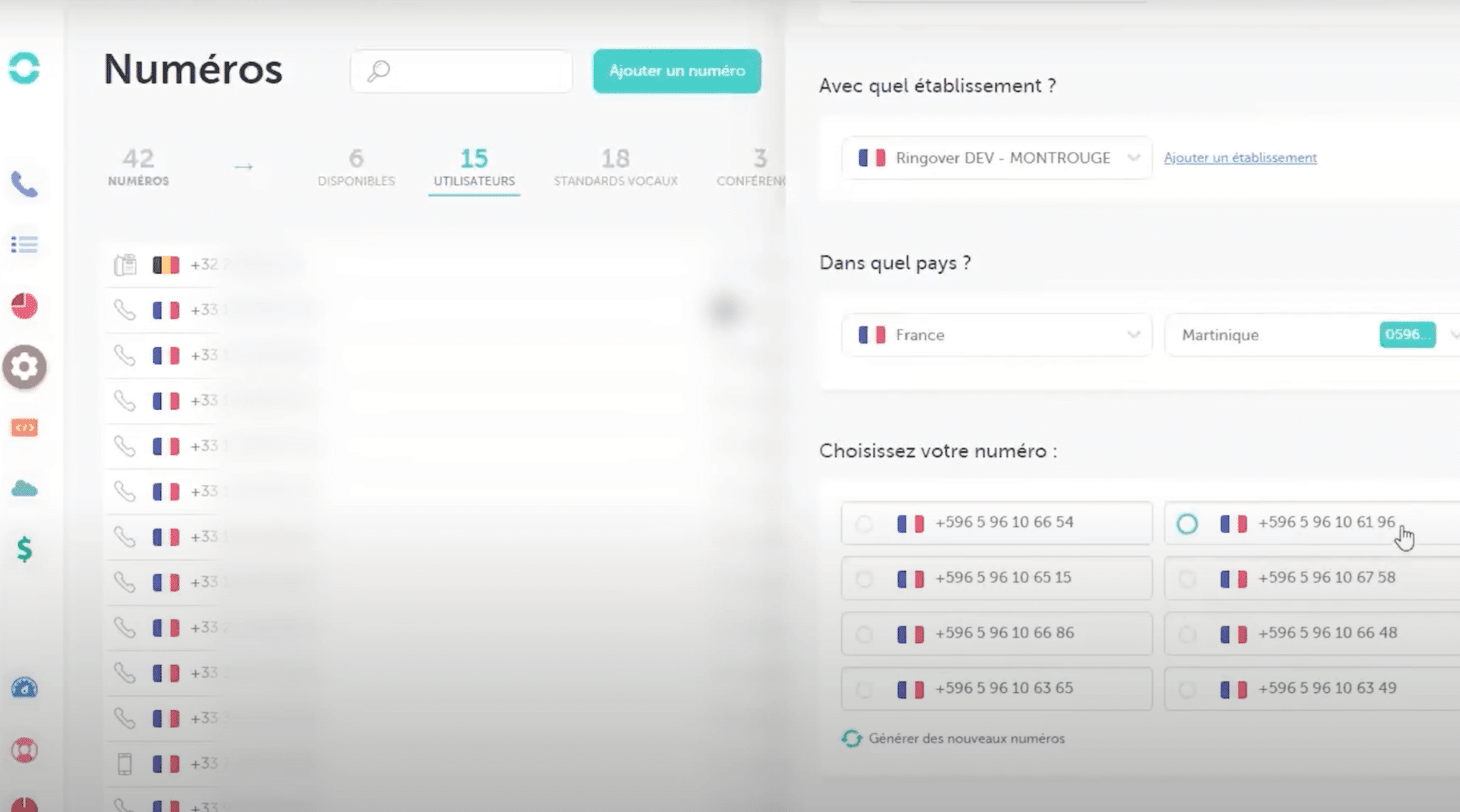
On call management, Aircall and Ringover are both very complete. You get the fundamentals: audio quality, international numbers to build a local presence, click-to-call from any tool, intelligent call routing, call recording… Nothing is missing.
But in the details, Aircall goes a notch further. The tool offers finer management of inbound calls, with advanced queue options, prioritization based on skills or contact history, and even built-in voice analytics elements.
Ringover, for its part, bets on simplicity. The configuration interface is cleaner, routing rules are easy to set up and everything can be deployed quickly. It’s less customizable than Aircall, but enough for 90% of use cases, especially in SMEs.
If you run a contact center or a team with demanding supervision and filtering needs, Aircall clearly has the edge. But for quick, effective setup in an SME or startup, Ringover already ticks a lot of boxes.
#2 Team productivity
Beyond call management proper, Aircall and Ringover offer various tools to optimize the productivity of your call center agents or sales reps.
Both solutions include collaborative functions so agents can communicate easily with one another: conference calling, call transfer, internal messaging at Ringover…
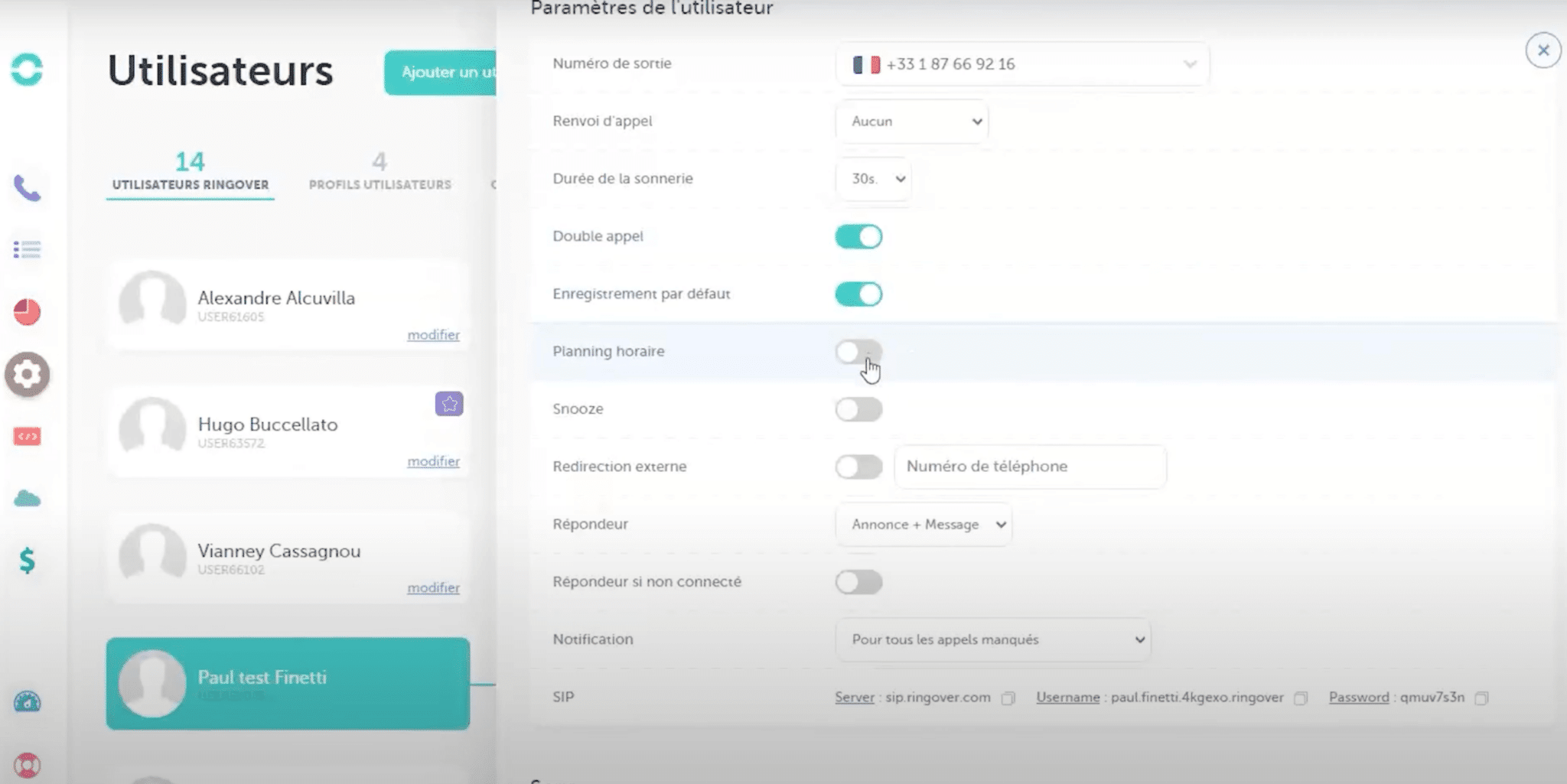
For supervisors, Aircall stands out with a very complete monitoring tool that lets you listen to calls in real time, step in if needed and coach teams on the fly.
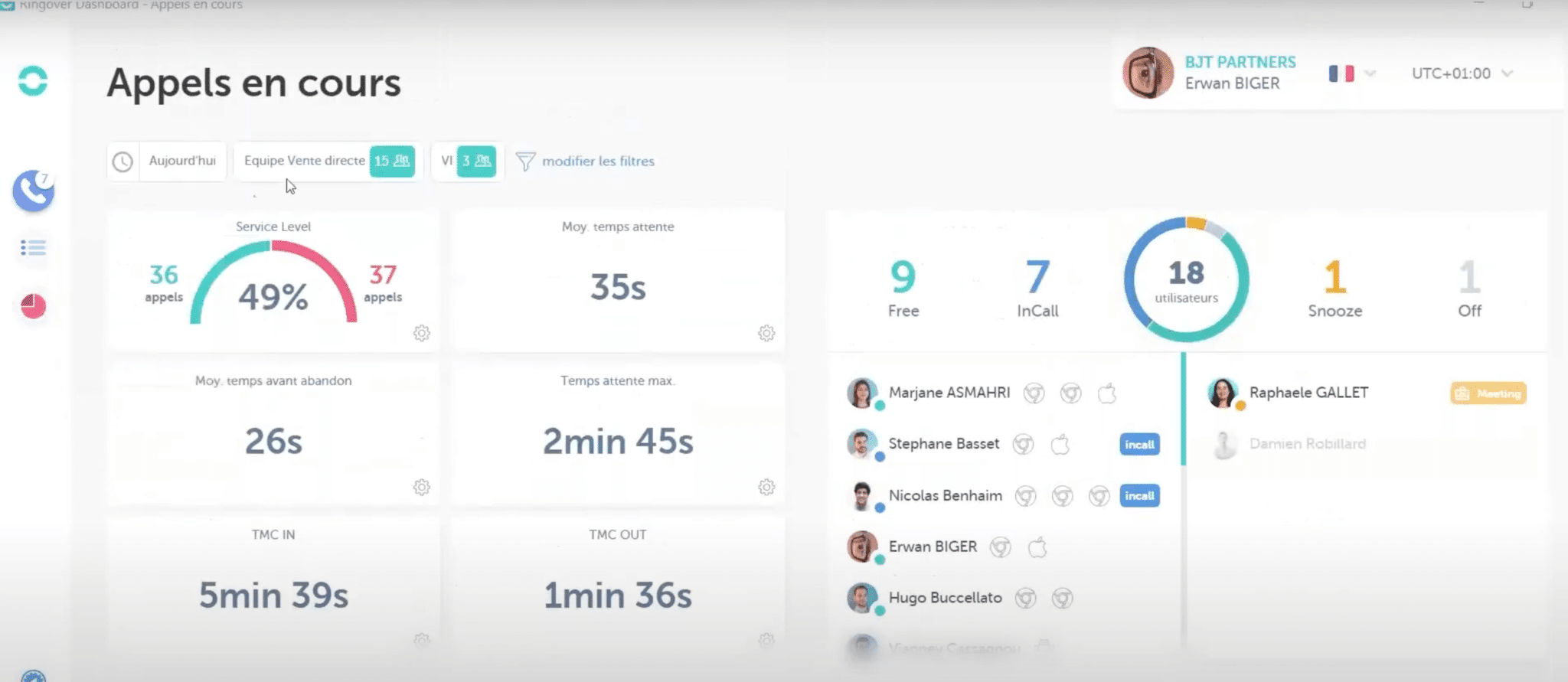
Ringover, for its part, offers more “macro” supervision through dashboards and key metrics such as talk time per agent. Call monitoring and whispering are also available there, from the Business plan.
Both tools also offer a power dialer to automate repetitive tasks as much as possible: up to 1,000 imported numbers at Aircall, 300 at Ringover.
On productivity, Aircall is more complete. But for most SMEs, the features Ringover offers are more than enough.
#3 Customer relationship tracking
For each contact, you get the list of calls made and received, with the option to replay recordings or read their transcripts.
Teams can also take notes directly in the tool and assign specific tags to certain calls to categorize them (“To call back”, “Complaint”…).
Still with follow-up in mind, real-time notifications alert agents if an important contact is trying to reach them. This helps prioritize certain callbacks.
Aircall goes a little further with advanced call assignment features between agents, based on their history. For example, the system can automatically ring first the sales rep who has already spoken several times with a strategic prospect who is calling back.
#4 Reporting and analytics
Aircall and Ringover both offer very complete dashboards accessible directly in the interface.
Supervisors can track key metrics in real time, such as the number of calls handled, average talk time, pick-up rate and so on. You can also create custom views and segment data by team, agent or time slot.
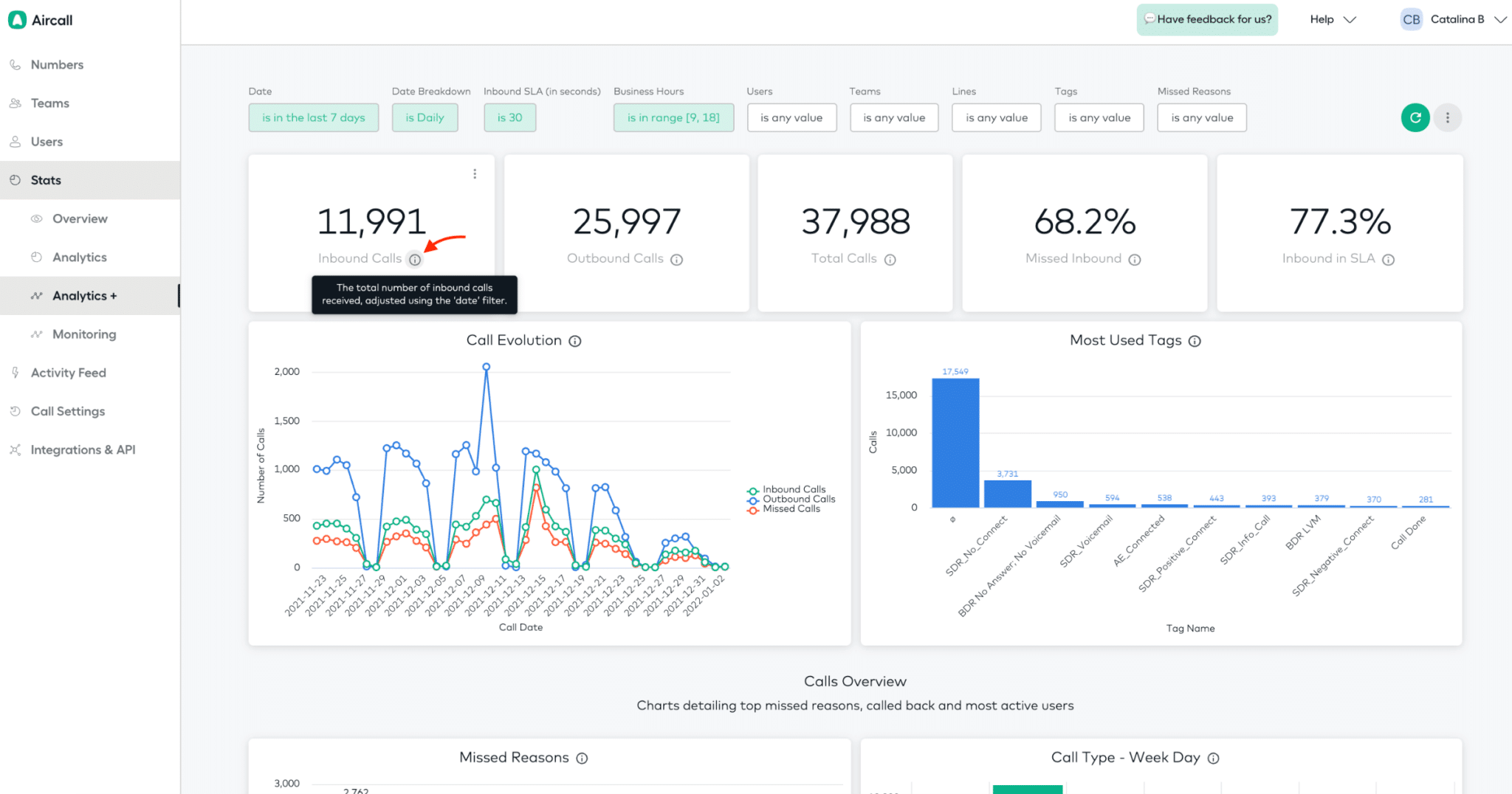
Talk-time analysis is very well handled in Aircall. The tool lets you, for example, identify peak hours to staff your teams properly, or detect abnormally long calls to investigate possible sticking points.
Ringover, for its part, focuses on tracking employee performance with configurable rankings and individual targets.
Each person’s actions are tracked in detail, which makes it easy to identify top performers and those who need support.
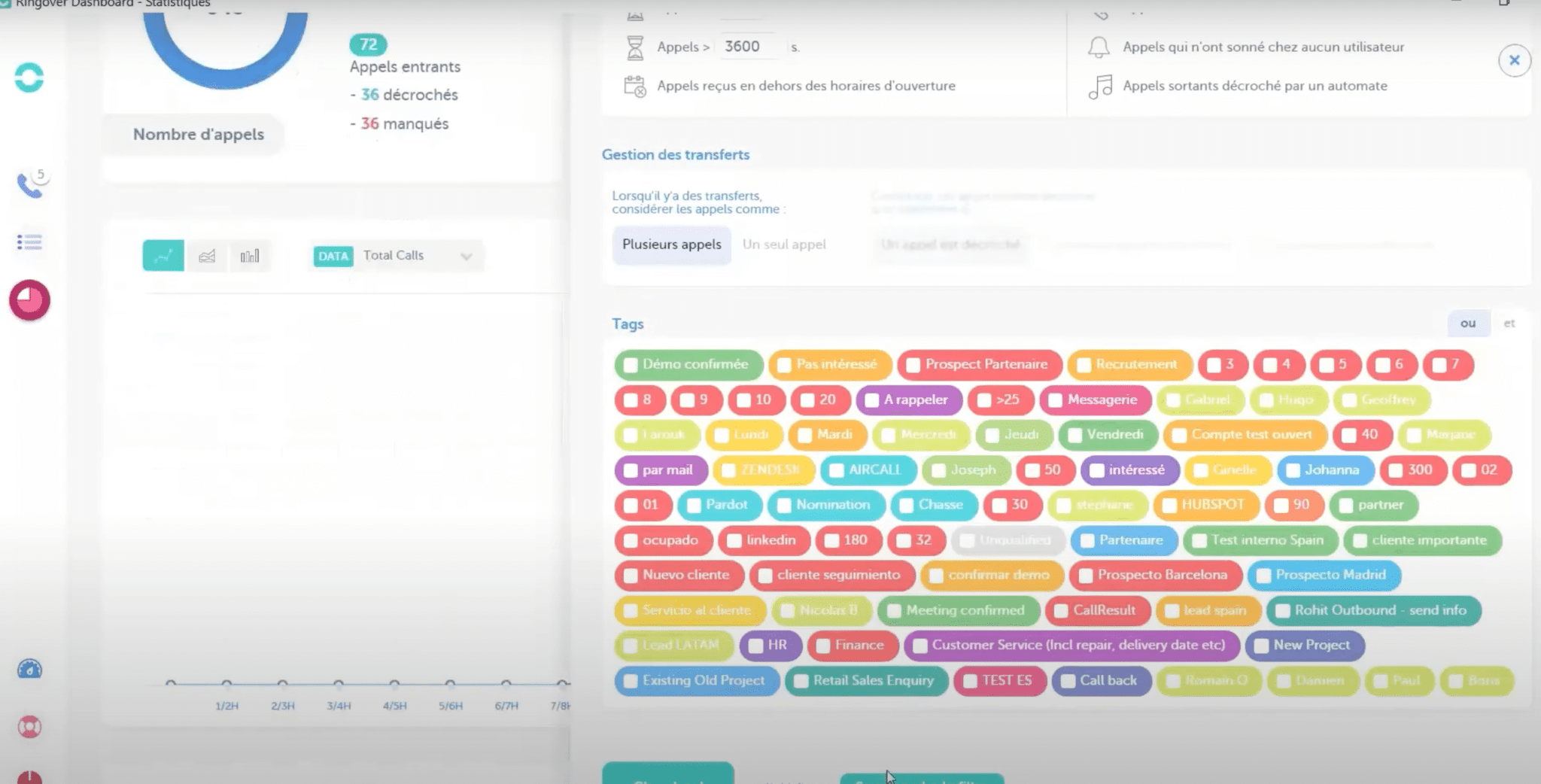
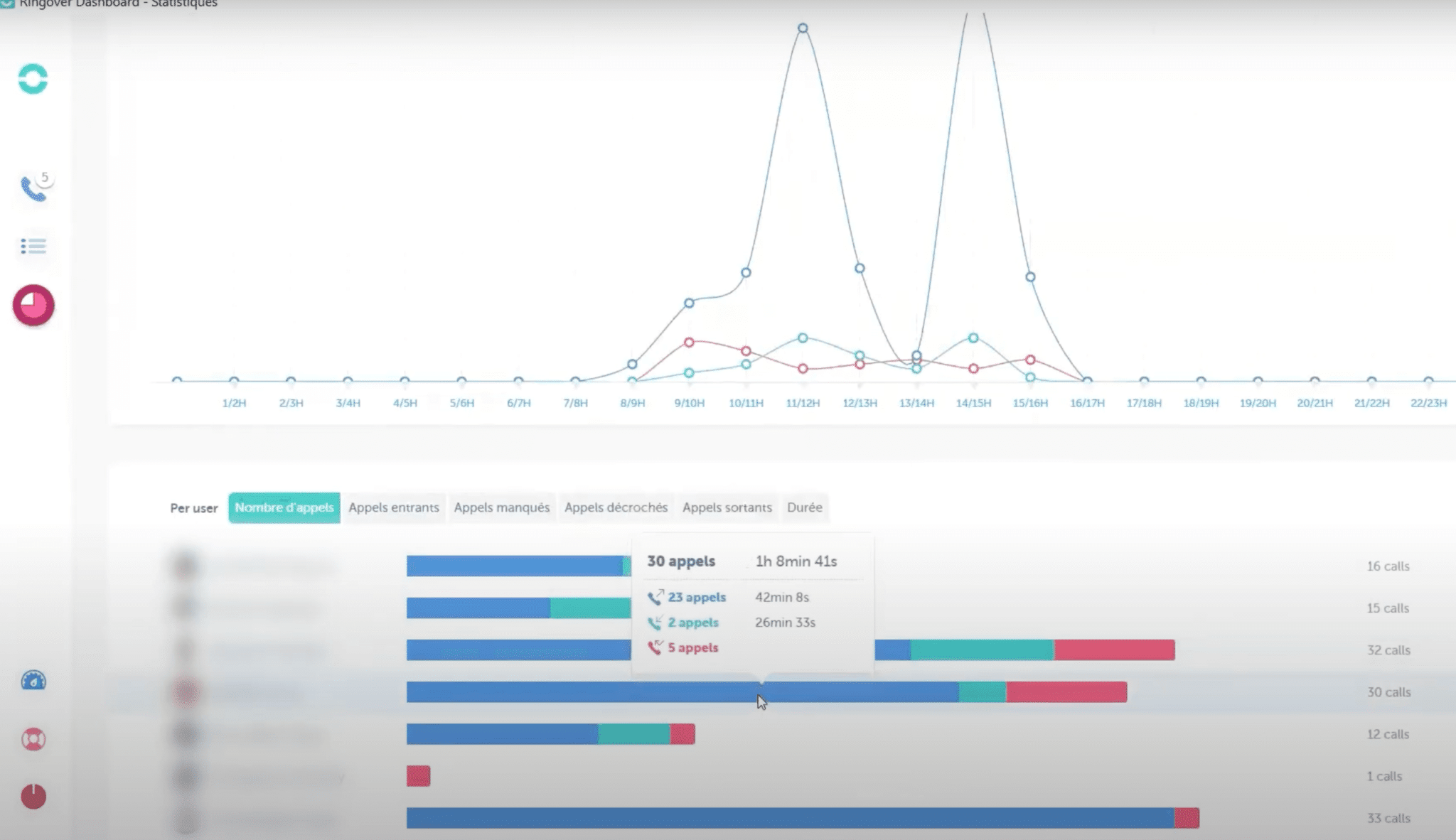
Both solutions are very well equipped for reporting and analytics. With a slight advantage to Aircall, whose dashboards are both more ergonomic and more advanced.
Ringover vs Aircall: integrations
Both tools integrate with most CRMs on the market, starting with the leaders Salesforce, HubSpot, Pipedrive… This lets you bring telephony directly into your CRM software (click-to-call and automatic call logging).
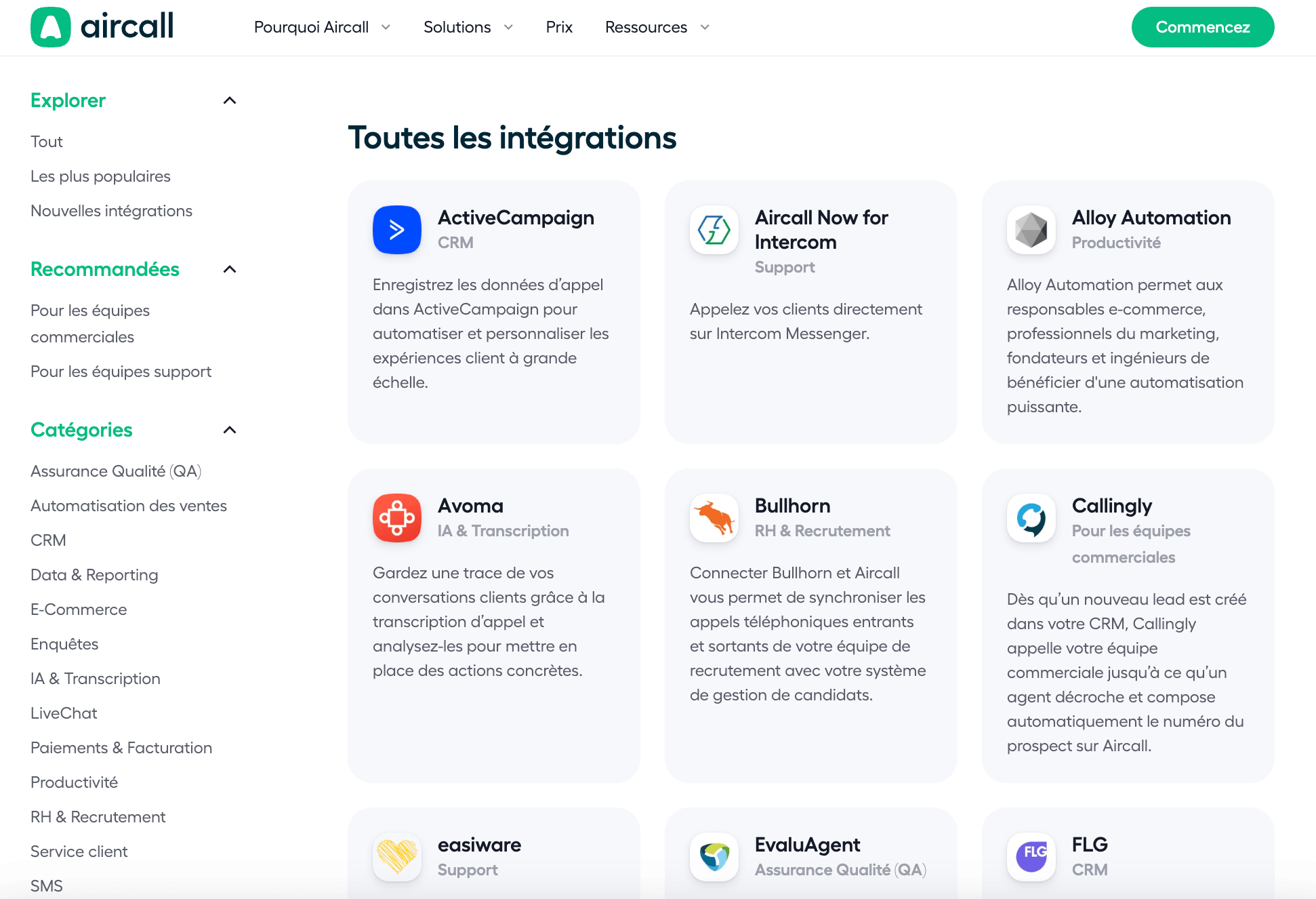
Same thing for customer support and helpdesk, with integrations connecting Aircall and Ringover to market leaders such as Zendesk, Freshdesk and Intercom.
This gives agents access to all customer information and interaction history in one click, directly from the phone interface.
Aircall offers more than 250 integrations with business tools, against more than 100 native integrations for Ringover.
Both solutions also provide an API and webhooks to connect with more specific tools that aren’t natively supported.
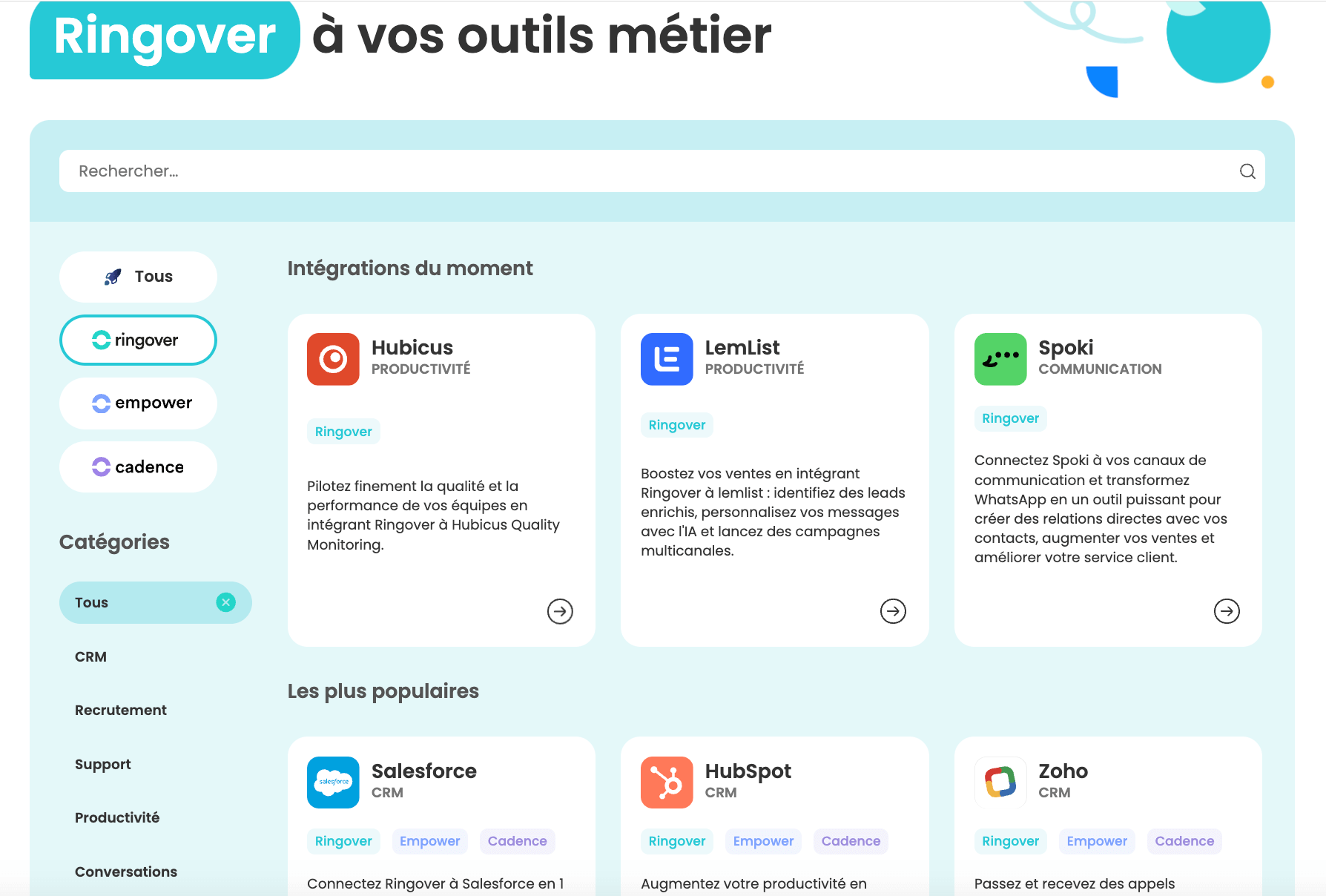
So overall, whatever your tool ecosystem, you shouldn’t have trouble plugging in Aircall or Ringover.
Ringover vs Aircall: customer service
Customer support is an important criterion when choosing a VoIP phone solution.
On this point, Aircall does better than Ringover.
The teams, based in Paris (so French-language support is available) and New York, can be reached by phone, email or chat. Response times are very fast.
Aircall also offers a very complete online help center, with plenty of articles and tutorials. The website also includes a knowledge base, webinars and an online community.
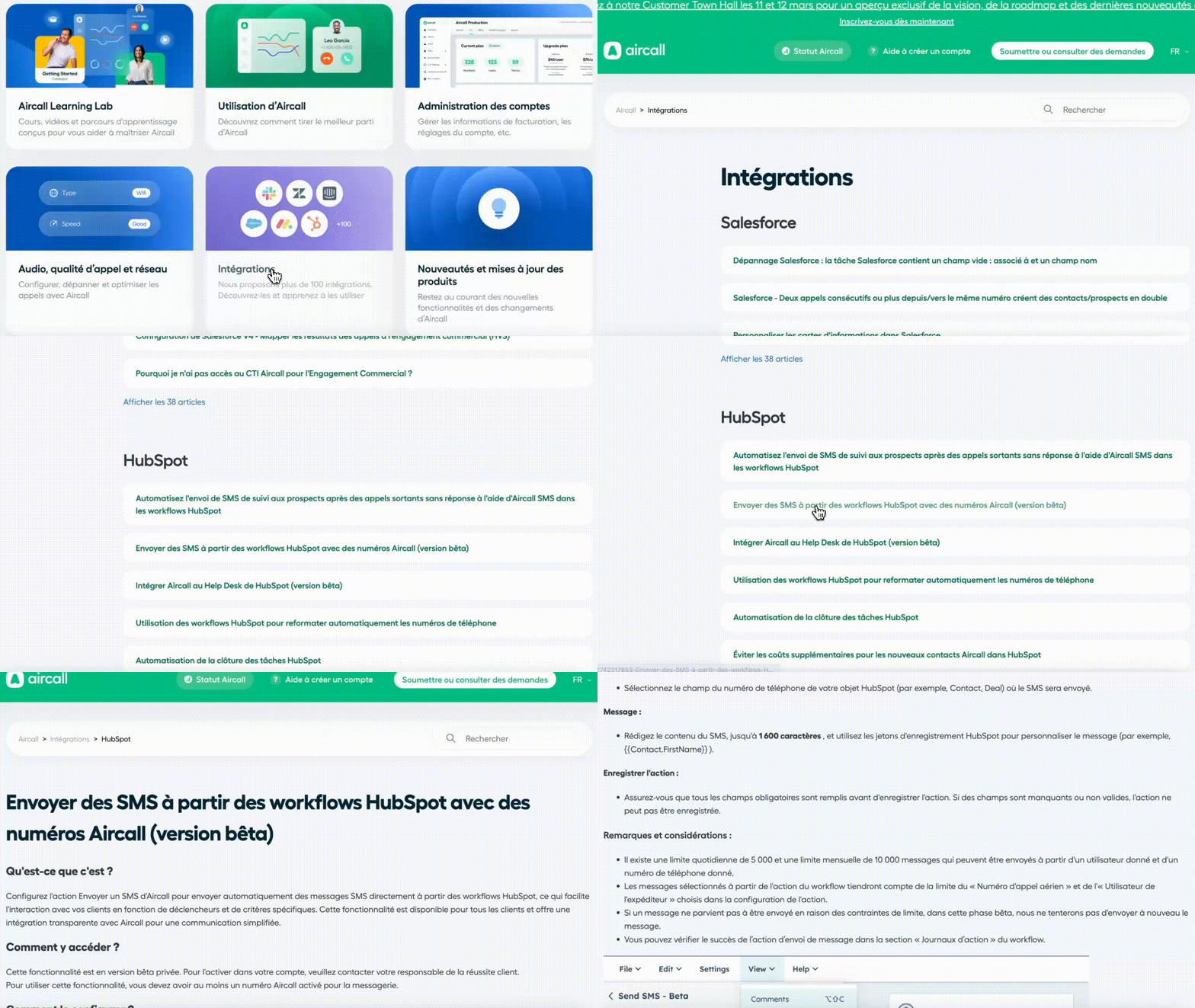
Ringover offers technical support only during office hours: Monday to Friday from 9:00 to 18:00, and Saturday from 9:30 to 13:30. Dedicated 24/7 support is reserved for the Enterprise plan. Assistance is provided by a team based in France, reachable by phone and email. Customer reviews are rather mixed on support responsiveness, it seems a bit hit or miss…
Ringover’s online knowledge base is also a bit more limited than Aircall’s. You’ll find the basics to get started and solve simple problems, but it’s thinner on specific use cases.
Aircall wins this round.
Customer reviews of Ringover and Aircall
We analyzed the reviews left by Aircall and Ringover users on the G2 platform. Both tools have very positive average ratings (Aircall reviews, Ringover reviews).
The strengths most often cited for Aircall:
- Call quality and reliability, even at high volumes. Users appreciate the stability of the solution.
- The very intuitive interface, easy for teams to pick up. The dashboard wins unanimous approval (or almost… you’ll always find detractors…)!
- The many integrations, notably with leading CRMs such as Salesforce and Hubspot.
- Responsive, competent customer support, with a special mention for the Customer Success Managers.
As for Ringover, users highlight:
- The very attractive value for money. As we’ll see in a moment, Ringover is cheaper than Aircall.
- How easy the solution is to use and configure. Very small businesses and SMEs appreciate being up and running quickly.
On the improvements side, a few Aircall users regret the lack of a numeric keypad for dialing numbers manually. Some also mention small bugs in the mobile app.
For Ringover, it’s mostly connection stability that is sometimes criticized, with a few dropouts reported.
But overall, for both Aircall and Ringover, customer reviews are overwhelmingly positive. These are clearly two safe bets.
Ringover vs Aircall: plans and pricing
Aircall and Ringover both bill by subscription, based on the number of users (the classic model for phone solutions, which CRM vendors also use).
Aircall’s offer comes in 3 main plans.
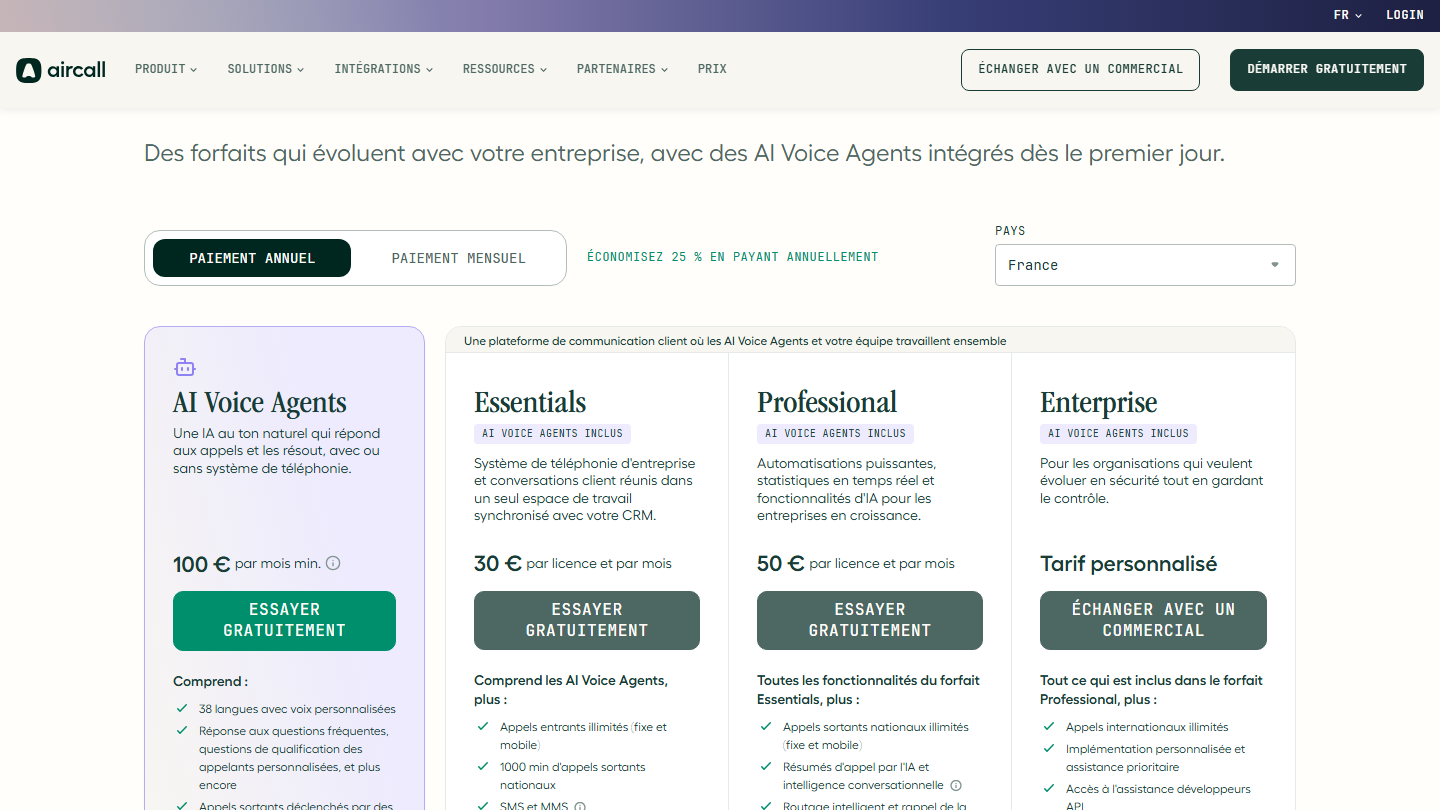
- The Essentials plan at €30 per license per month (billed annually). This is the most accessible option, best suited to SMEs and startups looking for a simple solution to handle a few dozen calls a day. This plan includes all the basic features: unlimited inbound calls, 1,000 minutes of domestic outbound calls per user, customizable IVR, click-to-dial, mobile and desktop apps, plus access to most integrations.
- The Professional plan at €50 per license per month is aimed at companies with more advanced needs, notably in productivity and supervision. On top of the Essentials features, you get the power dialer to automate outbound calls, coaching functions and a few additional integrations (notably integrations with Salesforce products).
- Finally, the Enterprise plan is a custom offer for contact centers handling large call volumes, from 25 licenses. The price is tailor-made, set after analyzing your needs. This plan unlocks additional features (unlimited international calls, SSO) but also, above all, a VIP level of support (SLA, custom implementation and priority assistance).
Ringover offers 4 plans:
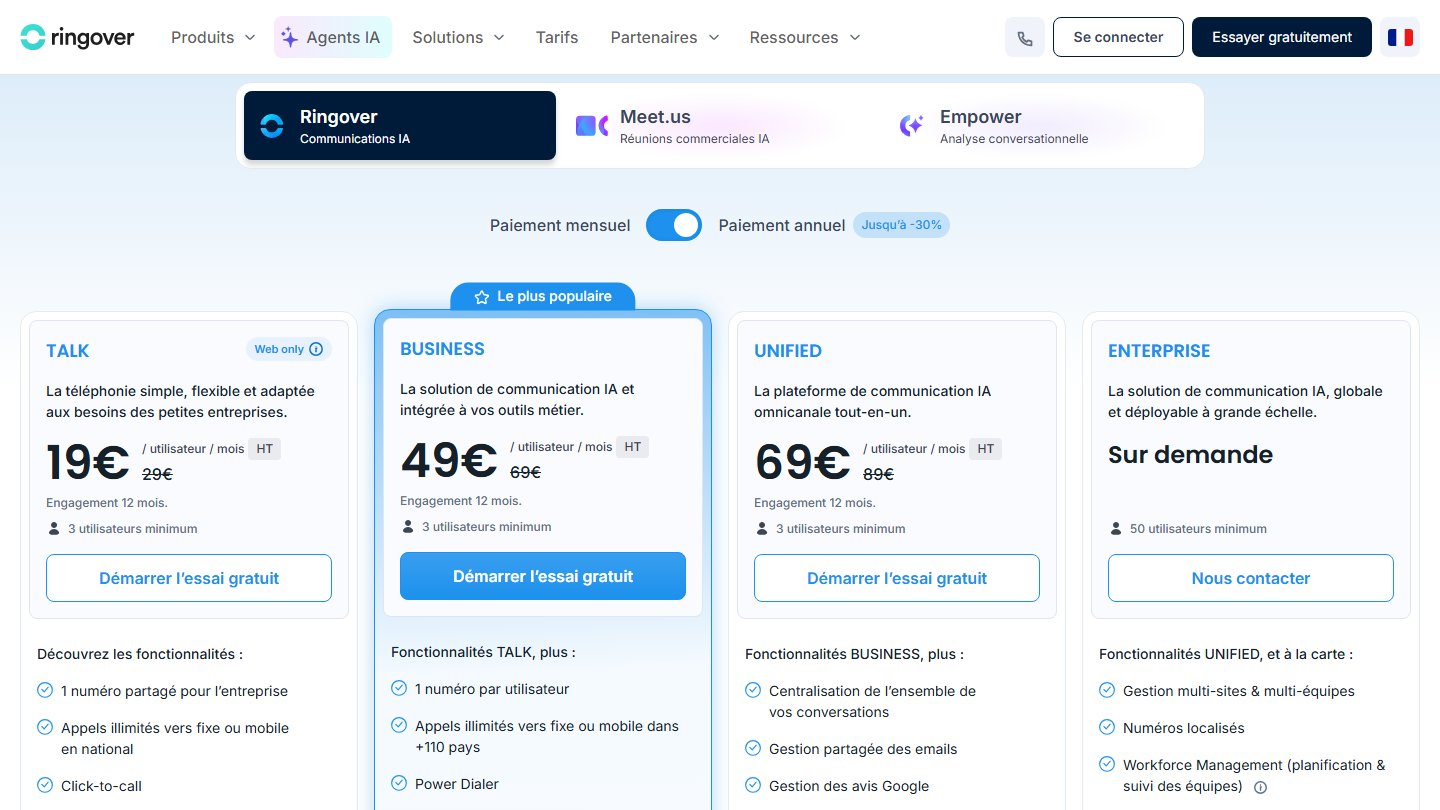
- The Talk plan at €19 excl. VAT per user per month (with a 12-month commitment, €29 with no commitment) is the entry-level option. Intended rather for very small businesses, freelancers and small teams, it covers the essentials: a shared number for the company, unlimited domestic calls, one-click dialing, call log and call recording.
- The Business plan at €49 excl. VAT per user per month (€69 with no commitment) is a better fit for SMEs and sales or support teams with more critical productivity needs. It notably adds one number per user, an advanced IVR for call routing, the Power Dialer (with a limited version of call scripts), detailed statistics and unlimited native integrations (CRM, helpdesk…).
- The Unified plan at €69 excl. VAT per user per month (€89 with no commitment) takes the Business features and centralizes all conversations: WhatsApp, Messenger, Instagram, shared email inboxes, Google reviews and video conferencing.
- The Enterprise plan is available on request, from 50 users, and is aimed at companies with advanced call center management needs: multi-site management, local numbers, team scheduling, dedicated 24/7 support and a dedicated Customer Success Manager.
Note: at both Aircall and Ringover, you need at least 3 users. Paying annually saves 25% at Aircall, and up to 30% at Ringover, with a 12-month commitment.
So Aircall is more expensive than Ringover at entry level (€30 against €19), but the plans that unlock the Power Dialer are on the same level (€50 against €49).