


- CROC: Contact, Reason, Objective, Conclusion. Every call ends with a concrete action.
- Prepare the call: research the prospect and their company, their LinkedIn profile, their business challenges.
- Be realistic about the objective: for software at €10K/year, aim for a qualification meeting or a demo, not the sale.
- Write 3 or 4 key sentences per stage without learning them by heart, and 2 or 3 answers for each classic objection.
- Suggest a specific date and time rather than asking the prospect when they’re available.
Do you run a startup or a small business and want to boost your phone prospecting? You’ve come to the right place. In B2B sales, picking up the phone is still one of the most effective ways to generate qualified leads. But you still need to know how to go about it…
That’s where the CROC method comes in. No, we’re not talking about plastic shoes, but about a formidable technique for structuring your prospecting calls. In this article, we’ll explain how to use it to turn your cold calls into real meeting machines.
Find the right providerNeed to outsource your prospecting? Find the provider that matches your real needs.
Find a provider
“CROC”, a method for structuring your phone call plan
What is the CROC method?
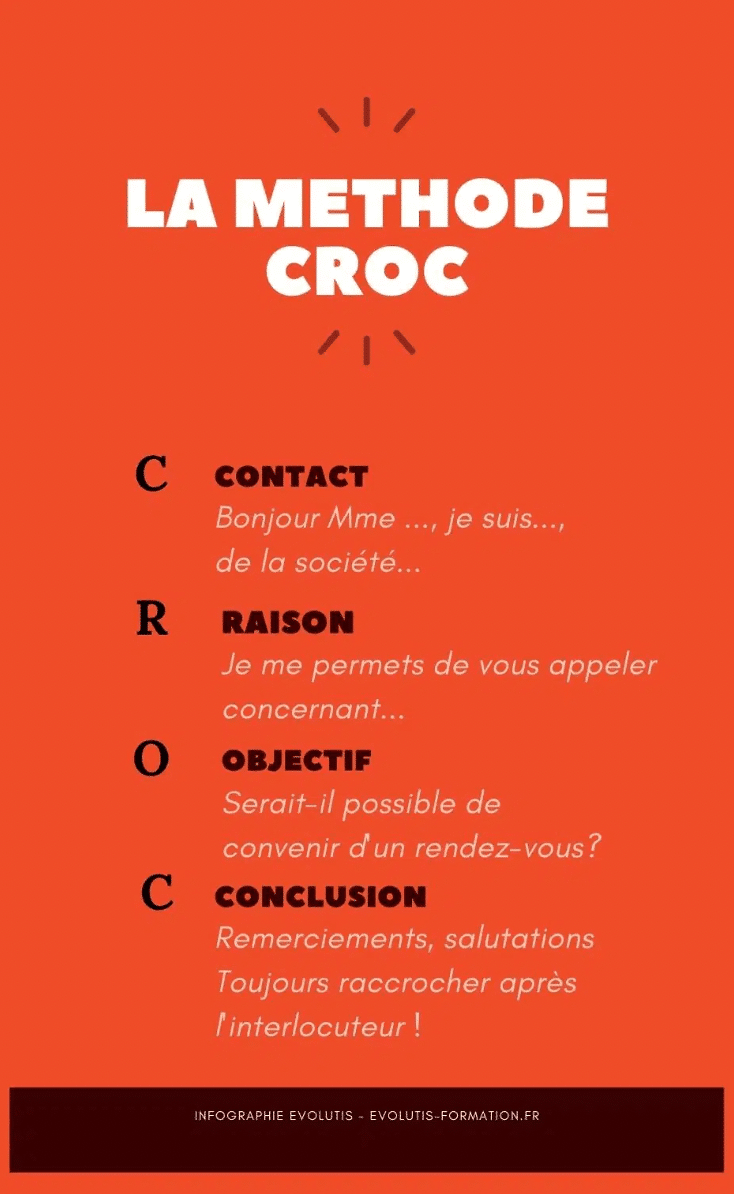
The CROC method (Contact, Reason for the call, Objective, Conclusion) is a sales strategy designed for phone prospecting. It breaks down into 4 key steps:
- Contact: Make the first contact.
- Reason: Explain the reason for your call.
- Objective: Present the objective of your approach.
- Conclusion: End the call with a clear action.
Let’s look at it in detail.
Contact: Break the ice
Contact is your opening. No need for frills, be direct and professional:
“Hello, this is Thomas from Salesdorado. Am I speaking with Julie Dupont, marketing manager at TechStartup?”
The goal here? Check that you really are on the line with the right person and lay the foundations of a professional conversation.
Also readExamples of sales opening lines
Reason: Give your call a purpose
Now that you’ve made contact, explain quickly why you’re calling. You need to be both concise and punchy:
“I’m calling because we help companies like yours optimize their sales process with our CRM software.”
No pointless chatter, get straight to the point. Your prospect has better things to do than listen to an endless monologue.
Objective: Show the value of your offer
The next step is to highlight the added value of your product or service. Focus on the benefits for your prospect:
“Our goal is to help you increase your conversions by 30% by automating your time-consuming tasks. That would let you focus on what really matters: the customer relationship.”
Be specific and put figures on your promises, as far as possible of course. Companies love concrete results.
Conclusion: Take action
Never let your call fizzle out. At the end of the call, always remember to propose a concrete action:
“To show you concretely how it works, how about a 15-minute call on Thursday at 2 p.m. for a quick demo?”
Salesdorado’s tipBe proactive and suggest a specific date and time. It works better than vaguely asking “when would you be available?”.
Why does the CROC method work?
The CROC method is a phone prospecting technique that has proven itself and keeps proving itself – and for several reasons. First of all, it’s a method that shines through its simplicity. It’s easy to remember and to apply, even for budding salespeople. That makes it easier for teams to adopt.
The CROC method follows a logical structure that gets straight to the point. Using the CROC method is the best way to avoid falling into the trap of pointless digressions. The sequential approach – Contact, Reason, Objective, Conclusion – lets the salesperson stay in control while covering all the essential points.
The CROC method, and this is linked to the previous point, respects the precious time of your prospects and your salespeople. It saves everyone time.
The effectiveness of the CROC method also comes from the last “C” of the acronym: the conclusion. It’s not only a structured approach, but also and above all an approach that is geared toward a clear goal: the call to action. The CROC method steers the conversation toward a concrete action.
In short, through its simplicity, its structure, its effectiveness and its focus on results, the CROC method is a very powerful framework for running productive prospecting calls. For all these reasons, you’d be wrong not to test it. But how do you go about it? That’s the subject of the next part.
How do you build a phone call plan with the CROC method?
Now that you understand the basics of the CROC method, let’s move on to the method. How do you build an effective call plan based on the CROC method? Here are the main steps:
1. Do your homework
Before you even pick up the phone, you need to prepare. Every prospecting call, every cold call needs preparation. No, we’re not talking about doing 50 push-ups, but rather about:
- Googling your prospect and their company (it takes 2 minutes, you have no excuse).
- Checking their LinkedIn profile in detail (to go further: find out how to prospect on LinkedIn)
- Identifying your prospect’s main business challenges.
This preparation will let you personalize your approach. A salesperson who knows their target is like a sniper: they never miss their target (or, at any rate, they’re less likely to miss it).
2. Define your objective
What do you want to get out of this call? A meeting? A demo? A direct sale?
You need to be very clear about the objective of the call.
You also need to be realistic. If you sell software at €10K/year, don’t expect to close the sale in a single call. Aim instead for a qualification meeting or a demo.
3. Prepare your CROC pitch
You know your prospect and the objectives of the call – your objectives. You can move on to the serious stuff.
For each step of the CROC method, prepare a mini sales script, 3-4 key sentences:
- Contact: Your introduction sentence.
- Reason: Why you’re calling (the sentence has to be punchy).
- Objective: The value you bring (with figures if possible).
- Conclusion: Your call-to-action.
Write these sentences down, but don’t learn them by heart. The goal is to sound natural, not like a robot.
4. Anticipate objections
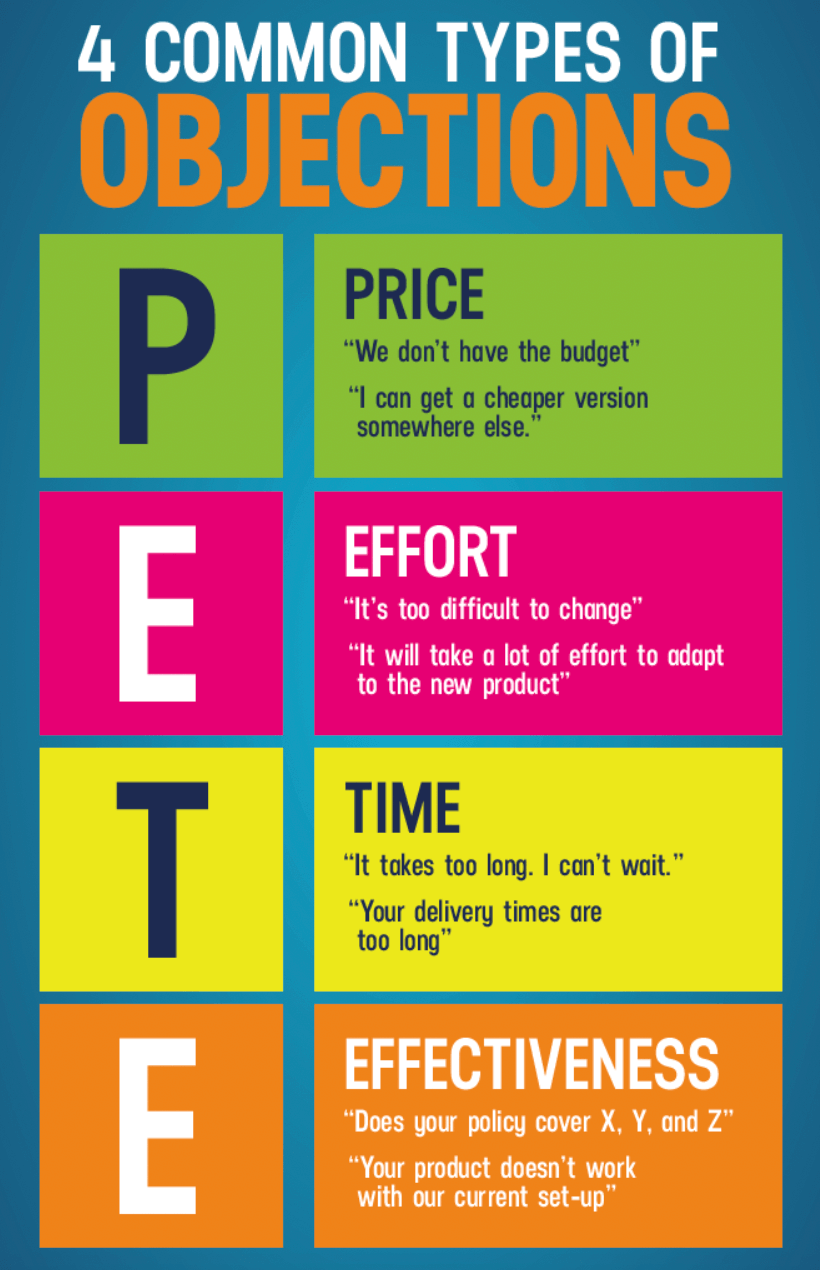
You know the tune: “It’s not a good time”, “We already have a solution”, “It’s too expensive”…
95% of objections can be anticipated and prepared for.
For each classic objection, prepare 2 or 3 answers.
Level up on LinkedInWant to take things up a notch on LinkedIn? It’s not insurmountable, but it’s not obvious either. The best thing is to take the subject seriously and get trained. Good news: we’ve put together a selection of the best LinkedIn courses of the moment.
See the benchmark Our favorite course
5. Create your call sheet
Gather all this information in a simple call sheet. It can be a Word doc, a Google Doc, a Trello board, or even a post-it (if you have small handwriting). What matters is that it’s easy to access during the call.
Here’s what your call sheet could look like:
Example of a phone call sheetProspect: Julie Dupont, CMO at TechStartup.
Key info: Recent Series A, scaling fast.
CROC:
- C: “Hello Julie, Thomas from Salesdorado…”
- R: “I’m calling because we help hypergrowth startups like yours to…”
- O: “Our goal is to save you 5 hours a week on your repetitive marketing tasks…”
- C: “How about a 20-minute call on Thursday at 2 p.m. so I can show you how?”
Objections:
- No time: “I understand, that’s exactly why…”
- Already have a solution: “Great, what do you like most about your current solution?”
6. Test and iterate
Rome wasn’t built in a day, and neither is your perfect phone call plan. After each round of calls, take 5 minutes to note what worked and what can be improved.
Don’t hesitate to test different approaches. As long as you stay within the CROC framework, you can play with the words, the tone, the order of the information… Find what works best for you and your target.
Go furtherTo make sure you get as many answers as possible, here we reveal the best times for your prospecting calls.
7. Train your team
If you have a sales team, even a small one, share your phone call plan with them. Organize role-play sessions so that everyone is comfortable with the CROC method.
Remember: a call plan is like a good wine, it gets better with time (and practice).
5 concrete examples of phone call plans using the CROC method
Enough theory, let’s get practical! Here are 5 examples of call plans that will show you how the CROC method applies in different situations. Take notes, get inspired, and adapt these examples your own way.
1. First contact with a cold prospect
Context: You sell project management software and you’re calling the head of product at a fast-growing startup.
C: “Hello, this is Sarah from ProjectPro. Am I speaking with Thomas, the head of product at TechInnovate?”
R: “I’m calling because we help startups like yours deliver their projects 30% faster with our project management tool.”
O: “Our goal is to save you time on team coordination so you can focus on product innovation.”
C: “Would you be interested in a 15-minute call on Thursday at 2 p.m. to see how it could apply to your team?”
2. Following up with a prospect after an email
Context: You sent an email last week about your marketing automation solution. No reply, so you follow up by phone.
C: “Hello Julie, it’s Marc from AutoMark. I hope I’m not disturbing you?”
R: “I’m calling about the email I sent you last week regarding our marketing automation solution.”
O: “I wanted to make sure you received it and see whether you’d be interested in doubling your email open rates by automating your campaigns.”
C: “How about a quick 20-minute demo next Tuesday to see how it works in practice?”
3. Qualification call
Context: A prospect filled in a form on your website to find out more about your online accounting service. You call to qualify the lead.
C: “Hello, this is Léa from ComptaSimple. Am I speaking with Alexandre? Are you the one who asked us for information about our service yesterday?”
R: “I’m calling to discuss your request and see how we could help you with your accounting.”
O: “My aim is to understand your specific needs to see whether our solution, which usually saves 5 hours a week on accounting tasks, would suit your situation.”
C: “Would you have 10 minutes now to tell me about your current accounting challenges?”
4. Booking a demo
Context: You sell a CRM specialized for real estate agencies and you’ve already had a positive first contact with the prospect.
C: “Hello Sophie, it’s Julien from ImmoCRM. How have you been since we last spoke?”
R: “I’m calling back as agreed to set up a demo of our CRM which, as a reminder, helps agencies like yours increase their sales by 25% on average.”
O: “The goal of this demo is to show you concretely how our tool can adapt to your sales process and automate your customer follow-ups.”
C: “I have two slots available next week: Tuesday at 10 a.m. or Thursday at 2 p.m. Which would suit you best?”
5. Handling a common objection
Context: You sell a cybersecurity solution and your prospect tells you they don’t have the budget.
C: “I completely understand, Thomas. Budget is always an important consideration.”
R: “That’s exactly why I’m calling. Many of our customers had the same concern before they realized the savings our solution can generate.”
O: “Our goal isn’t to be an extra cost, but to save you money. On average, our customers save €30,000 a year by preventing attacks and optimizing their IT infrastructure.”
C: “How about I send you a detailed case study showing the return on investment for a company similar to yours? We could then discuss it on a 15-minute call next week.”
There you go, you now have 5 concrete examples of how to apply the CROC method in different situations. Of course, the point isn’t to copy and paste them blindly. The idea is to draw inspiration from them and adapt them to your style, your product and your prospects.
10 tips to optimize your phone calls with the CROC method
Now that you’ve mastered the basics of the CROC method, it’s time to shift up a gear. Here are a few tips to turn your prospecting calls into real conversion machines.
1. Personalize like a pro
The secret of a call that hits the mark? Personalization. Forget generic scripts that reek of leftovers. A few ideas:
- Mention a recent article from the company’s blog.
- Refer to a recent piece of industry news.
- Quote one of the prospect’s LinkedIn posts.
- Comment on a recent achievement by the company (new product, partnership, funding round).
- Make a link with an event the company recently took part in.
- Mention a mutual customer or partner.
2. Master the art of silence
Using silence wisely is an underrated skill in phone prospecting. After asking a question, resist the temptation to fill the gap immediately. A strategic silence, even if it’s potentially uncomfortable, can be a powerful tool for getting valuable information.
Count to five in your head if necessary. This pause will create a slight tension and encourage the other person to expand on their answer or share additional information. It’s in these moments that prospects often reveal important details about their needs, challenges or decision-making process.
3. Use the power of anecdotes
Stories grab attention. Prepare 2-3 short anecdotes about how your product helped similar companies.
Example: “Actually, just last week, a startup like yours increased its conversions by 40% in only one month thanks to our tool. Their CEO couldn’t believe it!”
4. Ask the right questions
The right questions do 80% of the work. Forget closed questions like “Are you satisfied with your current solution?”.
Go for:
- “What frustrates you most about your current process?”
- “If you had a magic wand, what would you change in the way you manage leads?”
- “How do you see your needs in [your field] evolving over the next 6 months?”
5. Master your tone of voice
Your voice is your instrument. Play it!
A few tips:
- Smile while you talk (people can hear it)
- Vary the pace (slowing down on the important points)
- Adapt to the other person’s tone (if they’re fast-paced, be energetic)
6. Use mirroring
Mirroring is the art of subtly reflecting the language and tone of the person you’re talking to. If they use technical terms, do the same. If they’re rather laid-back, loosen your tie a little (metaphorically, of course).
7. Handle objections
A few tips, in no particular order, for handling objections:
- Listen carefully and always show empathy.
- Validate the prospect’s concerns.
- Ask questions to better understand the context.
- Share concrete examples of customers who had similar concerns.
- Offer solutions tailored to the prospect’s specific case.
8. Close in style
Never let a call end without a concrete action. Once again, that’s the foundation of the CROC method: it’s geared toward a precise end, action. If you haven’t landed the meeting, at least offer to send some information by email. And always set the next point of contact.
9. Debrief and iterate
After each call, take 2 minutes to note what went well and what can be improved. There are no secrets, that’s how you get better!
10. Practice, practice, practice
The CROC method is like riding a bike. At first, you struggle, you fall, you get back up. But with practice, it becomes natural. Do role-plays with your colleagues, record yourself, listen to yourself. It’s awkward at first, but it pays off.
Salesdorado’s tipDon’t forget: the key is authenticity. The CROC method is a guide, not a straitjacket. Adapt it, play with it, make it your own.
Conclusion
There you go, you now hold all the cards to become an ace at phone prospecting with the CROC method.
Now it’s your turn. Theory is all well and good, but nothing beats practice.
Start by testing the CROC method on 10 calls. Note what works and what gets stuck. Adjust. Try again. That’s how you get better.
Don’t forget: every “no” brings you closer to a “yes”. Every call is an opportunity to learn and improve.
And if you have questions, feedback or just want to share your successes, feel free to let us know in the comments. We love that at Salesdorado!
Go further
The questions we get over and over.
What is the CROC method?
A method for structuring phone prospecting calls in 4 steps: Contact (make the first contact), Reason (explain the reason for the call), Objective (present the objective of your approach) and Conclusion (end the call with a clear action).
Why does the CROC method work?
It’s easy to remember and apply, even for beginner salespeople. Its sequential structure avoids digressions, respects the prospect’s time and steers the conversation toward a concrete action.
How do you build a phone call plan?
Research the prospect, define the objective of the call, prepare 3 or 4 key sentences for each CROC step, anticipate objections, gather it all in a call sheet, then test, iterate and train your team.
What goes into a call sheet?
The prospect’s name and job title, key information about their company, one sentence for each CROC step and the prepared answers to the most likely objections.
How do you end a prospecting call?
With a concrete action, by suggesting a specific date and time. If you haven’t landed the meeting, at least offer to send some information by email, and always set the next point of contact.


What the community says.