



- Don’t give up after one or two calls: it takes an average of 18 calls to reach a buyer.
- Avoid “Did I catch you at a bad time?”, which cuts your chances of booking a meeting by 40% according to Gong.io.
- State the reason for your call right away, then sell the meeting without talking about the product.
- Only present your offer after making the prospect aware of an urgent problem to solve.
- Prepare a document in advance that lists the possible objections and how to counter them.
Phone prospecting is still a very effective way to get in touch with a prospect. No fewer than 69% of buyers accepted a call from new sellers over the last 12 months. And that’s not all: 75% of prospects across industries attended an event or scheduled a meeting because of unexpected cold calls. In this article, we will help you make your phone prospecting more effective. First, we give you a few statistics to help you diagnose your phone prospecting campaigns, then we share a few tips with a measured impact so your prospecting gets better results.
This article has two parts. The first covers how to open the cold call, backed by figures from Gong.io; the second walks through the sales call, from checking that you are talking to the decision-maker to closing or scheduling a new meeting.
Part 1: preparing and opening the cold call
Your phone prospecting isn’t paying off as much as it should
You’ve started phone prospecting, but the results are slow to come? Here are a few tips so you don’t go through the same misadventures again:
Great works are performed not by strength but by perseverance
One of the reasons salespeople fail at cold calling is that they give up too easily. Most of them aren’t ready to try again in a different way.
- 92% of sales professionals give up after four “no”s, but 80% of prospects say “no” four times before they say “yes”
- 44% of salespeople give up after a single follow-up call
- It takes an average of 18 calls to connect with a buyer
- On average, salespeople make no more than two attempts to get a lead through cold calling
Success is never easy to reach; even Henry Ford suffered business losses and went bankrupt. But those failures didn’t stop him from trying again and building one of the most successful car companies in the world. If you don’t put every chance on your side, it will be hard to succeed at cold calling. Prospects won’t easily trust an unknown caller. As a salesperson, you have to make an effort and earn their trust. Cold calling takes patience, perseverance and multiple attempts to get positive answers and longer-term prospects.
“Success is achieved and maintained by those who try and keep trying” – W. Clement Stone
Prepare your calls better
Another reason cold calls fail is a lack of research. Without proper research, you can’t personalize your sales calls. And personalization is a must to engage prospects and keep them on the line as long as possible. You need to study your prospects and gather information before you call them.
- 42% of salespeople feel they don’t have enough information before calling a prospect
- 82% of B2B decision-makers think sales reps are unprepared
Read alsoExamples of sales opening lines
Browse their website, look at their connections, customer reviews and social media pages to gather relevant information about them. Note their achievements, their business weak points and the interests you share, which can come up during the call.
Poorly qualified prospect databases
If you’ve taken the wrong road, you will never reach your destination. Good prospecting data is vital for successful cold calls. Without it, you will struggle to reach high-potential sales opportunities. You simply can’t call everyone. Narrow your search and improve the quality of your data for better cold calls.
- Inaccurate contact data in your B2B CRM software wastes 27.3% of sales professionals’ time. That’s about 546 hours a year for a full-time sales rep
- 94% of companies believe their customer data is inaccurate or incomplete
- 88% of companies said inaccurate data has a direct impact on their bottom line, with the average company losing 12% of its revenue.
- Poor data costs US businesses more than $611 billion a year
Avoid wasting precious hours and audit your list of phone numbers to make sure you are targeting the right buyers. Once you’ve collected the right contacts, use a contact management tool to organize them in one place.
And yet, cold calling works well. 69% of buyers accepted a call from new sellers over the last 12 months. Still not fully convinced? 75% of prospects across industries attended an event or scheduled a meeting because of unexpected cold calls.
So how do you do better?
1. Don’t accept hanging up before 5 minutes
Once the buyer has picked up, you have 5 seconds to win 5 minutes. Successful cold calls are almost twice as long as unsuccessful ones. The longer the sales call, the better your chances of getting a demo meeting for your product / service.
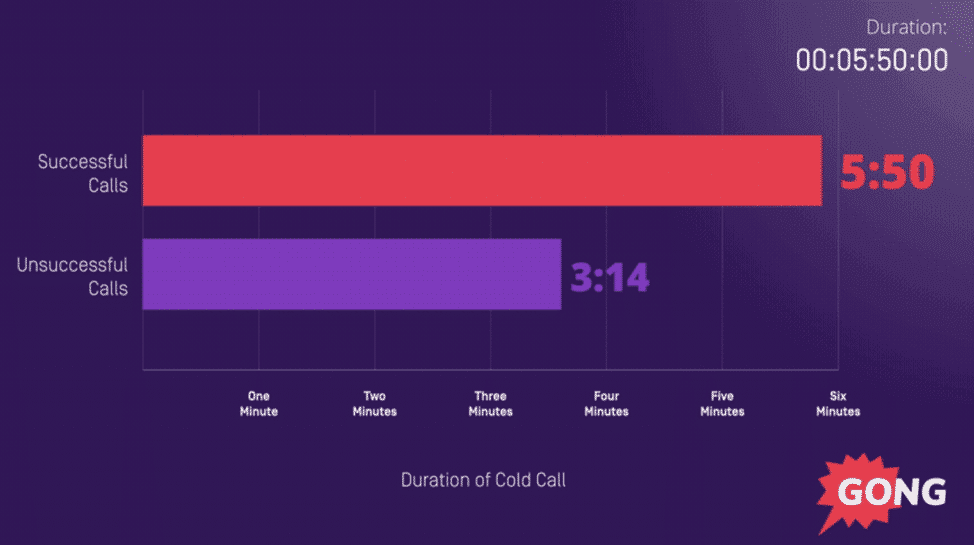
Your job isn’t only to grab your prospect’s attention on a cold call, but to hold it for the whole conversation. And here is your advantage: you have made this same cold call hundreds of times. You can predict the conversation “paths” and how to navigate them. You have the power to plan every move you will make in advance.
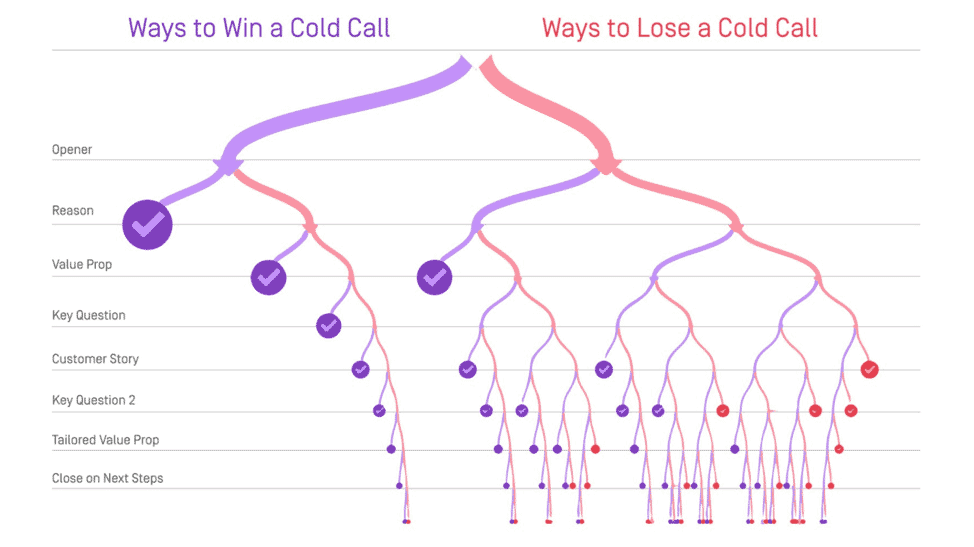
Every sentence you say should make the buyer listen to the next one. That means your script has to be lean and convincing. Here is how to be lean: imagine you get €100 every time you remove a useless word from your sales conversation.
2. Don’t say: “Did I catch you at a bad time?”
It’s a common way for new sales reps to open a cold call. “Hi John, it’s Pierre from Salesdorado, I hope I didn’t catch you at a bad time?” Several sales books recommend this line. The theory is that people like to say “no” to feel in control. And when you ask “Did I catch you at a bad time?” on a cold call, they want to say “No”. That opens the door to a successful cold call. You like the theory, don’t you? But according to Gong.io’s analysis, opening your sales process with “Did I catch you at a bad time?” makes you 40% less likely to book a meeting:
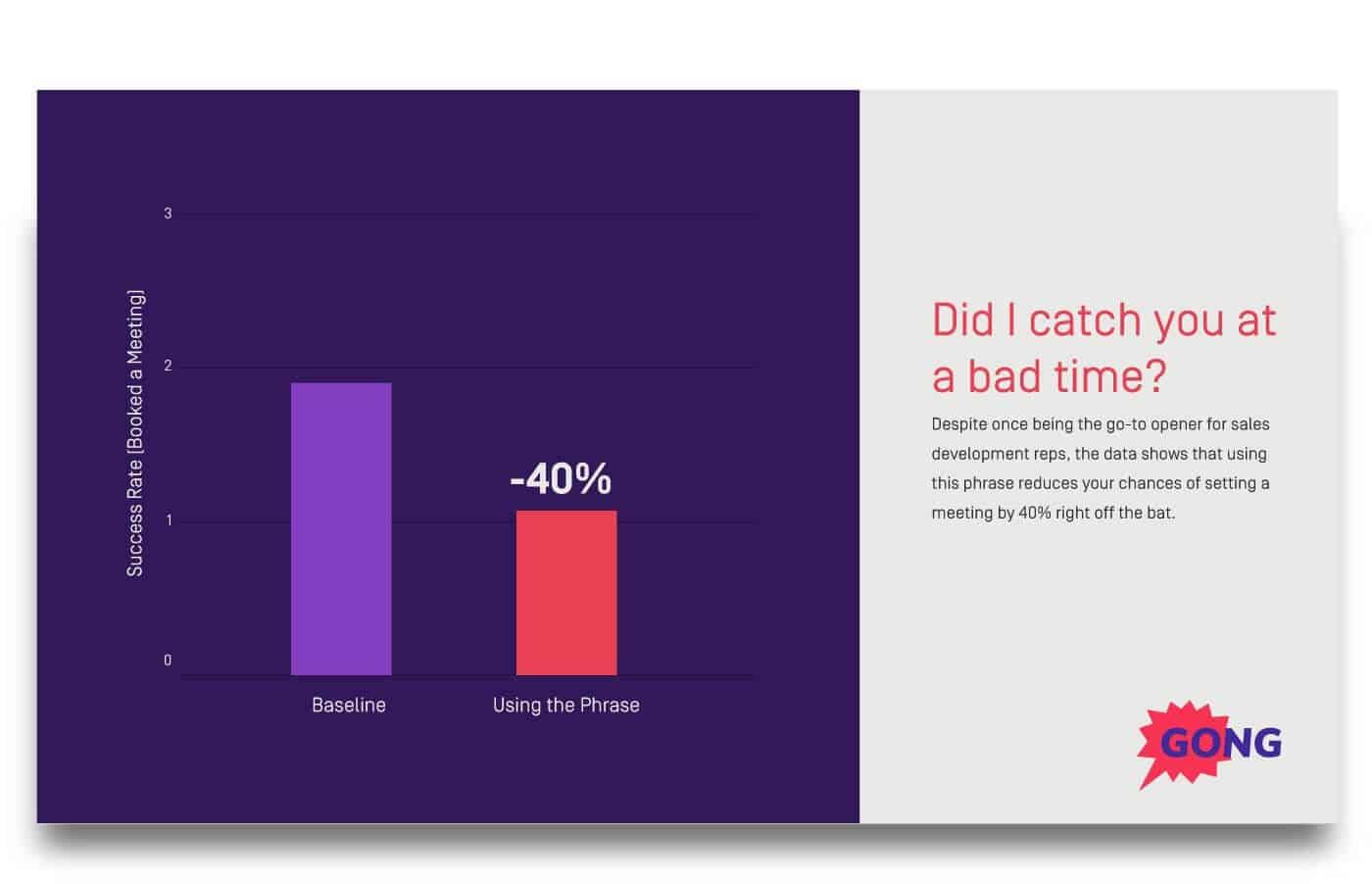
Cold calls that opened with this line had a dismal success rate of 0.9%.
3. Say: “How have you been?”
According to data from 90,380 cold calls collected by Gong.io, one opening line is far more effective than the others: the famous “How have you been?” It reached a success rate 6.6 times higher than the baseline:
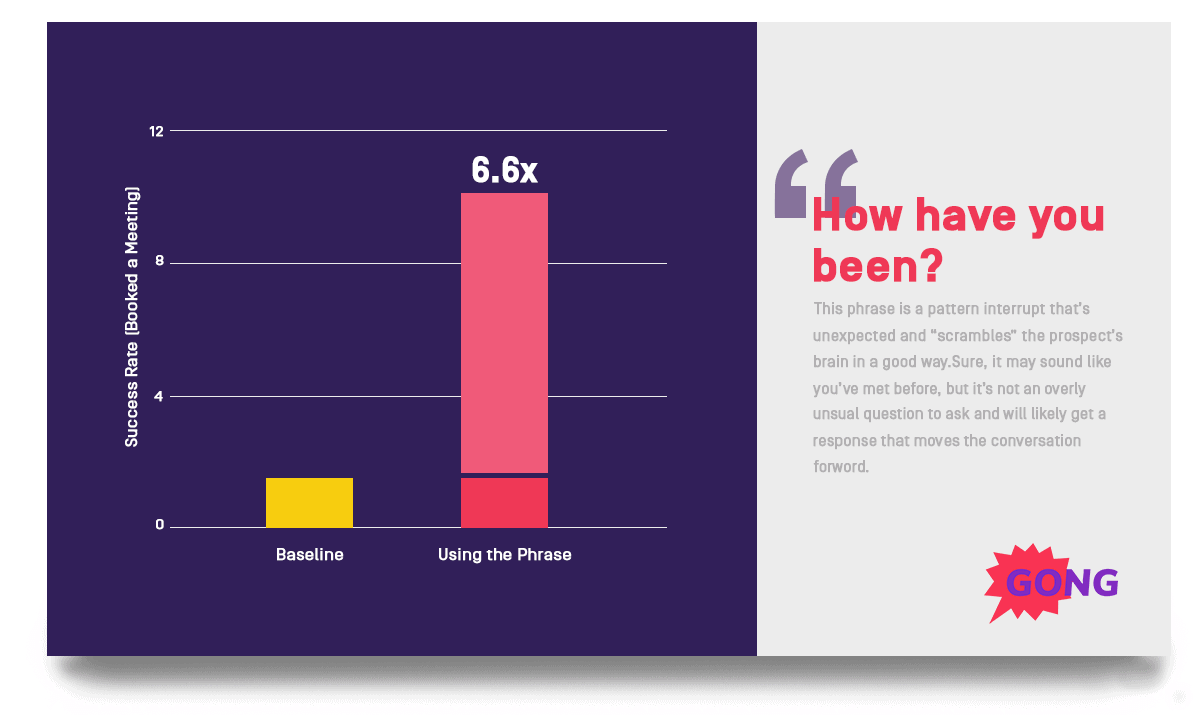
Cold calls using this question recorded a success rate of 10.01%. You may think there must have been an interaction before. “How have you been?” implies a previous interaction. But that’s not the case – the dataset was made up exclusively of first interactions (hence the term “cold call”). So why does this question work so well? It’s an unexpected question that scrambles the potential customer’s brain (in a good way). Even if you’ve never spoken to the person before, you can ask this question naturally to a complete stranger.
4. Start with the reason for your call, transparently
Starting your call by stating its reason increases your success rate by 2.1 times:
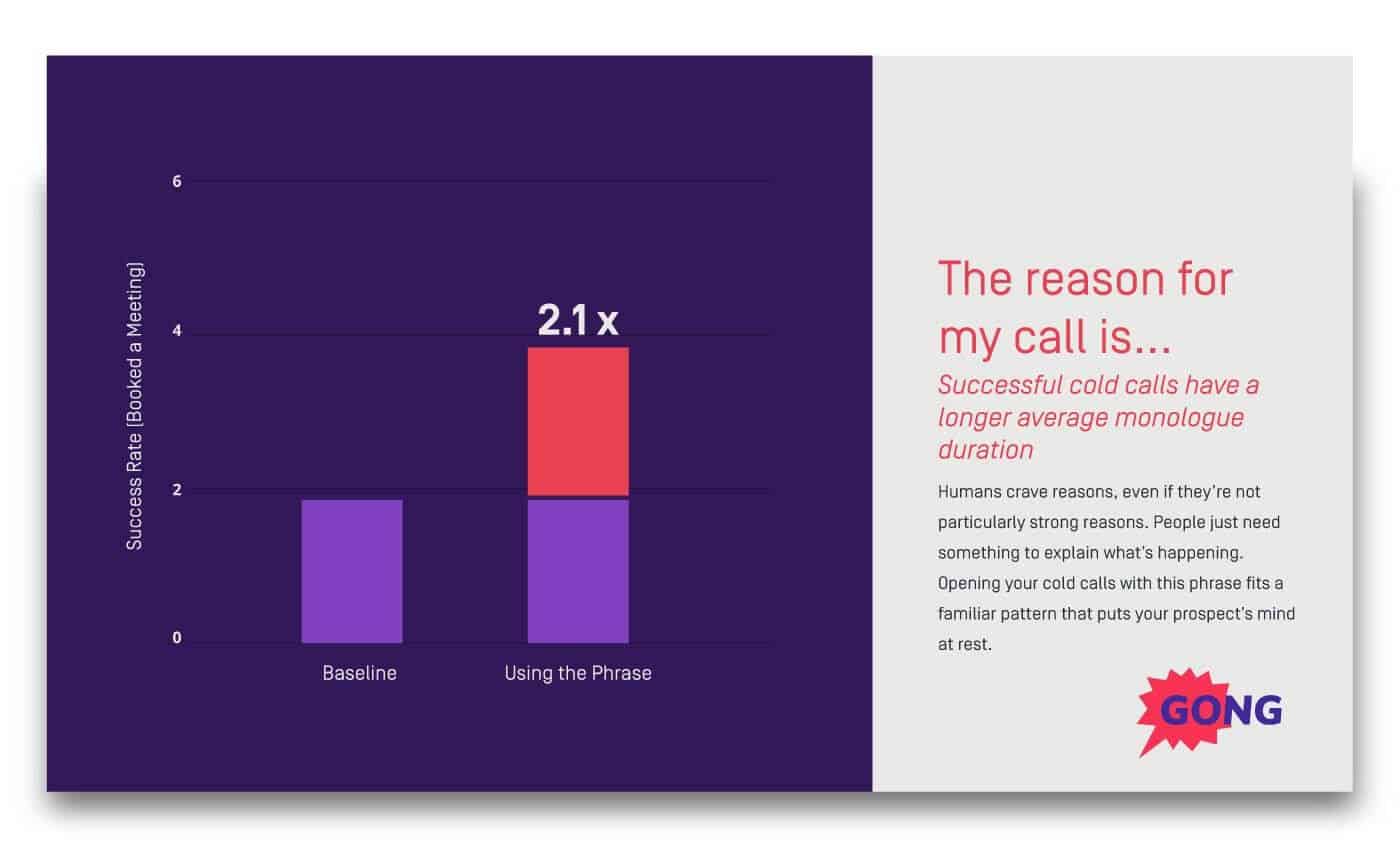
People want to know why you are calling them, even if it isn’t important to them. Here is what your cold call script could look like so far:
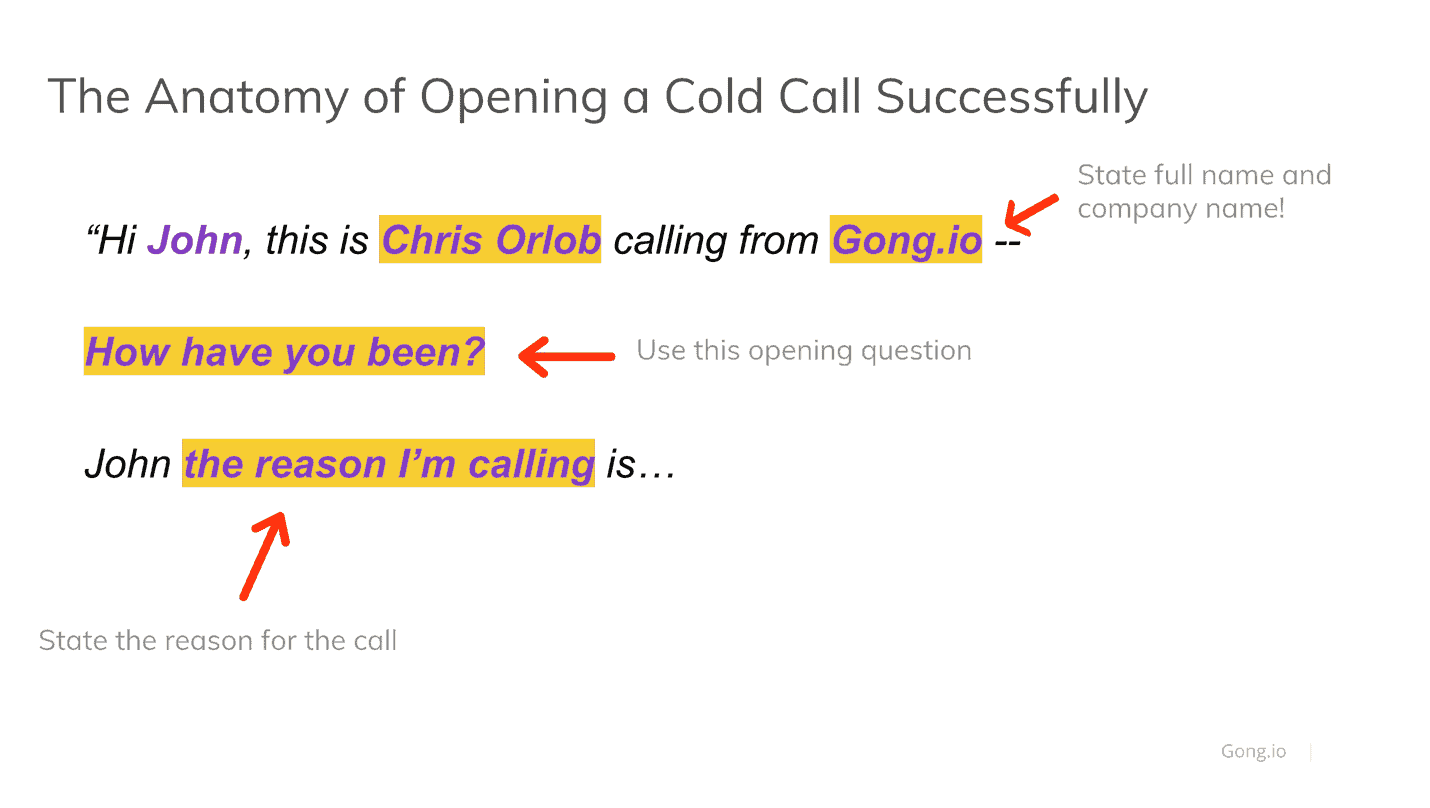
5. You aren’t calling to qualify, you are calling to sell a meeting
“Listen twice as much as you talk” doesn’t apply to cold calls. A cold call isn’t about discovery, it’s about selling a meeting. In fact, the ratio for successful cold calls is higher when you talk than when you listen:
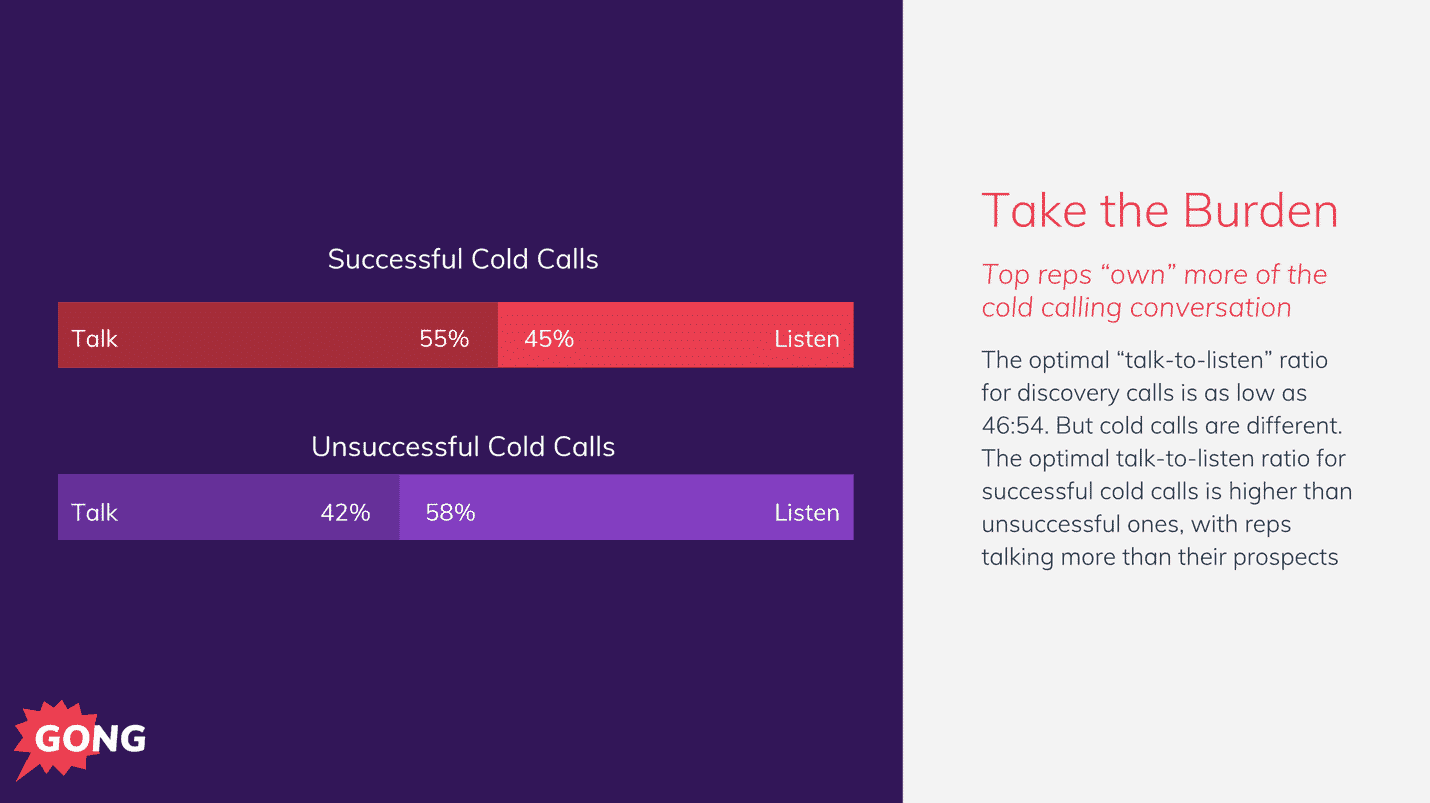
Your job is to sell the person on the line on “why they should attend the meeting”. You can start by asking about their “top strategic priorities” when booking the meeting. Have you ever tried asking “What are your top priorities…” at the start of a sales call? You probably didn’t get much of an answer. Focus on selling the meeting, not on asking an in-depth question your sales director would be proud of.
6. Talk about a competitor: the pitch
If you’ve followed the previous tips, you’ve secured a platform to make your presentation: it’s time to sell the meeting. Successful cold calls almost always involve making a pitch like this one:
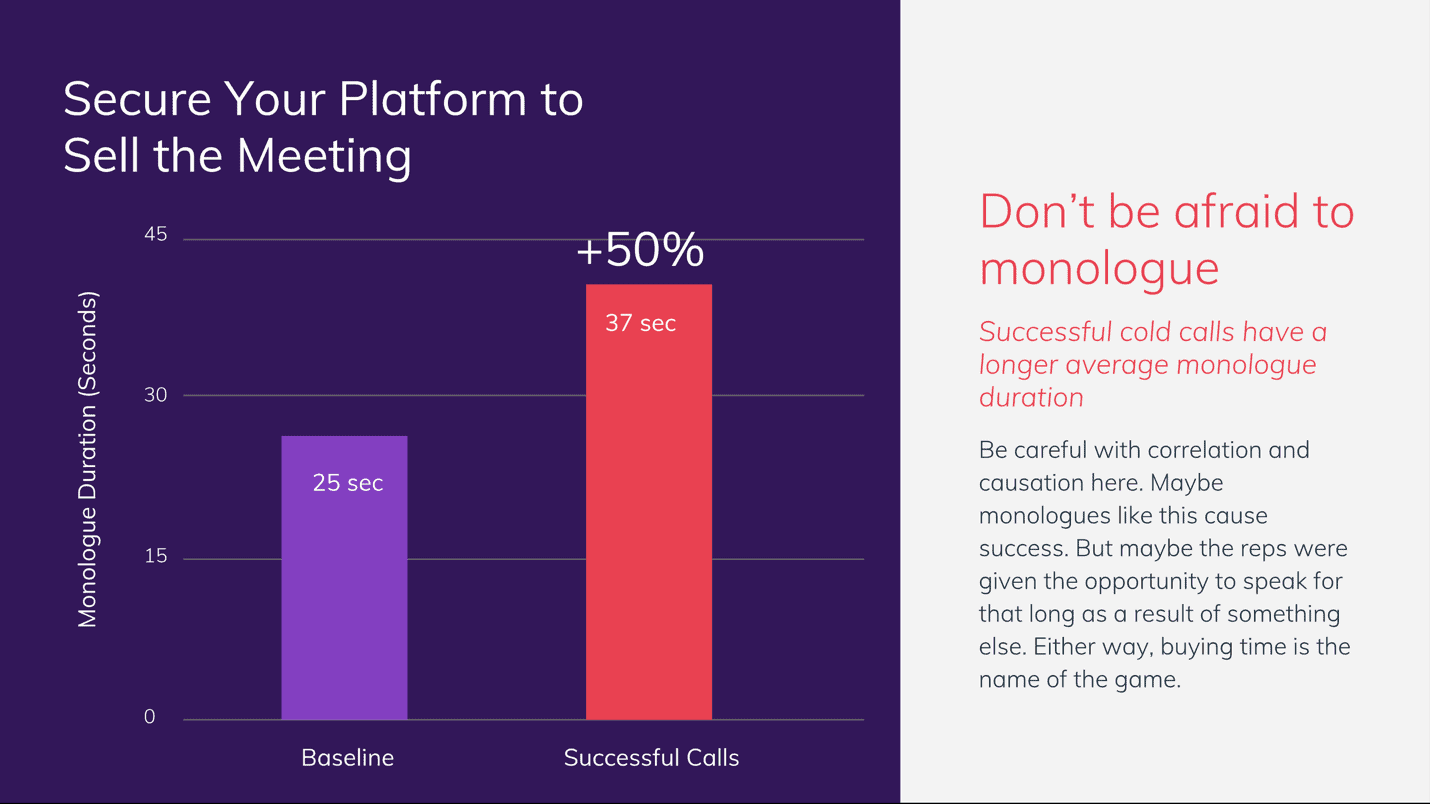
“Pitch” seems to be a forbidden word in sales today. But there is a time and a place for it. So what should you say during the cold call? You have to sell THE MEETING.
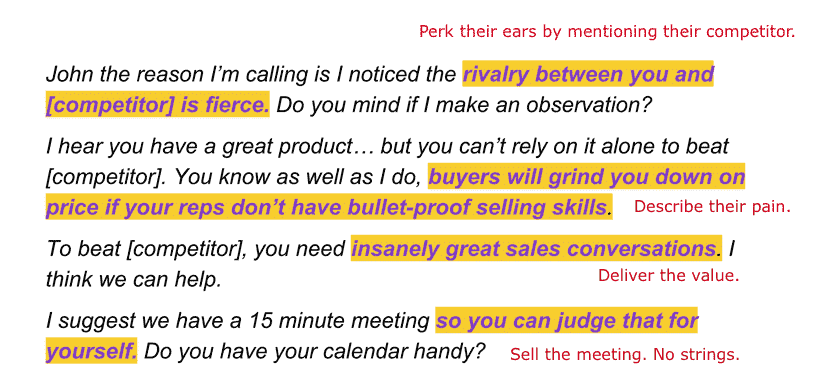
Let’s break it down. If you talk about their competitor, you’re sure to get an attentive ear. Then all you have to do is highlight their main pain points. That’s enough to sell the meeting (they simply want to know more). To top it off, you can finish with the famous line: … You can judge for yourself. THAT is “selling the meeting”. Note that there was no mention of the product/service.
7. Don’t be afraid to talk
We’ve covered plenty of tips to help you as a sales rep. So what should be going on in your prospect’s mind? The average length of a prospect monologue (how long you can get the prospect to talk without interruption) on successful cold calls is only 3.5 seconds. On unsuccessful cold calls, it lasts 8 seconds:
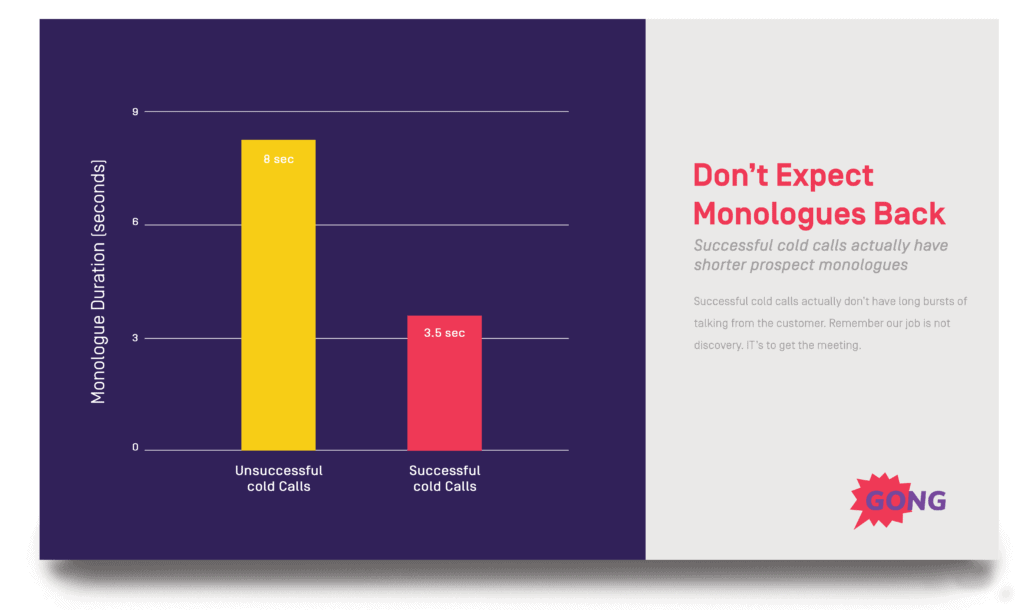
As we mentioned earlier, the job of a cold call is to sell the meeting. And to make a good pitch, a few well-placed discovery questions can help engage your potential customer. The research you’ve done before the call, combined with a few lean questions, is your best chance of getting there.
8. Give your call some rhythm
A strong sign that a cold call is going well (and that you’ve asked good discovery questions) is the rhythm of your conversation. While your cold call will probably start with a few monologues, the verbal back-and-forth between you and your prospect should speed up gradually as the call goes on. In other words, effective cold calls start as a pitch and slowly turn into a dialogue. Successful cold calls have 77% more speaker switches per minute than the ones that fail:
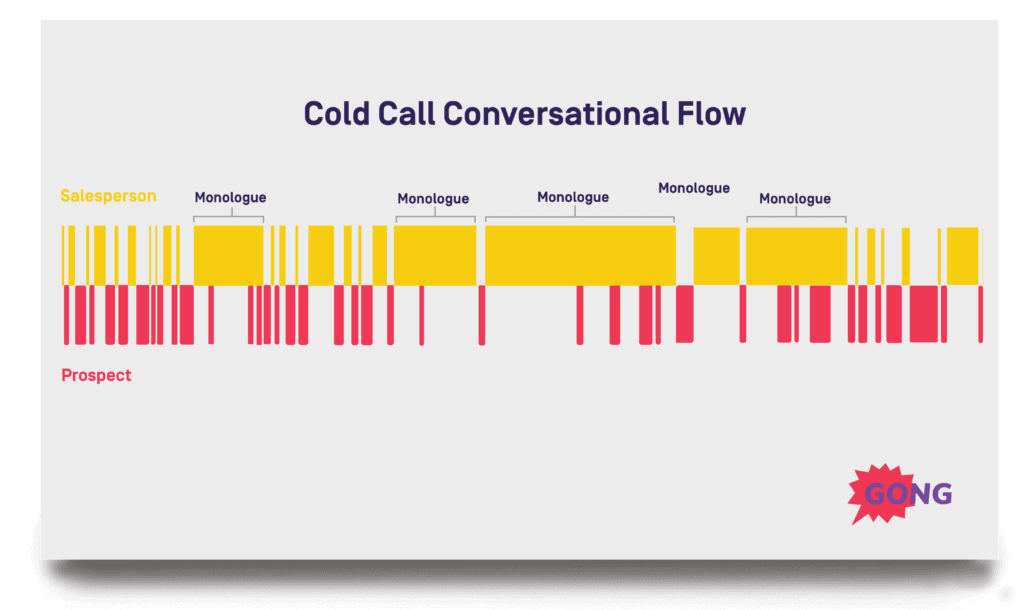
At this point, you know you’ve got the customer interested enough (in very little time) for them to engage you in a dialogue. They have questions you’ll need to answer. You have to overcome objections.
9. Use inclusive language
You shouldn’t use “I”, especially since you are speaking on behalf of a team. When you contact a potential customer for the first time, see yourself as the biggest “player” on the whole team. Cold calls that include inclusive language are generally more likely to lead to a follow-up. Take the example of “we” versus “I”.
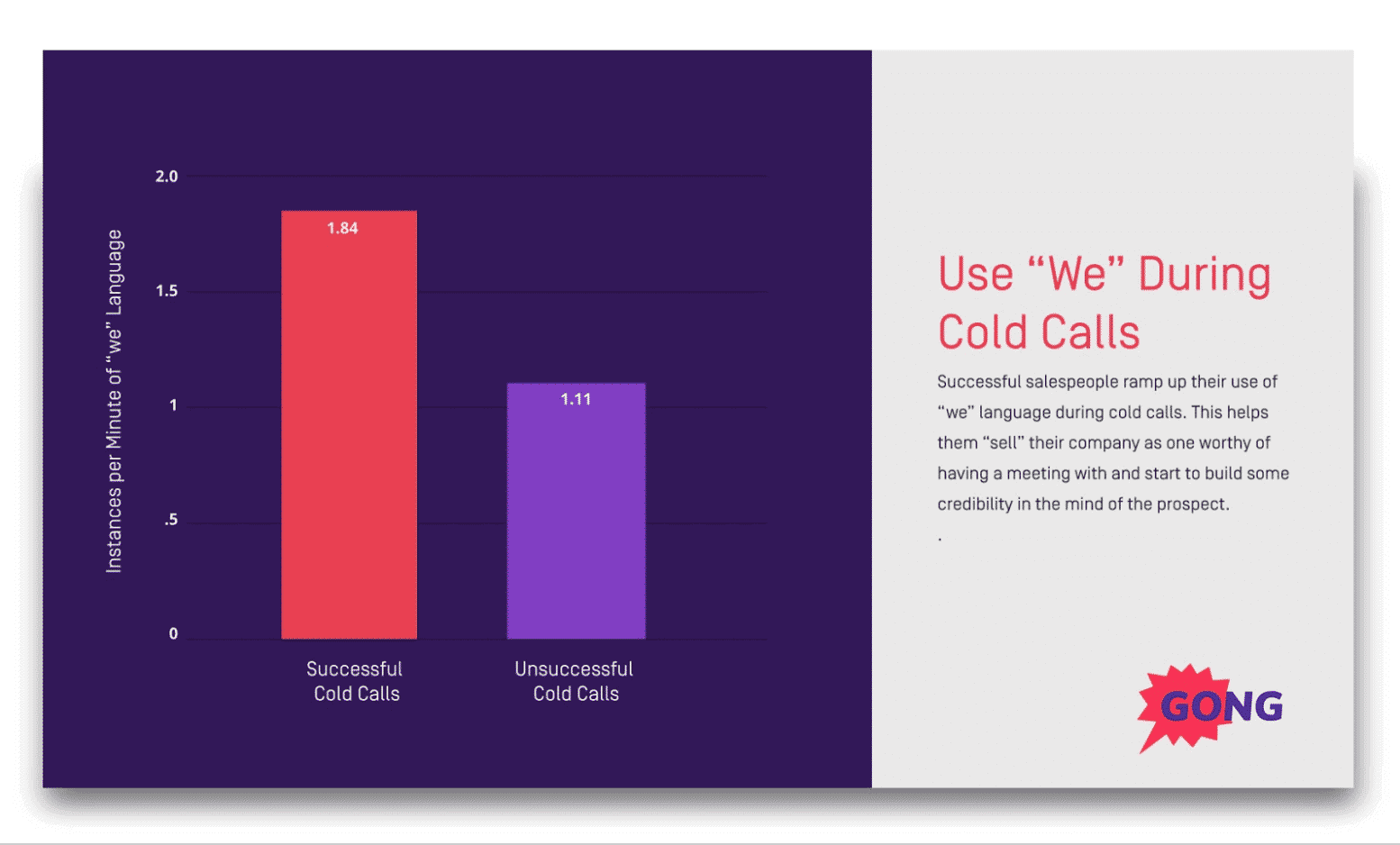
On average, the We / I ratio (the number of times “we” is used in a call divided by the number of times “I” is used) is 35% higher in successful cold calls than in unsuccessful ones. The same can be said for “our” versus “my”. According to Gong.io’s analysis, the Our-My ratio (the number of times “our” is used in a call divided by the number of times “my” is used) is 55% higher in successful cold calls. Besides “we” and “our”, successful conversations also included inclusive words like “ourselves”.
Part 2: running the sales call through to the close
Phone prospecting, a must in B2B, is a stage that takes preparation and method. The way you handle your calls with prospects has a decisive impact on your sales effectiveness. In this part, we offer 9 tips (in the form of steps) to be more effective in your phone prospecting and generate more sales.
Depending on the sales cycle, the prospecting call aims to land a meeting, as in the first part, or to close the sale over the phone, as in the steps that follow.
Find the right providerNeed to outsource your prospecting? Find the provider that matches your real needs.
Find a provider
1. Make sure you have a decision-maker on the line
To start, you need to make sure you are talking to the right person. Is the person on the line the one best placed to understand the nature and value of your product? Do they have enough decision-making power within the company? There is no point wasting time talking to someone who won’t have a say in the buying process.
Also remember to ask your prospect whether they are the only decision-maker in the company or whether several people are likely to be involved in the purchase decision. It is harder to close a sale when you have to convince several decision-makers in the organization.
If you want to become more effective in your phone prospecting, you need to address these questions from the start of the conversation.
To put every chance on your side and convince your prospect, adopt a friendly tone and highlight the solutions your product / service brings to the problems the company is facing.
2. Get your prospect to become aware of the problem
This is one of the most important points. You need to identify the specific problems faced by the person you are talking to, by asking the right questions and paying attention to their answers and behavior. The idea is not only to learn your prospect’s needs, but also, and above all, to get your prospect to become aware of the problems they face. It is easier to convince a prospect of the value of your product if you first manage to convince them they are facing an issue that needs solving.
With that in mind, ask your prospect for all the necessary information about the company, its business, its context, current projects and of course its current issues. Make sure you ask questions that call for the answers you want your prospect to give, that is, answers like: “I don’t know how to handle this problem”, “I’ve never had to deal with this kind of issue”, “I’ve never had to do that in the past”… If you get an answer like this from your prospect, you’ve clearly scored points. It will then be up to you to show that you are the right person for the job, and that you have the solution to your prospect’s problem.
Read alsoDiscover 20 high-potential lead generation techniques.
3. Show the gain that solving the problem would bring
Before making your prospect understand that you have the solution to the problem they have just fully realized, you need to show them how important it is to solve it. You need to insist on how truly problematic your prospect’s problem is (so to speak), but above all show them all the benefits they could get from solving it. Between becoming aware of a problem and deciding to fix it, there is sometimes a distance you need to shorten, and even remove.
How? We recommend using the weapon of storytelling. Tell your prospect about an experience you had with one of your customers, or in your personal life, that resonates with your prospect’s problem. Tell a story that shows the inconvenience and difficulties that came from leaving the problem unsolved.
4. Create a sense of urgency
You need to go further: not only convince your prospect that their problem must be tackled head-on and solved, but that it must be solved quickly. Explain, for example, that your prospect is losing hundreds (thousands, tens of thousands…) of euros every day (week…) by letting the problem drag on. Your pitch must rely on what you know about the company. The more personalized and tailored your sales pitch, the better your chances of convincing your prospect and converting them into a customer. If you can give the prospect concrete figures on what their company loses by not solving the problem, you very clearly score points.
Talk to your prospect about what their competitors are doing and the risk they run if they change nothing on their side. You need to convince your prospect to act as quickly as possible.
5. Present your offer
Only once all the previous tips have been applied can you start presenting your offer, your product or service. One of the secrets of successful phone prospecting is to never start rolling out your sales pitch before you’ve made your prospect realize they had an urgent problem to solve. Your offer meets needs. If those needs (and how important they are) aren’t clear in the prospect’s mind, you’ll have little chance of closing the sale. Following this order will also let you present your offer in a more impactful and personalized way, by stressing the benefits that resonate with the prospect’s problems.
A few tips at this stage:
- Don’t oversell your product.
- Avoid going too far into the details (so you don’t create confusion in the prospect’s mind).
- Throughout your presentation, make sure your prospect understands what you are telling them. Ask them what they think, whether they have questions, whether some points seem unclear. If the person on the other end of the line only answers with “Ok”, “sure” or “yes, that sounds interesting”, it isn’t necessarily a good sign. Chances are they haven’t really understood the value of your product.
6. Insist on the value of your offer for the prospect
You need to insist on the concrete (and, if possible, quantified) benefits of your offer’s features, more than on its characteristics. Once you’ve presented your offer, give a short recap. Bring the prospect’s problem back to the center of the discussion and put it in perspective with the offer you’ve just presented. It isn’t just about showing how your product or service is beneficial for the prospect, but also and above all about showing how it is beneficial for them, given their very specific, concrete problem. Here again, don’t hesitate to use storytelling, with analogies or real or realistic examples.
Read alsoDiscover the complete guide to lead qualification.
7. Try to close the sale
We won’t teach you anything by pointing out that the goal of phone prospecting is to turn prospects into customers. Once all the previous steps have been completed, it’s time to try to close the sale. A few tips for this step:
- Explain that different partnership formats are possible. Go through them in detail.
- Present your different offers and their respective prices, starting with the basic offer, then the intermediate offer and finally the most complete one.
- Advise the prospect on the offer that seems best suited to them. In general, it is advisable to steer the prospect toward the intermediate offer.
8. Listen to objections (and counter them)
Almost inevitably, when it comes to closing the sale, the prospect will raise objections. This is when all the doubts, fears and budget constraints come out into the open and are voiced by the prospect. You need to listen to these objections and take the time to give relevant answers. To be effective, prepare in advance a document listing all the possible objections, with how to counter them. This will let you easily counter every objection during your calls. It isn’t necessarily about proving that the objections are unfounded (that isn’t always possible anyway), but about putting them into perspective.
Read alsoDiscover how to build a lead scoring strategy.
9. Close the sale or schedule a new meeting
You’ve answered all the objections raised by the prospect. Now it’s time to try again to close the sale. If you feel the prospect isn’t ready to sign yet, the best solution is to offer another meeting and schedule it (day, time slot). Invite the prospect to do the necessary research on their side and to prepare their questions ahead of the second meeting. Be frank with the prospect and tell them politely that, next time, you’d like the meeting to end with either a “yes” or a “no”.
This 9-step phone prospecting process is both simple and effective. We hope it helps you close more sales!
The questions we get over and over.
Should you ask “Did I catch you at a bad time?” at the start of a call?
No. According to Gong.io’s analysis, opening a call with “Did I catch you at a bad time?” makes you 40% less likely to book a meeting. Calls that opened with this line had a success rate of 0.9%.
What opening line should you use for a cold call?
According to data from 90,380 cold calls collected by Gong.io, “How have you been?” achieved a success rate 6.6 times higher than the baseline. Stating the reason for the call from the start also increases the success rate by 2.1 times.
How long does a successful cold call last?
Successful cold calls are almost twice as long as unsuccessful ones. Once the buyer has picked up, you have 5 seconds to win 5 minutes.
When should you present your offer during a prospecting call?
Only after checking that you are talking to a decision-maker, getting the prospect to become aware of their problem, showing the gain of solving it and creating a sense of urgency. Starting by rolling out your sales pitch reduces your chances of closing the sale.
How should you respond to the prospect’s objections?
By listening to them and taking the time to give relevant answers, using a document prepared in advance that lists the possible objections and how to counter them. The goal isn’t necessarily to prove they are unfounded, but to put them into perspective.
What if the prospect isn’t ready to sign?
Offer them another meeting and schedule it, invite them to prepare their questions, and tell them politely that this second meeting will have to end with a yes or a no.


What the community says.