



- AI often remains at an exploratory stage in sales teams: the challenge is to move to real industrialization.
- By analyzing sales history and customer behavior, AI produces forecasts that help spot at-risk deals and allocate resources.
- AI lead scoring assigns each lead a predictive score, so efforts focus on the hottest prospects.
- Dynamic pricing and product recommendations rely on the same customer data: profile, purchase history, behavior.
- In reporting, AI consolidates CRM data and answers sales reps’ questions as a conversational assistant.
A good share of companies are aware of the potential of Artificial Intelligence (AI) to optimize B2B sales processes. Good!
But while many have already experimented with AI solutions, few companies have truly structured and industrialized their approach. AI is still largely at an exploratory stage, if not a “tinkering” one, without translating into a rational integration into the workings of the sales organization.
Yet from sales forecasting to automated reporting, through product recommendations and route optimization, AI use cases are many and touch every facet of B2B sales.
This article reviews 9 concrete applications of AI, 9 ways to move from experimentation to real industrialization of AI in the sales function.
1. Using AI to forecast sales
Prediction is one of the major fields of application of AI. With the progress of artificial intelligence, it is becoming possible to forecast sales with an increasingly satisfying level of accuracy.
The principle is simple: by analyzing sales history, customer behavior and plenty of other signals from the data, AI can detect recurring patterns and extract predictive trends from them. Applied to the company’s data, these models deliver fairly reliable projections of upcoming sales results, in the short or medium term.
The benefits are many for sales teams and management. For example, it lets you adapt sales tactics to the forecasts, optimize resource allocation, identify at-risk deals…
Solutions like Salesforce’s Sales Cloud natively include these predictive analytics features, based on the CRM giant’s in-house AI: Einstein AI. But, of course, most CRM software vendors have joined the AI race.
2. Setting up dynamic pricing with AI
How do you make sure the price offered is always the right one, the one that maximizes sales without eroding margins? Here again, AI can help.
AI-based dynamic pricing algorithms can analyze in real time a multitude of factors that influence the purchase decision: the customer’s profile, their transaction history, demand for the product, competitors’ prices…
From this data, they recommend the best price for each transaction, and can even adjust prices automatically on digital channels.
The result: continuously optimized pricing that adapts to each customer and each situation. This lets companies become more competitive while protecting their margins. Sales reps can focus on the customer relationship, relying on smart pricing recommendations.
3. AI for customer segmentation
AI can also be used in B2B sales to generate a finer and more relevant customer segmentation.
How? Again, through data and its large-scale analysis. Artificial intelligence can analyze vast volumes of customer data and go beyond the classic, sometimes basic, criteria used in segmentation. Buying behavior, digital interactions, responses to campaigns: every signal is analyzed to detect subtle similarities between customers and bring out high-value segments or “micro-segments”.
AI paves the way for hyper-segmentation and ultra-personalized sales approaches. Hyper-segmentation makes hyper-targeting possible, which lets companies optimize the effectiveness of their actions and build more relevant relationships with each customer.
Discover Salesforce’s AI for freeSalesforce is today the CRM offering the most B2B sales features based on artificial intelligence. All the use cases presented in this article are handled by “Einstein”, the name of Salesforce’s AI. Want to learn more about Salesforce’s AI capabilities? The vendor offers a free demo.
4. Using artificial intelligence for lead scoring
Not all leads are equal. That is why sales forces need to qualify them quickly and prioritize actions. The problem: with the multiplication of interaction channels, it becomes hard to get a complete view of each lead. How do you find your way?
AI provides an effective answer with new-generation lead scoring models. Their principle: automatically analyze a wide spectrum of data on each lead (demographics, firmographics, online behavior, engagement…) to assess in real time their level of engagement and propensity to buy.
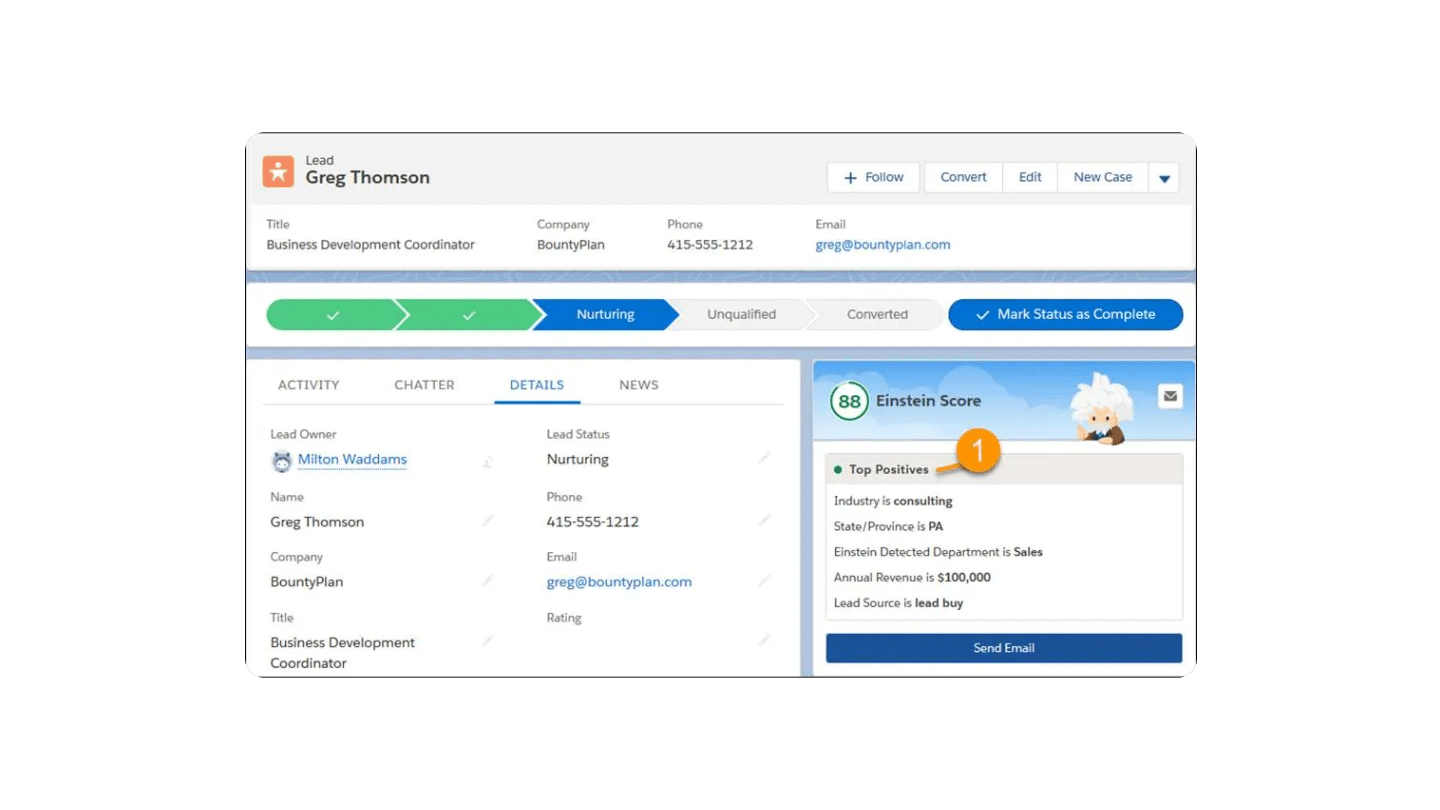
Each lead is thus assigned a predictive score that objectively reflects its potential “value”. Lead scoring lets sales teams focus their efforts on the hottest prospects, those that require quick action.
5. AI chatbots, the new assistants of sales reps
Chatbots have made huge progress in recent years thanks to artificial intelligence.
As you probably already know, these conversational agents use natural language processing (NLP) and machine learning technologies to analyze customer messages, grasp their context and intent, and then build suitable answers by drawing on a knowledge base. All of it smoothly and instantly, as in a natural conversation.
The use cases of chatbots in B2B sales and CRM are many: product support, appointment booking, lead qualification, personalized recommendations…
Chatbots can help automate a number of tedious tasks. Not only do they free up valuable time for sales teams, they also help improve the customer experience by offering 24/7 service and immediate answers.
Going further on AI applied to CRM / B2B sales
6. AI to optimize sales reps’ routes and schedules
For field sales reps, route optimization is one of the big challenges. How do you organize your trips efficiently, taking into account business priorities and time constraints? A complex problem, where AI can make the difference.
AI-based route optimization solutions rely on advanced algorithms that can process a multitude of parameters in a few seconds: customer locations, appointment priority, distances, travel times, reps’ availability… Crossing all this data generates the optimal schedule, the one that maximizes the number of visits while minimizing travel time.
For sales reps, this means a significant efficiency gain that lets them focus on the customer relationship rather than on logistics. It is also a sales performance lever, since it lets them see more customers and seize more opportunities.
7. Using AI for personalized product recommendations
Product recommendation is one of the major levers for personalizing the sales relationship. Helping customers find the product that suits them is not only a B2C issue, it is also true in B2B, obviously.
That is where AI recommendation engines come in. Their job is to analyze each customer’s behavior and preferences to suggest the most relevant products at the right time.
How? Once again, by relying on machine learning algorithms that can process vast volumes of customer data: purchase history, browsing behavior, interactions with the brand… This data provides as many signals for building a precise profile of the customer’s tastes and needs.
With this knowledge, the system can then generate ultra-personalized recommendations, whether complementary products, new categories or targeted promotions. All of it automated and at scale, across every touchpoint: website, mobile app, email…
Major CRM players (starting with Salesforce) now include these technologies in their solutions, whether for B2C or B2B sales.
8. AI for customer knowledge
Knowing your customers well is a prerequisite for any effective sales strategy. But with the multiplication of interaction channels and data sources, it becomes hard to get a unified view of each customer. That is where AI can help companies step up their management of customer knowledge.
AI-based Customer Intelligence solutions can collect and analyze customer data from multiple sources: CRM, customer service, social networks, surveys…
Every interaction, every piece of feedback is turned into an actionable insight.
AI consolidates all this information to build a 360° view of each customer, with a fine understanding of their profile, preferences, pain points…
This use case is no surprise: AI is first and foremost data analysis. Which brings us to the last use case in this selection.
9. AI to step up sales reporting
Reporting is often seen as a time-consuming task for sales reps and their managers. Collecting the data, consolidating it, analyzing it, etc. That is all time spent away from the field and from customers.
With AI, it is possible to automate a large part of this work, while making it more relevant.
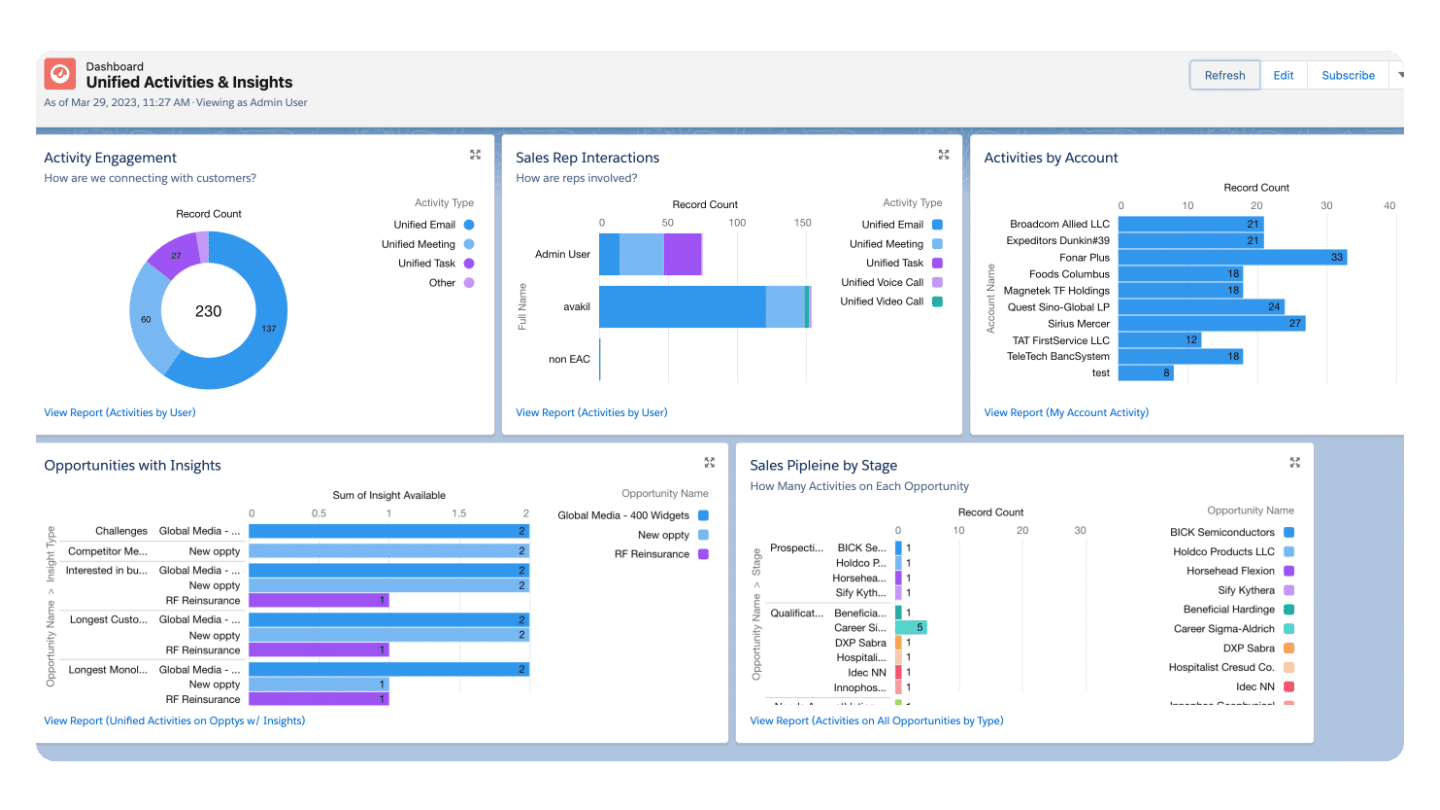
AI-based reporting solutions run a complete analysis of the data available in your source systems (starting with the CRM) to:
- Offer a unified view of sales performance.
- Answer sales reps’ questions, in the form of conversational assistants.
The result: more complete, more reliable and above all more actionable sales reports. Every rep, every manager receives personalized insights based on their goals and scope, which then helps them make better-informed and faster decisions. AI becomes a kind of copilot for sales effectiveness.
Artificial intelligence even goes further by detecting key trends, opportunities and risks… which brings us back to the first AI use case in B2B sales presented in this article. We have come full circle. And keep in mind that this selection is only a small glimpse of how AI can help improve B2B sales and CRM management processes. The AI revolution, here as elsewhere, is only in its infancy.
Discover Salesforce’s AI for freeSalesforce is today the CRM offering the most B2B sales features based on artificial intelligence. All the use cases presented in this article are handled by “Einstein”, the name of Salesforce’s AI. Want to learn more about Salesforce’s AI capabilities? The vendor offers a free demo.
The questions we get over and over.
How does AI forecast sales?
By analyzing sales history, customer behavior and other signals from the data, AI detects recurring patterns and extracts predictive trends from them. Applied to the company’s data, these models give fairly reliable projections of sales results in the short and medium term.
What is AI dynamic pricing?
Algorithms analyze in real time the customer’s profile, their transaction history, demand for the product and competitors’ prices. They recommend the best price for each transaction, and can even adjust prices automatically on digital channels.
How does artificial intelligence lead scoring work?
The model automatically analyzes a wide spectrum of data on each lead (demographics, firmographics, online behavior, engagement) to assess in real time its level of engagement and propensity to buy. Each lead receives a predictive score.
What are AI chatbots used for in B2B sales?
Product support, appointment booking, lead qualification and personalized recommendations. They automate tedious tasks and offer 24/7 service with immediate answers.
How does AI improve sales reporting?
It analyzes data from source systems, starting with the CRM, to offer a unified view of sales performance and answer sales reps’ questions in the form of conversational assistants.



What the community says.