


- Publish on your personal LinkedIn profile, not on the company page: it is people who carry the brand.
- YouTube is the long-term asset, LinkedIn the distribution engine. Shoot for YouTube, distribute the excerpts on LinkedIn.
- One shoot, ten pieces of content: one batch session, a long piece of eight to fifteen minutes, then three or four short clips per good passage.
- Burned-in subtitles, vertical format, a hook in the first three seconds, and never a YouTube link in a LinkedIn post.
- AI for editing, subtitles and cutting; no avatar or cloned voice speaking in your place.
If you’re reading this article, you already know you should be doing video. So we won’t sell you the obvious. The real problem was never getting started, it’s keeping going past the third video.
The game is changing for 2 reasons (which are not unrelated…):
- Producing has never been so accessible.
- Standing out has never been so hard.
Should you favor LinkedIn or YouTube as a B2B salesperson, marketer or executive? How do you produce enough without losing whole days to it? Can AI really help without turning you into yet another soulless robot polluting newsfeeds (the famous “AI slop” LinkedIn recently cracked down on)?
Here is our take on the subject and the method we recommend to build a personal brand that lasts.
Video & Personal Branding: What has changed today
Let’s start with the breaks, not the generalities. Because most of the content you will find on the subject relies on 2024 recipes, and the algorithms have moved since.
Four shifts, all counterintuitive, change the way to approach video today:
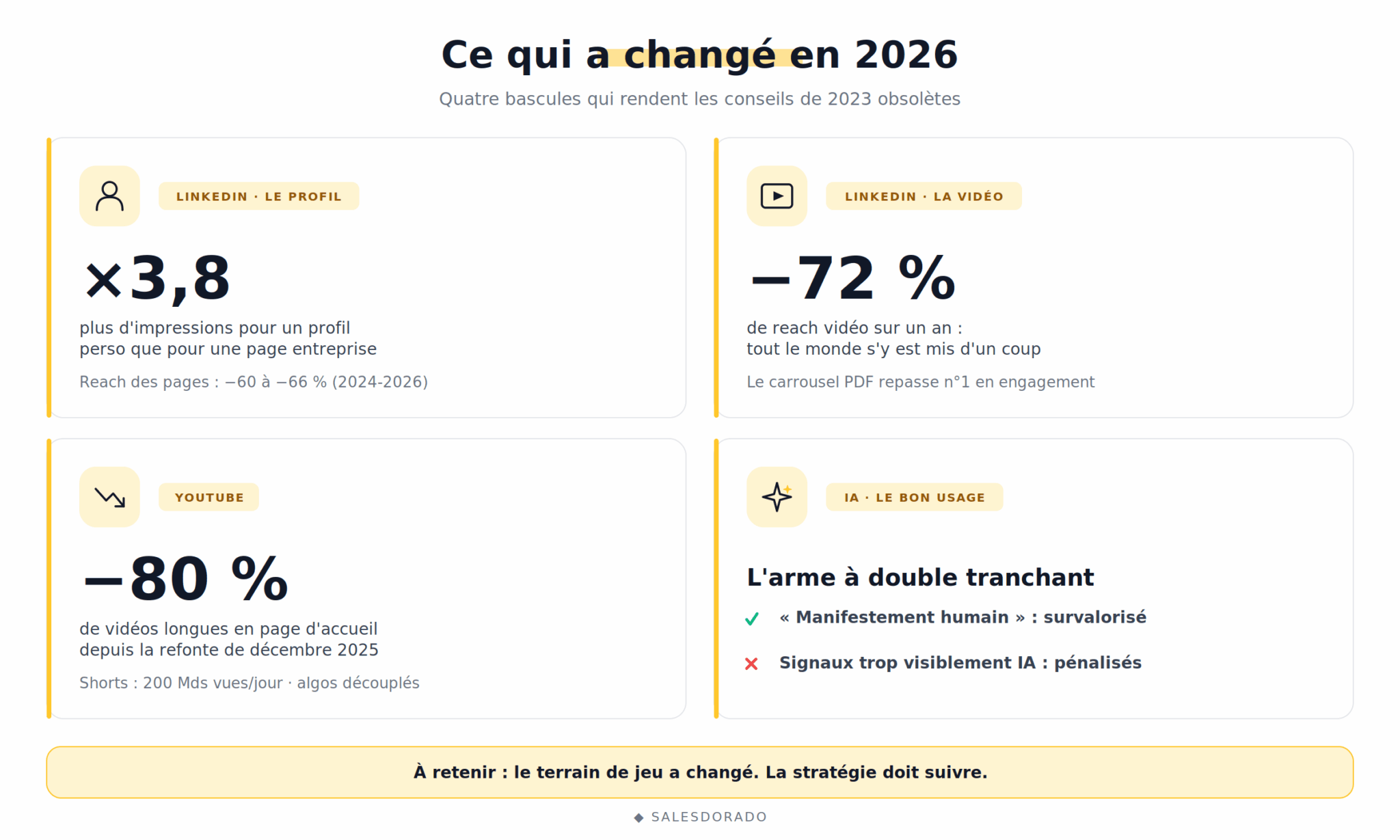
- The personal profile has crushed the company page. On LinkedIn, posts published by executives generate on average nearly 3.8 times more impressions than company pages on identical topics, while the organic reach of those pages collapsed by 60 to 66% between 2024 and 2026. That is the very foundation of personal branding in B2B: it is people who carry the brand. Not logos.
- LinkedIn video is living through a paradox you need to face. The algorithm still overvalues native video and heavily penalizes any outbound link that pushes users off the platform. But at the same time, video reach dropped in 2026, with one analysis pointing to a decline of around 72% in one year, simply because everyone jumped in at the same time. A surprising detail: the PDF carousel is once again the format with the highest engagement rate. The lesson is not to abandon video, but to stop treating it like a religion. It is one building block among others, and what makes the difference lies in the first three seconds and in your consistency.
- YouTube reshuffled the deck in December 2025. The algorithm overhaul cut long-form video slots on the home page by up to 80% and propelled Shorts (200 billion views a day) to the rank of main discovery engine. Above all, a major fact: the Shorts and long-form algorithms are now decoupled. Poor performance on Shorts no longer drags down your long videos, and vice versa. Direct consequence: you can no longer count on long-form alone to be discovered by new audiences.
- AI has become a double-edged tool. LinkedIn now detects and penalizes content with overly visible AI-generated signals and favors what it identifies as “clearly human”. The right use of AI is therefore not to speak in your place. It is to remove every friction around your face and your voice, so that you can publish consistently.
The trap most creators fall intoDon’t confuse “posting video” with “being seen”. Getting the right dimensions and format is necessary, but it is no longer enough. A perfectly encoded video dies within the hour if the first three seconds hold no one. The algorithm tests your content on a small sample and cuts distribution if the hook doesn’t work. Technique is a prerequisite, not an advantage.
These changes are not details. They explain why the advice from two years ago no longer works, and why LinkedIn and YouTube have become the two platforms that AI models cite most as reliable sources. The playing field has changed. Strategy has to follow.
YouTube or LinkedIn? A false dilemma
We are constantly asked which of the two platforms to choose.
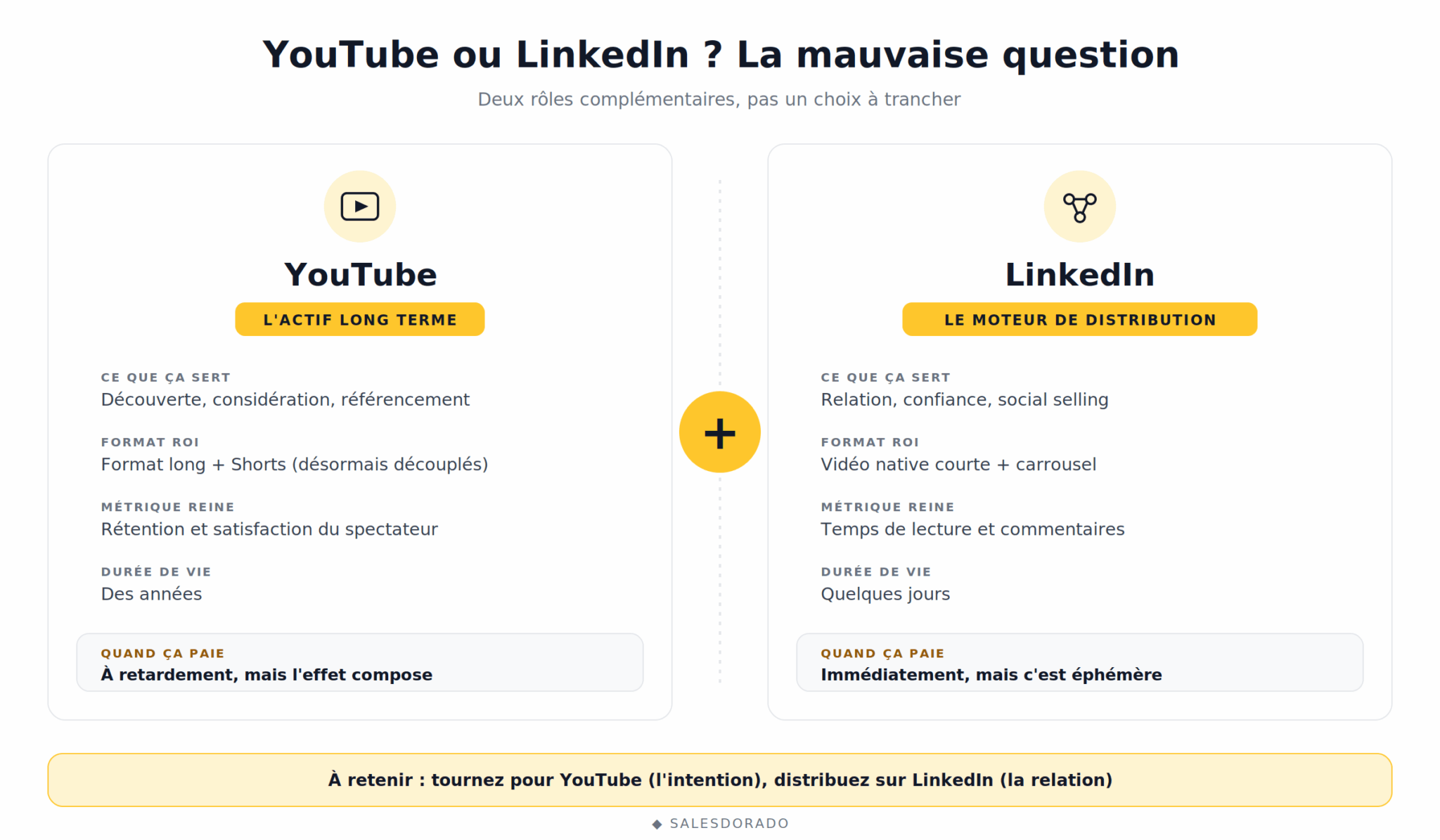
That is the wrong way to frame the problem: you don’t choose between LinkedIn and YouTube. The two platforms are complementary:
- YouTube is your asset. It is a library that works for you for years, the second-largest search engine in the world, the place where buying decisions play out when a prospect is actively trying to understand a subject. A good, well-optimized long video keeps generating views, subscribers and credibility long after it is published.
- LinkedIn is your distribution engine. It is where your decision-makers already are, where conversation happens, where social selling turns an audience into pipeline. Content lives there for a few days, but it generates immediate interactions and relationships.
The numbers back up this split: 70% of B2B buyers consume video during their decision process.
YouTube captures search intent, LinkedIn captures the relationship.
| Criterion | YouTube | |
|---|---|---|
| Role | The long-term asset | The distribution engine |
| What it serves | Discovery, consideration, search ranking | Relationship, trust, social selling |
| King format | Long-form and Shorts (now decoupled) | Short native video and carousel |
| Lifespan of a piece of content | Years | A few days |
| Key metric | Viewer retention and satisfaction | Dwell time and comments |
| When it pays off | Delayed, but the effect compounds | Immediately, but it is short-lived |
What about the other platforms? TikTok, Instagram or Snapchat can serve as a training ground to sharpen your ease on camera, or as a secondary distribution channel if your target hangs out there. But in B2B, they are not your priority ground. The heart of the game remains LinkedIn and YouTube.
Authentic or scalable? The false opposition holding you back
Here we reach the crux of the problem. In most people’s minds, there is a dilemma: either you are authentic, but you last three videos before burning out, or you produce in volume, but it sounds hollow and it shows. This opposition has been holding you back for years. Let’s say it: it is a false opposition.
Here’s why.
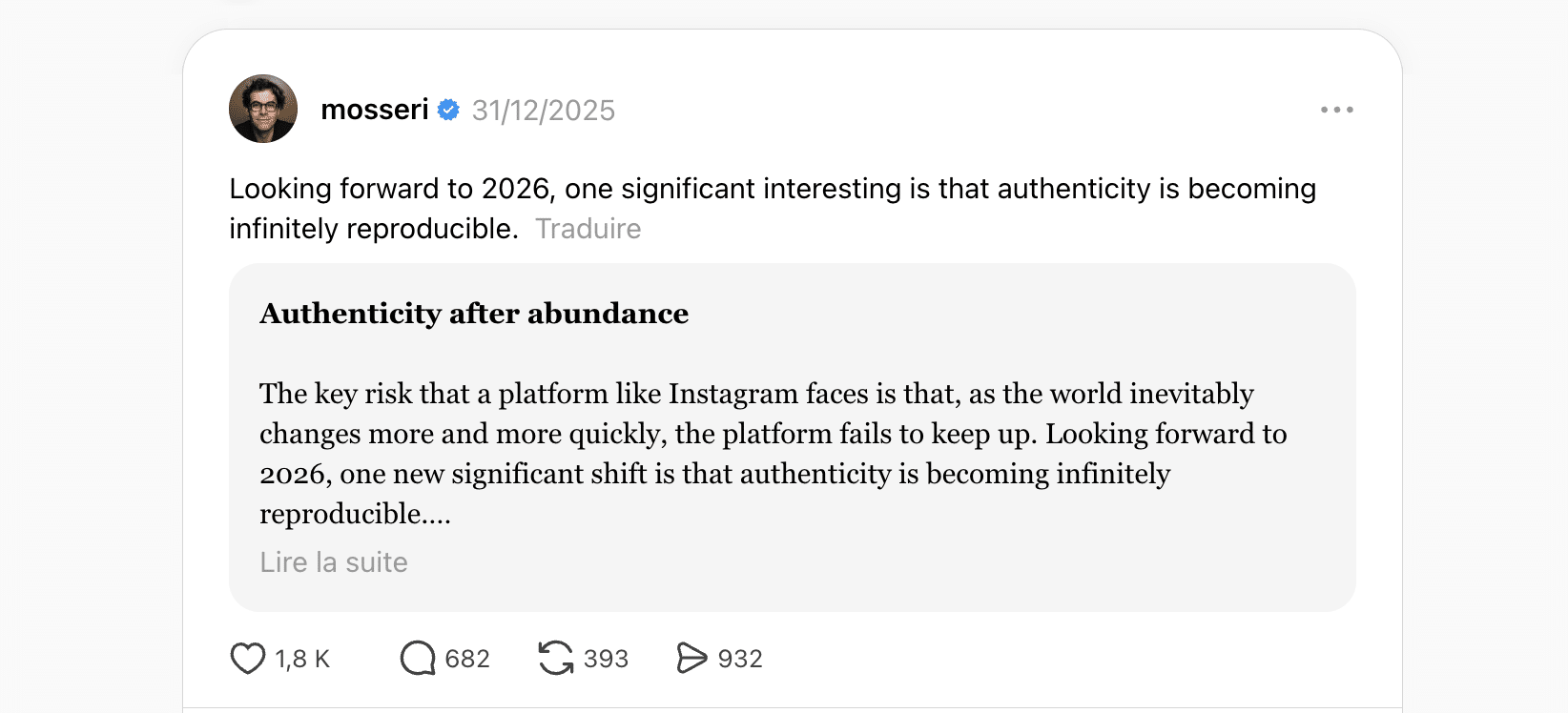
Imperfection has become proof. The head of Instagram himself, Adam Mosseri, put it recently: in a world where everything can be perfected by the machine, imperfection becomes a signal of the real. It says “this is authentic, because it isn’t polished”. This observation is even truer in B2B. As AI-generated text floods newsfeeds, decision-makers grow wary of it. A human face on camera cuts through that wariness like no text can. You can’t fake a face.
When everything can be made perfect, imperfection stops being a flaw and becomes proof of authenticity.
This distrust of polished content is not a pose, since it shows up in the numbers: 73% of B2B decision-makers consider an organization’s thought leadership content more trustworthy than its traditional marketing materials, and 55% (same source) actually use it to vet a provider before contacting them. Embodied video, imperfect but sincere, is the format of that trust.
Volume, for its part, has become necessary. 91% of businesses now use video. Taking part is no longer enough, you have to stand out, and standing out means multiplying angles to find what truly resonates with your audience. It is a quantity logic long reserved for B2C, but it is gradually taking hold in B2B. A single video per quarter does not build a personal brand.
So how do you reconcile the two? This is where AI changes everything.
Used well, it doesn’t manufacture fakes, it rids you of everything that kept you from being consistent: editing, subtitling, cutting, repurposing. You stay in control of the substance, of your face, your voice, your ideas. The machine takes the repetitive work. Result: authenticity and quantity, compatible at last.
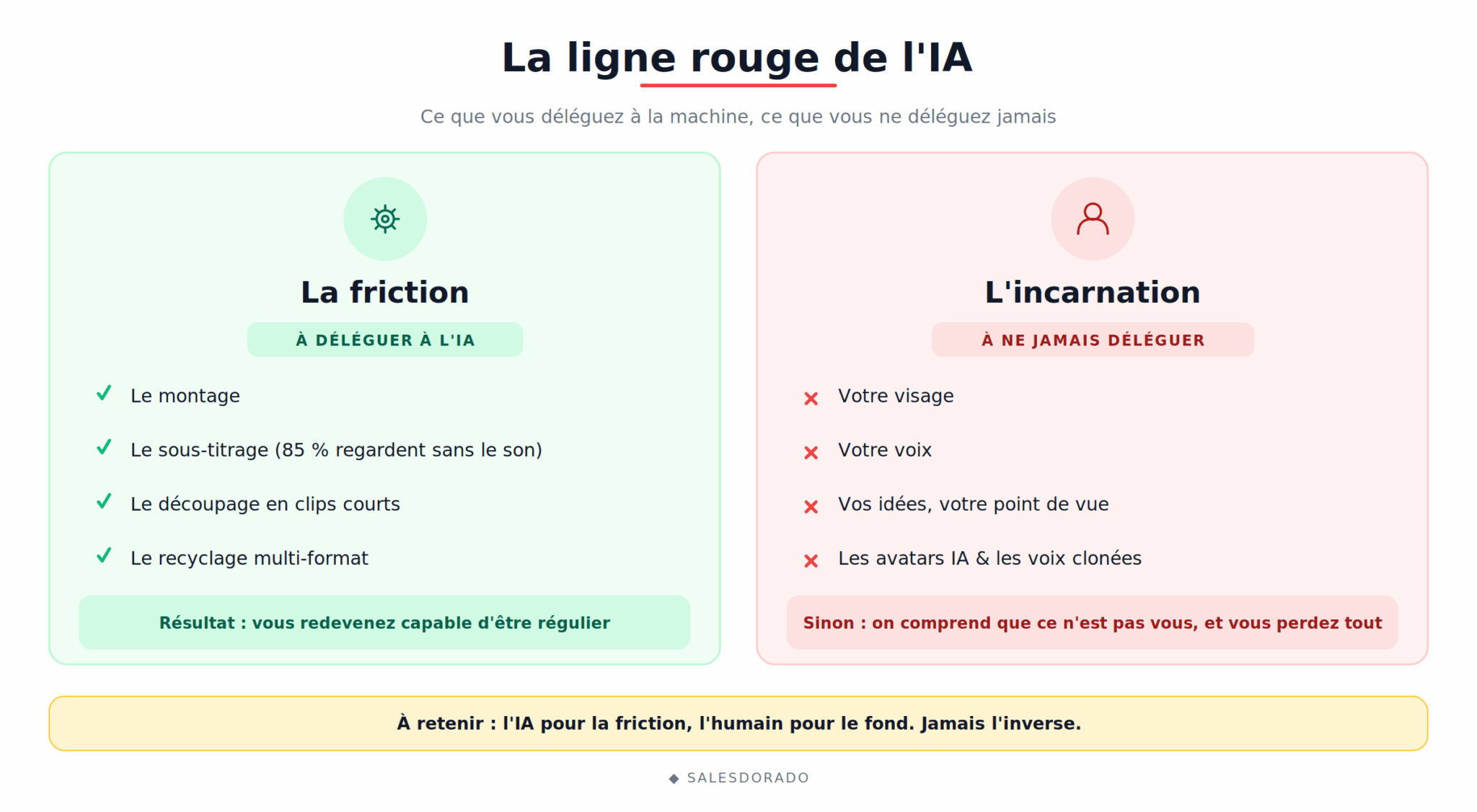
Salesdorado’s takeOur position is clear: yes to AI to remove production friction, no to AI speaking in your place. Avatars that recite a script for you expose you twice over: LinkedIn penalizes content that is too obviously artificial, and above all personal branding rests entirely on embodiment. The day your audience realizes it isn’t really you, you lose exactly what you were trying to build.
The system: one shoot, ten pieces of content
Let’s get concrete.
Consistency is not a matter of willpower, it is a matter of system.
The system that works best today rests on a simple idea: you shoot once, you publish ten times.
Here is the mechanism, step by step:
- Block a shooting slot. Rather than filming a video here and there, record several topics back to back in a single session. That is the batch principle: a single moment of getting into the zone, several pieces of content in the can.
- Shoot a long centerpiece. It is your YouTube asset: an interview, a demo, an eight-to-fifteen-minute stance on a subject you master. It is the raw material for everything else.
- Clean up and edit through text. Today’s tools let you edit the video by editing its transcript, and automatically remove hesitations and silences. A few minutes instead of an evening.
- Cut into short formats. Extract the highlights of your long piece to make YouTube Shorts and native LinkedIn videos. A good two-minute passage becomes three or four standalone clips.
- Dress for mute. Burned-in subtitles (up to 85% of views happen without sound), vertical format and a strong hook in the first three seconds. That is what protects your watch time.
- Distribute in cascade. Your short clips go out on your personal LinkedIn profile and as Shorts on YouTube. Absolute rule: never paste a YouTube link into a LinkedIn post, the algorithm would penalize you. The video must be uploaded natively.
- Feed it back in. A comment that keeps coming up, a question asked several times, and you have the topic of your next long piece. The loop feeds itself.
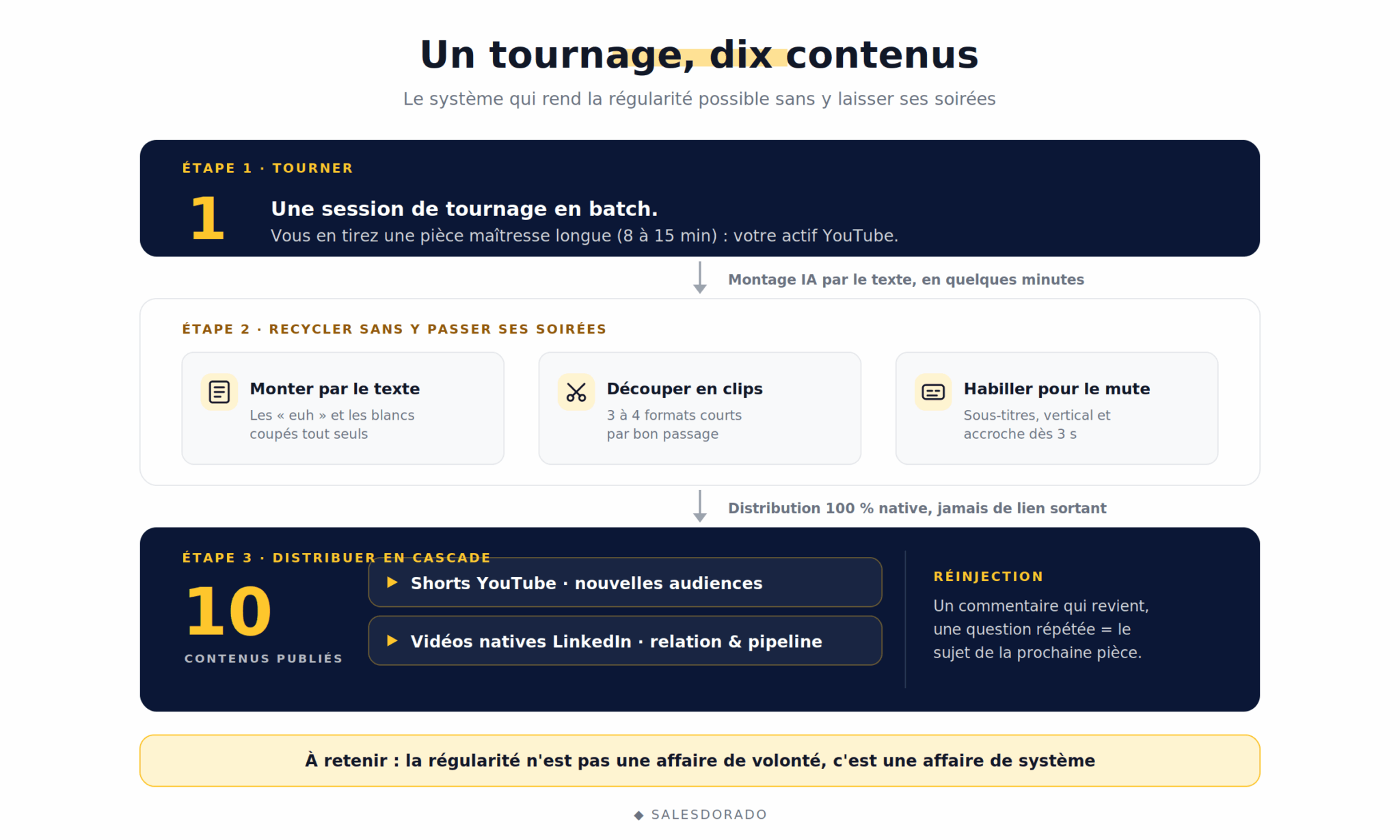
The technical reflexes that protect your reachShoot vertically for the mobile feed, always burn your subtitles directly into the image rather than relying on an imported transcript, polish the hook of the first three seconds and never send the user off the platform in the body of the post. These four reflexes cost little and make a huge difference to distribution.
To script your short formats effectively, our guide to writing LinkedIn posts that perform remains a good foundation.
The AI tools that save you time when building a personal brand through video
We won’t drown you under thirty tools, but give you the right ones for each use.
The guiding principle remains the one we set out above: AI for the friction, the human for the substance:
- To read your script while looking at the camera, Captions.ai offers a smart teleprompter and even an eye contact correction that removes the “read out” feel that gives away the amateur.
- To turn a long video into several short clips, OpusClip and Vizard automatically spot the best moments of a video, reformat them vertically and subtitle them. It is the core of repurposing without spending hours on it.
- To edit without a timeline, Descript lets you edit the video by deleting text in the transcript and erases the “ums”.
- To subtitle, Submagic or the native features of CapCut, which is free, do the job perfectly.
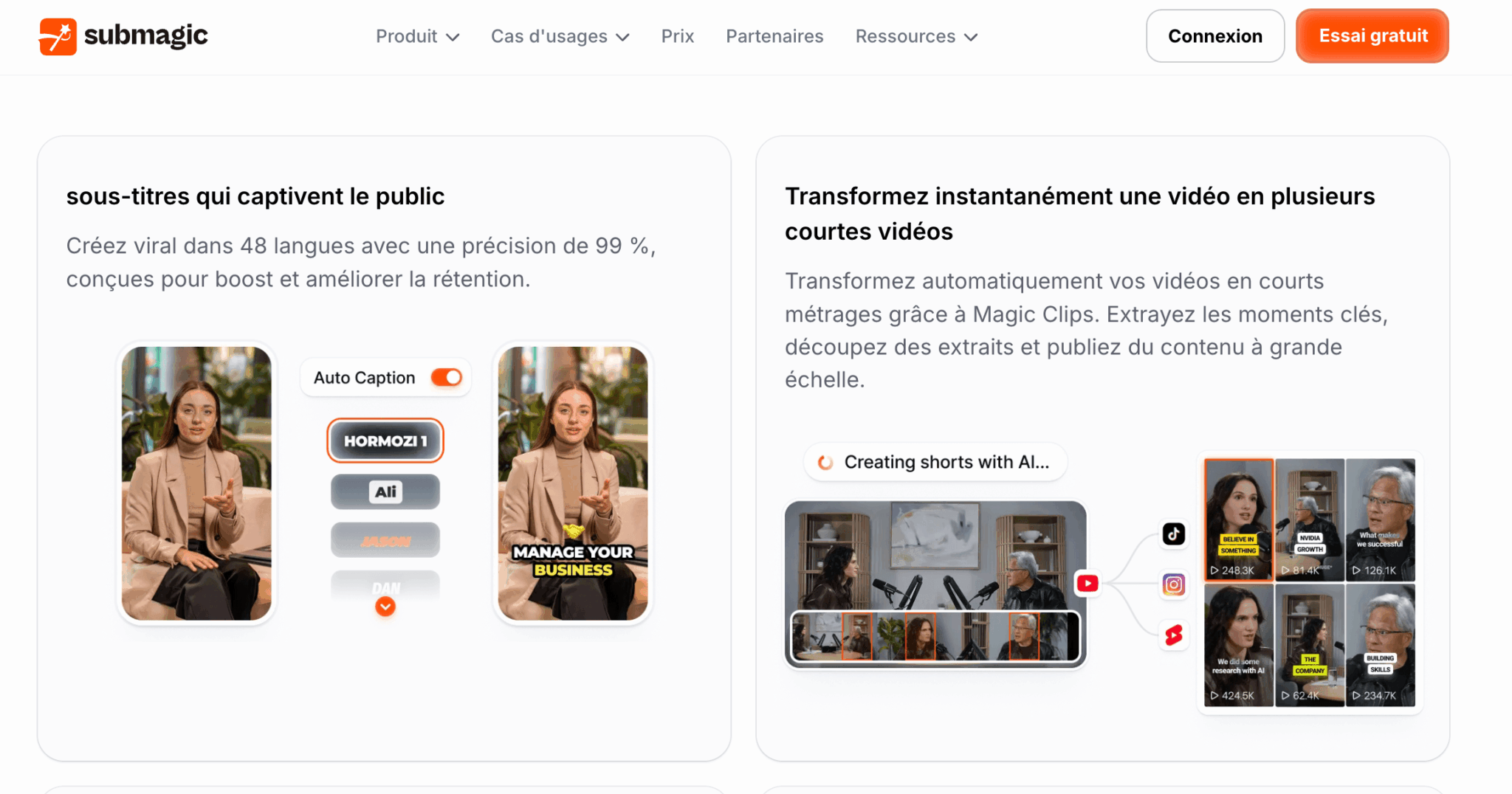
| Your need | Tools | Why it helps |
|---|---|---|
| Reading your script while looking at the camera | Captions.ai | Removes the “read out” feel and keeps eye contact |
| Turning a long video into ten clips | OpusClip, Vizard | Automatic repurposing, without spending hours on it |
| Editing by editing the text | Descript | Cuts hesitations and cleans up in a few clicks |
| Subtitling for sound-off viewing | Submagic, CapCut | Up to 85% of views happen without sound |
That leaves the question of AI avatars, such as HeyGen, which generate a digital version of you able to reel off any script. The technology exists, it is mind-blowing and it is scalable. But in personal branding, extreme caution…
The line not to crossAn avatar or cloned voice speaking in your place is the boundary not to cross. On one side, LinkedIn penalizes content that is too obviously AI-generated. On the other, your personal brand rests on the fact that it really is you, with your hesitations and your gaze. Delegate editing and cutting to the machine. Delegating embodiment is at your own risk.
Also worth readingWhy does an executive who doesn’t speak up become invisible?
When (and with whom) to get support to develop your personal brand through video?
Let’s be honest: the system we just described works on your own, but it has its limits.
An executive with a packed schedule won’t have time to edit their videos, even with AI. A brand aiming for high image quality won’t get there with a smartphone.
And some people simply have no desire to deal with the technical side. In those cases, delegating is rational. The value of good support is guaranteed consistency and moving upmarket without you having to think about it.
A few French providers have specialized in these topics, with distinct approaches depending on your need:
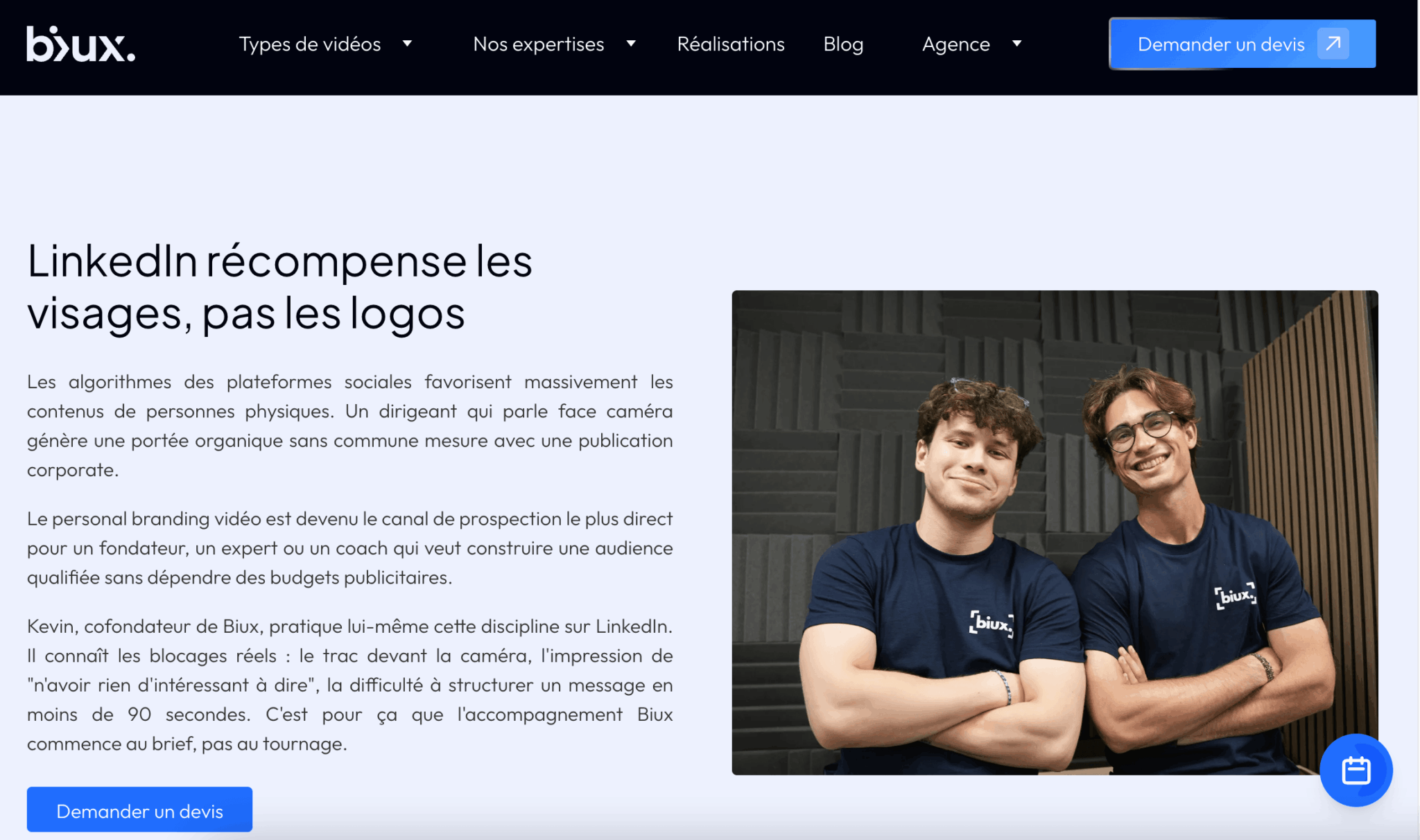
- Biux is a Paris-based video agency positioned on high-end production, strong on LinkedIn content and short formats, with an AI-assisted video offer in the works. For those who want high production quality.
- Teazit offers audiovisual solutions centered on executives speaking out, in an embodied and direct format. A partner we recommend for a CEO who wants to fully delegate the filming.
- Iconic Personal Brand positions itself on executive branding and the personal brand of business leaders. Their team supports you from start to finish.
If you want to widen the field and compare other options, our selection of the best branding agencies will give you a more complete overview.
Where to start this week?
No need to wait until you have understood everything. The effect builds over time, and the only thing that really matters is to start, then keep going.
Here is a plan you can achieve this very week:
- Choose a single topic you master perfectly. Not ten, one.
- Shoot a first long piece with your phone, a lavalier mic and a teleprompter.
- Cut it into three or four short formats.
- Publish on your personal LinkedIn profile, definitely not on the company page.
- Hold on for four weeks before judging anything.
That’s it.
The difference between those who build a real personal brand and the others doesn’t come down to equipment, or to on-camera talent. It comes down to consistency.
Going further
- Our guide to learning LinkedIn
- The tutorial to optimize your LinkedIn profile
- Our method to write posts that perform
The questions we get over and over.
Do you need good equipment to get started?
No. A recent smartphone, a lavalier mic and a bit of light are more than enough. What really kills your videos is not an imperfect image (which viewers tolerate) but bad sound, which makes them leave instantly. Invest in the mic before anything else.
LinkedIn or YouTube first?
LinkedIn for quick traction and social selling, YouTube to build a lasting asset that ranks over time. The ideal is to shoot for YouTube, then distribute the excerpts on LinkedIn. That way you get the best of both logics.
How many videos should you publish per week?
Better one useful video a week, kept up for six months, than five hollow videos published in a burst of enthusiasm. Algorithms now reward depth and consistency, not empty volume. Consistency beats frequency.
Does AI hurt authenticity?
Not if it stays confined to the friction: editing, subtitles, cutting, repurposing. It starts to hurt as soon as it speaks in your place through an avatar or a cloned voice. Your face and your voice remain non-negotiable. They are what builds trust.



What the community says.