



- A typical sales process follows five stages: prospecting, connection, research, product presentation, closing the sale.
- To be effective, it must be customer-centric, clearly mapped out, repeatable, predictable, focused on objectives, measurable and adaptable.
- Rather than applying a single sales methodology, pick from several the good practices suited to your context.
- Start from the last 5 or 10 closed deals to diagnose your current process before changing it.
- Choose a KPI for each stage, for example the average time a prospect spends in the stage.
A sale is the outcome of a process. The way you organize your sales processes has a direct impact on your prospect-to-customer conversion rate, and therefore on your company’s sales performance. The best-performing companies are the ones that manage to evolve and modernize their sales processes continuously.
What are the main stages of a B2B sales process? Which methodologies can help you evolve your sales approach and reach better operational efficiency? How do you build an approach for improving your sales processes? We answer your questions.
What is a sales process?
Let’s start by defining what we are talking about. A sales process refers to the series of stages that runs from identifying prospects to closing the sale. It is the concrete process the company’s salespeople use to acquire new customers. Each stage is an activity in its own right, with its own techniques and methodologies. Here are the classic stages of a sales process.
1. Prospecting
Prospecting is the activity of identifying prospects, that is, individuals or companies likely to be interested in your products. In its prospecting work, the company can use several channels and media: social networks (LinkedIn in particular, in a B2B context), email, phone, conferences and events, internet searches… The company can also prospect through its existing customers, by asking them whether they know people who might be interested in its products.
Before any prospecting work, salespeople must have acquired a thorough knowledge of the products being sold, the target customers (the personas), the industry, the competition…
Going furtherTo become more effective at prospecting, check out the articles we have published on the subject:
2. The “connection”
The second generic stage consists of getting in touch with the identified prospects to collect information about them, identify their needs, their challenges and their objectives, and sort them according to their value for the company. This stage is usually done through a phone call, but you can also use digital tools or set up a face-to-face meeting.
3. Research
As prospects move through the pipeline, the company must try to learn more about them in order to build a more personalized relationship with them and be able to offer them targeted products. The more you know about your prospects, the better you will be able to offer them suitable solutions, and the better your chances of turning them into customers.
During this stage, the salesperson may need to contact other people at the prospect company to better understand its business and its objectives. Some say that, by the end, the salesperson should know more about the company than the prospect does.
4. Presenting the product (the pitch)
This is obviously a stage you cannot skip. At some point, the salesperson has to present the products and services on offer. It is a very time-consuming stage. That is why it comes fairly late in the sales process and is only rolled out for well-qualified prospects.
To be effective, the presentation must be personalized, build on the prospect’s needs and issues, and anticipate possible objections. For this stage, the salesperson can bring along colleagues (engineers, product managers…) to answer the prospect’s more technical questions.
5. Closing the sale
This stage refers to all the activities carried out at the very end of the sales process to get the prospect to buy. The nature of the activities and methods used varies a lot from one company to another: quotes, sales proposals, negotiations, meetings with decision-makers, etc.
The sale is what every salesperson works toward. It is the ultimate goal. The salesperson usually receives a commission on the sale price negotiated with the customer. Once the sale is closed, the customer account moves from the salesperson to a customer success manager.
To be effective, a sales process must be:
- Customer-centric. Buyers have become more powerful, because they are much better informed than in the past and have many options in front of them. You need to build this reality into your processes. You should not insist on the intrinsic qualities of your products but on how well they fit your prospects’ needs, challenges and objectives.
- Clearly mapped out. To be effective, every stage and element of the sales process must be fully understood by all stakeholders.
- Repeatable. Salespeople must be able to repeat the different stages of the sales process in their logical sequence without difficulty.
- Predictable. The flows and results of your sales process must follow a predictable pattern.
- Focused on objectives clearly defined upfront: generating more revenue for the company, increasing salespeople’s productivity…
- Measurable. The activities and other elements that make up your sales process must be quantifiable so that performance can be managed.
- Adaptable. The sales process must be flexible so it can adapt to changes in your organization, to the evolution of the technologies you use and of the operations you run.
Read alsoCheck out 30+ tools to automate your sales prospecting.
Sales methodologies to make your sales processes more effective
Sales processes can be optimized by having your salespeople put sales methodologies into practice. The sales methodologies we are going to present, which are standardized methodologies of English-speaking origin, are relational approaches designed to optimize the work of the sales force in its various day-to-day activities.
Here are the 11 most popular sales methodologies:
- Challenger Sale
- Conceptual Selling
- Consultative Selling
- Customer-centric Selling
- Inbound Selling
- MEDDIC
- N.E.A.T Selling
- SNAP Selling
- Solution Selling
- SPIN Selling
- Value Selling Framework
1. Challenger Sale
The “Challenger Sale” methodology was theorized in 2011 by one Matthew Dixon, who sorted salespeople into 5 types in a book:
- Relationship builders
- Hard workers
- Lone wolves
- Reactive problem solvers
- Challengers
According to Matthew Dixon, challengers are the top performers, especially in a B2B context. Challengers are the salespeople who first make prospects aware of the changes their organization needs and of the opportunities that exist, before presenting effective, personalized solutions.
2. Conceptual Selling
This methodology consists of rethinking the sales process as a process of convincing a prospect to buy a concept (an expected result) rather than a product. The salesperson’s goal, through empathy, active listening and the questions asked, is to bring to light what the prospect wants, the solution that seems most acceptable to them, the state they want to reach. It is then up to the salesperson to propose solutions or present benefits of their product that match the prospect’s concept.
3. Consultative Selling
This is an evolution of the “solution selling” methodology made popular in the 1980s. In this sales approach, the salesperson takes on the role of expert advisor. They do not try to sell their product but to help their prospect through advice, which means starting by taking an in-depth interest in them. The goal is to earn the prospect’s trust and gain authority with them, so that they come to want to buy from the salesperson-advisor.
4. Customer-Centric Selling
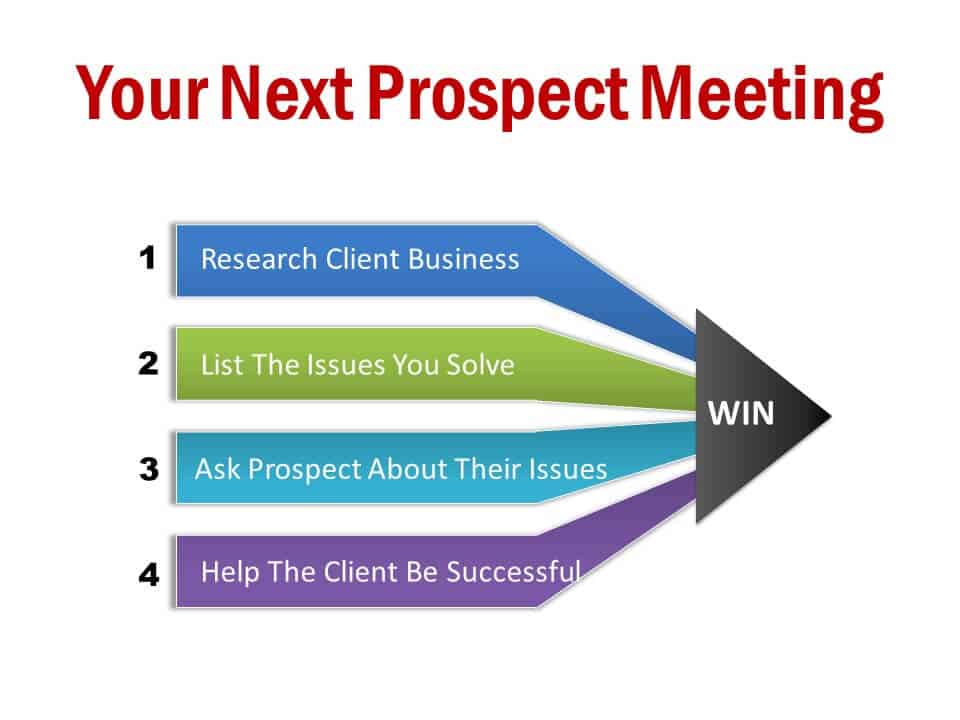
As the name suggests, this method consists of first taking an interest in the prospect’s challenges, needs, expectations and objectives. As in the previous method, you play the role of advisor before taking on any sales talk. In this approach, processes and activities are arranged to fit the prospect’s schedule, situation and various constraints. Rather than delivering presentation pitches, salespeople use the levers of conversation to lead the prospect to become aware of the solutions that could help them solve their challenges.
5. Inbound Selling
This is a fairly recent methodology, tied to the growth of the internet. This method consists of using the resources of content marketing to attract customers to you rather than going to them. The idea is to create high-value content (blog posts, infographics, white papers, ebooks, webinars…) that leads prospects to become aware of their need and to get in touch with the company. To go further, we invite you to read the article on the subject on La Fabrique du Net (in French): “Inbound vs Oubound marketing – Quelle stratégie marketing pour votre projet ?”.
6. MEDDIC
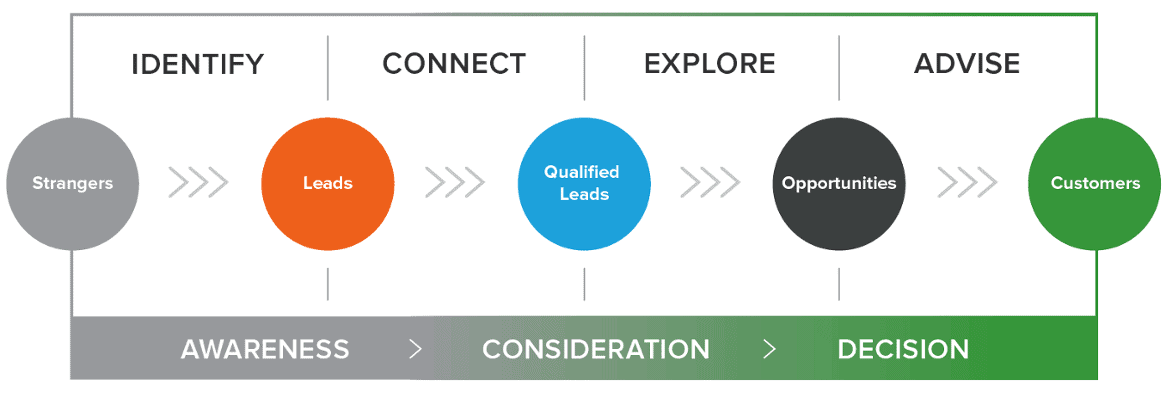
MEDDIC is an acronym for Metrics, Economic Buyer, Decision Criteria, Decision Process, Identify Pain, Champion. It is a highly structured framework for running a sales process driven by technology, metrics and data. This methodology is mostly used for the prospecting stage and lead qualification. We refer you to this for more: The complete guide to lead qualification.
7. N.E.A.T Selling
This is another acronym, for Need, Economic Impact, Access to Authority and Timeline. The idea is to start by identifying the prospects’ fundamental needs by looking at their challenges, before emphasizing the economic benefits to expect from implementing the proposed solution, contacting the various decision-makers to convince them one by one of the solution’s value, and setting a tailored decision-making timeline.
8. SNAP Selling
Another acronym, for Simple, iNvaluable, Aligned and Priority. This method consists of speeding up the sales process based on the principle that the potential buyer is a very busy person. The idea is to get straight to the point and focus on what matters, on the priorities expressed by the prospect.
9. Solution Selling
This method, dating from the 1970s, goes against the traditional product-centered approach. Instead, it focuses on the benefits, the impact and the relevance of the personalized solutions offered. The idea is to present the product not for what it is (its features) but as THE solution to the problems the prospect faces. This requires gaining a deep knowledge of the prospects’ needs and expectations, and precisely qualifying the current situation and the problem at hand.
10. SPIN Selling
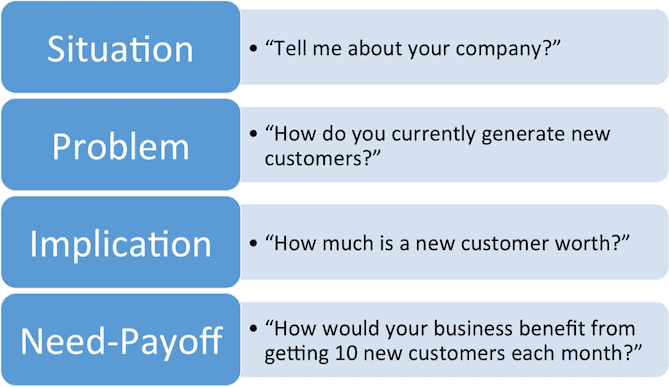
SPIN is an acronym summing up the four fundamental questions a salesperson must ask their prospects: Situation, Problem, Implication, Need-Payoff. The idea is 1/ to assess the situation the prospect is in, 2/ to isolate the fundamental problem that needs solving, 3/ to highlight the consequences to expect if the problem is not solved, 4/ to guide the prospect in solving the problem.
11. Value Selling Framework
This methodology focuses on qualifying leads and assessing their value. The goal is to help salespeople become more efficient by concentrating their efforts on the leads likely to generate the most value for the company. This methodology pushes salespeople to ask the right questions, to connect the product’s value with the prospects’ needs, and to play on personalizing the approach and the solutions offered.
These different methodologies are all tools that can help you change your sales approach and improve the efficiency of your processes. We advise you to pick good practices suited to your context from different methodologies rather than focusing on a single one.
Now let’s see how to set up effective sales processes.
Read alsoDiscover the 10 major trends in the world of B2B CRM software.
How do you set up an approach for improving your sales processes?
Want to evolve your sales processes? Here are the steps we recommend you follow.
1. Observe your salespeople and their working methods
Take the last 5 or 10 closed deals. Identify the main stages of the sales process that made the sale successful and the different touchpoints with the customer. Assess the time it took to complete each stage.
This analysis will let you diagnose your current sales practices, identify the blockers, the actions that moved prospects down the conversion funnel, and the areas for improvement. Before changing anything, you need to understand your existing sales processes well.
2. List the typical stages of your sales process
Every sales process is different. The process can differ from one prospect to another and depending on the nature of the products sold. Still, you can surely identify a generic pattern that includes all or some of the stages listed earlier in our article.
Mapping your sales process is an important step. It gives you a clear picture of existing practices.
3. Identify the actions that move the prospect from one stage to the next
For each of the stages you have defined, you need to try to understand what pushes a prospect to move from one stage to the next. In general, the cause lies in the prospect’s actions rather than in the salesperson’s perception. Ask yourself questions such as:
- During their research, did the salesperson end up identifying a pain point that motivated the prospect to book a phone meeting?
- During the pitch, did the prospect raise objections that blocked the sale, or did the presentation, on the contrary, quickly lead to the next stage?
- When the salespeople gave their presentation, did the prospects immediately say yes? Where the answer is yes, how did the salespeople go about it? How did they build their sales talk?
- …/…
Read alsoFind out how to set up and promote webinars to generate more leads.
4. Iterate
Building a sales process is a never-ending task. In the first weeks and months after launching your improvement approach, you will inevitably want to test things, based on feedback from your salespeople.
Your sales process will very likely evolve as your salespeople identify better ways of working and ways to get prospects to move faster through the stages of the process.
5. Measure
In a performance improvement approach, measuring is not optional. It is indispensable. Setting up a reporting system means selecting relevant KPIs. Choose KPIs for each stage of your sales process.
For example, the number of prospects who moved from stage X to stage Y over a given period, the average time a prospect spends in each stage, the percentage of prospects who bought after the presentation, the percentage of prospects who asked for a demo after a phone call, etc. Tracking these indicators will let you gradually improve your sales processes.
To conclude, never forget that a sales process, however proven, is not meant to stay the same over time. It will necessarily have to evolve, to adapt to changes in technologies, practices, customer behavior…
The questions we get over and over.
What is a sales process?
It is the series of stages that runs from identifying prospects to closing the sale: the concrete process the company’s salespeople use to acquire new customers. Each stage uses its own techniques and methodologies.
What are the stages of a B2B sales process?
Prospecting, the “connection” (first contact to qualify the prospect), research on the prospect, the product presentation, and closing the sale, which goes through a quote, a sales proposal or a negotiation.
What are the most widely used sales methodologies?
Challenger Sale, Conceptual Selling, Consultative Selling, Customer-centric Selling, Inbound Selling, MEDDIC, N.E.A.T Selling, SNAP Selling, Solution Selling, SPIN Selling and Value Selling Framework.
What does SPIN Selling mean?
SPIN sums up the four questions a salesperson must ask: Situation, Problem, Implication, Need-Payoff. The idea is to assess the prospect’s situation, isolate the problem to solve, show the consequences if it is not solved, then guide the prospect toward solving it.
How do you improve a sales process?
By observing salespeople on the last 5 or 10 closed deals, listing the typical stages of the process, identifying the actions that move the prospect from one stage to the next, then iterating and measuring each stage with KPIs.



What the community says.