


- “It’s too expensive” is rarely about the amount: it’s perceived value that’s at stake.
- A political objection doesn’t depend on the person you’re talking to: help them move the deal forward within their organization.
- “Send me some documentation” is often a “no thanks” in disguise. Quickly test whether there’s still room for dialogue.
- Validating the objection works better than countering it: “I understand” avoids a power struggle.
- CRAC: Clarify, Rephrase, Answer, Check.
“It’s too expensive”, “We don’t have the budget”, “It’s not the right time”: no salesperson likes hearing that. But customer objections are part of the sales process, especially in B2B, where cycles are long, stakeholders are many and decisions are rarely impulsive.
It’s normal for a prospect to voice doubts. So don’t panic. Let’s go even further: customer objections are desirable. As Juliette Ledoux writes in a LinkedIn post, “a prospect with objections is rather a good sign: it means they’re interested”. She couldn’t be more right.
In fact, you can spot the best salespeople by their ability to turn customer objections into opportunities. If you want to join that league, read this article.
Find the right providerNeed to outsource your prospecting? Find the provider that matches your real needs.
Find a provider
Top 10 most common sales objections
Here are the 10 most common sales objections in B2B, each with a quick look at what it reveals and some ways to respond.
1. “It’s too expensive”
It’s one of the most common objections and one of the easiest to misread. The prospect isn’t always saying the price is objectively too high. They’re saying they can’t connect that price with what it will bring them.
Usually, it’s not a discussion about the amount, but about perceived value. Before talking budget or discounts, you’re better off understanding: compared to what is the price judged “too high”? What’s missing to justify the investment?
That’s often the moment when you can clarify what really sets your solution apart, or adjust the scope without devaluing the offer.
Salesdorado’s tipWhen a prospect tells you “it’s too expensive”, never answer “we can work something out”. Start by asking: “Compared to what?” As long as you don’t understand their frame of reference, you’re talking in a vacuum.
2. “We don’t have the budget”
This objection looks like the previous one, but the wording is different. Here, the problem isn’t necessarily the amount itself, but the fact that the expense wasn’t planned for, that it doesn’t fit into the current budget or that it isn’t considered a priority at this stage.
The goal isn’t to negotiate right away. It’s to find out whether there’s any room to maneuver. Is the need strong enough to rethink the budget allocation? Could a different timeline or a smaller scope shift things?
A budget objection can be a closed door, but it can also be a test: it’s up to you to see whether there’s a way through.
3. “We already use [competitor]”
It’s a common customer objection, especially if you’re entering a market that’s already crowded. The person you’re talking to may be satisfied with their current solution… or simply used to it. And in many cases, it’s not that they don’t see a problem, it’s that they no longer ask themselves the question.
The challenge here? Getting the prospect to step to one side.
Ask them about their level of satisfaction:
- Does the current solution still meet their needs?
- Has it kept up with the way they work?
This kind of conversation often brings out latent irritants or friction points that nobody questions anymore. And that’s where you can get into the discussion.
4. “It’s not the right time”
This customer objection is almost always tied to internal constraints: an operational overload, a lack of budget visibility, organizational changes underway or coming up, tax or legal deadlines, or simply a team already committed to another major project.
Sometimes, it’s true. Sometimes, it’s a polite way of avoiding a decision.
Either way, the right reflex is to dig a little. Not to force the discussion, but to understand what’s really holding things up, what could change, what would make the topic a priority in a few weeks or months.
In a LinkedIn post, Alan Ruchtein suggests a simple, direct answer:
“May I ask, what will happen in 6 months in the business that will change the situation?”
Put another way:
“Can I ask you what, six months from now, will have changed in the company to make the situation different?”
5. “We don’t need this kind of solution”
This kind of objection often comes early in the conversation. It can point to poor qualification, but also to a gap in perception. The prospect doesn’t see how your solution meets a concrete need in their company, or they think the topic is already covered.
There’s no point disputing that judgment. What matters is understanding where it comes from. Is it a topic they’ve already explored? Has it been set aside because it’s not a priority? Or because it’s never really been raised?
In many cases, this clarification work makes it possible to reopen the discussion.
Read alsoThe art of persuasion in B2B sales
Salesdorado’s tipIf you hear “not the right time”, don’t try to convince. Ask instead “what would make this topic a priority for you?” That’s often where you open a real strategic discussion.
6. “I need to think about it”
It’s the objection you hear most at the end of a conversation. It suggests the prospect wants to take a step back, but it also, and often, means they don’t want to move forward, without saying so head-on.
It’s actually less a direct objection than a weak signal. In these cases, the challenge isn’t to push, nor to let it slide, but to test whether there’s still a question that hasn’t been asked, a point that’s still unclear or a hesitation waiting to be voiced.
If the discussion is still open, a simple refocus may be enough to bring out the real blocker. Otherwise, you might as well acknowledge it clearly and avoid pointless follow-up emails…
Salesdorado’s tip“I need to think about it” is rarely a rational objection. Before calling back in 15 days, try instead: “What would help you move forward in your thinking?”. Sometimes, it’s just a piece of information that’s missing.
7. “We’ve already tried this kind of solution and it didn’t work”
This kind of objection rarely rests on a mere opinion. It’s based on first-hand experience. And when a prospect still has a negative impression of a similar tool or project, they’re unlikely to change their mind on the strength of a product sheet.
There’s no point trying to defend your solution too early. The right reflex is to get them talking, to understand what had been put in place, in what context, with what goals, so you can identify what went wrong or what wasn’t anticipated.
Only once this debrief is done can you reposition the discussion. Not to say “this time, it’ll be different”, but to show concretely how your approach does a better job of addressing the friction points they mentioned.
And that’s where the objection becomes useful. Handled well, it lets you get down to the nitty-gritty, with a level of precision you never get on neutral ground.
Salesdorado’s tipBehind every past failure, there’s a specific frustration. Get them to talk about it. Not to criticize what was done, but to show that you, at least, have understood where things got stuck.
8. “Your solution is too complex”
It’s not the solution being questioned here, but its implementation. Too time-consuming. Too technical or too risky. This kind of objection mostly says one thing: the prospect anticipates internal roadblocks.
There’s no point going back over the features. What you need to understand is what makes this complexity a problem in their context.
Once these points are identified, you can reposition the discussion on how to roll out the solution, not on the solution itself. That’s often where it’s decided.
9. “I’m not convinced it would be useful for us”
It’s a common customer objection, especially when a prospect hasn’t identified a clear need beforehand or doesn’t immediately see the added value of the solution. It can reflect a gap between the sales pitch and the priorities the person perceives, or difficulty picturing themselves using it.
Rather than trying to prove the solution’s usefulness at all costs, you’re better off going back to the prospect’s business context: what are their current challenges? What irritants do they run into day to day?
This return to the real need often makes it possible to reconnect the proposal to a concrete problem.
10. “Your solution doesn’t handle [a specific feature/a particular use case]”
This customer objection is very targeted and highlights a specific expectation the prospect has about a feature or a use case they don’t see as covered by your offer.
It doesn’t necessarily call into question the overall value of your solution, but it expresses a gap they’ve identified relative to their specific need.
The challenge here is to understand why this feature matters to your prospect and whether your solution can address it another way (or whether other benefits can make up for this gap, real or perceived).
Read alsoLearning to negotiate: our pick of the best training courses
Salesdorado’s tipIf a feature is missing, don’t defend the indefensible. Show instead what you do better elsewhere, and check whether that makes up for it. A sale is rarely won on a single criterion. But it can be lost on a silence.
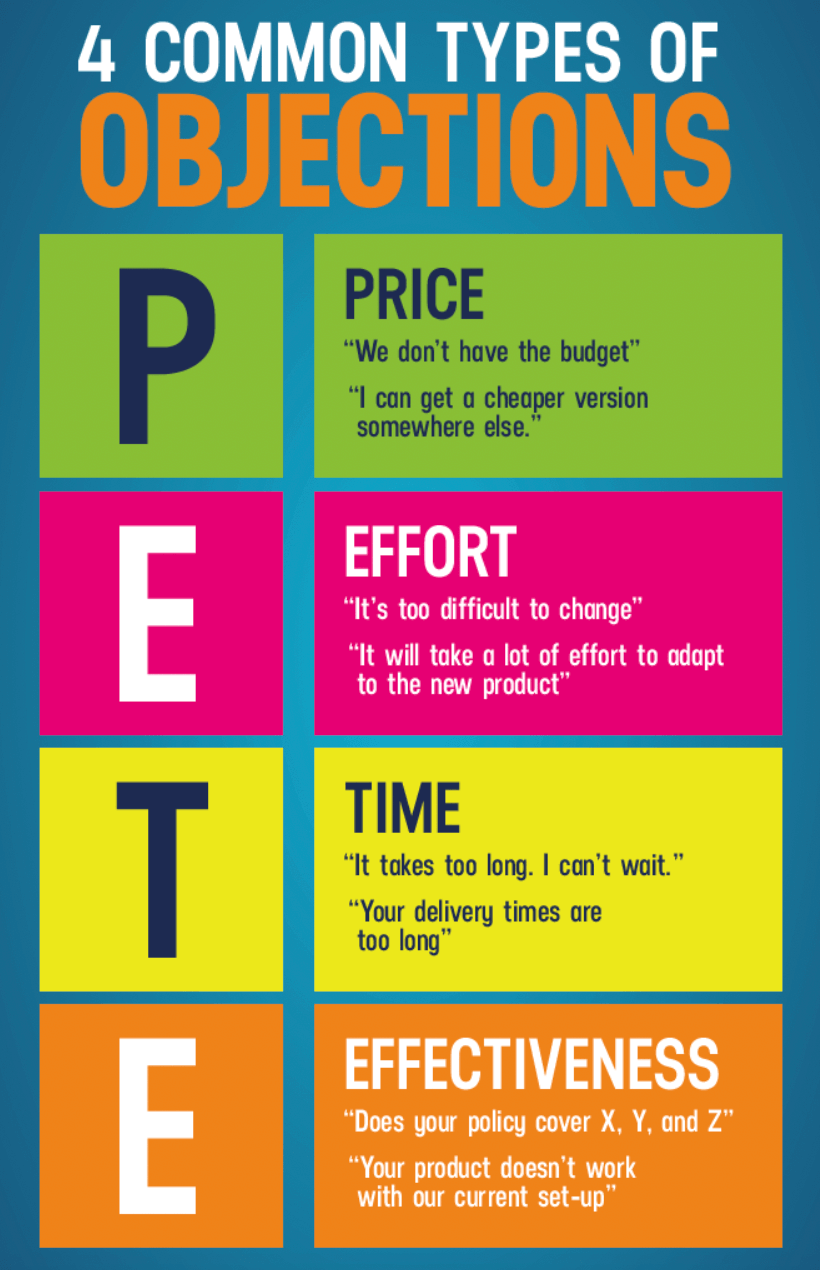
The 4 main types of customer objections
As we saw in the previous examples, not all objections play the same role in the conversation. Some reflect a genuine rational doubt, while others mask a discomfort or a constraint the prospect doesn’t bring up on their own.
Customer objections can be grouped into 4 main families. And it’s important to keep them in mind.
1. Rational customer objections
These are the most expected customer objections. They concern concrete elements: price, lead times, terms, functional scope, etc.
These objections often come early in the sales cycle, once the prospect starts picturing the solution. They seem simple to handle, and that’s exactly where the trap lies.
Answering too quickly means risking missing the point. A prospect who says “it’s too expensive” isn’t necessarily asking you for a discount. They may be telling you they haven’t understood the value of what you’re offering, or that they’re comparing your offer to another one without grasping the differences.
Before defending your price or adjusting your proposal, you need to make sure you’re speaking the same language, that the need is clear, that the ROI is easy to read and that the objection voiced really matches the actual concern.
2. Emotional customer objections
These are objectively the hardest to pin down, not because they’re aggressive or violent, but because they don’t say what they mean.
The problem here isn’t your solution, it’s the change it implies, the risk of getting it wrong, the effort it requires, the fear of upsetting a fragile balance, etc. etc. And no prospect will tell you that so clearly.
These objections often slip into the conversation in vague or very consensual forms, like: “we’ll see later”, “it’s not the right time”, “we already have a lot on our plate”.
The natural reflex is to come back with more arguments. Very bad idea! What you need to do is slow down, listen and go back to the stakes. Try to understand what’s holding them back. And above all, don’t try to force your way through.
Honestly, these are often the most interesting objections because they open up room for a more authentic dialogue. Handled well, they let you build a stronger relationship of trust than any sales pitch.
3. Political customer objections
These are the ones that don’t depend (or not only) on the person you’re talking to. They’re not the only one deciding. They have to talk to their partner, get a budget approved, bring another team on board, wait for a committee’s decision. It’s very common in B2B.
These objections aren’t technical, nor emotional, they’re organizational. The prospect isn’t against it, but they can’t move forward alone.
And that’s precisely what makes these situations tricky. Because you think, wrongly, that “everything went well”, that “the prospect is convinced”. But a political objection handled badly is a sale that drags on forever or dies in silence.
Read alsoSales organization
Your role here isn’t to convince harder, but to help the person you’re talking to move the deal forward within their organization, which means asking your contact questions:
- Who is really the decision-maker?
- Who has influence over the decision?
- Do you need to convince a pair of people, a business unit, the finance department?
- Is your contact used to championing topics like this?
- Are they comfortable defending your solution internally?
You don’t ask all these questions head-on, but they should guide you.
The most effective salespeople are often those who know how to handle this (often delicate) phase of indirect selling well.
4. Avoidance customer objections
These are the vaguest and most elusive customer objections. They don’t close the door, but they don’t open it either.
They’re fairly easy to recognize: “send me some documentation”, “we’ll keep your details on file”, “we’ll get back to you if needed”.
They often come up when the conversation is coming to an end, when interest is low or when the prospect doesn’t want to continue the discussion without having to say no.
They aren’t formal rejections, but they aren’t real objections either. More like emergency exits…
The risk here is following up for the sake of following up, piling up follow-ups into the void, reading this answer as a “later”, when it’s most likely a “no thanks” in disguise.
Faced with these objections, the challenge is simple: quickly test whether there’s still room for dialogue. Ask a short, neutral, factual question. For example: “have you already looked at this kind of solution in the past?” or “is this a topic that’s already been discussed internally?”.
If the conversation picks up again, you have an opening. Otherwise, you might as well acknowledge it and move on.
Better to clarify a disqualification than to stay in limbo. It’s neither wasted time nor a sales failure. It’s sorting, which you need in order to focus on the prospects who want to move forward and can.
How to respond well to an objection: 4 simple tips
Responding to a customer objection isn’t about pulling out a good argument at the right moment.
Most of the time, it’s neither the substance of the answer nor its speed that makes the difference, but the way the objection is received.
Posture comes before method. And in many cases, it’s posture that keeps the conversation constructive.
Here are the main principles to keep in mind to handle customer objections like a pro.
1. Don’t try to convince too quickly
It’s a common reflex: at the slightest objection, you try to respond, to defend yourself, to argue.
But the reality is that the more you try to convince, the more the prospect closes up. At least, that’s very often how it goes. The challenge, when a customer objection comes up, is rarely to “win” the exchange but to keep the door open.
That’s why validating the objection is often more effective than trying to counter it. Saying “I understand” or “that’s a point we often hear” helps you avoid a power struggle and sets up a calmer discussion. We borrowed this good idea from Juliette Ledoux, in the post mentioned above.
2. Dig to understand what’s really being said
We’ve seen it several times: the way an objection is worded often hides something else. It’s that something else, the real obstacle, that you need to try to uncover:
- “It’s too expensive” can mask a doubt about value.
- “It’s not the right time” can reflect apprehension about implementation.
- “We don’t have the budget” can signal that the topic is poorly prioritized.
- “We already use a solution” can reflect a form of inertia or a fear of change.
- “We don’t need this kind of tool” can betray a misunderstanding of your offer.
You should never take customer objections literally, but try to dig deeper by asking the right questions. Simply asking “What makes you say that?” gets the prospect engaged in the conversation and keeps you from answering beside the point.
3. Structure your answer with the CRAC method
The CRAC method is a good reference and a good approach for structuring an answer without rushing.
It relies on four simple steps:
- Clarify > Ask a question to clarify what’s really at stake.
- Rephrase > Show that you’ve understood the point raised, without necessarily agreeing with it.
- Answer > Provide a targeted response, tied to the need expressed.
- Check > Verify whether the answer has removed the blocker or whether other points remain to be addressed.
Read alsoGlossary of sales techniques
Let’s take a concrete example to illustrate, with the classic customer objection “Your tool is too complex to get to grips with”:
- “Have you already tried other similar tools?” > Clarify
- “So what’s holding you back is mainly the workload that adoption represents” > Rephrase
- “We support every new customer with personalized onboarding, often in less than a week” > Answer
- “Does that address your concern about getting started?” > Check
4. Accept that an objection doesn’t always need to be “handled”
Not every objection has to be overcome at all costs.
Sometimes, as we’ve seen, it’s more strategic to acknowledge that the timing isn’t right or that the prospect isn’t well qualified. Knowing how to disengage cleanly is also part of the job.
But as long as the objection is sincere, clearly expressed and a dialogue is still possible, it’s worth handling. Not to close the topic, but to move the discussion forward, on firmer ground.
What to take away from all this? There’s no magic formula. Knowing how to respond well to customer objections takes a few techniques (we’ve seen some of them), but above all it’s a mindset. You need to know how to listen (really listen), stay curious, and see every sales objection as an opportunity to understand better, so you can move the sales conversation forward.
And like everything in sales, it can be learned, through practice. Over to you!
Go further
The questions we get over and over.
How do you respond to the “it’s too expensive” objection?
Never answer “we can work something out”. Start by asking “Compared to what?”: as long as you don’t understand the prospect’s frame of reference, you’re talking in a vacuum. Most of the time, the discussion is about perceived value, not the amount.
What are the 4 main types of customer objections?
Rational objections (price, lead times, terms, functional scope), emotional ones (fear of change or of getting it wrong), political ones (the prospect doesn’t decide alone) and avoidance ones (“send me some documentation”, “we’ll get back to you if needed”).
What is the CRAC method?
A method for structuring your answer to an objection in four steps: Clarify (ask a question to clarify what’s at stake), Rephrase, Answer with a targeted response, then Check that the answer has removed the blocker.
What should you say to “I need to think about it”?
Before calling back in 15 days, try instead: “What would help you move forward in your thinking?”. Sometimes, it’s just a piece of information that’s missing. If the discussion is no longer open, you might as well acknowledge it and avoid pointless follow-ups.
Should you always handle an objection?
No. It’s sometimes more strategic to acknowledge that the timing isn’t right or that the prospect isn’t well qualified. As long as the objection is sincere and a dialogue is still possible, it’s worth handling.



What the community says.