



- Marketing automation aims to convert captured leads into MQLs, sales automation to convert SQLs into customers.
- In B2B, buying journeys are complex and sales are rare: a marketing automation sequence is hard to measure.
- Micro-conversions (white paper, webinar, pricing page) provide volume to iterate, but only the sale counts.
- Before automating qualification, you must formalize the process: data points, ranges, relative weights.
- In prospecting, sending at scale is easy; finding the right segment and the right message remains the challenge.
Marketing automation is the art of automating the management of your marketing tasks (SEO, social marketing, etc.). Sales automation focuses on automatically managing the relationship with leads and customers (recording email addresses, sending personalized emails, etc.), through a CRM for example.
What is sales automation? How does it differ from marketing automation? How do you make them work together? We cover it all in this article.
Sales automation vs marketing automation at a glance

We recommend starting with this guide on sales qualification to fully understand what follows.
We are talking mainly about B2B here. Marketing automation is also widely used in B2C, particularly in e-commerce. But in that kind of sector there is no sales team, so marketing covers the entire value chain.
| Marketing automation | Sales automation | |
|---|---|---|
| Goals | Convert MCLs (Marketing Captured Leads) into MQLs (Marketing Qualified Leads) | Convert SQLs into new customers |
| Communication channels | Email marketing (newsletter, etc.), social media, webinars… | Email, phone, social media, SMS… |
| Company stage | Doesn’t matter | Doesn’t matter |
On goals, the whole problem with sales automation and marketing automation is converting an MQL into an SQL, because there is nothing for that. That is why lead scoring, communication and alignment between marketing & sales teams are fundamental.
On communication channels, while marketing has historically addressed a multitude of leads at once, it increasingly hides its one-to-many side behind pseudo one-to-one: that is ultra-personalization. The idea is to use marketing methods (I target a segment, I adapt my message to a segment) and sales codes: plain-text emails, hi “first name”…
WarningOne last point: you sometimes read that marketing automation should be used very early, while sales automation is something to set up only in well-established sales teams. That is nonsense.
You automate what you want, when you want, based on the business impact it can have. That said, automating your sales reps’ one-to-one relationships with prospects and customers is clearly far more critical than a bad marketing automation scenario.
What is marketing automation?
The principle of marketing automation is to design automated journeys for customers (or customer segments). A B2B classic, for example:
- Download of a white paper.
- 2 or 3 informational emails over two weeks to qualify the lead’s needs & interests.
- Lead scoring based on the reactions (or lack of reaction) to those emails. By the way, an article on building a lead scoring strategy is available on Salesdorado!
- Conversion of the lead (or not) into an MQL so that sales teams can take over.
The main principles of marketing automation
The key principle is to use “hard data” (real data) to build marketing segments and messages.
Marketing automation lets you implement a digital marketing strategy without having to write and send your content manually, which saves time and resources.
In practice, this means collecting data on customers through many interactions: emails, website visits, app usage, social media. Some tools, for example, let you prospect very effectively on LinkedIn.
From there, marketing automation does all the work: streamlining targeting processes to determine the right audiences, quickly and at scale. In a few clicks, you create personalized emails, text messages or posts.
Marketing automation therefore lets you offer personalized experiences to your customers efficiently.
The benefits of marketing automation
Marketing automation can bring many benefits to your company by making a good number of tasks easier for your teams.
- Personalized workflows: marketing automation software can help you prioritize your tasks and structure your work process. You can track how a marketing campaign is progressing and how many leads it has generated.
- Streamlined processes: you can create processes that work across different teams to reduce the customer’s effort at each step of their journey. No need for complicated handover procedures: all the data is centralized, and internal workflows can help you prioritize tasks according to needs.
- Integrated data and analytics: manually tracking your prospects’ actions is impossible. With marketing automation software, however, companies can use this data across several channels to gain an in-depth understanding of their customers’ needs and deliver the right content at the right time. These flows direct qualified prospects toward useful content, which can help turn them into customers faster.
Examples of marketing automation use cases in B2B
Marketing automation can solve many problems, for example:
- Managing your customer relationships: marketing automation lets you track customer data and purchase history, and contact buyers regularly to make sure they are satisfied.
- Handover from marketing to sales: some B2B marketing automation platforms have lead scoring systems. Sales teams then use this information to decide which leads to prioritize.
- Email marketing automation: certain emails, such as welcome emails, abandoned cart emails and requests for feedback, can be powered by marketing automation.
- Automating your website’s homepage: many marketing automation solutions let you create dynamic landing pages that adapt to the visitor’s location and previous visits to the website.
- Webform automation: if you use forms, you can complement them with marketing automation tools to route form entries to the right teams or departments. You can also follow up on a customer’s form submission with an automatic appointment confirmation email.
- Social media automation: many solutions let you automate social media tasks such as publishing new content, adding comments, following users…
- Automated customer re-engagement: B2B marketing automation tools also let you restart the conversation with customers you have not done business with for a while.
- Automating marketing analytics: to make your marketing campaigns succeed, you need to measure your performance. Most B2B marketing automation solutions make this easier with built-in reporting features and integrations with other analytics tools.
A gift from SalesdoradoHere you go: we are giving you B2B prospecting files to help you get started with your marketing automation strategy!
The problem with marketing automation in B2B
In B2C, marketing automation means abandoned cart reminders, private sale campaigns… All the fairly classic loyalty levers, more or less automated to define more precise segments.
For example, instead of running private sales two weeks before the sales open to everyone, you make a gesture for the customer’s birthday. Or for the anniversary of their last purchase.
The problem in B2B, and more generally with larger baskets, is that buying journeys are much more complex. On paper, a marketing automation sequence always looks more or less sound. In reality, it works far less well than you would like, and above all it is far harder to measure. That is where sales automation comes in.
What is sales automation?

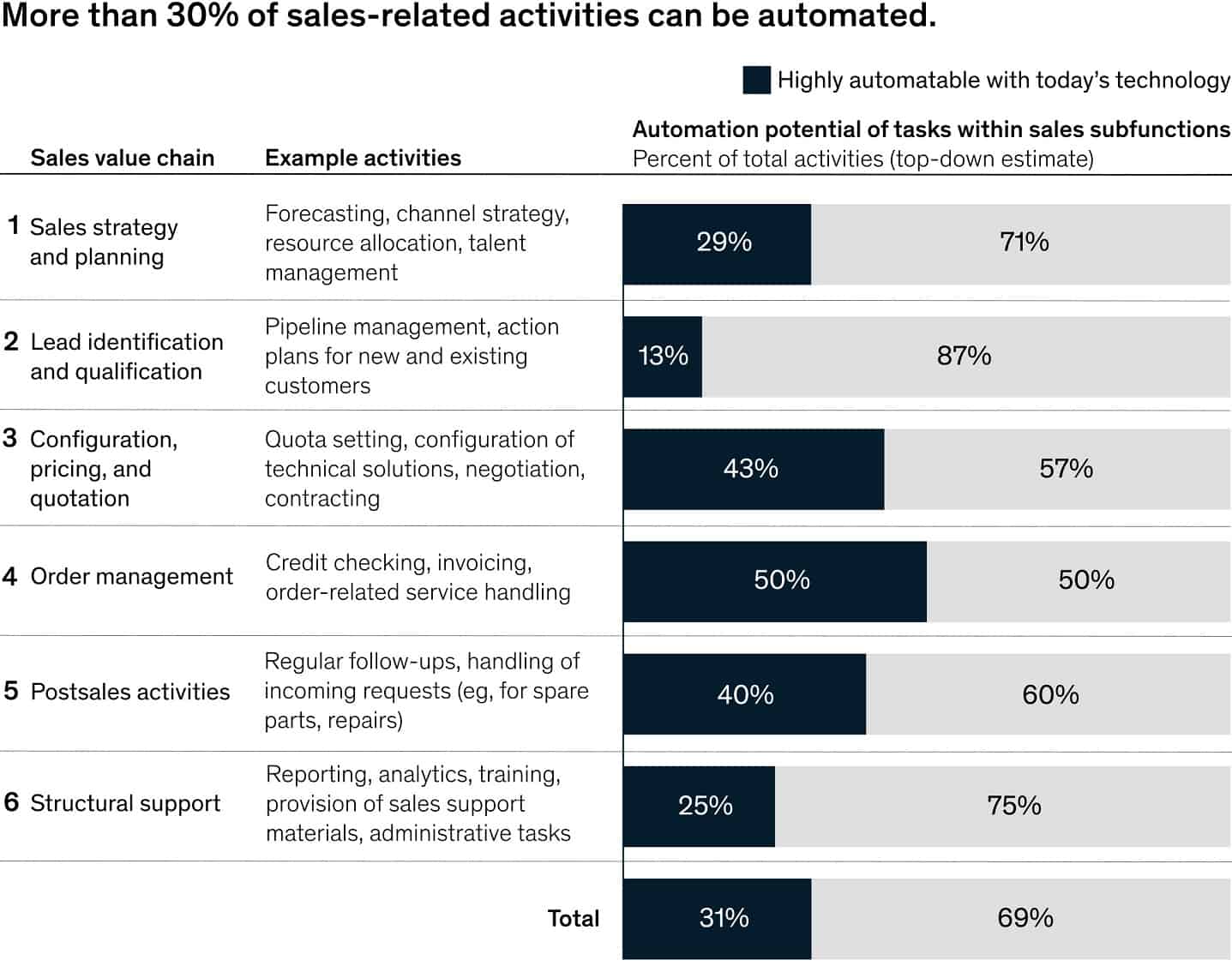
Sales automation, for its part, aims to automate sales actions that are generally carried out more or less manually. According to a McKinsey report from May 2020, a third of sales activities can be automated.
CRM at the heart of sales automation for years
The role of a CRM is to centralize all customer & prospect information in one place. As in marketing automation, this is a sine qua non for automating anything at all and for having centralized, accurate data.
CRM software is therefore quite naturally first in line to offer sales automation features:
- Automatic profile creation: when your sales teams scan business cards or receive newsletter sign-up confirmations, they can simply let the sales automation software create the new profiles.
- Activity logging: sales emails, calls, visits: everything must be logged in real time so that other reps know where a salesperson stands with a potential customer. Sales reps can then focus more on closing deals.
- Automated data entry: by automatically filling in sales data such as prices, product details and prospect & customer contact information, sales automation software streamlines contact management and saves your sales reps precious hours every day.
- Automated research: sales automation software can find key information on prospects and customers on the web and social media. It uses this information to create and update prospect profiles, assess their likelihood of success and identify sales opportunities.
Broadly speaking, sales automation means equipping your sales reps so they can automate part of their most tedious activities.
The complexity is that to automate, you first have to formalize the process. For example, if you want to enrich your CRM to automate qualification, or at least set up automatic scoring, you need to know:
- The data points that drive qualification.
- The ranges and relative weights of each of these data points.
People usually start with a rough guess, but be careful: setting up this kind of automation without excellent prior knowledge of the market can be disastrous.
A word on sales automation in prospecting
This is certainly one of the sales activities where automation gets the most talk, and where automation is least effective. Think of all the cold emailing software, all the LinkedIn automation tools, the phoning software…
In prospecting, the conversion funnel is at its widest, so this is where the volume to process is highest. Hence the obvious appeal of automating as much as possible to process more volume.
Yet this is also where:
- You have the least information about prospects, since they are not yet qualified.
- Making contact is hardest, since prospects don’t know you.
We say it all over Salesdorado, and we will say it again here: sales automation in prospecting is above all a matter of data and sales maturity.
Personalizing your emails with variables or sending LinkedIn messages at scale is dead simple, there are tons of tools that do it, and the stakes are close to zero. Finding the right segment to prospect and the right message is the only thing at stake.
A few more advanced sales automation use cases
Once you have mastered sales automation, you can use it for more advanced purposes:
- Churn prevention: by relying on variables such as buying habits, interaction preferences and web data to identify the customers most likely to cancel, sales and marketing teams can take targeted action to prevent churn, such as preconfigured discounts to encourage customers.
- Lead management: we have prepared a complete guide on lead management. Chatbots can select customers independently, contact them by text message or email, use natural language processing to understand the context of their response and reply accordingly to encourage conversion. According to McKinsey, this solution can increase the time sales reps spend selling by 15 to 20%, while improving deal flow transparency and conversion.
- Product activation: bots can prepare license certificates for new customers and send license keys to activate their purchases. They check that an order is valid and inform internal functions, such as finance and legal, of the activation. This can save you a huge amount of time and let customers activate their products much faster than before.
How do you make sales and marketing automation work together?

Another big problem with marketing automation in B2B is conversion volume.
If you sell cat kibble, you will sell it regularly to the same customer. These conversions are regular enough to optimize your campaigns, and you can iterate very quickly.
But if you sell marketing automation software at €50,000 / year, you are likely to sell to your customers far less often. Once a year, at most.
The best solution we have found so far is to create micro-conversions. For example:
- Download of a white paper
- Attendance at a webinar
- Visit to the pricing page
These micro-conversions give you a higher volume of conversions, and so shorten iterations and help optimize messages and segments.
But, and the but matters, the only conversion that truly counts is the sale. You can run a webinar with 1000 attendees: if none of them buys, you have lost.
And this creates a major bias. We have seen a huge number of white papers, webinars, guides like this one and other content openly targeting an audience very, very far from converting. Then the marketing folks call them MQLs, because they got a phone number and an email. And the sales teams answer that the leads are worthless.
Broadly speaking, most of what aligns everyone comes down to lead scoring. As long as you don’t call them MQLs, why not. But once you clutter sales teams with leads who have no idea who you are or what you do, it starts to be a problem.
Marketing automation vs account-based marketing
Some believe the next step in streamlining marketing will be a convergence between account-based marketing (ABM) and marketing automation software.
ABM software vendors are adding capabilities and features similar to those of marketing automation to their products. Today, ABM can include native email, landing page and form features, engagement programs and native databases.
Account-based marketing software helps B2B marketing specialists identify and target accounts based on specific parameters. This helps them coordinate better with sales teams. The approach differs from the one used in B2C, where marketers target individuals.
The philosophy of ABM is that accounts are what generate sales in the B2B world. By focusing on account behavior, engagement and activity, marketing specialists can identify, attract, engage, convert, close and then measure progress with customers and prospects.
Managing the volumes of data that B2B marketers handle can be tricky, even with ABM tools. That is why ABM tools are starting to include automation features, and vice versa. The tools have therefore evolved considerably in their features.
The questions we get over and over.
What is the difference between marketing automation and sales automation?
Marketing automation automates the management of marketing tasks and customer journeys by segment, to convert captured leads into MQLs. Sales automation automates the relationship with leads and customers, often through the CRM, to convert SQLs into new customers.
Should you start with marketing automation before sales automation?
No. You automate what you want, when you want, based on business impact. Automating sales reps’ one-to-one relationships with prospects and customers is in fact more critical than a bad marketing automation scenario.
What share of sales activities can be automated?
According to a McKinsey report from May 2020, about a third of sales activities can be automated.
How do you make sales and marketing automation work together?
By creating micro-conversions (downloading a white paper, attending a webinar, visiting the pricing page) to iterate faster, and by aligning teams through lead scoring, without sending sales reps leads who don’t yet know the company.



What the community says.