



- Hire two or three reps at once: healthy competition motivates, and rejection is easier to handle as a team.
- Have every new hire shadow a more experienced salesperson, and encourage them to find mentors across the team.
- Train on one task at a time, starting with the simplest products and services.
- A weekly check-in with the manager lets you react fast, and find out early if a new hire won’t make it.
- Six to eight weeks of follow-up training counter the forgetting curve.
How do you get your new sales reps to full capacity faster? How do you build a supportive sales team & culture in your organization? The onboarding process for your new sales reps is a major lever for that. In this article, we give you a framework & a few best practices to build the best onboarding possible.
1. Hire several salespeople at once
When it comes to training new sales reps, there is strength in numbers. Instead of hiring one new candidate at a time, consider hiring two or three:
- Healthy competition can be a strong motivator for new sales reps.
- Rejection is a big part of the sales process, and new reps handle rejection more easily when they are part of a close-knit team.
- Hiring several reps lets you test new sales strategies with several employees, and gather more data to assess how effective your training methods are.
- If all your new hires make it, you will significantly strengthen your sales force. Conversely, if one of them decides to jump ship, you will have several options to cover their departure.
As a bonus, it makes the paperwork with the various organizations you need to contact much easier: health insurance, meal vouchers, etc.
2. Streamline your onboarding process
New hires want two things when they join your organization:
- A chance to succeed
- The feeling of being part of a team that will help them get there
If your new sales reps have a negative or difficult hiring experience, they will be much more likely to leave your company in the first few months.
Far too many companies drag out new rep onboarding, either by delaying the actual training or by interrupting it once it has started.
Onboarding should be treated as separate from training, and every new hire should complete it during their first week on the job.
For a successful sales rep onboarding, you can follow these steps:
- Ask new employees to fill in the payroll, insurance and HR paperwork on their first day, and make sure you answer all their questions.
- Give every new hire a copy of your company’s policies and procedures handbook. Spend time going over your workplace rules and the principles of your company culture.
- Set clear expectations. Make sure your new employees know your company’s overall mission as well as their individual responsibilities.
- Make sure they know your time-off tracking policy well and can plan ahead. Give them access to leave tracking tools; we like Vacation Tracker, for example. The tool helps your teams manage their own time-off requests and get a full view of their remaining days.
3. Pair your new hires with more senior reps
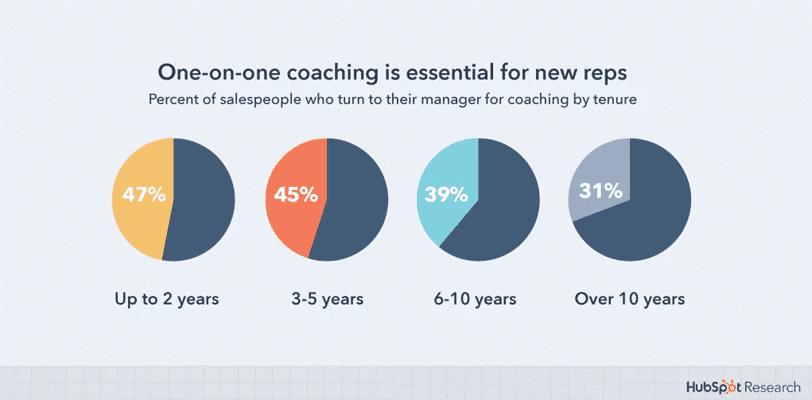
Handbooks and tutorials matter, but no training is complete without guidance from an experienced peer. After introducing your new reps to your team, have each of them shadow a more experienced salesperson.
Your new reps can pick up invaluable knowledge by watching and listening to their more experienced colleagues make sales calls and run demos. It also speeds up their learning, since they can ask questions at the right moment.
Key takeawayThis interaction should not be limited to the partners they are assigned to, either. New reps should be encouraged to interact with your whole sales team to find mentors. Mentors can not only guide their day-to-day progress, but also give them long-term career direction.
4. Don’t overload your new hires with information
You may have a ton of interesting information to share with your new employees, but they simply won’t retain it if you just drop the documentation on their desk.
Instead, train them on one specific task at a time.
Here is a solid training model for onboarding your new sales reps:
- Start by introducing them to the simplest products and services.
- Once they can describe the products’ selling points effectively, have them start learning the cold calling and email outreach processes.
- Let them join senior salespeople on their demos and presentations.
- Have them practice using the demo and presentation scripts.
- Once they have mastered the scripts, they can start running demos and presentations themselves.
- Keep up this pattern until your new employees have mastered your entire sales process.
You should also consider using sales training software. There are plenty of good options for almost every budget and team size, and salespeople who successfully use top-tier sales training platforms close 10% more deals than those who don’t.
Key takeawayYour new employees’ priority should be to take ownership of your sales process as a whole. Not only is it more rewarding, it also matters more. Wait until they have finished their training before asking them to learn other products or services.
5. Check in with them once a week
Once your new hires have started training with their peers, have managers meet them once a week to assess their progress.
At each weekly meeting, managers should keep these questions in mind to get the most out of new rep onboarding:
- Is the new rep’s coach a good fit? Could they be paired with someone else?
- If the new hire is struggling, is it in one particular area or across the board?
- Does the new employee show particular strengths or ideas that could be useful for selling specific products or services?
- Will the new employee be a good fit for the company?
Key takeawayBy reacting quickly to any problem and making the necessary changes, you can speed up the training process. And if it looks like a new hire won’t make it, it’s better to know as early as possible.
Also readThe 10+ best sales recruitment agencies
6. Monitor their performance
On top of weekly check-ins with your new hires, you need to set up a (short) list of key metrics to track their progress, and make sure they take ownership of them.
These metrics vary from one company to another, but your company should pay close attention to the following:
- Do your new hires understand your company’s sales targets, as well as the ins and outs of your sales funnel?
- Are they getting better at using your company’s sales software & CRM software?
- Will your new hires be able to hit your target?
- Do your new reps understand the problems your potential customers face? Will they be able to successfully present your products or services as a solution?
- Do they actively listen to their coaches and peers? Are they earning the trust of your whole team?
You can get answers to these questions in meetings with the new employees, their managers and the peers they shadow. You can also assess their progress by listening to their sales calls and sitting in on their sales meetings.
7. Run follow-up training
However talented your new reps are, onboarding won’t be enough for them to master every aspect of your sales process. They are also likely to forget a good part of what they learned during training.

You can address your new reps’ struggles and counter the « forgetting curve » by adding follow-up training.
Once their initial training is over, run six to eight weeks of follow-up training in which your new reps review what they learned and ask questions. They should also get the chance to put their new skills into practice, both internally and, more importantly, with real prospects, so they can see the results of their work.
Not only will this active learning help new reps become effective, it can also help you refine your sales operations processes.
8. Bring your new hires into your marketing team
Your company will perform better if your sales and marketing teams are aligned.
Every new sales rep should take the time to get to know your marketing team, the marketing channels it uses (and why), and where your sales team fits in the mix.
Key takeawayEncouraging positive interaction between your sales and marketing teams can make both departments more effective.
Salespeople can share valuable information (such as the problems potential customers face, their questions, their tastes, etc.) that the marketing team can use to build better messages, strategies and campaigns.
These marketing efforts will help you generate more leads for your salespeople.
9. Let your new reps spend time with customer service
More and more companies are putting the emphasis on customer experience, especially through account based marketing.
It can be easy for salespeople to see customers as mere deals or transactions. But anyone in customer service knows that customers are real people with very human preferences, emotions, problems and desires.
Use your new reps’ onboarding to have them spend time with your customer service team. That way, they will learn to listen to customers and know exactly what they want and need. It will have a big impact on your sales and your retention, and will help you turn more customers into advocates who recommend your products and services to others.
The questions we get over and over.
Why hire several sales reps at once?
Healthy competition motivates new reps, rejection is easier to handle in a close-knit team, and several hires let you test new sales strategies and gather more data on how effective your training is. If one of them leaves, you have other options.
What is the difference between onboarding and training a sales rep?
Onboarding should be treated as separate from training and completed by every new hire during their first week: administrative paperwork, policies and procedures handbook, clear expectations, time-off policy.
In what order should you train a new sales rep?
Start with the simplest products and services, then the cold calling and email outreach processes. Let them join senior salespeople on demos, practice the scripts, then run their own demos, until they master the entire sales process.
What should you cover in the weekly check-in with a new sales hire?
Whether their coach is a good fit, whether their struggles concern one particular area or all of them, whether they show strengths useful for selling certain products, and whether they will be a good fit for the company.
How long should follow-up training last?
Six to eight weeks after the initial training, during which new reps review what they learned, ask questions and put their skills into practice, internally and with real prospects.



What the community says.