



- Before launching the project, define the goals, the scope, the volume and state of the data, the expected features and the budget.
- Data preparation (audit, deduplication, standardization) determines the quality of the future CRM: build some slack into the schedule.
- Involve users from the needs definition stage, then in the tests and training sessions.
- Ambassadors in each team help their colleagues day to day.
- Underestimating the scale of the job or trying to do everything in-house exposes you to cascading delays and rushed steps.
Is your current CRM causing you more trouble than anything else? Do you feel it slows you down more than it helps? Welcome to the club! Plenty of companies reach the same conclusion: their CRM software no longer meets their needs and they are thinking about switching. But be careful, a CRM migration is no small matter: it is a major project that takes a lot of preparation upfront.
In this article, we tell you everything you need to know before you get started: when a migration becomes necessary, the key questions to ask yourself, the steps to follow… In short, we give you all the keys to know whether a migration makes sense in your case and how to pull it off.
Why change CRM?
Let’s start at the beginning: why would you want to change CRM? Before you even launch a CRM migration project, you need to make sure that a CRM migration really is the right answer to your challenges and needs.
Here are the most common scenarios:
- Your CRM holds you back more than it helps you: it has become so complex to use that your teams spend more time fighting with the tool than doing business. As a result, adoption is at rock bottom and you are clearly not getting the most out of your investment.
- Your company has evolved but your CRM has stayed stuck in the past: it lacks the features to meet your new needs and its ability to evolve is extremely limited. In short, you need more than a cosmetic update.
- Integrating your CRM with your other tools is a real obstacle course: there is no way to connect it cleanly to your ERP, your marketing tool or your support system. So you spend your life juggling between tools and re-entering information.
- The ROI of your CRM is hard to defend: between soaring license costs, piling maintenance fees and one training need after another, your management is starting to seriously frown at the bill. It is time to find a more cost-effective alternative.
If one (or more) of these scenarios rings a bell, then it is high time to consider a CRM migration. But before you rush in headfirst, there are a few key questions to ask yourself.
The key questions to ask yourself before launching a CRM migration project
A CRM migration is not something you do on a whim.
Before you get started, take the time to ask yourself the right questions:
- What are the goals of this migration? Gaining productivity, getting your agility back, cutting costs? Be clear about your priorities.
- What is the scope of the migration? Are you migrating all your entities, all your processes or only part of them?
- How much data are we talking about and what state is it in? An audit is a must to see more clearly and anticipate the prep work.
- What are the must-have features you will need tomorrow? Now is the time to challenge your users!
- What budget can you devote to this project, in terms of investment but also internal resources? (find out how much CRM software costs).
In short, the idea is to frame the project as much as possible upfront. Once you have answered these questions, you can get down to serious business and move on to the main steps of the migration.
The main steps of a CRM migration
I won’t hide it from you: a CRM migration is quite a project. But by following a proven method, you give yourself every chance of success. Here are the main steps to follow:
Analyzing the existing setup and defining your needs
This is the scoping phase, the foundation of your project. Take the time to make a complete inventory of your CRM processes, your data, your current tools. Go through everything with a fine-tooth comb, identify the strengths, the weaknesses, the pain points. Then project yourself into the future: what are your short, medium and long-term needs? What are your priorities? The goal here is to draw up an exhaustive picture of your current situation and your target situation. This scoping work will be your compass throughout the project.
Sourcing and choosing the new CRM
Now that you know where you are going, it is time to find the vehicle that will take you there. This is where the selection phase begins. Armed with your CRM requirements document, you can go and meet the vendors on the market. What should you do in practice? Shortlist the vendors most in line with your project. Challenge them, put them in competition with each other. Set up meetings and personalized demos to check that the software fits your needs. You will feed an analysis grid that will ultimately let you make the best decision.
Preparing the data
This is the big technical chunk of a CRM migration. Migrating a CRM is not just moving data from point A to point B. It is the opportunity to sort, clean and restructure your data so that it is compatible with your new CRM. Painstaking work, but it will determine the quality of your future tool. So roll up your sleeves and be patient: audit, deduplication, standardization… There is plenty on your plate.
Configuring and deploying the new CRM
Your data is clean, your new CRM is ready to welcome it. All that is left is to configure it so that it fits your business processes perfectly. Custom fields, business rules, automations… Now is the time to get your hands dirty and build your tailor-made tool. A technical step, admittedly, but oh so strategic. Because it is the one that will determine how well your CRM sticks to your business reality, and therefore how your teams will adopt it in the future. Be meticulous, test, iterate… And don’t hesitate to involve your key users in the process.
Change management and training
This is the home stretch, and by no means the least important part. You have a tailor-made CRM in your hands, now you need to convince your teams to use it. That is not always an easy task. Because a CRM migration is not just a technical project. It is above all a human project, a transformation project. You will have to support your teams, train them on this new tool, but also reassure them, listen to them, address their fears. In short, you will have to bring them on board this adventure. And that cannot be improvised. It takes a real change management strategy, with sponsors, ambassadors, quick wins… A whole art, but an indispensable one to ensure the adoption of your CRM and turn it into a real performance lever.
As you will have gathered, a CRM migration is hard work. Calling on a service provider (consulting firm, agency, integrator…) can turn out to be necessary, especially if you don’t have the required skills or enough bandwidth in-house. We introduce a few of them at the end of the article.
Going furtherWe have combed through the market for you. To help you select your new CRM software, check out the Salesdorado comparisons.
Focus on 3 key success factors for a CRM migration
A successful CRM migration is not just about selecting a new tool. To reach your goals, you need to take into account three key factors that determine the success of your project: a clear definition of needs, a solid data migration strategy and an adoption plan that involves users from the start.
1. A rock-solid definition of needs and goals
The first success factor of a CRM migration is having a clear vision of where you want to go. And that comes down to a rock-solid definition of needs.
Your mission is to challenge your users to identify their real needs, the ones that make sense for your business. The idea is to be exhaustive but also to prioritize. You won’t be able to do everything right away, so you might as well focus on what matters most.
Salesdorado’s tipInvolve the operational staff as much as possible in this phase. Organize workshops, interviews… In short, go into the field to understand their reality. That is how you will build a requirements document that holds water and wins buy-in.
2. A carefully crafted data migration strategy
I won’t hide it from you, it is often the biggest chunk of the project. But it is also the most critical: no room for slip-ups.
Here again, you will have to roll up your sleeves. On the agenda: a complete audit of your data to identify duplicates, outdated info, inconsistencies… In short, anything that could crash your migration. Then comes cleaning and restructuring so that your data is clean before the big leap.
Salesdorado’s tipDon’t underestimate this step and build some slack into your schedule. Better to take a little more time now than to end up with a shiny brand-new CRM full of poor-quality data.
3. An adoption plan that involves your users from the start
The last key success factor, and by no means the least: the adoption of your new CRM by users. Because you can choose the best tool on the market, if nobody uses it, it is pointless! The key is to involve your users from the very start of the project. Get them to take part in the needs definition workshops, the user tests, the training sessions… In short, make them understand that this project is theirs too.
Salesdorado’s tipAppoint ambassadors in each team, power users a bit more tech-savvy than the others who can help their colleagues day to day.
CRM migration: the pitfalls to avoid so you don’t blow it
While a well-run CRM migration can transform your customer relationships for the better, the reverse is also true: a badly managed project can quickly turn into a nightmare. To give yourself every chance of success, you need to identify the most common pitfalls upfront. Here are the main traps to avoid so your CRM migration project doesn’t go off the rails.
1. Underestimating the scale of the project and its impact on the company
The first trap, and by no means the least: underestimating the scale of the task. A CRM migration is a company-wide project that will affect all your processes and all your employees. Needless to say, it doesn’t happen at the snap of a finger…
Underestimating the scale of the project means exposing yourself to serious slippage. Cascading delays, rushed steps, budgets cut to the bone… All ingredients that throw the door wide open to nasty surprises. So you had better take the measure of the job from the start to give yourself the means to match your ambitions.
Salesdorado’s tipPlan generously, whether in terms of time, resources or budget. Better to have a bit of slack than to find yourself panicking halfway through.
2. Neglecting the crucial data preparation step
We have already talked about it, but I can’t say it enough: data preparation is THE key to a successful migration. Yet it is often the step people tend to neglect, or even skip entirely.
Neglecting data preparation is like building a house on sand. Picture it: your new CRM is finally here, all shiny, but the data it holds is outdated, inconsistent, incomplete. Users, already skeptical, will then have no trouble turning their backs on it and going back to their good old spreadsheets. And there goes your fine project down the drain! To avoid this disaster scenario, there is one watchword: rigor in the data migration.
Salesdorado’s tipGo all out on data quality. Appoint a data owner, set governance rules, clean, restructure… In short, don’t skimp on resources.
3. Rushing into a new tool without involving the teams
Another classic mistake: choosing your new CRM behind closed doors, without involving users. Often, it is management or the IT department that drives the project, in “I know what’s good for you” mode.
Imposing a new tool without consultation is the best way to put your teams’ backs up. Put yourself in their shoes: overnight, they are asked to change their habits and adopt a CRM they only learned about at the last minute. No wonder they drag their feet and are reluctant to use it!
To win buy-in, nothing beats transparency and co-construction. Involve your users from the start of the project, take their needs and their fears into account. In short, make them your allies rather than your opponents.
4. Trying to do everything yourself, without expert support
The last mistake not to make: trying to play the hero by doing everything on your own. I know, it is tempting to think you will save money by doing without consultants or integrators. But believe me, it is often a false good idea.
Why? Because a CRM migration requires specialist skills, whether on the technical, methodological or change management side. By trying to do everything in-house, you run the risk of missing some key points and wasting a huge amount of time.
Salesdorado’s tipSurround yourself with experts who are used to this kind of project. They will help you anticipate the pitfalls, make the right decisions and stick to your deadlines. Real assets for carrying out your migration with peace of mind!
Going further
4 service providers to support you in your CRM migration project
You now have the keys to a successful CRM migration. But between theory and practice, there is sometimes a gap. That is why, even if calling on an external provider is not a must, it can be a valuable asset to secure your project. An expert eye, specialist skills, proven experience… All good reasons to get support.
To help you think it through, we suggest you discover four solid players on the market. All of them know the issues involved in a CRM migration very well and help their clients succeed in their CRM project.
1. Markentive
A CRM integrator, Markentive positions itself as a “Growth Enabler”, putting its expertise at the service of the growth of ambitious companies. Their REBEL approach (RE-solve, B-uild, E-xecute, Learn) aims to offer a complete service ranging from consulting to execution, including training.
When it comes to CRM migration, Markentive offers end-to-end support, including an audit of the existing system, the implementation and configuration of the new CRM, and team training. With their experience with more than 250 clients, they are particularly well placed to help scale-ups and SMBs get the most out of their new CRM tool.
2. Cartelis
Cartelis is a consulting firm specializing in data and CRM. Their consultants combine technical skills and business sense to address every aspect of a project, from strategic scoping to operational implementation.
Their approach to CRM migration is meant to be complete and pragmatic, built around initial scoping, a precise definition of needs, an audit of the existing setup, the design of a tailor-made IT architecture, the selection of the tool and the operational management of the deployment: configuration, data migration, change management. The little extra: they make a point of making client teams autonomous on their new CRM.
3. Inbound Value
Inbound Value is a B2B inbound marketing agency recognized for its in-depth expertise in the HubSpot platform. Ranking among the leading HubSpot partners in France, it counts many SMBs and startups among its clients.
Inbound Value also puts this command of the HubSpot ecosystem to work on CRM migration projects, whether the goal is to migrate to HubSpot or to connect the platform with a third-party CRM. Their experience with “sales enablement” issues also allows them to make it easier for sales teams to adopt the new CRM.
4. Ateja
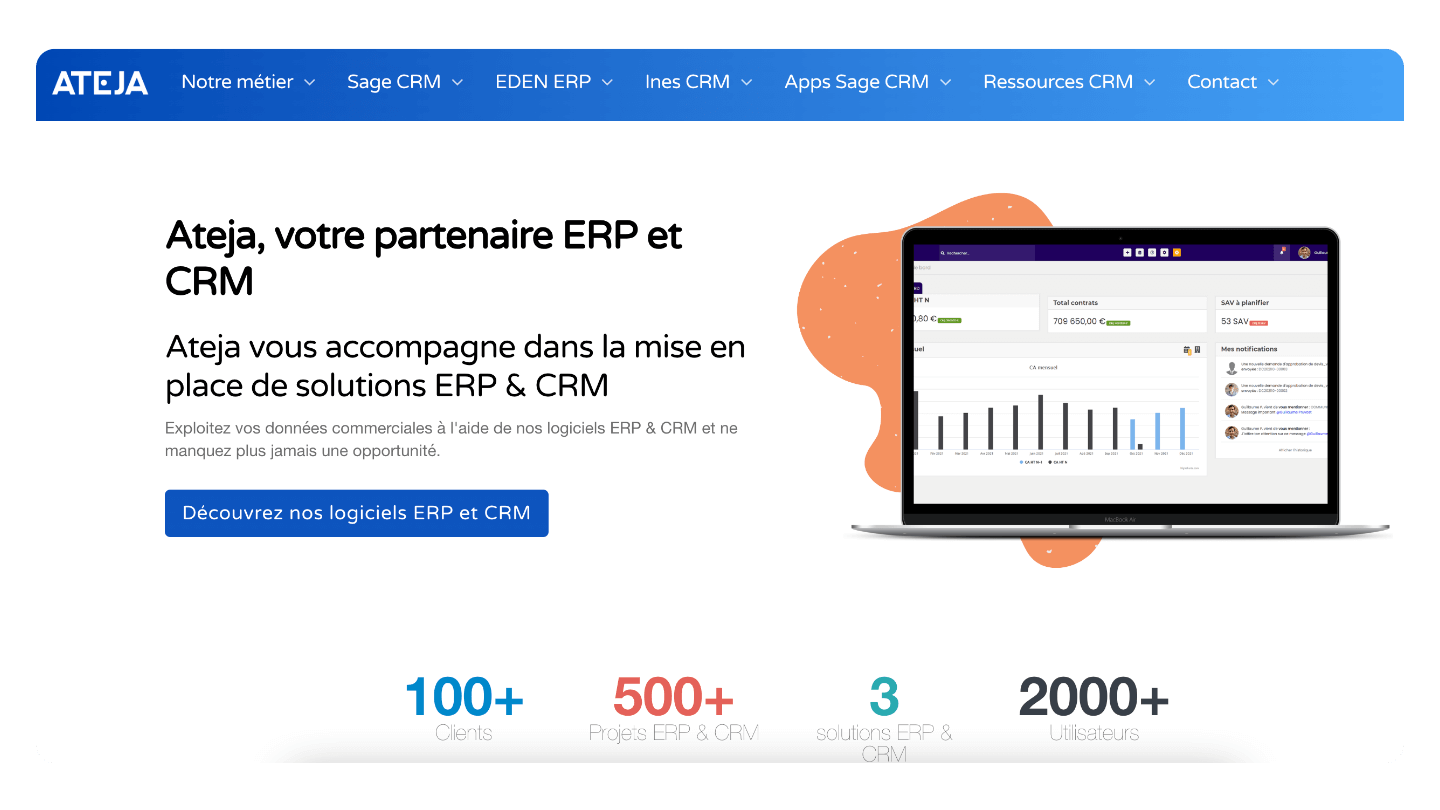
Since 2012, Ateja has been helping B2B SMBs and large accounts set up CRM solutions in line with their business challenges. Their philosophy: putting technology at the service of smoother processes and interactions. This “business-first” approach also guides their practice when it comes to CRM migration. Ateja has strong expertise in Sage CRM, INES CRM and Salesforce.
Beyond these four players, there are dozens of very good CRM integrators able to support you in your CRM migration project. To go further, check out our Top 30 CRM integrators in France.
The questions we get over and over.
When should you change CRM?
When the tool has become so complex that adoption drops, when it lacks features for the company’s new needs, when it connects poorly to the ERP, the marketing tool or support, or when its license, maintenance and training costs become hard to defend.
What are the steps of a CRM migration?
Analyzing the existing setup and defining needs, sourcing and choosing the new CRM, preparing the data, configuring and deploying, then change management and team training.
What questions should you ask yourself before a CRM migration?
What the goals are (productivity, agility, cost reduction), what scope is to be migrated, how much data is involved and in what state, which features will be indispensable tomorrow, and what budget to devote to it, in investment as well as internal resources.
How do you prepare data before a CRM migration?
With a complete audit to spot duplicates, outdated information and inconsistencies, then by cleaning, deduplicating, standardizing and restructuring the data to make it compatible with the new CRM. Appointing a data owner and setting governance rules helps maintain quality.
Should you get outside help to migrate your CRM?
It is not a must, but a migration requires technical, methodological and change management skills. A consulting firm, an agency or an integrator helps anticipate the pitfalls and stick to deadlines, especially without enough skills or bandwidth in-house.



What the community says.