



- CAC adds up advertising costs, marketing salaries and sales costs, then divides them by the number of customers acquired.
- An ad with a higher cost per click can work out cheaper per customer: it’s the cost per customer that counts.
- To lower CAC: segment to convert better, go through partners or referrals, work on organic traffic.
- A cost means nothing without associated revenue: CAC is read against LTV.
- A profitable average CAC can hide growth that isn’t, hence tracking marginal CAC.
Customer acquisition cost (CAC) is a metric that lets you measure the profitability of your sales & marketing efforts, since it corresponds to the cost of acquiring one customer. It’s very close to the cost per lead, traditionally preferred by marketing teams.
While it’s fairly simple to calculate, you need to distinguish between several levels of CAC and compare it with other metrics such as customer lifetime value (LTV) to make it truly actionable.
In this article, we walk you through the different uses & definitions of CAC, and the methods to deduce from it the efficiency & effectiveness of your sales & marketing investments.
1. What is customer acquisition cost used for?
What is CAC? An operational definition
Customer acquisition cost (CAC) is the total cost you spend to “win” a new customer. It usually includes the following items:
- Advertising costs (Facebook ads, LinkedIn Ads, Google Ads, etc.)
- Marketing team salaries
- Costs related to your sales teams
You then divide this cost by the number of customers acquired. It’s a really useful figure to calibrate your investment and make sure you’re making the right decisions for your company’s growth.
Example: What does this look like in practice within a company?
Let’s say you bought 3 ads at 100 clicks each, but they don’t cost you the same price per click. Consider the following example:
- Ad A: €5 per click, i.e. €500. Your 100 clicks get you 5 customers
- Ad B: €10 per click, i.e. €1,000. 100 clicks get you 15 customers
- Ad C: €20 per click, i.e. €2,000. But this time, 100 clicks bring you 40 customers
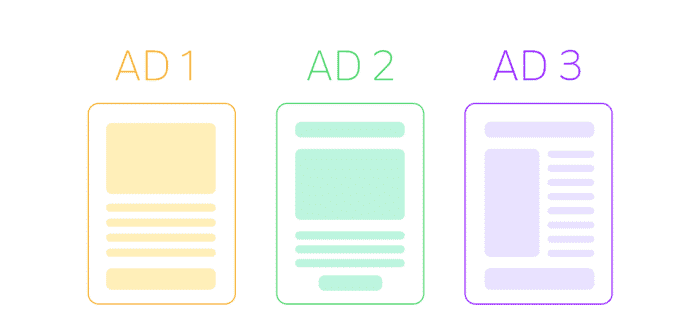
If you only look at cost per click, you’d prefer ad A, which is theoretically cheaper.
But if you divide the total cost of an ad by the number of customers it brings in, ad C is the most attractive, because you’ll only pay €50 for each new customer, whereas ad B costs you €67 / customer, and ad A costs you €100 / customer.
Operationally, with a growth objective (assuming €100 is an acceptable CAC), you’d look to grow volume on ad C (even if it means raising that ad’s CAC a bit along the way). With a profitability objective, on the other hand, you’d rather look to optimize ads A & B.
Salesdorado’s tipConversion rates can vary greatly from one channel to another and from one campaign to another. Hence the need for a “universal” metric: acquisition cost. Note right away that not all customers are equal either, and that acquisition cost is a useful variable to steer your cost (or budget), but it doesn’t (yet) let you measure profitability.
Why is calculating CAC important?
Calculating CAC can be used in two contexts:
Assessing a company’s strategy and positioning
Here, CAC is used to analyze a company’s potential to evolve. It lets you determine:
- A company’s profitability, by looking at the difference between the cost of a new customer and the money that customer brings in
- Growth potential, by comparing how CAC has evolved over the last few months with how the volume of new customers has evolved. If CAC rises a little but volume climbs sharply, the company still has plenty left in the tank. On the other hand, if CAC explodes while the volume of new customers barely moves, you’ll need to consider fairly radical changes to get back to a healthy growth trend.
Assessing & optimizing a company’s operational performance
To align sales with marketing, you can use CAC to optimize the return on advertising investments and on sales investments (hiring). In other words, the idea is to reduce the cost of acquiring a customer to increase the company’s margin and therefore its profit, or to keep it under control as best you can in growth or hyper-growth contexts.
Whether the context is one of growth or one of operations (i.e. optimizing profitability), CAC is THE operational metric that sales & marketing teams track to assess the performance of their efforts.
Be careful though to always look at it alongside the volume of new customers and the average revenue of those customers, otherwise all you’d have to do is stop spending to get a CAC of … zero.
The CAC sweet spotWhen the goal is to optimize profitability, there’s a “sweet spot” (an ideal value) between a CAC that’s too low, which means you’re letting the competition take market share too easily, and a CAC that’s too high, which means you’re buying customers at a higher price than the competition (and therefore eating into your profitability compared with the rest of the market).
2. How do you calculate customer acquisition cost?
The formula
To calculate CAC, you add up all the costs related to acquiring new customers (marketing and sales spend) and divide them by the number of customers acquired. This calculation is usually done for a specific period, such as a year or a fiscal quarter.
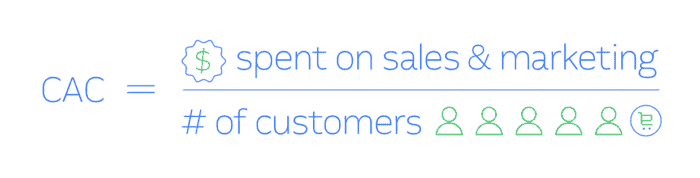
Example: over one year, a company spent $1,000 on marketing and acquired 2 new customers.
- 1,000 / 2 = 500. The CAC is $500 / customer.
- If it had acquired 2x more customers, the CAC would be 2x lower, i.e. $250.
This formula is fairly simple, but adding up total spend can involve many factors, including the cost of multiple marketing strategies (in particular lead generation strategies) and staff salaries.
Which costs should you include in your CAC calculation?
Total sales and marketing spend usually involves the following three items:
- Salaries
- Tools
- Spend
Everything that falls into these categories should be included in your CAC calculation.
| Spend category | CACs | % Customers | # Customers | Total cost |
|---|---|---|---|---|
| PPC CAC | €600 | 25% | 2,500 | €1,500,000 |
| Strategic alliance partners | €300 | 15% | 1,500 | €450,000 |
| SEO | €200 | 20% | 2,000 | €400,000 |
| Free acquisition | 0 | 40% | 4,000 | 0 |
| Total Marketing | €235 | 100% | 10,000 | €2,350,000 |
| Total sales | €250 | N/A | 10,000 | €2,500,000 |
| Total total | €485 | N/A | 10,000 | €4,850,000 |
Salesdorado’s tipThink of it this way: you need to include everything in the income statement that contributes to acquiring new customers. You’re trying to optimize your profitability: by leaving items out, you hide the real profitability of a customer.
Example: an online CRM software company (SaaS)
This company provides CRM software. As for its costs,
- Its distribution cost is generally fairly low because most companies leave onboarding to CRM integrators. Its retention cost is also fairly low because it’s quite expensive to switch CRM software.
- Its search engine cost is high because the company ranks very well in search engines and bets heavily on content production to generate customers.
- It pays a sales support team in its call centers located in the United States.
- It pays for many strategic partnerships that ensure a steady supply of customers.
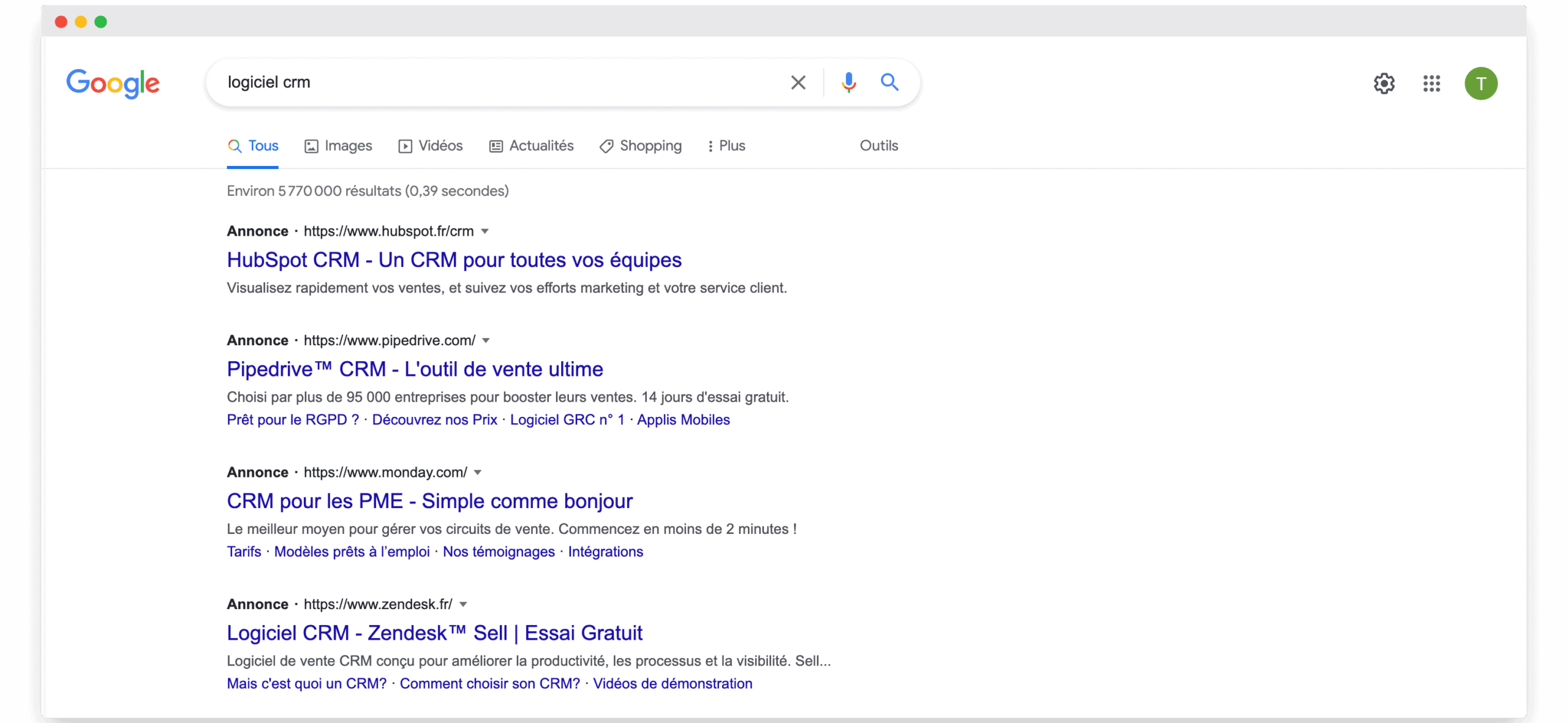
So, according to the following calculation, it spends €235 to acquire a new customer:
- Total cost of the sales call teams: €1,500,000 / year.
- Total cost paid to strategic alliance partners: €450,000 / year.
- Total cost of search engine optimization: €400,000 / year.
- Total new customers generated in the year: 10,000
Customer acquisition cost: €2,350,000 / 10,000 customers = €235
Watch outThis is only the beginning of the CAC calculation: we haven’t yet taken into account the money each customer brings in, which is calculated using customer lifetime value (LTV). You could settle for the average order value over the first month, or the first purchase, but you increasingly need to reason in terms of LTV.
3. How do you optimize customer acquisition cost?
Improve your conversion rates
The idea is to get more customers without increasing ad spend: you optimize CAC by increasing the return on investment (ROI), but without cutting costs.
To do this, you can improve your lead conversion rate, in other words convert more leads into paying customers.

How do you actually improve this conversion rate?
The only real lever for optimizing conversion rates is segmentation.
The more precise your target / message pairs, the better you’ll be able to convert. But that precision comes at a cost: operational complexity.
Optimizing CAC is almost always a trade-off between operational complexity and scalability.
Example: If we segment more, we’ll perform better and earn €10 more per customer, which lets us, with the same budget, acquire even more customers. But we also increase the complexity of our campaigns, so it will be harder (and longer and more expensive) to launch a new one. And the cost of maintaining these campaigns also rises significantly.
Go further
Turn your current customers into ambassadors
You have two options for this:
Create a partner program
In fact, it means creating a kind of reseller program: the best way to reduce your CAC is to hand over the job of marketing, selling and serving your customers to other companies.
By setting up the right partnerships, resellers don’t just refer relevant prospects to you (meaning prospects that are easy to convert into customers), they also market you through their own marketing channels.
This way, they close deals themselves and even help you retain your customers and sell them additional products.
Salesdorado’s takeOnce you’ve trained a partner, they can sell for you for years, because the success of their business depends on the success of yours.
Use a referral program
A referral program can encourage current customers to promote your company through a freemium product or a service extension.
The principle is simple: if one customer in ten brings you an additional customer, then one customer is actually worth 1 customer + 10% of a customer, i.e. 1.1 customers. You multiply your CAC by 1 / 1.1, so about 91%.
A referral program also lets you:
- Reward your most loyal customers: and we know they contribute far more to the company’s results than the constant search for new customers or recycling them.
- Access new sales opportunities: ambassador customers get a taste of the premium aspects of your products that they may already have considered without ever taking the plunge. So they’re more likely to choose to pay for these extensions to keep the freemium feature, or even buy others.

All in all, the referral program is a kind of virtuous growth circle, commonly called a “growth loop”.
Watch out for the cost of measurementLaunching a referral program concretely means that you pay your customers (one way or another) to recommend you. But in reality, some of your customers already recommend you! For free! Offering a reward therefore mostly lets you measure this channel, at least at first. But once you measure, you can work on it and optimize performance. Still, be well aware of this and above all don’t isolate the acquisition cost of referrals from the rest of your marketing operations. To properly measure the increment the program brings, you need to measure the overall impact on acquisition, including acquisition that is poorly measured or not measured at all.
Build an asset
SEO, by targeting top-of-funnel keywords, will “capture” customers who don’t know your brand and who are therefore slower to convert and so too expensive for marketing techniques.
The idea here is to reduce CAC without increasing ad spend, by playing on unpaid channels and in particular on so-called organic traffic.
DefinitionOrganic traffic on the Internet measures how many visitors come from a query made on a free search engine. Good search rankings let visitors click through to your site without it costing you a cent.
On top of that, good rankings produce more lasting results, because organic search acts like a flywheel and keeps producing organic traffic, whereas paid traffic stops when you stop buying ads.
Salesdorado’s takeCompanies can remove brand keywords from their ad spend, such as “Carrefour”: if someone types this word into Google, they’re looking either for the nearest store or for the website. Buying a keyword that matches a specific item only increases CAC.
4. The real issue: the LTV / CAC ratio
What is LTV?
Customer lifetime value (CLV, or sometimes LTV) refers to what a customer brings your company over their “life” as a buyer.
Of course, a customer’s lifetime and how much they spend vary considerably from one company to another and from one industry to another. So you need to take your company’s specifics into account.

However, some components of CLV are relevant for many companies:
- Average customer lifetime: how long an individual remains a customer.
- Customer retention rate: percentage of customers who buy again.
- Profit margin per customer: expressed as a percentage, it takes into account CAC as well as other expenses such as the overall cost of goods sold (i.e. production and marketing costs), and the cost of running the business.
How do you calculate profit margin per customer?Net revenue per customer (what they spend minus CAC) / estimated revenue from the customer over the whole relationship * 100.
- Average amount spent by a customer over their lifetime: amount spent by each customer over their lifetime / number of customers.
- Average gross margin per customer: can be calculated over a set period (one year) or based on the customer’s lifetime. In that case, you take the profit margin per customer over their whole lifetime, divide it by 100, and multiply it by the amount they spend over their lifetime.
How do you calculate average gross margin?Calculation over a customer’s whole lifetime: profit margin per customer over their whole lifetime / 100 * amount they spend over their lifetime.
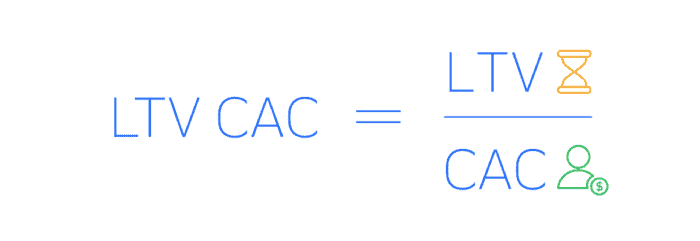
In reality, we should only talk about the CAC / LTV ratio, to compare CAC with the revenue that LTV represents. A cost means nothing without associated revenue.
You have two options for this:
- Reduce CAC
- Increase LTV
Watch outFor a long time, companies reasoned in terms of the average order value spent by the customer on one order. But a customer isn’t necessarily profitable from the first order, which is why today we calculate their LTV more.
Increase the perceived value of your offers
You need to understand what matters to your customers to strengthen their satisfaction and so increase your LTV.
The value of your offer is entirely subjective: adding new features similar to your competitors’ doesn’t mean the perceived value of your offer will change.
You’re better off spending time interacting with your customers (this is one of the major trends in CRM software), through surveys or emails, to determine what best matches their needs.
Salesdorado’s tipYou can use statistics such as your customer retention rate, but also more subjective data such as customer reviews, by looking for correlations between these different data points.
Optimize the customer experience
It’s indispensable: to put it simply, if your customer has a good experience with your company, they’re more likely to come back, which increases their LTV. A better customer experience goes hand in hand with a higher LTV and therefore a better LTV/CAC ratio.
You can obviously optimize your ads indefinitely, but there’s a limit to their effectiveness, and costs always go up. The point is to focus on the customer once they’re on your website.

The idea is to build a real relationship with them: you need to give them plenty of information about your products, set up good support, and offer a variety of payment and delivery options.
There are huge benefits to creating a fantastic customer experience both on the site and after purchase. It’s a way to retain customers and so increase their value, while boosting word of mouth and the brand’s overall exposure, which also helps lower CAC on paid channels.
Salesdorado’s takeCustomer experience is a far too underestimated area. While your competitors are sometimes obsessed with ad copy and creatives, you’ll see ten times more growth by working on the experience on your site. If that scares you, know that it’s one of the benefits of implementing CRM software.
How to calculate CAC: the formula
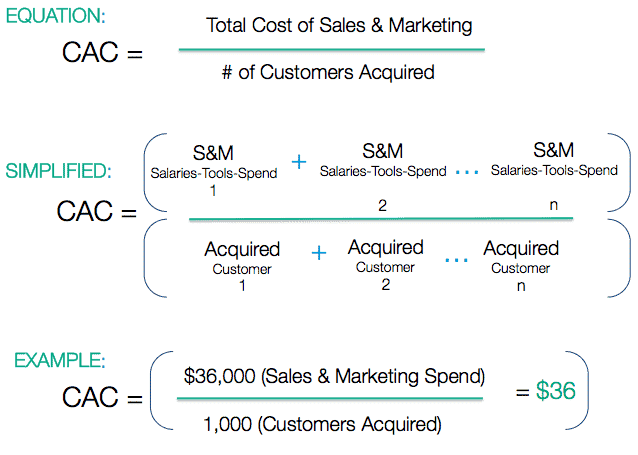
A company’s CAC is calculated by dividing all sales and marketing costs by the number of new customers acquired over a given period.
For example, if Jean spent $36,000 marketing a bag and 1,000 people bought his product in one week, his acquisition cost for that week is $36.
Why calculate the CAC / LTV ratio?
It’s the ratio that represents the return on investment (ROI) of all sales and marketing efforts relative to the new customers obtained through them. It’s an indispensable indicator of the effectiveness of different sales strategies.
CAC is also a key measure used by revenue leaders to better understand the drivers of their business model.
What is a good CAC?
It largely depends on the type of industry and the strategies a company implements to win new customers.
A widely accepted LTV/CAC ratio in the software world (SaaS) is 3/1 for example, but let’s remember that gross margins in the software world flirt with 90%.
To set a CAC target, you need to focus on the gross margin you get per customer (drawing on the LTV and profit margin per customer calculation detailed above), subtract a desirable or desired operating margin, and deduce the maximum acceptable acquisition cost.
Watch outThis acquisition cost is a marginal acquisition cost. We explain what that means right after 👇
What is marginal CAC?
So far, we’ve looked at operational CAC, i.e. the amount a company spends on sales and marketing divided by the number of customers it has won. But CAC is only meaningful in relative terms, hence the calculation of strategic (or marginal) CAC.
A company’s historical customer count usually includes customers who came through paid sources (SEM, SEO, Facebook ads) and unpaid sources (organic traffic).
Some marketing techniques are scalable, others aren’t. They can even have reverse economies of scale. Customer acquisition is a bit like drilling for oil. You can dig in the right place and it gushes, until it runs dry and you have to find another one.
The concept of marginal CAC is used to solve this problem. If you’re thinking about future sales, you want to know the cost of your next batch of customers, i.e. the CAC of the marginal customer.

Example: an e-commerce entrepreneur has a historical CAC of €150. He expected these costs to fall in the long run thanks to the development of his brand, his awareness, and his customer portfolio.
If we look at how the costs included in CAC break down,
- The organic channel is free by definition
- Only the cost of the paid channel will change: in the future, it will be 300 euros.
So this company’s marginal CAC is that of the paid channel, which rises exponentially while following a fairly strong logic of diminishing returns: so it’s possible that, contrary to what you estimated, your marginal CAC will rise in the future.
Salesdorado’s takeMarginal CAC is very important: by looking at your operational CAC, you may judge that you’re profitable overall. But your growth isn’t necessarily: that’s the averages bias. If each additional customer costs you more than they bring in, you need to change your acquisition strategy, and fast (!)
The questions we get over and over.
Which costs should you include in the CAC calculation?
Total sales and marketing spend: salaries, tools and spend. You need to include everything in the income statement that contributes to acquiring new customers. By leaving items out, you hide the real profitability of a customer.
Why not stick to cost per click?
Because conversion rates vary across channels and campaigns. An ad at €5 per click that brings 5 customers for 100 clicks costs €100 per customer, whereas an ad at €20 per click that brings 40 only costs €50 per customer.
How does a referral program lower CAC?
If one customer in ten brings you an additional customer, one customer is actually worth 1.1 customers. You multiply your CAC by 1 / 1.1, so about 91%.
Why does SEO reduce acquisition cost?
Organic traffic costs nothing per click, and good rankings produce lasting results: organic search keeps producing traffic, whereas paid traffic stops when you stop buying ads.
How do you increase LTV to improve the LTV / CAC ratio?
By increasing the perceived value of your offers, which means talking with your customers to find out what matters to them, and by optimizing the customer experience, both on the site and after purchase.



What the community says.