



- Count 3,400 to 17,000 € in fixed set-up costs, before the first production hour.
- The specifications are not optional: what is outsourced, the channels, the target markets, the tools.
- Managing the provider is an internal workload that companies almost always underestimate.
- Only outsource in the sales execution phase, when you have at least 80% of the answers on your leads, your conversion rates and your acquisition cost.
- With average deals below $1,000, the model does not cover the costs of outsourcing.
Outsourcing all or part of your sales force has, on paper, many advantages. But it is not always possible or profitable, and it also carries a few risks.
When should you outsource? What are the risks of outsourcing? And above all, how much will it cost you? We answer all these questions in this article 🙂
Find the right providerNeed to outsource your prospecting? Find the provider that matches your real needs.
Find a provider
Outsourced sales force vs supplementary sales force: definition
People generally talk about a supplementary sales force when it works on top of a sales organization that is already established and stable. An outsourced sales force would then be the full outsourcing of your sales headcount.
But whatever outsourcing format you have in mind, sales outsourcing can only work if you already have an established sales process.
In practice, an external sales force usually works on one specific part of your sales process: prospecting, qualification, an upsell or cross-sell campaign. The idea is that you need a clear interface between the internal sales team and the outsourced sales force so that both teams can work efficiently.
Outsourcing your sales force: how much does it cost?
Beyond the “production” cost, which depends directly on the rates charged by the provider you choose, you also need to budget for defining the specifications, selecting the provider, the technical deployment, and also training and managing that same provider!
So there are variable costs and fixed costs, which we have summed up in the tables below 🙂
Fixed costs of setting up the outsourcing project
| Cost item | Cost item details | Cost estimate | Total cost |
|---|---|---|---|
| Formalizing the sales process | This only means gathering and formalizing the elements of the sales action plan. Building all these elements “from scratch” would take much longer. More or less complex depending on the size, maturity and tools of the sales team. | 2 to 5 FTE days | 800€ – 2000€ |
| Defining the specifications | Defining precisely which parts of the sales process will be outsourced (prospecting, qualification, ad-hoc campaigns, …), and formalizing the different operational interfaces | 1 to 2 FTE days | 400€ – 800€ |
| Selecting the provider | Benchmark, first contact, formalizing needs, assessing the different solutions | 4 to 5 FTE days | 1600€ – 2000€ |
| Technical deployment (set-up) | This part is usually offered by the provider. The final cost depends on how complex your tools are. If you are on a VoIP solution, the cost is negligible. On the other hand, if you use complex solutions such as an intranet, VPNs, etc. the cost can quickly climb to 5000€ | Flat fee – Count 1 to 2 internal FTE days if technical interactions are complex | 0 – 5000€ |
| Initial training on products & sales process | Training is usually billed at the cost of a production hour. Depending on how complex your products and your target are, it can range from two hours to six weeks. We obviously recommend starting simple: count between 2h and 20h. | 2 to 20h of production * the number of people trained * the production hour | 600€ – 7200€ |
| Total cost: | 3400€ – 17000€ |
Before going furtherOur estimates are based on a full employment cost of 55€ / hour – i.e. 100,000 € a year per employee including French employer contributions, offices, training, etc…
1. Formalizing the sales process
Formalizing your sales process means defining your sales action plan, your target – message pairs and your sales scripts in particular.
Before defining your specifications as such, it is very important to be aware of how mature your company is in terms of sales processes. Many providers such as Lalaleads can support you during this phase, which can however be optional if your sales processes are already well enough established.
Watch outIf you get a provider to support you on this part, the key elements of your sales strategy actually take years to fine-tune. Putting them to the test is what lets you polish your pitch and your sales approach. Here it is mostly about gathering and formalizing the elements of the sales action plan.
Is outsourcing this upstream work a good idea? Here are the benefits you can get from it, depending on your maturity.
For companies whose sales strategy is still “under construction”, this step lets you define and adapt your ICP, your tools, your sales processes, your pitch, your sales arguments, etc… This support is also an opportunity to take stock of your positioning and your competitors.
For companies that are mature on the sales side, the approach is a little different:
- If your organization is well structured, you can start by asking yourself whether this outsourcing approach is profitable. Take stock before you start: you might end up deciding not to outsource your sales prospecting.
- Also take stock of the sensitive targets you want to handle yourself, so you don’t damage your company’s brand image with calls to poorly qualified leads. You can focus this outsourcing on one particular segment.
- It is also an opportunity to define the right sales KPIs that will let you measure how effective your outsourcing approach is, for example the number of meetings generated by a telemarketing campaign.
Going furtherRead the following articles before you start:
2. Defining the specifications
If the first step was optional, this one on the other hand is critical. Defining your specifications should let you:
- Establish precisely which parts of the sales process will be outsourced: Prospecting (Booking meetings only? Pure selling?), qualifying your leads, setting up ad-hoc campaigns…
- Define the channels used: Phone, email, LinkedIn or omnichannel sequences?
- Locate your providers: define the markets you are targeting, and choose providers based on the language spoken by your potential customers if you sell internationally.
- Take stock of the tools you already have in-house or need to get: CRM tools (Pipedrive, noCRM, HubSpot CRM, etc…); prospecting tools such as Captain Data, or Waalaxy for example; VoIP tools; enrichment tools; tools for finding leads (B2B database providers); closing tools (Zoom, Livestorm for webinars or Youtrust, formerly Yousign, for e-signatures for example).
- Formalize the different operational interfaces.
3. Selecting the provider
Even this selection process will cost you money, and for good reason: making the right choice of provider is crucial insofar as it represents a significant financial investment.
And when you outsource your prospecting, you are handing your brand image to an external provider. That provider is going to contact many prospects and potential partners in your name. Choosing the wrong provider can unfortunately tarnish your reputation in the long run.
The cost of quality also has to be taken into account. A prospect contacted with the wrong approach will probably not become a customer and will be deaf to your future attempts. It’s a waste of time and money!

Benchmark, first contact, formalizing needs, assessing the different solutions… A few tips to carry out this selection process successfully:
- Identify one to three people in your organization in charge of talking to the different providers. They will also have to rank the providers’ strengths and weaknesses in an analysis grid, based on the criteria set in your specifications.
- Draw up a shortlist of 3 or 4 providers, and ask them for a demo.
- Hold internal meetings, and above all involve your salespeople, but also the marketing teams in charge of lead generation for example. Don’t forget that Sales / Marketing alignment is key to your sales success!
- Expect these negotiations to be time-consuming. Don’t leave it to the last minute, so you keep enough negotiating leverage.
4. Technical deployment (set-up)
This part is often offered by the provider; here the costs depend on how complex your technical environment and your sales processes are.
For complex environments that require a high level of security, VPNs, etc… the cost can quickly climb to 5000€.
Tools such as Ringover increase companies’ communication capacity thanks to a cloud-based phone system. With these tools, your lines won’t be saturated during your phone prospecting operations. So your customers can still reach you. These solutions don’t require any physical hardware installation. It saves both time and a lot of money.
Salesdorado’s estimateCount a flat fee of 1 to 2 internal FTE (full-time equivalent) days, especially if you have complex technical needs. That comes to a cost of 0 to 5000 € depending on your expectations and the equipment you already have in-house.
Variable production costs
Initial training on products & sales process
An hour of training is usually billed at the rate of a production hour. The training time itself depends mainly on how complex your offers and products are.
You need to plan enough hours to train the provider’s teams. It’s hard to estimate this cost item precisely: it can range from 2h to 6 weeks (to be multiplied by the hourly production rate of the chosen provider & of course by the number of people to train!).
The lower the provider’s cost, the more weight you need to give to training.
Salesdorado’s tipAlso test your sales pitch to give yourself every chance of success. Get several people to test the scripts over a few months, then pick the right one through A/B testing. The vast majority of call centers work without a commitment, so you can easily stop part of the activity at any time.
Managing and tracking performance
Managing your providers is a significant internal workload, which companies always tend to underestimate. It is in fact a critical part of an outsourcing project’s success.
The budget to plan for necessarily depends on the size of your project. So no precise estimate, but we very strongly recommend that you plan ahead for this point by identifying the right person within your teams to manage your providers.
Careful: managing providers is not something you can improvise. Make sure the person in charge of this responsibility has a good command of:
- Performance reporting tools
- Production report templates
- Call monitoring grid templates
- What a calibration session is
Some organizations offer training in managing providers, or even outsourced management of those providers, in interim management mode.
Salesdorado’s tipCreating documentation upfront can help standardize these processes, especially if the person in charge is likely to change.
Production cost
The (hourly) production cost, depending on the provider chosen, can range from around fifty euros an hour in France down to less than 10€ an hour farshore (in Mauritius for example).
Breakdown of production costs, the example of call centers:
| Call center location | Rates | Examples of providers |
|---|---|---|
| France | 50€ / production hour | Lalaleads |
| Nearshore (Europe) | 22€ – 25€ / production hour | – |
| Offshore (Maghreb) | 12 – 15€ / production hour | Exosell (Morocco) |
| Farshore (Mauritius) | 7 – 10€ / production hour | – |
Which players, and why such differences?
In France
By working with a French agency, you benefit from being close to your provider, which means you avoid time differences when you get in touch with them, among other things. On the other hand, the hourly cost will be higher.
For example, Lalaleads is a prospecting agency specializing in B2B. They combine rigor with a pirate spirit that lets them design tailor-made campaigns built on quality data.
Find the right provider Discover LaLaLeads
Nearshore
These agencies are based elsewhere in Europe, close enough to France for the time difference to stay small (or non-existent). The hourly cost goes down compared with a French call center.
Offshore
These companies are beyond Europe’s borders, but are still usually located in a relatively close geographical area (such as North Africa, for example). They have the advantage of low-cost labor, and of flexible hours similar to those of European companies, since the time difference stays small.
Take the example of Exosell, a call center located in Morocco. Since 2004 they have been providing telemarketing and customer service operations to 200 French companies. Their teams receive general training in the French language and culture, as well as in sales relations. The agents also receive tailor-made training based on your requirements and specific features.
Farshore
This means using call centers located in areas geographically very far from yours, such as India or Mauritius for example. Labor costs there are significantly low.
To choose among the most reputable call centers on the market, feel free to check our comparison of the best B2B call centers.
When should you use an outsourced sales force?
Outsourced sales prospecting
Prospecting agencies (in France, or offshore) are plentiful, and the most common format in B2B is a pay-per-meeting contract.
Agencies usually commit to a certain number of meetings (per month for example), and you buy each meeting at a fixed price, or else you agree on a best-efforts commitment, usually with performance safeguards.
The discovery meeting and the whole negotiation and closing phase are then usually handled by an internal team that knows the company’s products and processes well.
It is the most common case because prospecting is one of the thorniest topics in sales teams. Despite every optimization you can think of, success rates hit a glass ceiling fairly quickly, and the only way to increase performance is to increase volume.
But it is also one of the least structuring aspects for a sales team, in the sense that prospecting efforts depend fairly little on the product or the market, and a lot on the person making the calls, running the cold mailing campaigns, etc.
Most of the cost of getting to a high-performing prospecting team lies in recruiting, training and running a sales floor. And even if the start-up nation got a little carried away in the days of low interest rates and completely crazy valuations, it really makes fairly little sense to invest massively in a prospecting floor when many agencies do it very well.
Handling a variable volume of inbound leads
One of the main reasons to turn to an outsourced or supplementary sales force is when you can’t cope with a volume of inbound leads that is too high. A good problem on paper, but not always.
For example, if your business is highly seasonal, recruiting, training and running a floor of salespeople all year round to handle a two-month peak in the year is very inefficient.
That’s where a supplementary sales force really makes sense. You can set up a support team in a few weeks that can handle all the inbound leads, considerably shorten sales cycles, and limit the opportunity cost.
In detail, these teams very generally work on the least critical parts of the sales value chain, for example to handle the sales qualification phase, before handing over to the established teams for the negotiation and closing phases.
New product or market
This is another classic case of sales outsourcing. Your sales organization is structured and performs well on a range of products and in a given geographical area. And you launch a new region, or a new product range.
Reorganizing your team to take on this market is not only a significant cost, but also a big risk. As the saying goes, never change a winning team.
Handing this new market to an external sales force limits the risks and limits resistance to change. Better still, if it’s done well, it can introduce healthy competition between the internal team and the supplementary sales force, which helps integrate the new market into existing processes (or at least limits the apprehension).
Why use sales outsourcing?
Let’s start with the advantages of the approach, to set the scene.
1. Outsourcing your sales force is often cheaper
According to most surveys, cost savings are the main reason for outsourcing. Data from job sites such as Glassdoor or Indeed suggest that the average base salary of a Sales Development Representative (SDR) ranges from $47,800 to $62,000.
None of these costs usually take into account software, hardware or other standard overheads – around 25% of salary. On top of that, the part least taken into account is the allocation of management time, money and resources. These hidden costs can easily run to six figures.
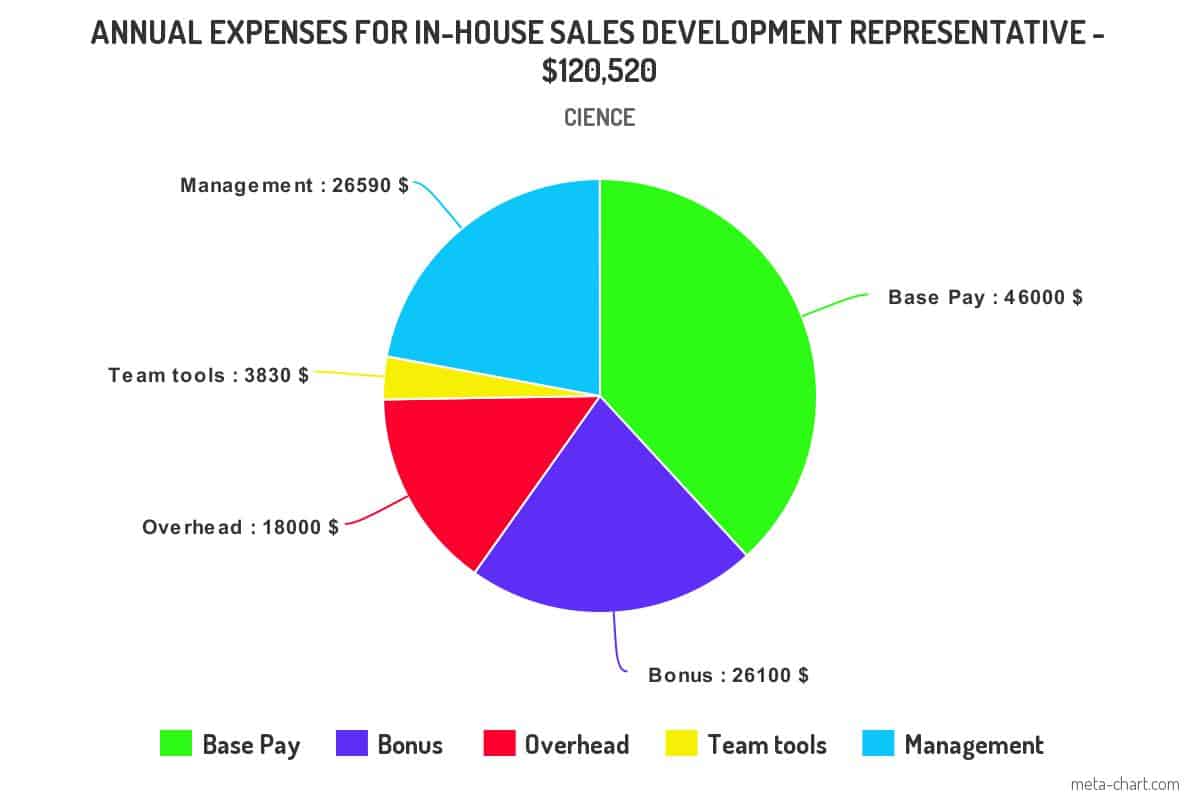
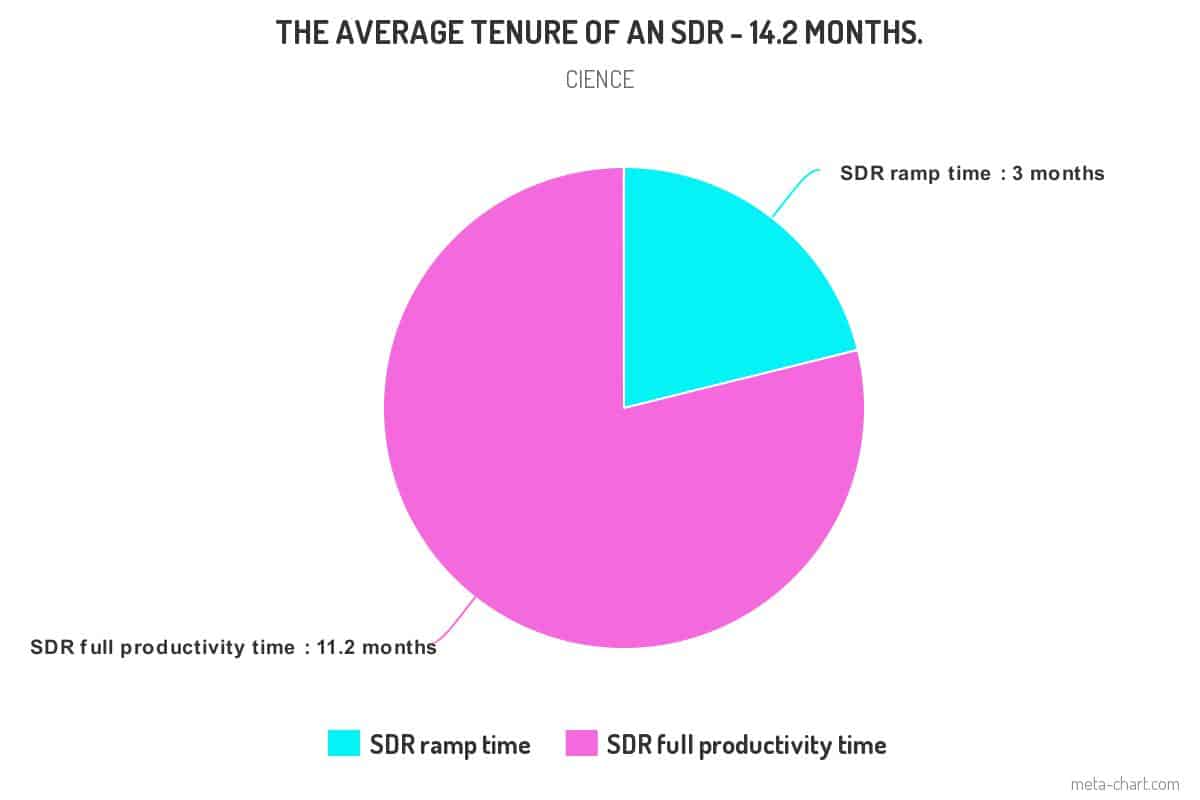
The SDR role largely serves as a short-term springboard for a sales career. The average hire comes with less than 12 months of experience and stays with the company less than 15 months on average.
It is rare to find companies that allocate HR costs to the training and retention needed to make insourcing work.
In other words, hiring an SDR to bring prospecting in-house amounts to training your competitors’ future salespeople. An SDR will take at least 3 months to become effective, and will leave on average 11 months later. That means positive productivity for less than a year.
Besides cutting costs, companies usually try to estimate the return on investment using the following criteria:
- Freeing up your internal employees’ time.
- Better analysis and planning (consistent opportunity creation)
- Gaining knowledge and experience
- Strategic value (building a pipeline)
- Innovation
The freshness mythBasically, new hires with less than a year of experience bring a lot of energy and a lot of ideas. But don’t expect them to bring innovation and strategy to your company during their first year on the job. That year has to focus on learning.
Insourcing comes with a multitude of costs, most of them hidden.
Outsourcing, on the other hand, may seem expensive, but the costs will always be obvious. Make sure you run a thorough analysis of both before drawing conclusions about which one is really more expensive.
2. Outsourcing your prospecting lets you move much faster
All good relationships need to be nurtured, and that takes time. However, when your business is at stake, time becomes a luxury you can’t afford. When you have no customers, you can’t sell.
When you are looking for buyers (or for salespeople to hire), you are not selling. So browsing LinkedIn profiles isn’t really an option. In our experience, it takes about 3 interviews and at least 4 people to find a truly relevant professional for your internal team.
How does outsourcing your sales force help you avoid getting stuck in this loop?
When you outsource your sales to a B2B agency, you get a reliable assistant who will help you choose the best experts for your team in just a few days.
Then this team will take care of lead generation and prospecting, delivering warm prospects ready to close. As a result, you can invest more time in perfecting your products or services to gain even more competitive advantages.
Besides reducing the time needed to find and assemble your sales team, you also spend less time worrying about hitting your targets.
You will be working with professionals who can quickly get to grips with your company’s needs and goals.
The risks of outsourcing your sales prospecting
1. Outsourcing prospecting too early
To understand this point properly, you need to split the evolution of sales processes into two phases:
- Sales exploration : this is the phase where your sales processes are not yet fully defined. Your salespeople are still feeling their way to find the right answers to objections, the right sequences, and to identify the average values of key indicators such as the sales cycle or average revenue per account.
- Sales execution : this, on the contrary, is the ramp-up phase. Your processes & your key indicators are identified & measured, and the main challenge is to gain in efficiency & performance.
Note that these two phases are not as sequential as they seem. All sales organizations should keep doing some exploration, even if they think they have found most of the answers. And conversely, doing too much exploration often goes hand in hand with a lack of process, and a glaring dependence on a few over-performing salespeople.
Salesdorado’s tipIt is fundamental to turn your teams’ individual learnings into organizational learnings in order to gain efficiency.
Sales exploration
At this stage, you are still figuring things out. It is about learning and experimenting. You have not yet defined a predictable, repeatable sales action plan. You have not yet developed your sales funnel. You are still looking for an answer to these questions:
- How do you generate leads?
- How much does a lead cost?
- What are your conversion rates?
- What kind of salespeople should you hire and how do you pay them?
- How much does it cost to acquire a customer?
You don’t need 100% of the answers to all these questions, but if you are below 80%, consider yourself still in the exploration phase.
Sales execution
At this stage, you already have all the answers, or at least 80% of them. You already have something to build on that works. Now it’s about scaling it and optimizing it.
Salesdorado’s tipOnce you are in the sales execution phase, you can subcontract. You can hand this over to sales professionals who really know how to run and optimize a sales model.
They can take you from 80% to 90% and finally 100%. That’s what they specialize in: not the creative thinking and experimentation needed to build your first sales model, but simply fine-tuning it.
2. Outsourcing too much
Although you can track its activities, you can’t always control the way your partners engage with your potential customers. Are they in line with your values & your sales ethics? Do they present your offer accurately? Do they contribute to the image you want to build?
These problems are hard to manage and require close contact with the partner team. And don’t forget: even if you get professional help, you remain the expert on your product or service. Take the time to train the team that is going to work for you.
3. Your average order value is too low
If you work in B2C, B2B2C or B2C2B, there is a good chance your business model is simply not suited to outsourcing your sales force. It depends largely on the price of your products.
If you close average deals below $1,000, it is unlikely this can cover the costs of outsourcing both the SDRs and the account managers.
Another way to find out is to analyze your lead generation. Do you rely on inbound marketing to build your pipeline, or on your salespeople?
Grammarly is a good example of B2C2B success. At first, they only offered paid accounts. According to Alex Shevchenko, the program’s developer, the company was losing 95% of potential users because of this approach.
After a gigantic $110 million funding round in 2017, Grammarly now offers both freemium and premium services. More than 95% are freemium users, or more than 10 million people worldwide. Professional content writers and journalists will always want the Premium version and will persuade their employers to buy it.
With a model like this, Grammarly simply doesn’t need outbound prospecting. It is a highly scalable B2B lead generation model, suited to Grammarly’s (very low) average order value.
A fully outsourced sales force: a myth?
In theory, you can outsource the entire sales process to a provider. As long as the sales process is well defined, the KPIs are known, and the sales relationship is minimal, you could imagine outsourcing the entire sales force.
But if you dig out your corporate strategy classes, outsourcing is traditionally reserved for “non-critical” activities – that is, to take a little shortcut, activities in which the company can’t really differentiate itself from the competition.
And it is still very hard to sell without differentiating yourself.
Conclusion
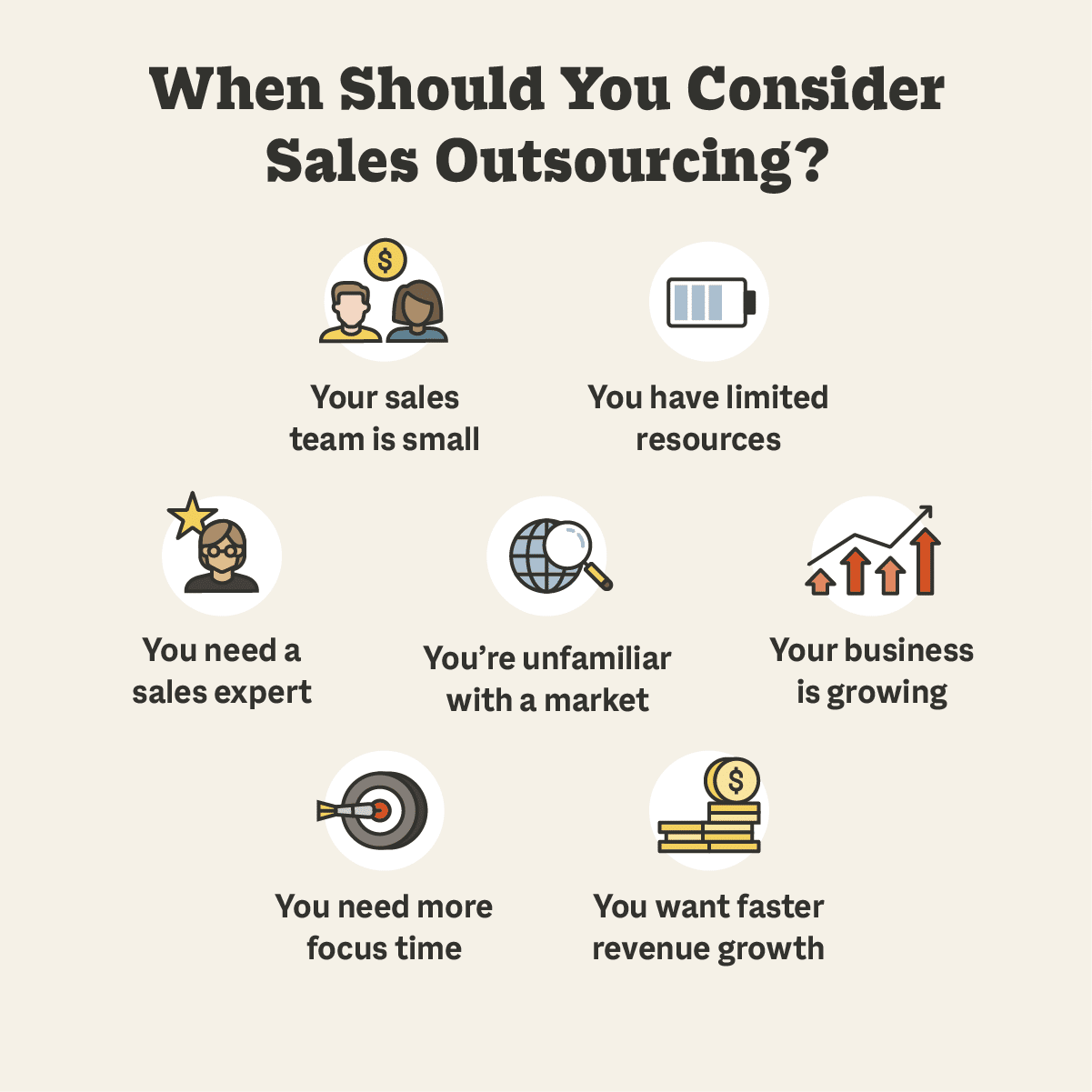
Sales outsourcing is generally seen as a temporary option. But that “temporary” can last from several months to several years. The main use cases for considering outsourcing are:
- Going international (building on an existing sales success)
- Launching a new product (building on an existing sales success)
- Hyper-growth (outsourcing then supports a specific phase of the sales funnel, such as prospecting)
- Highly seasonal campaigns, for the most mature companies
The questions we get over and over.
How much does it cost to set up sales outsourcing?
Salesdorado estimates the fixed costs at between 3,400 and 17,000 €: formalizing the sales process (800 to 2,000 €), specifications (400 to 800 €), provider selection (1,600 to 2,000 €), technical deployment (0 to 5,000 €) and initial training (600 to 7,200 €). These estimates are based on a full employment cost of 55 € an hour, a French figure.
What is a call center’s hourly rate depending on its location?
Around 50 € per production hour in France, 22 to 25 € nearshore, 12 to 15 € offshore (Maghreb) and 7 to 10 € farshore (Mauritius).
Why outsource your sales force rather than hire SDRs?
Because it is often cheaper and faster. An SDR takes at least 3 months to become effective and leaves on average 11 months later, not counting the hidden costs of recruitment, software and management. A B2B agency, on the other hand, puts the team together in a few days.
When is it too early to outsource your prospecting?
As long as you are in the sales exploration phase: you don’t yet know how to generate leads, how much a lead costs, what your conversion rates are or how much it costs to acquire a customer. Below 80% of answers to these questions, keep prospecting in-house.
When should you consider sales outsourcing?
Going international and launching a new product, building on an existing sales success, hyper-growth, as support on a specific phase of the funnel such as prospecting, and seasonal campaigns for the most mature companies.



What the community says.