The tool in detail
What is Clay really, and where does the company come from? We go through its features (waterfall enrichment, the Claygent AI agent, intent signals, no-code workflows, integrations), take apart the credit model and its hidden costs, then position the tool against Apollo, ZoomInfo, Cognism, La Growth Machine and Lemlist.
You’ve definitely seen Clay come up on LinkedIn. « GTM Engineers » swearing they tripled their reply rates. Influencers hailing the tool as the revolution in B2B prospecting. Impressive case studies at OpenAI, Anthropic or Canva, and credit-based pricing that promises to replace 4 or 5 separate subscriptions.
Except that when you dig a little (and we did dig) the reality is more nuanced. We went through feedback from more than 500 users (G2, Reddit, LinkedIn), analyzed the customer cases, took apart the credit system and tested the platform. Our verdict: Clay is probably the most powerful data enrichment tool on the market. But there’s a « but », and it’s a big one.
What exactly is Clay?
First misunderstanding to clear up: Clay is not a CRM, nor an emailing tool, nor a plain data provider like ZoomInfo. Clay is a Go-To-Market data orchestrator, an intelligence layer that sits between your data sources and your execution tools (CRM, sequencers, ads).
In practice, picture a supercharged spreadsheet that can query more than 150 databases, apply AI to qualify, score and personalize each row, then push the result into your HubSpot or Salesforce automatically. All without writing a single line of code, in theory at least.
The company was founded in 2017 in New York by Kareem Amin and Nicolae Rusan. For six years, Clay searched for its product-market fit, moving from a general-purpose data automation tool to a « personal CRM » before finding its niche in 2021: data enrichment and orchestration for B2B sales and marketing teams.
The pivot was spectacular: revenue multiplied by 10 between 2022 and 2024, then 600% growth in 2024. In June 2025, a $100 million Series C led by CapitalG (Alphabet’s fund) pushed the valuation to $3.1 billion. Among the customers it claims: OpenAI, Anthropic, Canva, Intercom, Rippling and Vanta.
Salesdorado’s takeClay’s trajectory is impressive, but keep in mind that most of the customer cases it showcases are American tech scale-ups with dedicated RevOps teams. The value doesn’t automatically carry over to a French SMB with 20 salespeople.
Clay’s key features
Waterfall enrichment, the core innovation
This is the heart of the engine. The principle is simple but formidably effective: rather than relying on a single data provider (which will inevitably have gaps in its coverage), Clay queries several providers one after another for the same field.
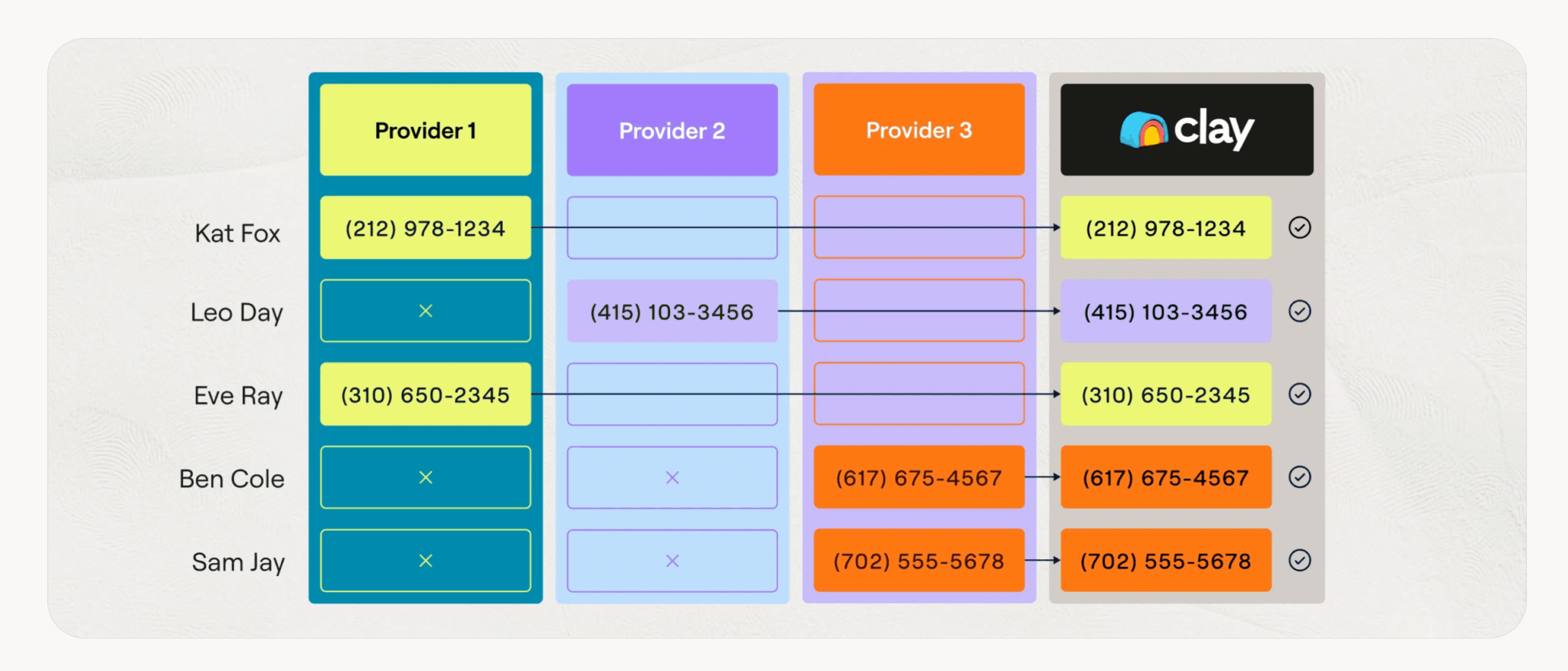
Say you’re looking for a prospect’s work email. Clay will first query Hunter (the cheapest), then Dropcontact if Hunter finds nothing, then People Data Labs, then ContactOut, and so on. As soon as a provider returns a valid result, the cascade stops. The email found can then be verified automatically through NeverBounce or ZeroBounce to protect your deliverability.
The results speak for themselves: several documented customer cases report tripling data coverage compared with a single provider. OpenAI, for example, went from 40% to 80% enrichment coverage on its inbound leads using Clay workflows.
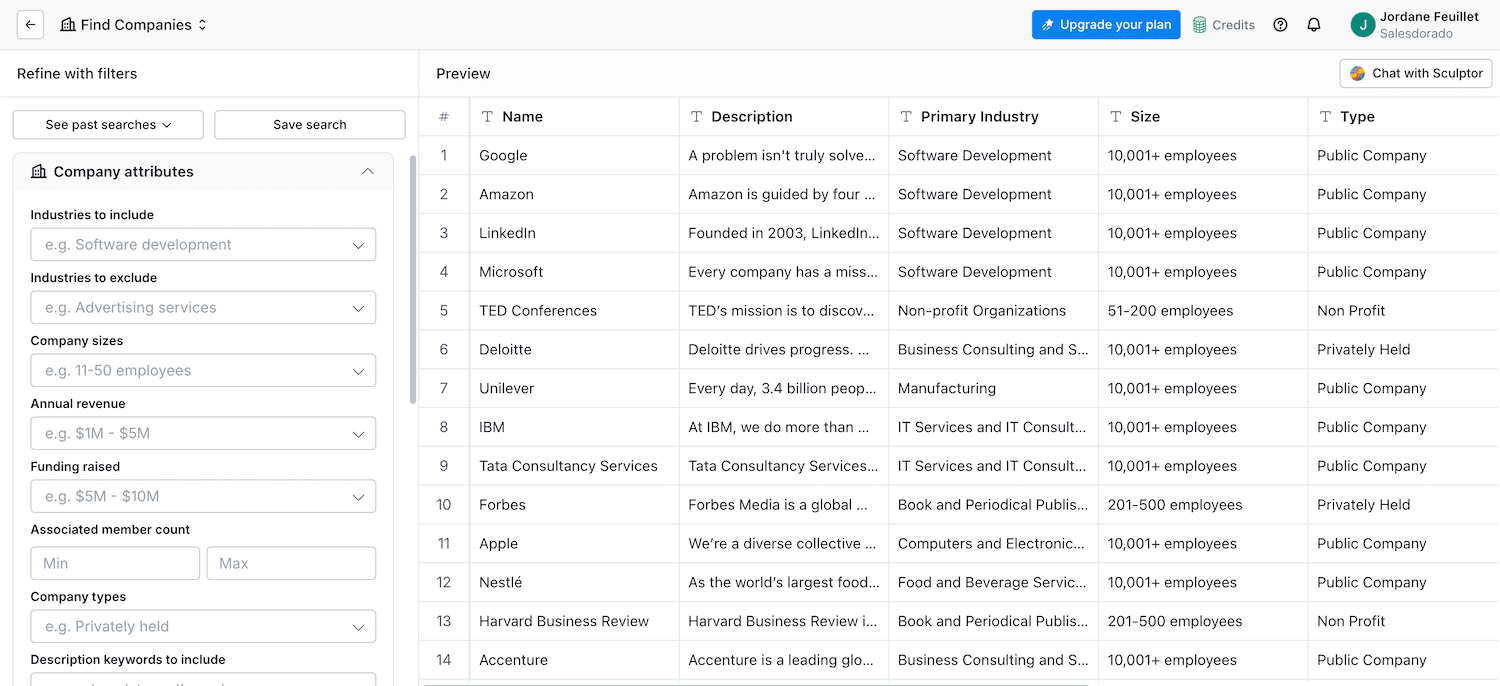
Enrichment isn’t limited to contact details. You can aggregate firmographic data (size, funding rounds, industry), technographic data (the stack used by the target company), hiring trends, web traffic and much more. It’s by combining these signals that you can then build lead scoring that is genuinely relevant.
Claygent, the AI web research agent
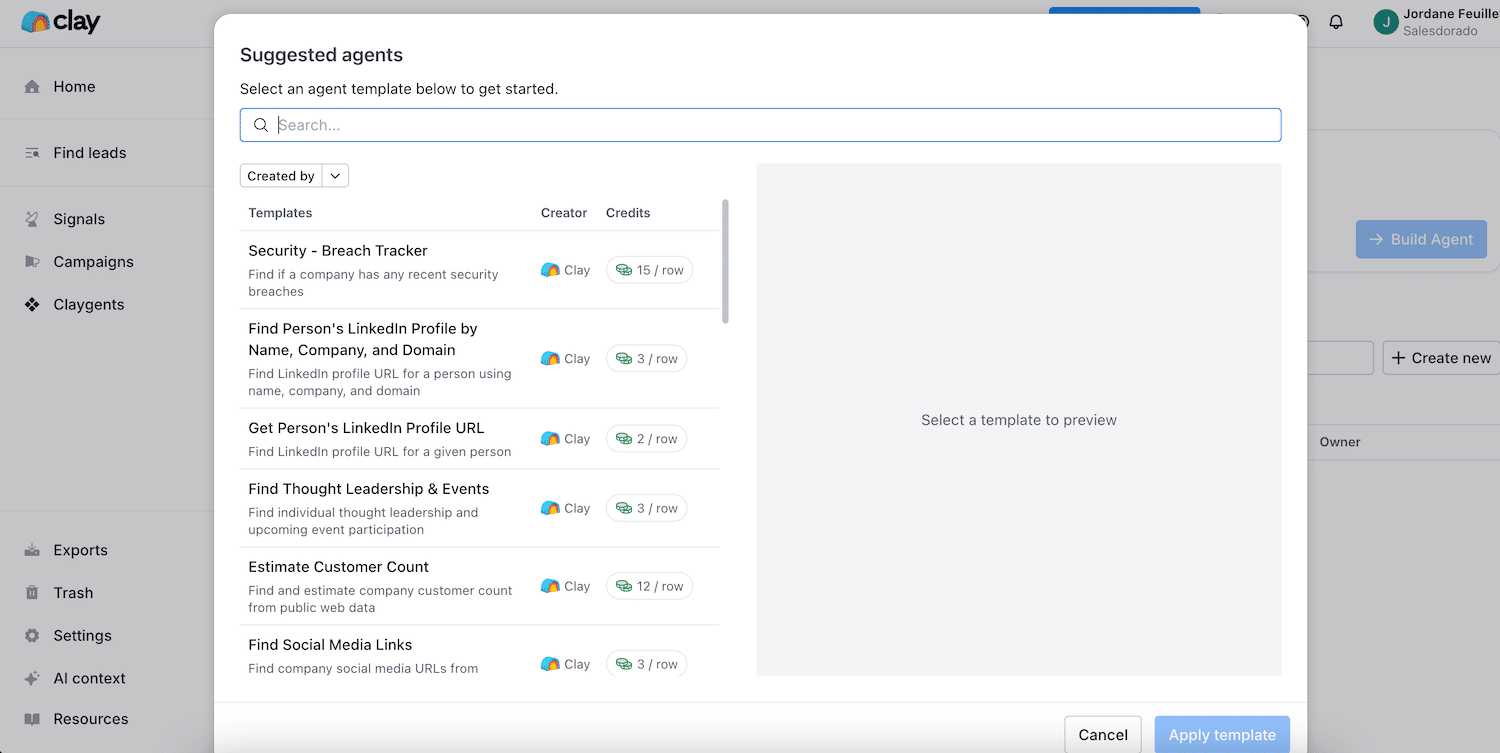
Claygent is an artificial intelligence agent that can browse the web on its own to extract information that structured databases don’t contain. We’re talking about unstructured signals here: recent content published by a prospect, a target company’s brand tone, whether it has a blog or a specific careers page, mentions in the press.
Claygent passed the milestone of one billion cumulative runs in June 2025. Powered by cutting-edge language models, it can summarize news articles, sum up a competitor’s value proposition, analyze careers pages to infer a company’s priorities, or generate personalized hooks for your prospecting emails.
This is probably the feature that creates the most value for teams doing hyper-personalization at scale. Instead of spending 15 minutes researching each prospect by hand, Claygent does the job in a few seconds. The result isn’t always perfect (hallucinations are possible), but on large volumes, the time saved is massive.
Intent signals and triggers
How relevant a sales action is depends as much on data quality as on timing. Clay includes a tracking engine for business signals that automatically detects the right moments to contact a prospect.
Among the signals you can monitor are job changes (a new VP Sales coming in probably means the tooling gets reviewed from scratch), funding rounds (more budget, more purchases), job postings (hiring a « Head of RevOps » often signals a need for tooling) and competitor mentions on social media (a customer unhappy with a competitor is an opportunity).
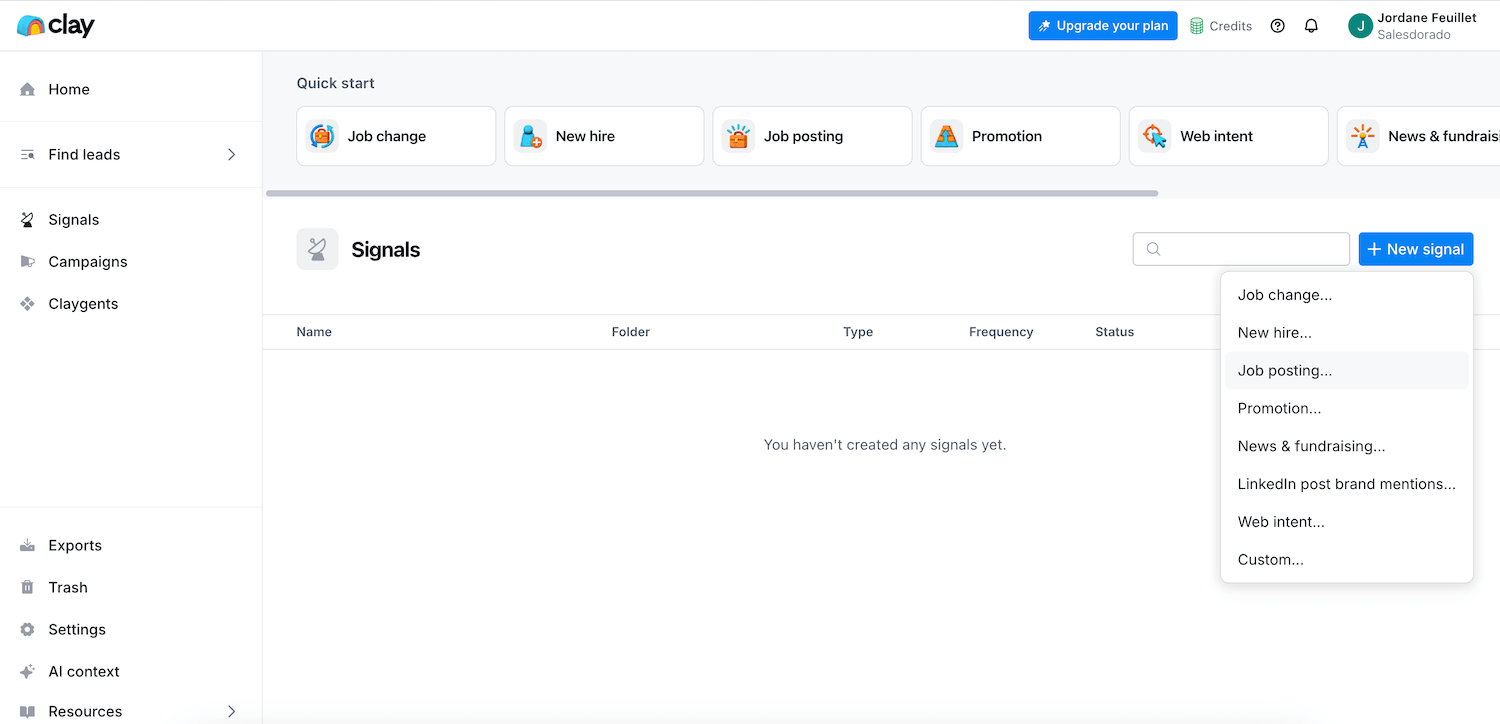
This approach ties directly into the logic of Event-Based Marketing: rather than cold prospecting on static lists, you trigger targeted actions based on real events. It’s an approach the most advanced sales teams are increasingly adopting, and Clay makes it accessible without custom development.
Orchestration and no-code workflows
Clay’s interface looks like a spreadsheet, but it’s a spreadsheet on steroids. Each column can be an action:
- enrich a field,
- apply a filter,
- run an AI search,
- score a lead,
- send a data point to a CRM.
You can chain dozens of actions in a cascade, with conditional logic (if X then Y), loops and deduplication.
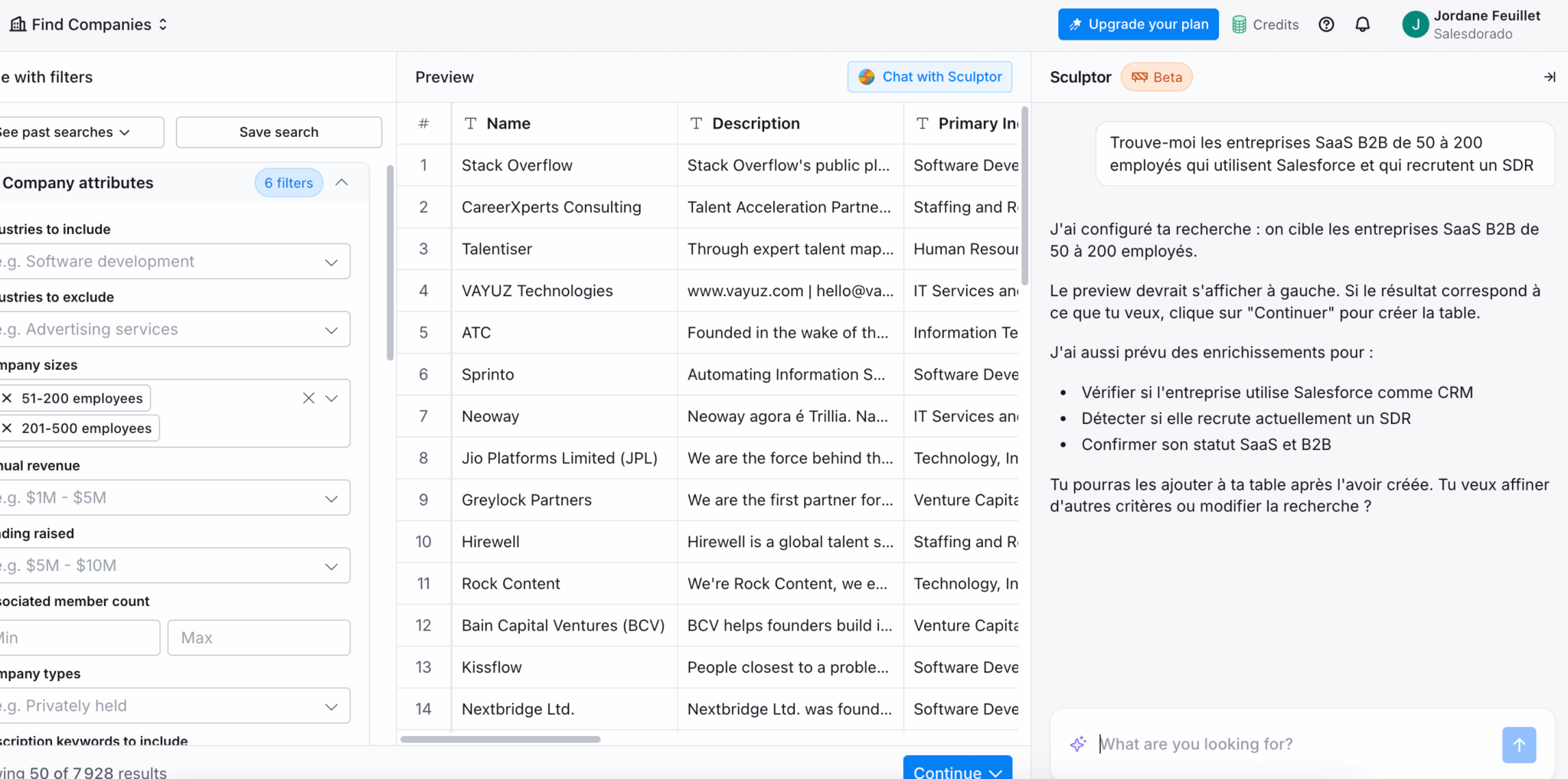
Two features are worth pointing out:
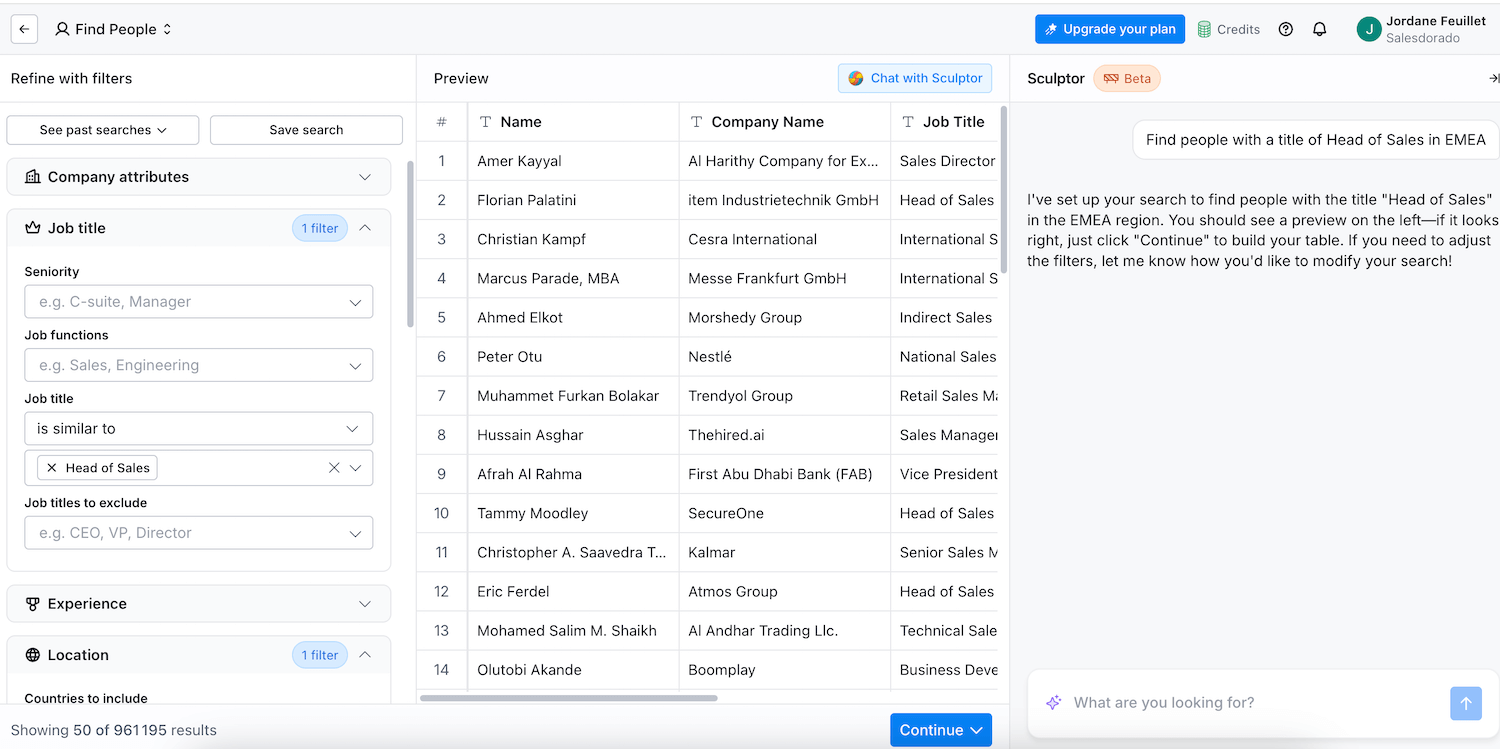
- Sculptor, a conversational agent that lets you describe a workflow in natural language (for example: « Find me B2B SaaS companies with 50 to 200 employees that use Salesforce and are hiring an SDR ») and Clay automatically generates the table and the enrichments needed.
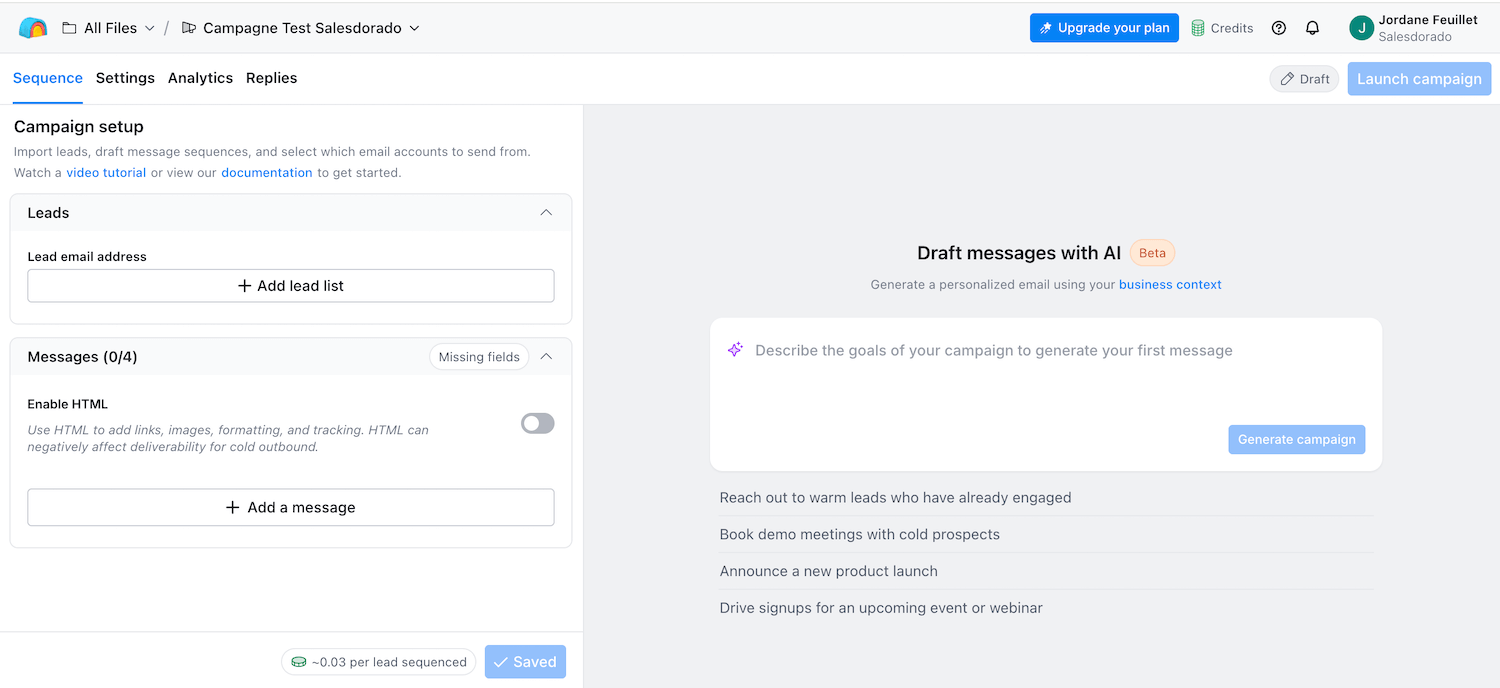
- The native Sequencer, which lets you launch emailing campaigns directly from Clay, even though most teams prefer to use a dedicated tool such as Lemlist, Smartlead or Instantly alongside it.
Integrations
Clay connects natively to the main CRMs on the market (Salesforce, HubSpot, Pipedrive), to email sequencers (Outreach, Salesloft, Smartlead) and offers a marketplace of more than 150 data providers available directly through Clay credits with no separate subscription.
For more advanced cases, the Growth plan and above let you integrate any HTTP API and configure webhooks, which turns Clay into a real integration hub. The platform can also push enriched audiences to LinkedIn Ads, Meta Ads or Google Ads for ABM campaigns.
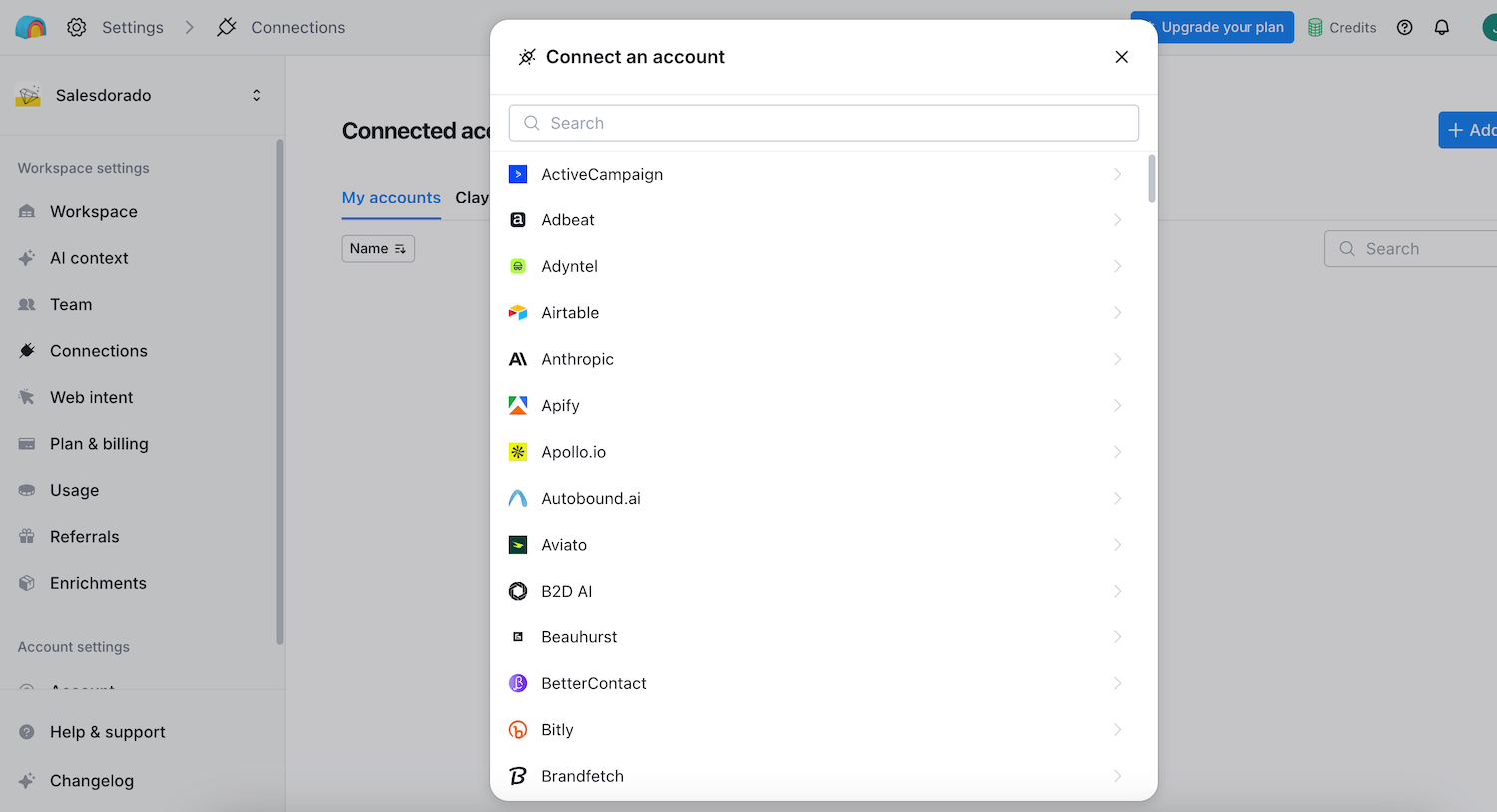
The major friction point: native CRM integrations (Salesforce, HubSpot) are only available from the Growth plan, billed at a minimum of $446 per month on annual billing. With the Free and Launch plans, you have to use workarounds (CSV exports, Zapier) to sync data with your CRM. It’s a commercial choice that many users find frustrating.
Clay pricing: how much does it really cost?
Plans and credits
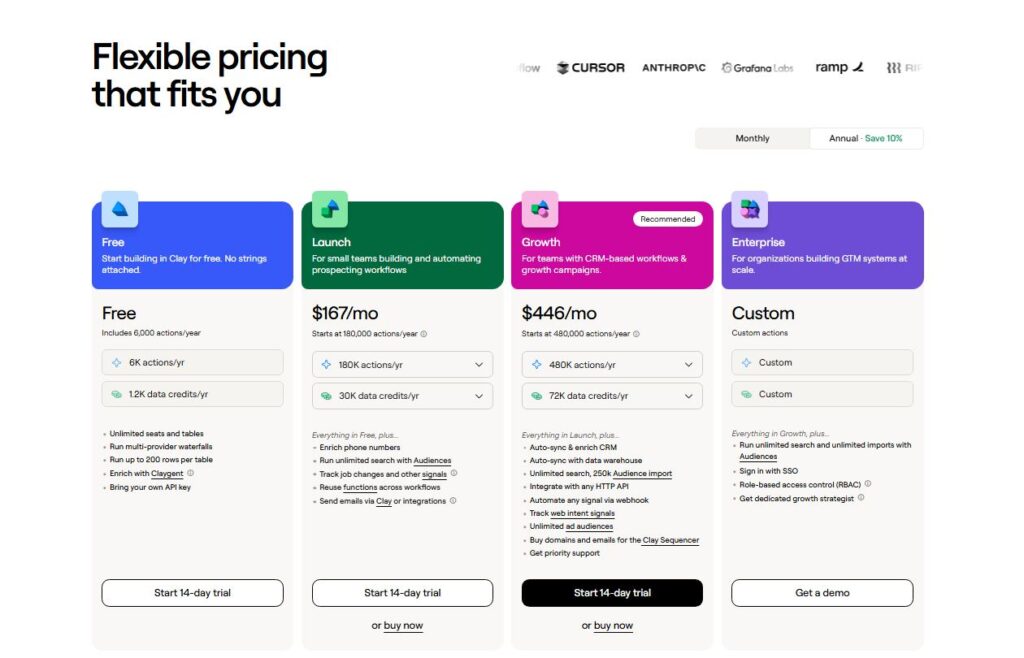
Clay runs on a usage-based model, not per user. Every plan includes unlimited users: your processing volume is what determines the bill. Since its latest pricing overhaul, Clay uses two counters:
- actions, consumed by the processing run in your tables;
- data credits, consumed by the data retrieved through the providers offered by Clay.
On annual billing, both are allocated per year.
| Plan | Price (annual billing) | Actions/year | Data credits/year | Key features |
|---|---|---|---|---|
| Free | $0 | 6,000 | 1,200 | Unlimited users and tables, multi-provider waterfalls, Claygent, your own API keys, 200 rows max per table |
| Launch | from $167/month | from 180,000 | from 30,000 | Plus phone number enrichment, unlimited search through Audiences, job change tracking and other signals, email sending |
| Growth | from $446/month | from 480,000 | from 72,000 | Plus CRM sync and enrichment, data warehouse sync, HTTP API, webhooks, web intent signals, unlimited ad audiences, priority support |
| Enterprise | Custom quote | Custom | Custom | Plus SSO, role management (RBAC), unlimited imports and a dedicated growth strategist |
Each paid plan comes in several volume tiers. Annual billing saves 10% compared with monthly ($185 and $495/month on monthly billing for Launch and Growth). A 14-day free trial gives access to CRM integrations, the HTTP API and webhooks with 1,000 data credits, without phone number enrichment.
Hidden costs to plan for
This is where things get complicated, and it’s the point the community criticizes most. Several sources of extra cost often fly under the radar:
- The learning tax is the first trap. Every test, every query run by mistake, every experiment to understand the tool consumes actions and credits. A survey of 500 GTM professionals found that 42% of complaints concern uncontrollable credit consumption. Some users report burning through $500 or more just learning how to use the interface.
- Limited rollover: on monthly billing, unused data credits carry over, but with a strict cap of 2 times your monthly allocation. On annual billing, only 15% of the year’s data credits carry over to the next year, and only if you renew. Actions reset to zero every cycle. If your activity is irregular (for example, one-off enrichment campaigns), you risk losing credits.
- Top-ups with a surcharge: if you run out of data credits mid-cycle, one-off top-ups are billed 30% above your plan’s rate. Clay cut this surcharge from 50% to 30% in its March 2026 pricing overhaul.
- API throttling: to respect third-party providers’ limits, Clay imposes rate limits on requests. Some users report caps of 400 records per hour on certain providers. The upshot: you pay for credits you can’t always consume within the month.
Clay versus a classic stack: cost comparison
To put things in perspective, here is a rough comparison.
A classic B2B enrichment and prospecting stack could include a ZoomInfo subscription (around $15,000 per year minimum), an automation tool such as Zapier or Make and a cold emailing tool. That adds up to an annual budget of $20,000 to $30,000.
With Clay on the Growth plan ($446 per month, or about $5,350 per year), you centralize enrichment, workflows, CRM sync and more than 150 data providers. Clay now offers its own sequencer, but many teams still add a dedicated outreach tool on top, and often a LinkedIn Sales Navigator subscription (around $1,200 per year). The real total cost is more like $8,000 to $11,000 per year for serious use, and more if you need to move up a volume tier.
Clay’s advantage becomes real as soon as you use several data providers in a waterfall: you pay for a single platform subscription instead of 3 or 4 separate data subscriptions.
But for a French SMB that prospects only in its domestic market, solutions such as Societeinfo or Dropcontact often offer a better coverage-to-price ratio on the French market.
Salesdorado’s takeClay’s credit model is attractive when you compare it with ZoomInfo’s or Cognism’s per-user licenses. But without strict governance over consumption (qualifying leads before enriching them, capping credits per campaign, filtering aggressively), the bill can double in a month. As one LinkedIn user nicely put it: « Clay should come with a seatbelt ».
Clay versus the alternatives: where does it fit?
Clay doesn’t play in the same category as every other prospecting tool. To see things clearly, here is a comparative positioning against the main alternatives.
| Tool | Type | Entry price | Complexity | FR coverage | Who is it for? |
|---|---|---|---|---|---|
| Clay | Data and AI orchestrator | $167 per month ($446 for CRM) | High | Medium | Advanced RevOps teams, tech scale-ups |
| Apollo | All-in-one (data and outreach) | $49 per month per user | Low | Medium | Startups and SMBs getting started with outbound |
| ZoomInfo | Enterprise database | Around $15,000 per year | Medium | Low | Large accounts, US market |
| Cognism | European database | Custom quote (around $1,000 per month) | Low | Good | SMBs and mid-market companies prospecting in Europe |
| La Growth Machine | Multichannel outreach | €50 per month | Low | Good | French SMBs, multichannel approach |
| Lemlist | Cold email and LinkedIn | $55 per month | Low | Good | Small teams, personalized approach |
Clay’s positioning is unique: it doesn’t replace Apollo or ZoomInfo, it orchestrates them. A robust Clay workflow can query Apollo’s API for cost reasons, fall back on ZoomInfo if the first query fails, and complete the picture with targeted web scraping. The result: data coverage above 90%, where each provider individually tops out between 60% and 80%.
But this combinatorial power comes at a much higher total cost: the Clay layer adds to the costs of the underlying providers (even though Clay doesn’t mark them up). And for French teams that don’t need this heavy artillery, tools such as La Growth Machine, Waalaxy or Lemlist offer a much simpler approach for a result that is often good enough.
Salesdorado’s takeIf you mainly prospect in the French market and send fewer than 10,000 emails per month, Clay is probably oversized for your needs. French solutions such as Societeinfo (for company data) combined with a cold mailing tool will be more effective and far cheaper. Clay comes into its own when you go after international markets at scale.