


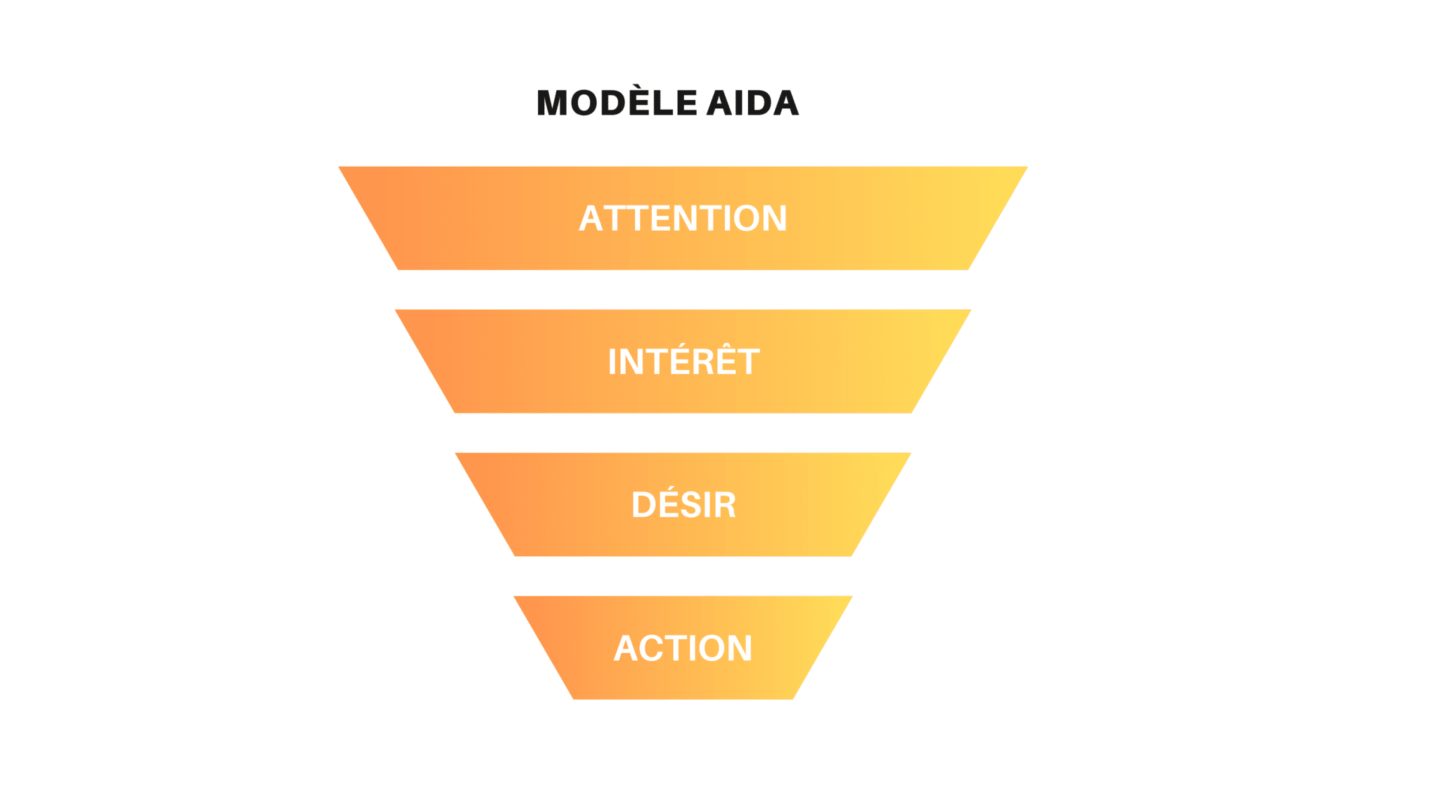
- AIDA reads on two levels: at the macro level, a buyer journey to cover stage by stage; at the micro level, a checklist to make sure a message contains everything it needs to perform.
- In a prospecting email, attention is won or lost on the subject line: it should look written by a human, without shouting “this is a sales email”.
- For the action, don’t ask for too big a commitment: suggest a date and time for a call, or just a “yes” reply.
- On the phone, talk about advantages rather than features, and clear up the prospect’s doubts and objections to create desire.
- On a landing page: a punchy headline, social proof, a clear CTA, and a form that only asks for the information you need.
AIDA stands for Attention, Interest, Desire and Action.
It’s a framework we owe to the world of advertising – to Mr. Elias St. Elmo Lewis to be exact – and it’s still used in virtually every advertising medium today.
In this article, we have some fun applying the AIDA method to the main channels we use in B2B: emails, phone scripts, and landing pages. We also describe the AIDA framework from a more macro angle, applied to the buyer journey.
What is the AIDA model?
The AIDA model is first and foremost a communication method for creating more effective messages. The model lets you structure all your sales communications.
There are two ways to read AIDA:
- It’s a “Macro” framework that draws a linear buyer journey – which has its limits – and lets you build a strong marketing mix at each stage of the funnel.
- It’s a “Micro” framework (that’s actually how it was invented) to make sure a piece of advertising contains everything it needs to perform.
It was the advertising man E. St. Elmo Lewis who, in the late 1800s, explained:
“The mission of an advertisement is to attract a reader, so that he will look at the advertisement and start to read it; then to interest him, so that he will continue to read it; then to convince him, so that when he has read it he will believe it. If an advertisement contains these three qualities of success, it is a successful advertisement.”
Here is a summary of the four stages of the model and how they read at each level:
| Stage | Goal | Performance indicator | Macro example | Micro example |
|---|---|---|---|---|
| Attention | Create catchy headlines, visuals or messages to stand out and spark the interest of potential customers. | Ad impression rate, brand awareness | Write blog articles relevant to the industry | An online store uses bold, colorful visuals in its social media ads to grab the attention of its target audience. |
| Interest | Provide valuable information, answer customers’ problems or present selling points to stimulate interest and encourage the prospect’s engagement. | Newsletter sign-ups, number of website visits. | Create a product page | An educational platform shares in-depth articles on industry trends, to spark the interest of professionals looking for relevant information. |
| Desire | Highlight the advantages, solutions or benefits your offer brings, using emotion and persuasion. | Ebook downloads, number of CTA clicks, leads. | Write and publish “The ultimate guide to marketing” | An online clothing store uses customer testimonials in its product descriptions, to convince shoppers of the advantages of its clothing line. |
| Action | Get the customer to take specific actions: a purchase, a newsletter sign-up, a quote request, etc. | Demos, offers, CTA clicks | Create product pages packed with information to generate new business. | An online travel booking platform displays prominent “Book now” buttons, with tempting offers. |
1. The AIDA model applied to the buyer journey
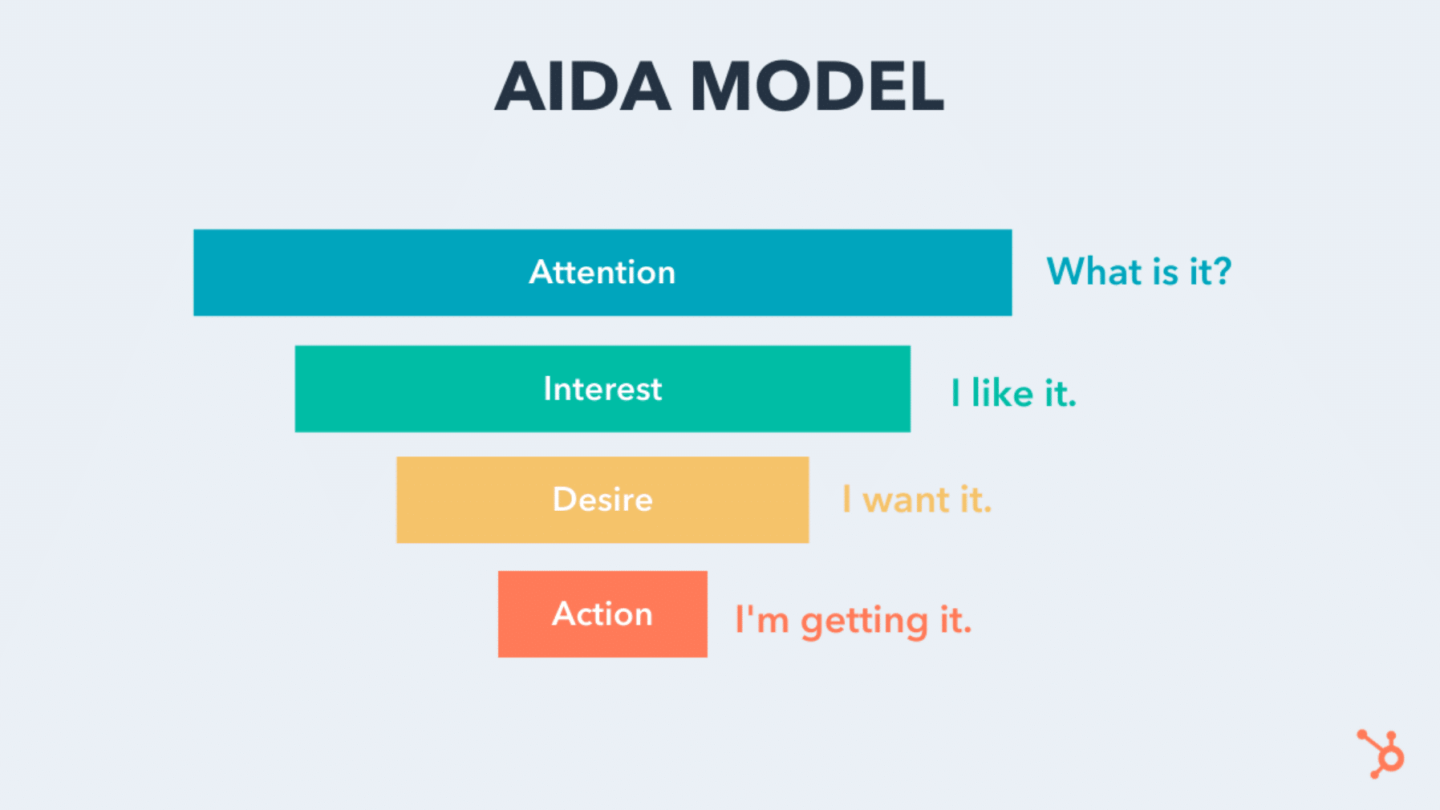
1. Attention
The goal is to quickly catch a potential customer’s attention.
For example, by creating content with real added value, by holding a high position in search engines or by investing in paid ads. As soon as they land on your website, the job is to awaken their interest with attractive headlines, good-looking visuals, etc.
2. Interest
The aim is to spark your potential customer’s interest and convince them to buy from you rather than from your competitor.
Use case studies and testimonials so the customer can picture themselves using your product. Show them statistics and other documents that demonstrate the advantages of your solutions and the reliability of your company.
3. Desire
To create desire in a prospect, let them test your product so they form their own opinion of it and want to buy it. The customer has to realize that your product solves their problem.
The simplest way is to offer a free trial, but you can also offer a demo video. Discounts and special offers are also very popular.
4. Action
To close the deal, you have to push the customer to act at every phase of the buyer journey.
The power of CTAs is undeniable here: place them in strategic spots and make them easy to follow, so the customer can reach you easily. Depending on your business model, encourage them to write or call you, or even to book a discovery call or a meeting with you directly.
2. The AIDA model applied to prospecting emails
1. Attention
The goal is to make an excellent impression that the customer won’t forget. Needless to say, that’s very hard by email, when you have to stand out from the hundred or so other emails your prospects receive every day.
The first impression an email makes is its subject line. Your subject line should look like it was written by a human being and feel natural – without shouting “this is a sales email”. Think ahead about how your subject line will appear in your recipient’s inbox, whether on a computer or a mobile device. Plenty of tools let you track open rates and test subject lines.
2. Interest
You need to spark your prospect’s interest from the very first line of your message.
You can:
- Tell a (short) story that explains why your recipient should care about what you’re selling.
- Draw attention to a problem your target prospect is known to have (if you’re sending a cold emailing campaign, you need to segment prospects by their likely problems – for example, based on their industry or their job title). The goal is to make your prospecting emails as personalized as possible.
- State concretely what you can help your prospects achieve – for example, you can cut the cost of x by x, help them win x more customers per x, or help them be x more efficient at x.
Read alsoB2B cold emailing: the bible
3. Desire
Create desire for your product in your prospect by demonstrating its value. There are many ways to do this, and you don’t have to stick to just one. Keep in mind that prospecting emails must always – without exception – be short.
You can:
- Hook recipients with your USP. If you have several USPs, tie them to your different segments and to the mailing lists that match them.
- Briefly explain how your product will help solve one (or more) of their problems. Here again, you’ll get better results if you segment your email list according to your prospects’ needs.
- Share a short testimonial.
- Mention a special price or an extended free trial you can offer the recipient.
Whichever way you choose to create desire, you need to measure its effectiveness through reply rates and click rates (by including a link to more information to track the second one).
4. Action
To get your prospect to take action, you have to explain what you expect from them, with a clear and direct CTA. The trick? Don’t ask for too big a commitment. Even if your sales email is perfect, that’s never enough: you don’t want to trigger the purchase directly, but rather invite the prospect to ask for more information or to book a meeting to discuss their needs.
Make replying as easy as possible: if you’re suggesting a call, give a date and time and ask whether it works for them. If you’re asking whether they’d like more information, tell them all they have to do is reply “yes”. Be clear about what you want.
To evaluate your results, the simplest way is to track conversions and the conversion rate.
Go further
3. The AIDA model applied to cold calling scripts

1. Attention
There’s no secret to making an excellent first impression on the phone, but work on your introduction and state the purpose of your call clearly.
2. Interest
Show your prospect all the advantages they can get from your solution and how it can solve their problems.
To hold their attention on the phone, focus on the advantages, not the features, of your product or service, and tailor them to your prospect’s situation and needs.
3. Desire
To create desire in your prospect, you have to overcome all their doubts and objections. Identify them and show that you understand them. On the phone, show empathy to prove to your prospect that your product will meet their need – and therefore ease their frustrations.
4. Action
On the phone, you have to give them a clear, precise instruction about what you expect from them. Here again, don’t ask for the moon. You can create a sense of urgency to motivate them to act.
Go further
- The best cold calling training courses.
- Our tips for successful cold calling.
- How to nail your discovery calls?
4. The AIDA model applied to landing pages
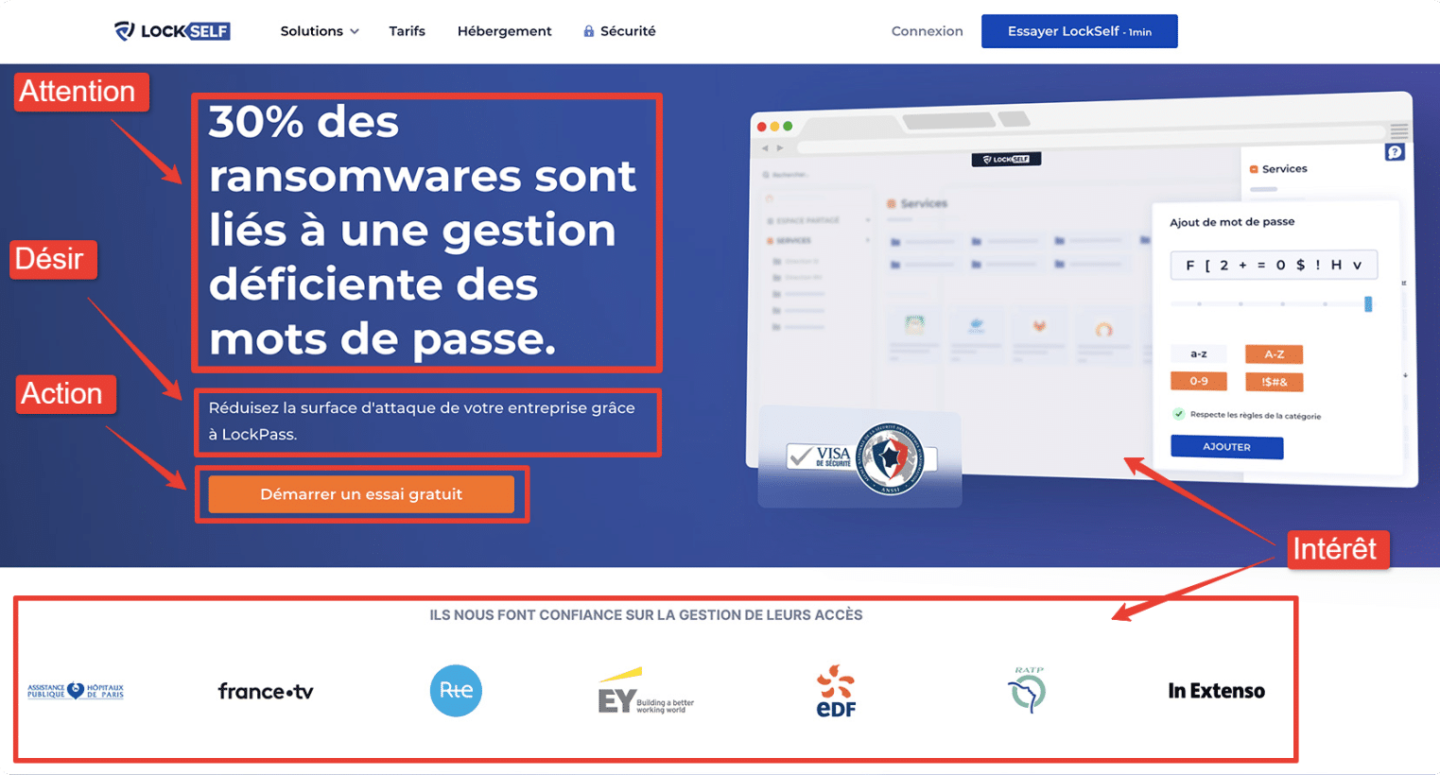
1. Attention
When a visitor lands on your page, you only have a few seconds to catch their attention. It’s your chance to introduce your offer.
- Headline: a punchy headline lets you get your main message across concisely.
- Images: use good-quality images related to your product or service. They can be photographs, graphics or videos.
- Load time: make sure your landing page loads quickly. A slow page can put visitors off before they’ve even seen your offer.
2. Interest
To stir the visitor’s interest, it’s time to give more details about your offer.
On your landing page, highlight:
- Advantages, not features: to show the user directly how your product can be useful to them.
- Social proof: testimonials, case studies and good customer reviews are a very good way to demonstrate the value of your offer.
- Engaging content: favor original formats such as infographics, animations or interactive elements to explain your product or service.
3. Desire
To turn the prospect’s interest into a real desire to buy or learn more, we recommend highlighting on your landing page:
- A compelling call to action: your CTA must be clear, compelling and easy to find. Use action words and keep it short.
- Trust signals: display logos of well-known customers, awards or certifications to inspire trust.
- A value proposition: what sets you apart from the competition? Make sure it’s clear and compelling.
4. Action
Encourage the customer to sign up for a newsletter, make a purchase or fill out a contact form. On your landing page, make the process as simple and quick as possible. If you’re selling something, simplify the checkout process. If you’re looking for leads, only ask for the information you need.
Limited-time offers or mentions like “Only a few items left in stock” can encourage immediate action.
Make sure your landing page is optimized for mobile devices. Many users may visit your page on the go – it would be a shame to lose them because of a poor mobile experience.
Go further
- 25 successful landing page examples.
- 10 tips for building landing pages that collect leads.
- The landing page tools comparison – to evaluate the performance of your landing pages.
Read alsoGlossary of sales techniques
Alternative models to AIDA
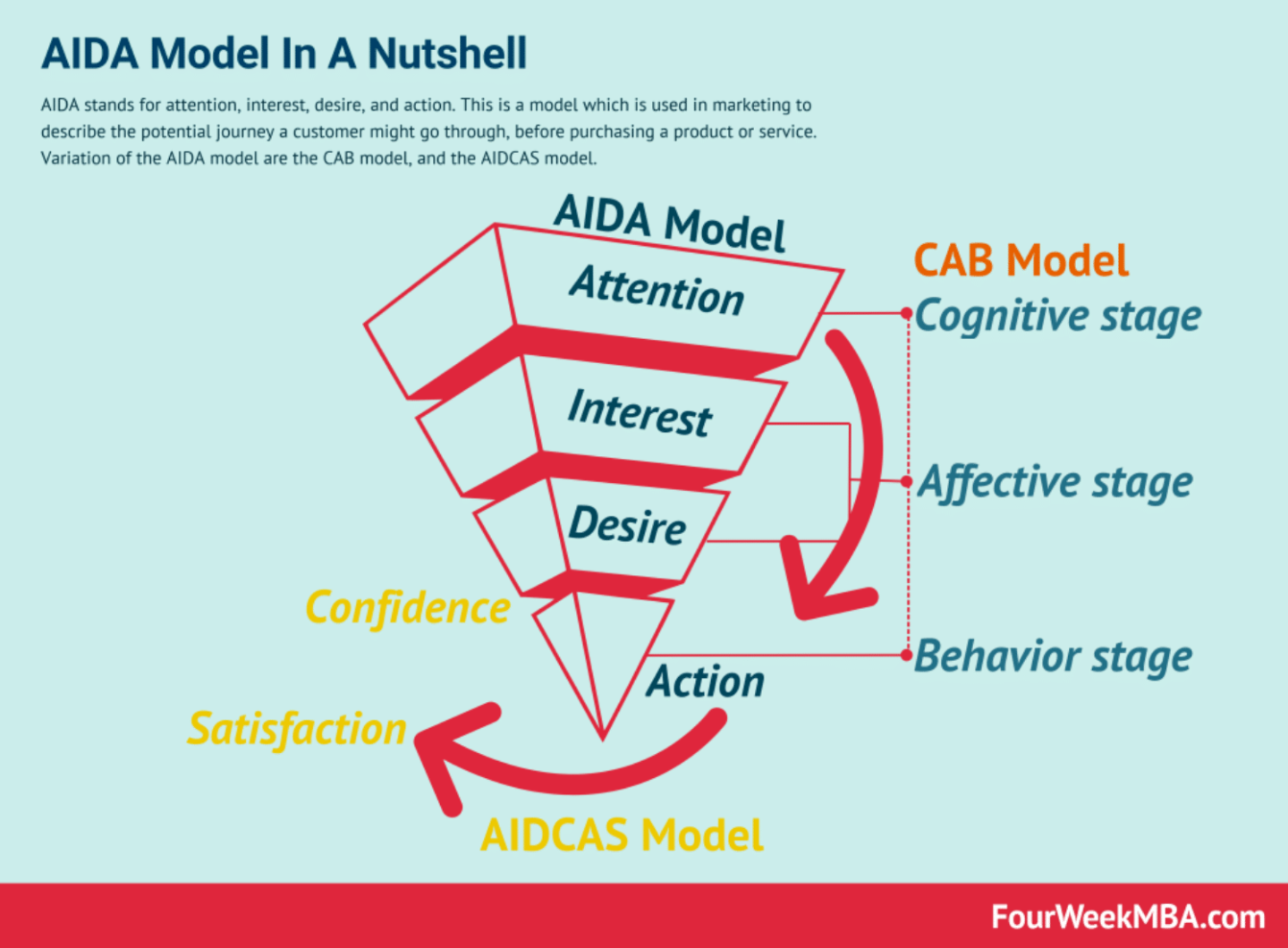
Variants of the AIDA model
- Modified AIDA model (Awareness – Interest – Conviction – Desire – Action) – adding the “conviction” phase lets you show in detail how the customer’s decision process works.
- AIDAS (+ Satisfaction) – this model adds the final factor of satisfaction, which should be the goal of any business. Satisfied customers tend to come back when they want to buy again.
- AISDALSLove (Awareness – Interest – Search – Desire – Action – Like/Dislike – Share – Love/Hate) – to apply the AIDA model to the digital age of selling. It takes into account the fact that customers want to research the product or service before they desire it. At the end, it shows how people react to what they buy and how they recommend (or don’t recommend) their choices to others.
- Hierarchy of effects (awareness – knowledge – liking – preference – conviction – purchase) – this model is quite similar to the modified AIDA model, with different names for each element of the formula.
- McGuire’s model (Presentation – Attention – Comprehension – Yielding – Retention – Behavior) – another, broader version of the AIDA model with slightly different names for the stages.
The questions we get over and over.
What does AIDA stand for?
Attention, Interest, Desire and Action. It’s a framework that comes from advertising, which we owe to the advertising man Elias St. Elmo Lewis in the late 1800s, and it’s still used in practically every advertising medium.
How do you apply the AIDA model to a prospecting email?
Attention: a subject line that looks written by a human. Interest: from the first line, a short story, a problem the prospect is known to have or a concrete result. Desire: your USP, how the product solves a problem, a short testimonial or an offer. Action: a clear CTA that doesn’t ask for too big a commitment, for example a date for a call or a “yes” reply.
How do you use AIDA in a cold calling script?
Work on your introduction and state the purpose of the call clearly, focus on the advantages that fit the prospect’s needs, overcome their doubts and objections with empathy, then give them a clear, precise instruction, without asking for the moon.
How do you build a landing page with the AIDA model?
Catch attention with a punchy headline, quality images and fast loading. Spark interest with advantages and social proof. Create desire with a compelling CTA, trust signals and a clear value proposition. For the action, simplify the process and only ask for the information you need, on a page optimized for mobile.
Which indicators should you track at each stage of the AIDA model?
Attention: ad impression rate and brand awareness. Interest: newsletter sign-ups and website visits. Desire: ebook downloads, CTA clicks and leads. Action: demos, offers and CTA clicks.
What are the variants of the AIDA model?
The modified AIDA model, which adds a conviction phase; AIDAS, which adds satisfaction; AISDALSLove, which adds search and then sharing and recommendation; the hierarchy of effects; and McGuire’s model.



What the community says.